Author: openclaw-Lisa-New

  • 5G RedCap CPE Devices Enter Commercial Phase: How NR-Light Expands IoT and Fixed Wireless Markets

    5G RedCap CPE Devices Enter Commercial Phase: How NR-Light Expands IoT and Fixed Wireless Markets

    The 5G ecosystem is entering a new phase of segmentation. While enhanced Mobile Broadband (eMBB) and massive Machine-Type Communications (mMTC) have dominated early deployments, the commercial arrival of 5G RedCap — formally defined in 3GPP Release 17 as NR-Light — is reshaping the CPE landscape. RedCap carves out a middle tier between ultra-high-performance eMBB and low-power NB-IoT / LTE-M, delivering a balanced mix of throughput, power efficiency, and cost that makes it uniquely suited for a broad class of industrial and fixed wireless devices.

    What 5G RedCap Brings to CPE

    RedCap devices operate with a reduced set of 5G NR capabilities compared to full eMBB equipment. The maximum bandwidth is capped at 20 MHz in FR1 (versus 100 MHz for full NR), antenna configurations are limited to 1Rx/2Rx (versus 4Rx MIMO), and the modulation ceiling sits at 64QAM in the downlink. These constraints translate directly into silicon savings: smaller die area, fewer RF chains, lower power consumption, and reduced bill-of-materials cost.

    For CPE manufacturers and B2B buyers, the implications are substantial. A RedCap-based outdoor CPE unit can deliver 150–220 Mbps downlink under real-world conditions — more than adequate for SME branch connectivity, video surveillance backhaul, point-of-sale networks, and industrial sensor aggregation — while costing 40–60% less than a full-capability eMBB CPE. This price-performance sweet spot opens volume procurement opportunities that were previously bottlenecked by premium 5G CPE pricing.

    Commercial Momentum in 2026

    Chipset vendors including Qualcomm (Snapdragon X35), MediaTek (T300 series), and UNISOC have shipped RedCap modem-RF platforms designed specifically for CPE and IoT gateway form factors. Module vendors — Quectel, Fibocom, MeiG, and SIMCom — have followed with LGA and M.2 modules targeting the B2B CPE integration market. Multiple tier-one operators across Asia-Pacific, Europe, and North America have validated these modules for their networks, and commercial RedCap CPE devices are now appearing in operator procurement catalogs.

    The momentum is driven by three converging forces. First, operators are seeking lower-cost CPE SKUs to expand fixed wireless access into price-sensitive market segments without cannibalizing premium tiers. Second, industrial enterprises deploying private 5G networks need affordable endpoint devices at scale — deploying 500 RedCap gateways across a manufacturing campus becomes economically viable where 500 eMBB routers would not. Third, regulatory frameworks in markets including China, the EU, and India are actively incentivizing RedCap adoption as part of broader 5G industrial digitization strategies.

    Market Segments Where RedCap CPE Excels

    SME Fixed Wireless Access. Small businesses with headcounts of 10–50 need reliable connectivity but cannot justify US$400–600 eMBB CPE units. RedCap gateways in the US$120–200 range fill this gap while supporting VPN, VLAN, and basic SD-WAN features that SMEs require.

    Industrial IoT Aggregation. Manufacturing floors, warehouses, and logistics hubs generate data from hundreds of sensors and controllers. A RedCap aggregation CPE with Ethernet, RS-485, and Wi-Fi 6 backhaul consolidates these data streams onto the 5G core without the overkill of full eMBB throughput.

    Smart City and Utility Infrastructure. Traffic management systems, environmental monitoring stations, and smart grid nodes need always-on connectivity with moderate bandwidth. RedCap’s lower power envelope enables solar-powered or battery-backed CPE installations in locations where power is constrained.

    Retail and Hospitality. Chain stores, quick-service restaurants, and pop-up locations require reliable WAN connectivity for POS, digital signage, and guest Wi-Fi. RedCap CPEs offer a cost-optimized path to 5G connectivity that LTE-A alternatives cannot match in spectral efficiency and latency.

    RedCap vs. eMBB vs. LTE-A: A Procurement Perspective

    Procurement teams evaluating connectivity options should understand the positioning clearly. Full eMBB CPE remains the right choice for high-capacity use cases — multi-gigabit branch offices, 4K/8K video uplink, and mission-critical applications demanding sub-10ms latency. LTE-A CPE, while inexpensive, sits on a sunsetting technology curve with diminishing operator investment. RedCap occupies the strategic middle: 5G-native signaling, network slicing support, URLLC-capable latency ranges, and a forward-compatible path to 3GPP Release 18 enhancements — all at a price point competitive with LTE-A.

    Key Specifications to Evaluate

    When sourcing RedCap CPE, B2B buyers should examine carrier aggregation combinations (many initial RedCap designs support 2CA, enhancing throughput beyond single-carrier limits), power-over-Ethernet support for outdoor deployments, industrial protocol translation capabilities (Modbus, PROFINET, OPC-UA), and eSIM provisioning for multi-operator deployments. Devices supporting both SA and NSA architectures provide maximum deployment flexibility as networks evolve from non-standalone to standalone cores.

    Looking Ahead: Release 18 eRedCap

    3GPP Release 18, now being finalized, introduces eRedCap — further reduced capability targeting sub-10 Mbps use cases with even lower power and cost profiles. This will create a new tier below current RedCap, expanding the addressable CPE market into wearable hubs, agricultural sensors, and ultra-low-cost asset trackers. Procurement strategies built on RedCap today will have a natural evolution path as the ecosystem matures.

    For telecom operators, system integrators, and enterprise buyers, RedCap CPE represents one of the most actionable opportunities in 5G infrastructure in 2026. The silicon is ready, the modules are shipping, and the operator certifications are in place. The question is no longer whether RedCap will matter — it’s how quickly procurement teams can integrate it into their connectivity portfolios.

    Related News from Honlly Telecom:

  • 5G Fixed Wireless Access Expands into Emerging Markets: How Southeast Asian, African, and Latin American Operators Are Scaling Broadband Connectivity with Cost-Optimized CPE in 2026

    5G Fixed Wireless Access Expands into Emerging Markets: How Southeast Asian, African, and Latin American Operators Are Scaling Broadband Connectivity with Cost-Optimized CPE in 2026

    The fixed wireless access (FWA) market is entering a decisive phase of global expansion in 2026, and the center of gravity is shifting. While mature markets in North America and Western Europe have driven early 5G FWA adoption, the next wave of growth is unmistakably coming from emerging markets—Southeast Asia, Sub-Saharan Africa, and Latin America—where operators are leveraging 5G FWA as a cost-effective path to bridge persistent broadband gaps.

    According to the latest GSA data, over 165 operators in 85 countries now offer commercial 5G FWA services, with emerging-market operators accounting for more than 40% of new FWA launches in the first half of 2026. The economics are compelling: deploying fiber to every household in developing regions remains prohibitively expensive, while 5G FWA can deliver 100–300 Mbps broadband at a fraction of the civil engineering cost. For operators in markets like Indonesia, Nigeria, and Brazil, this is not a niche play—it is becoming the primary broadband access strategy.

    The CPE Equation: Cost, Capability, and Climate

    What differentiates emerging-market FWA from its developed-world counterpart is the CPE requirement profile. Operators in these regions are demanding devices that balance three competing imperatives: aggressive unit cost targets (often below USD 80 per indoor unit), sufficient RF performance to maximize cell-edge throughput in spectrum-constrained environments, and environmental resilience to operate in high-temperature, high-humidity, and unstable-grid conditions.

    Honlly Telecom has observed a marked shift in procurement RFPs from emerging-market operators in Q2 2026. The specifications are increasingly sophisticated: 4×4 MIMO on sub-6 GHz with antenna gain exceeding 5 dBi, support for n28 (700 MHz) and n40 (2.3 GHz) bands alongside mainstream n78, and integrated power management tolerant of voltage fluctuations from 100V to 280V AC. These are not “budget” devices in any traditional sense—they are purpose-engineered platforms optimized for a distinct deployment environment.

    Southeast Asia Leads the Charge

    Southeast Asia has emerged as the most dynamic FWA growth region in 2026. Indonesia’s Telkomsel has expanded its 5G FWA footprint to 214 cities, targeting the 40% of Indonesian households that lack fixed-line broadband. Thailand’s AIS and True Corp are competing aggressively on FWA bundles in secondary cities where fiber buildout remains years away. Vietnam’s Viettel launched a dedicated FWA tariff in April 2026 that undercuts fiber pricing by 30%, using CPE with integrated external antenna ports for rural installations.

    The common thread across these deployments is a pragmatic approach to spectrum. Rather than waiting for dedicated mmWave allocations, Southeast Asian operators are refarming existing sub-3 GHz holdings and combining them with n78 (3.5 GHz) where available. This spectrum strategy demands CPE with superior low-band sensitivity and carrier aggregation capabilities—requirements that are reshaping the ODM product roadmaps of CPE manufacturers serving the region.

    Africa’s Leapfrog Moment

    Across Sub-Saharan Africa, 5G FWA is positioned as a leapfrog technology that could bypass the fiber gap entirely. MTN Group reported in its H1 2026 operational update that FWA subscribers across its 17 African markets grew 78% year-on-year, driven largely by 5G FWA in Nigeria, South Africa, and Ghana. Airtel Africa has partnered with multiple CPE vendors to deliver sub-USD 60 indoor units with integrated eSIM, enabling remote provisioning that eliminates the logistics cost of physical SIM distribution across vast rural territories.

    The African FWA market presents unique technical challenges that CPE vendors must address. Tower-to-CPE distances often exceed 5 km in rural deployments, requiring high-gain directional antennas and advanced beam management. Grid instability means CPE must support wide-voltage power supplies and, increasingly, integrated battery backup for multi-hour outages. These are not optional features—they are table stakes for operators evaluating CPE partners for African rollouts.

    Latin America: Fixed-Mobile Convergence Drives FWA

    In Latin America, the FWA growth story is intertwined with fixed-mobile convergence strategies. Brazil’s Vivo and Claro are bundling 5G FWA with mobile postpaid plans, using the fixed connection as a churn-reduction tool. Mexico’s Telcel has deployed over 2 million 5G FWA connections, making it one of the largest single-country FWA bases outside of China. Chile’s Entel and Argentina’s Personal are following similar playbooks, positioning FWA as the anchor product in converged household connectivity bundles.

    The Latin American market is notable for its demand for outdoor CPE (ODU) with integrated high-gain antenna arrays, driven by the prevalence of concrete-and-rebar construction that attenuates indoor signals. ODU shipments to Latin America grew 44% in H1 2026 compared to the same period in 2025, according to industry supply chain data. Honlly’s engineering teams have responded with a new generation of compact, easy-to-mount outdoor units that reduce installation complexity—a critical factor when operator installation workforces are stretched thin.

    CPE Supply Chain Implications

    The emerging-market FWA boom is reshaping the global CPE supply chain. Volume orders from Southeast Asian and African operators are increasingly dictating component sourcing strategies. The shift toward sub-USD 80 indoor units and sub-USD 150 outdoor units (with integrated antenna) is driving innovation in system-on-chip integration, shared antenna architectures, and simplified thermal design that eliminates active cooling.

    For telecom operators and ISPs evaluating CPE partners for emerging-market FWA rollouts, the key evaluation criteria in 2026 extend beyond RF performance to encompass supply chain resilience, local regulatory certification capability, and the ability to customize firmware for market-specific requirements—from local-language WebUI to operator-specific QoS policy enforcement. The vendors that succeed in this market will be those that treat emerging-market FWA not as a down-market variant of developed-world products, but as a distinct engineering discipline requiring purpose-built solutions.

    The 5G FWA opportunity in emerging markets is not a future prospect—it is happening now, at scale. Operators that move decisively to secure CPE supply partnerships with vendors who understand these markets’ unique requirements will be best positioned to capture the broadband growth story of the decade.

  • WiFi 7 and 5G CPE: Client and Network Testing

    WiFi 7 and 5G CPE: Client and Network Testing

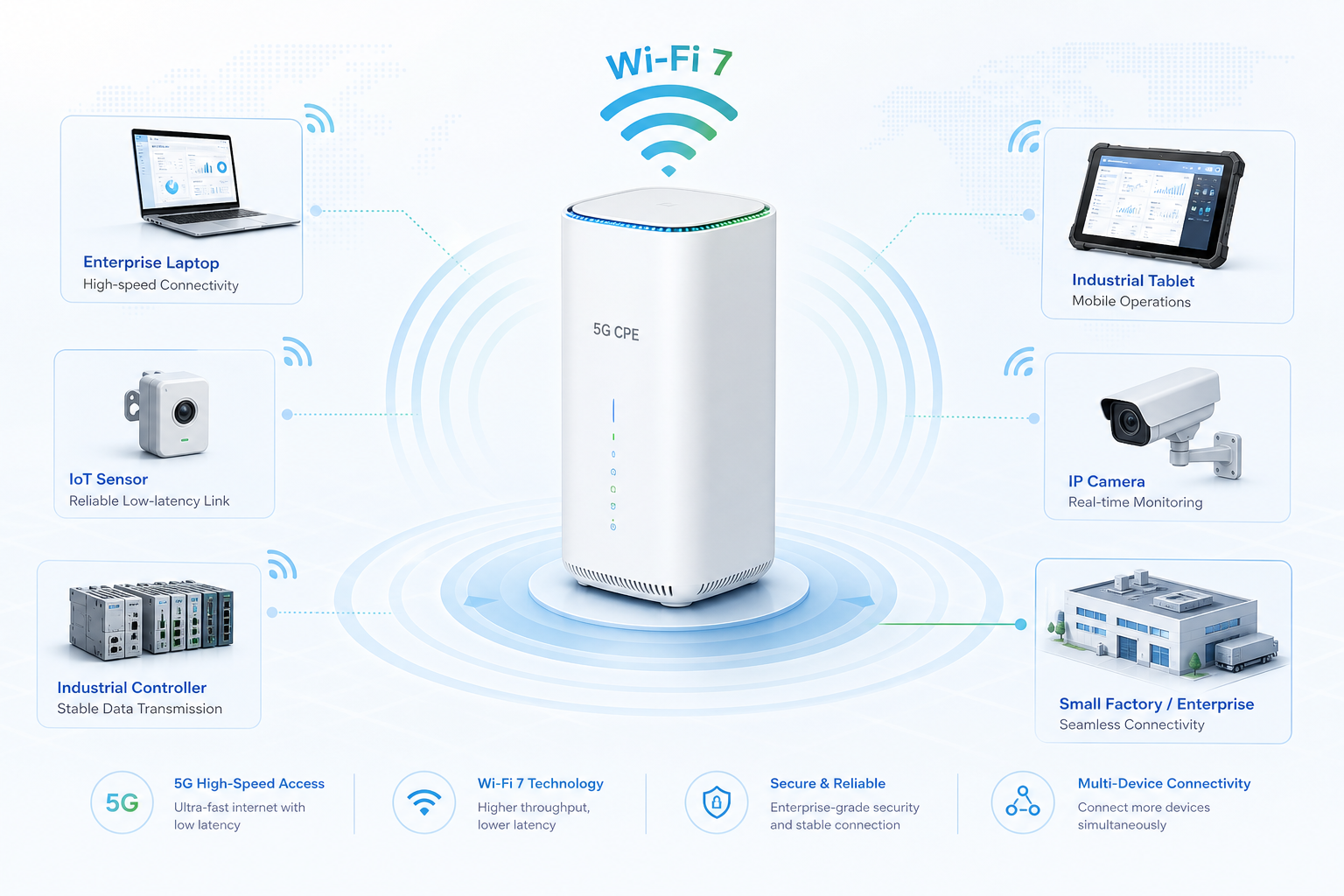
    As enterprise wireless networks brace for the next capacity leap, the convergence of 5G CPE and Wi-Fi 7 (IEEE 802.11be) represents one of the most consequential architectural shifts in access network design since the transition from Wi-Fi 5 to Wi-Fi 6. For telecom operators, ISPs, and enterprise IT buyers evaluating CPE procurement in 2026, understanding how Wi-Fi 7 capabilities integrate with 5G WAN connectivity—and what this means for real-world throughput, latency, and spectrum management—is no longer optional. It is a procurement imperative.

    Why Wi-Fi 7 Matters for 5G CPE

    Wi-Fi 7 is not an incremental upgrade. The standard delivers maximum theoretical throughput of 46 Gbps—roughly 4.8× that of Wi-Fi 6—through three foundational innovations: 320 MHz channel bandwidth (doubled from Wi-Fi 6’s 160 MHz), 4096-QAM modulation (up from 1024-QAM), and Multi-Link Operation (MLO), which enables simultaneous transmission across multiple frequency bands. When these capabilities are embedded in a 5G CPE that terminates a multi-gigabit 5G WAN link, the result is a gateway device that can serve 50+ concurrent enterprise clients without becoming a bottleneck.

    Compare the proposed cellular WAN and local wireless network together. Test with representative clients, channel conditions, application traffic and installation locations. A WiFi generation alone does not establish a fixed client rate or latency improvement.

    Multi-Link Operation: The Architecture Game-Changer

    MLO is Wi-Fi 7’s defining innovation and the feature with the most profound implications for 5G CPE design. In conventional Wi-Fi architectures, a client associates with a single band at a time—2.4 GHz, 5 GHz, or 6 GHz. MLO allows a Wi-Fi 7 client and access point to maintain simultaneous links across two or three bands, dynamically steering traffic based on channel conditions, interference, and QoS requirements.

    For a 5G CPE functioning as the Wi-Fi 7 AP, MLO enables several deployment-critical capabilities. First, it provides seamless band steering without the connection interruption inherent in traditional band-steering mechanisms. A client moving from a 6 GHz-dominated office zone to a 5 GHz-dominated common area maintains uninterrupted connectivity. Second, MLO’s link aggregation mode—where traffic is striped across multiple bands—effectively doubles or triples the per-client throughput ceiling. Third, MLO’s redundancy mode allows critical traffic to be duplicated across bands, achieving sub-millisecond failover for industrial and telemedicine applications.

    Enterprises evaluating 5G CPE with Wi-Fi 7 should verify that the device supports at least STR (Simultaneous Transmit and Receive) MLO across 5 GHz + 6 GHz, not just the less capable eMLSR (enhanced Multi-Link Single Radio) mode that some early chipsets implement. STR MLO requires dual-radio RF front-end design and adds approximately USD 12–18 to the bill of materials—an investment that pays for itself in environments with more than 30 active clients.

    320 MHz Channels and 6 GHz Spectrum Planning

    Wi-Fi 7’s 320 MHz channel support is transformative for high-throughput enterprise applications, but it demands careful spectrum planning—particularly in the 6 GHz band (5.925–7.125 GHz), where regulatory availability varies significantly by country. As of mid-2026, approximately 62 countries have opened portions of the 6 GHz band for unlicensed use, but the specific sub-band allocations differ: the U.S. has made the full 1,200 MHz available, the EU has released the lower 500 MHz (5.945–6.425 GHz), and many Asia-Pacific countries have adopted a middle-ground approach.

    A globally deployable 5G CPE with Wi-Fi 7 must support software-configurable 6 GHz channelization that adapts to local regulatory domains without hardware changes. This capability—sometimes called geo-aware channel provisioning—should be a baseline requirement in operator RFPs. Enterprises should also confirm that the CPE supports Automated Frequency Coordination (AFC) where required, particularly for standard-power 6 GHz operation in the U.S. and Canada, to avoid interference with incumbent fixed-service and fixed-satellite users.

    Integration Architecture: Where 5G Meets Wi-Fi 7

    The integration of a 5G NR modem and a Wi-Fi 7 access point within a single CPE enclosure introduces engineering challenges that extend beyond RF coexistence. Thermal management is the primary concern: a Cat 19 or Cat 20 5G modem transmitting at +23 dBm alongside a tri-band Wi-Fi 7 chipset can generate 12–15W of sustained thermal load. Passive cooling designs using advanced thermal interface materials and chassis-as-heatsink approaches are essential for fanless operation in enterprise environments where acoustic noise and dust ingress are unacceptable.

    On the software side, the CPE’s embedded operating system must implement intelligent traffic steering between the 5G WAN and Wi-Fi 7 LAN domains. This includes DSCP-to-802.11be QoS mapping that preserves DiffServ markings across the gateway, buffer management that prevents Wi-Fi 7’s higher throughput from overwhelming the 5G link’s buffer (bufferbloat mitigation), and per-client airtime fairness algorithms that prevent a single Wi-Fi 7 client from monopolizing shared airtime. OpenWrt-based CPE platforms with configurable sqm (Smart Queue Management) and the CAKE qdisc are increasingly preferred by enterprise buyers who require transparent traffic management without proprietary lock-in.

    Procurement Checklist for Wi-Fi 7 + 5G CPE

    When evaluating Wi-Fi 7-integrated 5G CPE for enterprise deployment, operators and buyers should assess against the following technical criteria:

    Radio Capabilities: Tri-band concurrent operation (2.4 + 5 + 6 GHz), STR MLO support (not eMLSR-only), 4×4 MU-MIMO on 5 GHz and 6 GHz, 4096-QAM on all bands, and configurable 320/160/80 MHz channel bandwidth.

    5G WAN Integration: 3GPP Release 17 or later modem, 4×4 MIMO on sub-6 GHz with carrier aggregation (at least 3CC), support for n77/n78/n79 plus at least four additional FR1 bands for global deployment flexibility, and an external antenna port option for edge-of-cell installations.

    Software and Management: TR-069/TR-369 (USP) support for operator ACS integration, zero-touch provisioning with secure bootstrap, VLAN-to-SSID mapping for multi-tenant deployments, WPA3-Enterprise with 802.1X and RADIUS integration, and geo-aware 6 GHz channel provisioning.

    Hardware Architecture: Fanless passive cooling rated to 45°C ambient, 2.5 GbE LAN port (minimum one, preferably two with link aggregation), USB-C for optional external storage or debug console, and industrial temperature range (-20°C to +55°C) for outdoor or unconditioned-space installations.

    The era of treating Wi-Fi as a downstream afterthought in CPE design is over. As 5G networks deliver multi-gigabit WAN capacity to the enterprise edge, the access layer must keep pace. Wi-Fi 7 is the technology that closes that gap—and the CPE that integrates it well will define the enterprise connectivity experience for the next five years.

  • A Technical Buyer’s Guide to Multi-WAN SD-WAN Integrated 5G CPE: Link Aggregation, Intelligent Failover Architecture, and Enterprise Branch Deployment Planning

    A Technical Buyer’s Guide to Multi-WAN SD-WAN Integrated 5G CPE: Link Aggregation, Intelligent Failover Architecture, and Enterprise Branch Deployment Planning

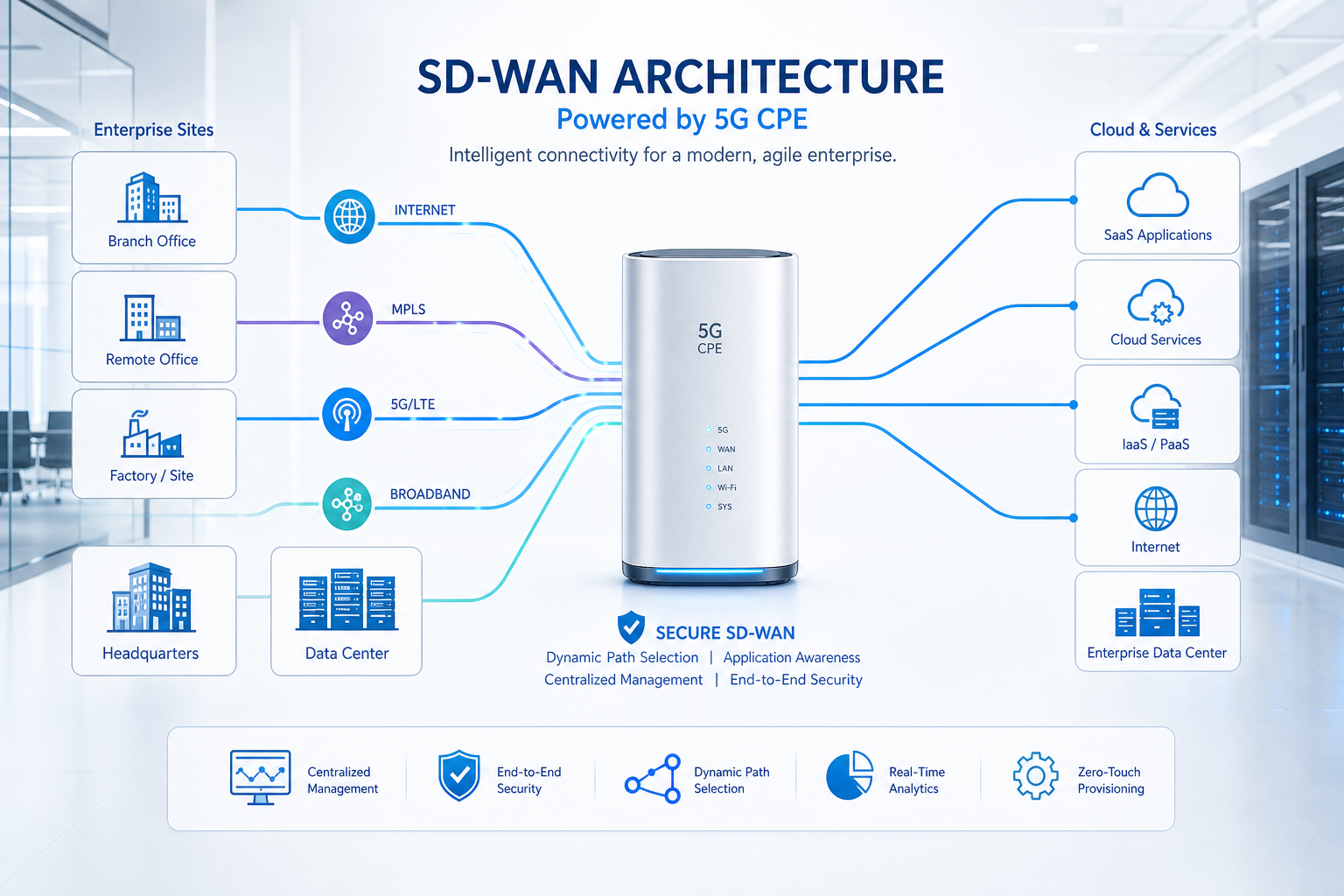
    As enterprise branch networks evolve beyond the traditional MPLS-and-backup-4G model, multi-WAN SD-WAN integrated 5G CPE is emerging as the primary connectivity platform for distributed organizations in 2026. This technical buyer’s guide examines the architecture, key evaluation criteria, and deployment planning considerations for operators and enterprises procuring next-generation multi-WAN CPE.

    The Architectural Shift: From Backup to Active-Active Multi-Path

    A multi-WAN design may use cellular access as a primary, secondary or parallel connection if the device and service support the proposed arrangement. Evaluate actual capacity, response behaviour and recovery at the installation instead of assuming a fibre-equivalent service.

    This architectural shift demands CPE with:

    • Hardware-Accelerated SD-WAN Forwarding: Multi-gigabit IPsec throughput with AES-256-GCM encryption offloaded to dedicated silicon. Software-only forwarding on a general-purpose CPU will bottleneck at sub-500 Mbps under real-world traffic conditions with small packets and concurrent tunnel termination.
    • Application-Aware Path Selection: Dynamic per-packet or per-flow steering based on application signatures (DPI), real-time link quality metrics (jitter, loss, latency), and administrator-defined policies. A VoIP call may be steered over the lowest-jitter path while bulk file transfers use the highest-bandwidth link.
    • Failover and session recovery: define acceptable interruption for each application. Confirm detection, routing, addressing and session-handling functions, then test loss and restoration of each path. A monitoring interval alone does not establish hitless recovery.

    WAN Interface Portfolio: What to Look For

    A production-grade multi-WAN CPE should support a flexible combination of WAN interfaces:

    | Interface Type | Typical Use Case | Key Specification |

    |—|—|—|

    | 5G NR (SA/NSA) | Primary or active-active cellular path | 3GPP Release 17, 4×4 MIMO, carrier aggregation up to 8CC |

    | 4G LTE Cat 20 | Fallback cellular path | Multi-operator SIM support, eSIM ready |

    | 2.5GbE / 10GbE WAN | Fiber/FTTx handoff | SFP+ cage for optical modules |

    | 1GbE / 2.5GbE LAN | Local switching, PoE for APs/cameras | 802.3at PoE+ (30W per port) |

    | Wi-Fi 7 (802.11be) | On-site wireless access, wireless WAN backup | 4×4 MIMO, MLO, 320 MHz channels |

    The CPE should expose each WAN interface independently to the SD-WAN policy engine, with per-interface health probes (ICMP, HTTP, DNS) and configurable SLA thresholds that trigger automated path reassignment.

    SD-WAN Overlay Technologies: Standards-Based vs. Proprietary

    Buyers face a critical architectural choice between standards-based overlay protocols and vendor-proprietary SD-WAN fabrics:

    • Standards-Based (IPsec/IKEv2 + VXLAN/Geneve): Maximizes interoperability with existing enterprise infrastructure and multi-vendor environments. However, it may lack advanced features like forward error correction (FEC) and per-packet duplication that proprietary protocols offer.
    • Vendor-Proprietary SD-WAN (Cisco vEdge, VMware VeloCloud, Fortinet Secure SD-WAN): Delivers tightly integrated security, FEC, and cloud on-ramp optimizations, but can create vendor lock-in and complicate multi-vendor CPE strategies.

    The emerging best practice among large enterprises is to select CPE hardware that supports both paradigms — running standards-based tunnels for general connectivity while integrating with a proprietary SD-WAN fabric for latency-sensitive and high-security workloads.

    Security Architecture: Zero Trust at the Branch Edge

    Multi-WAN CPE sits at the boundary between the enterprise LAN and multiple untrusted WAN paths, making it a critical security enforcement point. Key security capabilities to evaluate:

    • NGFW Integration: Layer 7 application identification, intrusion prevention (IPS), and TLS 1.3 decryption at line rate. The CPE should not become a security bottleneck when performing deep packet inspection on multi-gigabit 5G links.
    • Zero Trust Network Access (ZTNA): The CPE should act as a ZTNA enforcement point, authenticating every flow against the enterprise identity provider before granting access to internal applications — regardless of which WAN path the traffic arrives on.
    • SASE / SSE Integration: Native integration with cloud-delivered security services (SWG, CASB, DLP) via GRE/IPsec tunnels or API-driven service chaining, enabling consistent security policy across all branch locations without backhauling traffic through a central data center.

    Centralized Management and Zero-Touch Provisioning

    For deployments spanning hundreds or thousands of branch locations, the CPE management plane is as important as the data plane:

    • Zero-Touch Provisioning (ZTP): The CPE should bootstrap from a factory-default state upon first power-on — authenticating to the orchestrator via TPM-stored device certificates, downloading configuration, and establishing SD-WAN tunnels without any on-site technician intervention.
    • Template-Based Configuration Management: Hierarchical configuration models that allow global policy definition with local overrides for region-specific parameters (cellular bands, regulatory domain, SSID naming).
    • Telemetry and Analytics: Streaming telemetry (gNMI, NETCONF/YANG) that feeds into the enterprise observability stack, providing per-application, per-path performance metrics for capacity planning and SLA monitoring.

    Deployment Planning Checklist

    For operators and enterprises planning a multi-WAN SD-WAN CPE rollout:

    Site Survey: Verify 5G coverage (signal strength, RSRP, SINR) at each branch location, not just at street level but at the precise CPE installation point — indoor attenuation at higher 5G frequencies (n77/n78) can be significant.

    SIM Strategy: Multi-IMSI or eSIM profiles that allow failover between mobile operators without physical SIM swaps. Evaluate roaming agreements for cross-border branch deployments.

    IP Addressing and Routing: Plan for the SD-WAN overlay’s impact on existing IP addressing schemes. Dynamic routing protocol redistribution (BGP, OSPF) from CPE to LAN core switches.

    Power and Environmental: For branch locations without dedicated IT rooms, the CPE must tolerate ambient temperatures up to 50°C, operate fanless for dust-sensitive environments, and support PoE-powered operation for flexible placement.

    Lifecycle and Support: Evaluate vendor commitments to firmware update cadence (monthly security patches, quarterly feature releases), hardware warranty (minimum 3-year with advanced replacement), and 24/7 TAC support coverage across all deployment time zones.

    The Bottom Line

    Multi-WAN SD-WAN integrated 5G CPE is not a commodity product — it is a strategic infrastructure decision that shapes branch network architecture for a 5-7 year lifecycle. Buyers should prioritize hardware-accelerated forwarding, standards-based overlay flexibility, integrated zero-trust security, and centralized ZTP management as table-stakes requirements. The CPE that delivers all four will provide the foundation for enterprise branch connectivity well into the 6G era.

  • Private 5G Networks Drive CPE Innovation as Manufacturing and Logistics Sectors Accelerate Industry 4.0 Wireless Deployments in 2026

    Private 5G Networks Drive CPE Innovation as Manufacturing and Logistics Sectors Accelerate Industry 4.0 Wireless Deployments in 2026

    The private 5G network market is entering a decisive expansion phase in mid-2026, with manufacturing, logistics, and warehousing operators moving from pilot programs to full-scale production deployments — and this shift is fundamentally reshaping the requirements for customer premises equipment (CPE) designed for industrial environments.

    Private 5G: From Lab Trials to Factory Floors

    According to recent industry data, the global private 5G equipment market is projected to exceed $8 billion by 2027, driven by enterprises seeking dedicated wireless infrastructure that delivers deterministic latency, network isolation, and spectrum control. Unlike public 5G services, private networks operating in n77 (3.7 GHz), n78 (3.5 GHz), and n79 (4.7 GHz) bands give factory operators complete authority over QoS policies, security posture, and device authentication — capabilities that Wi-Fi 6E and public cellular cannot match for mission-critical industrial workloads.

    Manufacturing giants in Germany, Japan, South Korea, and increasingly Southeast Asia are deploying private 5G to support automated guided vehicles (AGVs), real-time machine vision inspection systems, collaborative robotics, and digital twin synchronization — all of which place exacting demands on the CPE at the network edge.

    What Industrial 5G CPE Must Deliver

    The migration from carpeted-office CPE to industrial-grade devices requires a significant architectural rethink. Industrial 5G CPE must deliver:

    • Ruggedized Enclosures with IP65+ Ratings: Factory floors expose equipment to dust, moisture, vibration, and wide temperature ranges (-40°C to +70°C). Consumer-grade plastic housings simply will not survive. Industrial CPE designs now incorporate die-cast aluminum chassis, fanless thermal management, and DIN-rail mounting options for control cabinet integration.
    • Ultra-Reliable Low-Latency Communication (URLLC): Private 5G networks supporting closed-loop industrial control require CPE that can sustain sub-5ms latency with 99.999% reliability. This means optimized 5G NR modem firmware, hardware-accelerated packet processing, and IEEE 802.1 Time-Sensitive Networking (TSN) translation at the CPE-to-Ethernet boundary.
    • Multi-RAT Redundancy: Industrial operators increasingly require CPE that can failover between private 5G, public 5G, and Wi-Fi 7 without session interruption. This multi-radio architecture ensures production lines keep running even if the private 5G core experiences maintenance downtime.
    • Edge Compute Capacity: Forward-looking industrial CPE designs are embedding ARM-based application processors capable of running containerized edge workloads — predictive maintenance models, local video analytics, and protocol translation — directly on the CPE, reducing backhaul traffic and cloud dependency.

    Regional Deployment Patterns

    Southeast Asian manufacturers, including electronics assembly plants in Vietnam and automotive parts suppliers in Thailand, are emerging as aggressive private 5G adopters. These greenfield deployments often leapfrog wired industrial Ethernet entirely, using private 5G CPE as the primary WAN gateway for entire production cells. In contrast, European manufacturers tend to deploy private 5G as an overlay alongside existing PROFINET and EtherCAT infrastructure, demanding CPE with sophisticated Layer 2/3 bridging and industrial protocol awareness.

    The procurement pattern is also shifting: whereas early private 5G trials were led by mobile network operators offering managed services, 2026 is seeing a rise in direct enterprise procurement of CPE through system integrators and OEM channels. This creates new opportunities for CPE vendors who can offer flexible, standards-compliant devices that integrate easily with multiple private core vendors — Nokia NDAC, Ericsson Private 5G, Microsoft Azure Private MEC, and emerging Open RAN-based cores.

    Spectrum Liberalization Unlocks New Markets

    Regulatory developments are accelerating adoption. Germany’s BNetzA has expanded its 3.7-3.8 GHz local licensing program, Japan’s MIC now permits enterprises to operate private 5G in the 4.6-4.9 GHz band, and several ASEAN nations are finalizing private network spectrum frameworks modeled on the UK’s Ofcom shared-access approach. Each spectrum band and regulatory regime imposes specific CPE requirements around band support, power limits, and interference coordination — creating a complex matrix that CPE vendors must navigate.

    The CPE Opportunity for B2B Vendors

    For B2B telecom equipment providers, the industrial private 5G CPE segment represents a high-margin, high-growth opportunity distinct from the price-sensitive consumer FWA market. Enterprises are willing to pay a premium for CPE that comes with industrial certifications (IEC 61850-3, EN 50155 for rail applications), comprehensive remote management APIs, and multi-year lifecycle support commitments.

    As private 5G moves from the innovation lab to the production floor, CPE is no longer a simple modem-and-router box — it is becoming the intelligent edge node that bridges operational technology (OT) and information technology (IT) in the Industry 4.0 era. CPE vendors who invest now in ruggedized industrial designs, TSN integration, and edge computing capabilities will be well-positioned to capture this rapidly expanding market segment through 2027 and beyond.

  • A Technical Buyer’s Guide to QoS and Network Slicing in 5G CPE: End-to-End Slice-Aware Architecture, 5QI Mapping, and Multi-Service Deployment Planning for Operators

    A Technical Buyer’s Guide to QoS and Network Slicing in 5G CPE: End-to-End Slice-Aware Architecture, 5QI Mapping, and Multi-Service Deployment Planning for Operators

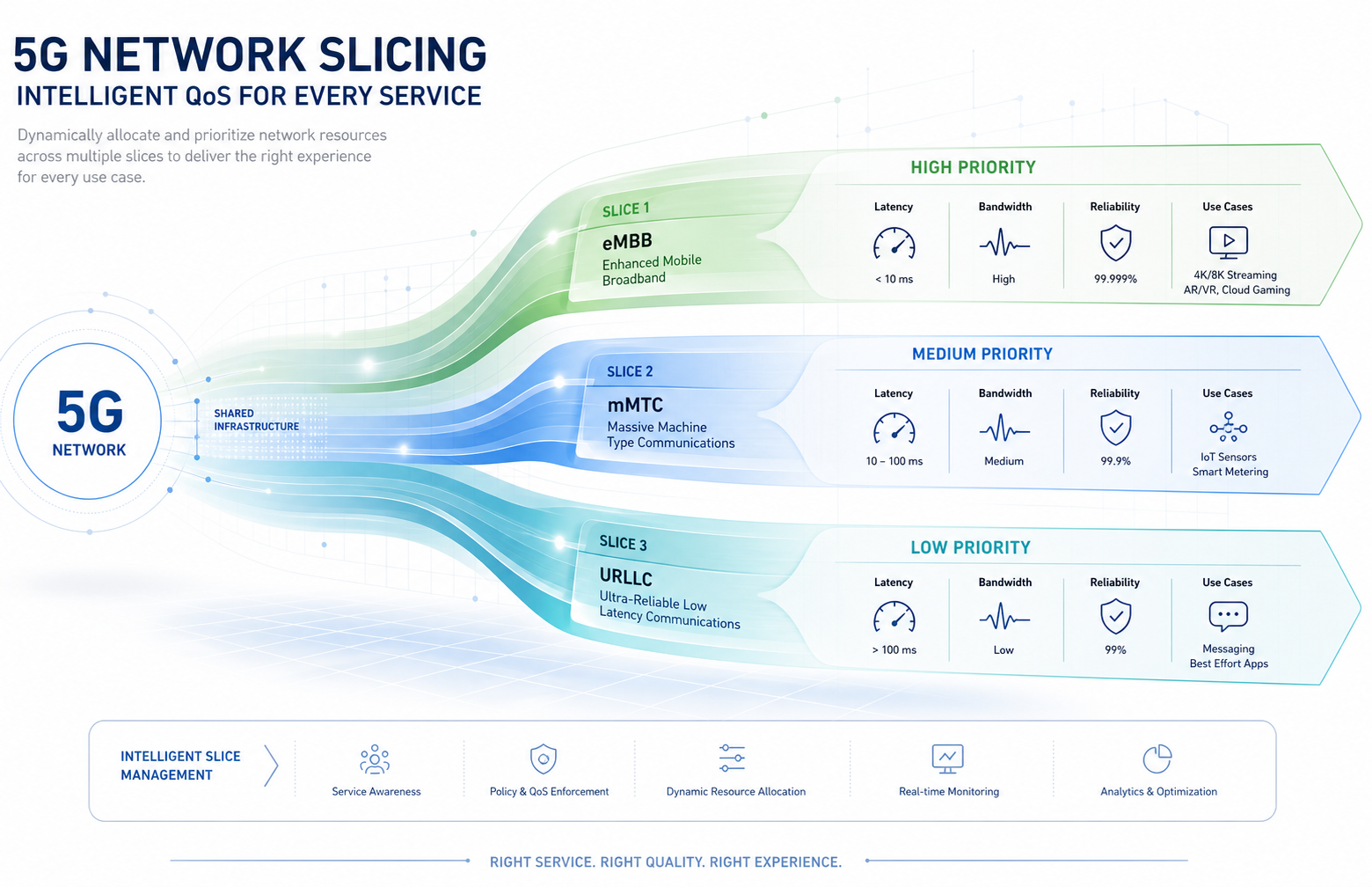
    Network slicing is one of the defining architectural features of 5G Standalone (SA), enabling operators to deliver multiple virtualized networks over a shared physical infrastructure — each with its own performance characteristics, security policies, and service guarantees. For CPE buyers, understanding how network slicing is implemented at the subscriber endpoint is essential to making informed procurement decisions. This guide examines the QoS framework, slice identification, and CPE-level architecture that operators need to evaluate when selecting 5G CPE for multi-service deployments.

    The 5G QoS Model: Beyond 4G Bearer Architecture

    5G introduces a fundamentally more flexible QoS framework than 4G LTE. The 5G QoS Identifier (5QI) replaces the QCI model with finer granularity and standardized packet delay budgets across 33 defined 5QI values (versus 9 QCIs in LTE). Key 5QI characteristics that CPE must handle include:

    • GBR (Guaranteed Bit Rate) QoS Flows for services requiring committed throughput, such as enterprise VPN tunnels, real-time video conferencing, and industrial control traffic
    • Non-GBR QoS Flows with standardized priority levels, suitable for general internet access and best-effort enterprise traffic
    • Delay-Critical GBR (5QI 82-85) for ultra-reliable low-latency applications requiring sub-5ms packet delay budgets
    • Reflective QoS — where the CPE derives uplink QoS rules from downlink packet markings, reducing signaling overhead for dynamic traffic patterns

    A properly designed 5G CPE must maintain independent QoS flow state for multiple concurrent PDU sessions, each potentially carrying multiple QoS flows with different 5QI profiles. This is a non-trivial requirement that separates enterprise-grade CPE from consumer-grade devices.

    Network Slice Identification: NSSAI and S-NSSAI

    Network slicing in 5G is identified through the Single Network Slice Selection Assistance Information (S-NSSAI), composed of a Slice/Service Type (SST) and an optional Slice Differentiator (SD). Standardized SST values include eMBB (SST=1), URLLC (SST=2), and MIoT (SST=3), with operator-defined values available for custom slice types.

    The CPE receives a Configured NSSAI from the core network during registration, which defines the slices the device is authorized to access. Critically, the CPE must then be capable of establishing separate PDU sessions on different slices simultaneously — a capability known as multi-slice support. For enterprise CPE deployments, this means one device might concurrently maintain:

    • A URLLC slice PDU session for factory automation traffic (SST=2, latency <5ms)
    • An eMBB slice PDU session for office internet access (SST=1, high throughput)
    • A custom MIoT slice for sensor aggregation (SST=3, low power, massive connectivity)

    URSP: The Traffic-to-Slice Routing Engine

    The UE Route Selection Policy (URSP) is the mechanism by which the 5G core instructs the CPE on how to route application traffic to specific network slices. URSP rules consist of traffic descriptors (IP tuples, FQDN, DNN, application IDs) mapped to route selection descriptors (S-NSSAI, DNN, SSC mode).

    For enterprise buyers, URSP support in CPE translates to a practical capability: the ability to enforce slice-based traffic steering without per-application configuration on end-user devices behind the CPE. A well-implemented CPE can, for example, automatically route all traffic destined for a manufacturing execution system to the URLLC slice while directing office productivity traffic to the eMBB slice — transparently to the LAN devices.

    Multi-Slice CPE Architecture: VLAN-to-Slice Mapping

    Enterprise-grade 5G CPE typically implements slice-to-VLAN mapping as the bridge between the 5G WAN and the local area network. Each PDU session (one per slice) is mapped to a distinct VLAN on the CPE’s LAN ports, allowing downstream switches and routers to segregate traffic by slice without 5G awareness.

    A reference multi-slice CPE architecture includes:

    • Multi-PDU Session Engine — supporting 4-8 concurrent PDU sessions with independent IP stacks per session
    • URSP Client — processing URSP rules from the 5G core and maintaining a local traffic-to-slice routing table
    • VLAN Translation Layer — mapping each PDU session to a configurable 802.1Q VLAN tag on the LAN side
    • Per-Slice QoS Enforcement — maintaining independent QoS flow state per PDU session with hardware-accelerated packet scheduling

    Performance and Isolation Guarantees

    A critical procurement consideration is the degree of resource isolation between slices at the CPE level. While the 5G core guarantees slice isolation within the network, the CPE itself must not become a bottleneck through shared buffer contention, CPU oversubscription, or inadequate packet scheduling. Buyers should verify:

    • Per-slice throughput floors that are maintained regardless of traffic load on other slices
    • Hardware queue separation — dedicated hardware queues per slice rather than software-based prioritization
    • Slice-specific latency budgets measured end-to-end from LAN ingress to 5G air interface
    • Fail-open behavior — documented behavior when a slice becomes unavailable (traffic fallback policies)

    Buyer’s Verification Checklist

    When evaluating 5G CPE for multi-slice deployment, procurement teams should request:

    1. Documented multi-PDU session support with a minimum of 4 concurrent sessions
    2. URSP rule capacity (minimum 8 traffic descriptor + route selection descriptor pairs)
    3. VLAN-to-slice mapping configuration interface (GUI and TR-069/TR-369 manageable)
    4. Per-slice throughput and latency test reports under simultaneous multi-slice load
    5. Interoperability test results with the operator’s specific 5G SA core vendor (Ericsson, Nokia, Huawei, Samsung, Mavenir)
    6. Software upgrade path for 3GPP Release 17/18 slice enhancements including slice-level authentication and authorization (NSSAA)

    Conclusion: Slice-Aware CPE as a Competitive Requirement

    As 5G SA networks mature through 2026, network slicing is transitioning from a standards capability to a commercial service differentiator. Operators launching enterprise slicing services need CPE that translates core-network slice intelligence into practical LAN-side traffic management. CPE without robust multi-slice support, URSP processing, and per-slice QoS enforcement will increasingly limit an operator’s ability to monetize their 5G SA investment. For procurement teams, slice-aware CPE is not a future consideration — it is a present requirement for any 5G SA deployment targeting enterprise, industrial, or multi-service consumer markets.

  • Open RAN and Virtualized RAN Architectures Gain Procurement Momentum: How O-RAN Interoperability Is Reshaping CPE Requirements for Global Operators in H2 2026

    Open RAN and Virtualized RAN Architectures Gain Procurement Momentum: How O-RAN Interoperability Is Reshaping CPE Requirements for Global Operators in H2 2026

    The Open RAN (O-RAN) movement has entered a decisive procurement phase in 2026. What was once an industry aspiration has now become a formal requirement in operator RFPs across multiple regions, and the implications for CPE vendors and buyers are significant. As virtualized RAN (vRAN) deployments scale from pilot projects to commercial networks, the CPE ecosystem must adapt to a more open, interoperable, and software-driven radio access environment.

    The O-RAN Procurement Shift in 2026

    Several major operators — including Vodafone, Deutsche Telekom, Rakuten Mobile, and Reliance Jio — have now committed over 40% of their RAN spend to O-RAN-compliant infrastructure. The O-RAN Alliance’s specifications, particularly the O1, O2, and Open Fronthaul interfaces, are being adopted as procurement checklists by regulators in the EU, Japan, and Southeast Asia. For CPE manufacturers, this means that interoperability with O-RAN architectures is rapidly becoming a baseline requirement rather than a competitive differentiator.

    The GSMA’s June 2026 Open Gateway update further underscores this trend, extending API-driven network openness from the core to the RAN edge — and by extension, to the CPE that terminates the subscriber link.

    How O-RAN Reshapes CPE Technical Requirements

    Traditional RAN-CPE coupling has long tied subscriber devices to specific vendor ecosystems through proprietary scheduling algorithms, custom beamforming implementations, and closed-loop power control. O-RAN disaggregation breaks this coupling in three critical ways:

    1. Open Fronthaul Interface. The O-RAN 7.2x split between O-DU and O-RU means that physical-layer processing is separated from higher-layer scheduling. CPE must now demonstrate consistent performance across mixed-vendor RU/DU combinations rather than optimizing for a single vendor’s proprietary stack. For operators running multi-vendor O-RAN deployments, CPE that shows vendor-agnostic throughput and latency characteristics has a measurable procurement advantage.

    2. RIC (RAN Intelligent Controller) Integration. The near-real-time RIC introduces AI/ML-driven policy updates to the RAN scheduler. CPE with open telemetry capabilities — specifically the ability to report per-flow QoS metrics, radio conditions, and mobility events via standards-based APIs — enables RIC applications to optimize resource allocation dynamically. This creates a feedback loop where intelligent CPE improves RAN efficiency, which in turn improves CPE performance.

    3. Service Management and Orchestration (SMO). The O1 interface for network management extends logically to CPE management. O-RAN-aligned operators increasingly expect CPE to integrate with their SMO framework via standardized YANG models and NETCONF/RESTCONF protocols, enabling zero-touch provisioning and automated fault management across the entire RAN-to-CPE chain.

    Regional Adoption and CPE Certification Trends

    Japan leads global O-RAN adoption, with NTT DOCOMO and KDDI now requiring O-RAN Alliance certification for CPE supplied to their 5G SA networks. The European Commission’s Digital Decade 2030 policy framework mandates O-RAN interoperability testing for public-funded broadband projects starting in Q3 2026, directly affecting CPE procurement for rural FWA deployments.

    In North America, the NTIA’s Public Wireless Supply Chain Innovation Fund has allocated USD 420 million for O-RAN testing facilities, including CPE interoperability labs. Dish Wireless (EchoStar) continues to operate the world’s largest commercial O-RAN network, and its CPE certification program has become a de facto benchmark for O-RAN-compatible subscriber equipment.

    Southeast Asian markets — particularly Malaysia, Indonesia, and Vietnam — are leapfrogging directly to O-RAN architectures for new 5G builds, creating substantial demand for O-RAN-compatible CPE across multiple price tiers.

    CPE Buyer’s Checklist: O-RAN Readiness

    Operators and distributors evaluating CPE for O-RAN environments should verify:

    • Multi-vendor interoperability test reports — documented performance across at least two independent O-DU/O-RU combinations using O-RAN 7.2x fronthaul
    • RIC compatibility — support for E2 interface KPIs including per-flow throughput, BLER, RSRP/RSRQ reporting in O-RAN-defined formats
    • SMO integration readiness — TR-069/TR-369 (USP) support with YANG data models aligned to O-RAN O1 interface specifications
    • Open Fronthaul validation — O-RAN Alliance Open Testing and Integration Centre (OTIC) certification or equivalent third-party validation
    • Software upgradeability — capability to receive OTA firmware updates that align with RIC policy changes without service interruption

    Strategic Implications for H2 2026 and Beyond

    The O-RAN procurement momentum is not a future trend — it is a current reality accelerating through H2 2026. CPE that is tested, certified, and proven in O-RAN environments will capture procurement preference in markets representing over 60% of global 5G capex. For operators, the transition to O-RAN-compatible CPE procurement is both a technical necessity and a strategic lever for vendor diversification, cost reduction, and network programmability.

    For CPE manufacturers, the message is clear: O-RAN interoperability is no longer optional. It is the foundation upon which the next generation of operator CPE procurement will be built.

  • eSIM and Multi-IMSI CPE: Provisioning Questions

    eSIM and Multi-IMSI CPE: Provisioning Questions

    As 5G fixed wireless access deployments scale globally, a seemingly simple component — the SIM — is undergoing a transformation that has far-reaching implications for CPE procurement, logistics, and operational efficiency. The embedded SIM (eSIM) and its multi-IMSI architecture, governed by GSMA’s SGP.22 and SGP.32 specifications, enable operators to provision, swap, and manage operator profiles on CPE devices without physical SIM card handling. For ISPs, MVNOs, and enterprise operators managing fleets of thousands of distributed CPE units, eSIM technology is not a convenience feature — it is a strategic procurement requirement that directly impacts total cost of ownership, supply chain agility, and subscriber churn.

    This technical buyer’s guide examines the eSIM and multi-IMSI architecture as it applies to 5G CPE, covering the GSMA compliance framework, hardware integration considerations, remote SIM provisioning workflows, and practical vendor evaluation criteria for procurement teams specifying next-generation FWA devices.

    eSIM Architecture Fundamentals: eUICC, Profiles, and the LPA

    At the hardware level, an eSIM implementation in a 5G CPE device consists of an embedded UICC (eUICC) — a soldered, tamper-resistant secure element that conforms to the GSMA SGP.02 (M2M) or SGP.22 (consumer) architecture. Unlike a traditional removable SIM card, the eUICC supports multiple operator profiles stored simultaneously, with secure over-the-air (OTA) profile download, activation, and deletion managed through a Local Profile Assistant (LPA) component integrated into the CPE’s baseband or application processor.

    The key architectural choice for CPE procurement teams is between the M2M eUICC architecture (GSMA SGP.02) and the consumer eUICC architecture (GSMA SGP.22):

    M2M eUICC (SGP.02). Designed for device-to-device and IoT use cases, the M2M architecture uses a “push” model where the operator’s Subscription Manager-Data Preparation (SM-DP) server pushes profiles to the eUICC through a Subscription Manager-Secure Routing (SM-SR) intermediary. This architecture is well-suited to fixed-location CPE with predictable network attachment patterns, but it requires operator-side SM-SR infrastructure that not all MVNOs maintain.

    Consumer eUICC (SGP.22). The consumer architecture uses a “pull” model where the CPE’s LPA initiates profile download from the SM-DP+ server — the operator-controlled platform that prepares and delivers encrypted profiles. SGP.22 is the dominant architecture for smartphones and is increasingly adopted in FWA CPE because it enables end-user or installer-initiated profile switching, supports QR-code-based activation workflows, and integrates naturally with operator mobile apps and self-service portals.

    For most FWA and enterprise CPE deployments, SGP.22 consumer eUICC is the recommended architecture due to broader ecosystem support, simpler operator onboarding, and alignment with GSMA SGP.32 — the emerging IoT eSIM standard that extends consumer architecture capabilities to constrained devices.

    Multi-IMSI Architecture: Enabling Operator Flexibility at the CPE Level

    While eSIM enables profile portability, multi-IMSI capability enables profile concurrency. A multi-IMSI CPE device stores multiple International Mobile Subscriber Identities — each associated with a distinct operator profile — and can switch between them based on network availability, cost optimization rules, or geographic location without requiring a profile download.

    In a 5G CPE context, multi-IMSI architecture serves three primary deployment scenarios:

    Multi-Carrier Failover for SLA-Grade Deployments. Enterprise CPE deployed at branch offices, retail locations, or remote industrial sites can maintain active IMSIs from two or more operators. If the primary operator’s network experiences congestion or an outage, the CPE’s connection manager — typically implemented in the modem firmware or an SDK-provided middleware layer — triggers an IMSI switch to the secondary operator within seconds, maintaining session continuity for critical applications.

    For a cross-border subscription proposal, confirm service availability, roaming terms, profile eligibility and switching behaviour with the connectivity provider. Multiple subscription identities do not by themselves remove roaming charges or guarantee a saving.

    MVNO and Wholesale Operator Multi-Tenancy. MVNOs that resell connectivity from multiple host operators can deploy a single CPE SKU with pre-provisioned MNO profiles, activating the appropriate IMSI at subscriber onboarding based on the subscriber’s service plan and coverage area. This eliminates the logistical complexity of stocking operator-specific CPE variants and enables dynamic MNO switching if the MVNO renegotiates wholesale agreements.

    Remote SIM Provisioning Workflow: From Factory to Field Deployment

    The GSMA-defined RSP (Remote SIM Provisioning) workflow for consumer eUICC CPE follows a four-phase lifecycle:

    Phase 1: Factory Provisioning. During CPE manufacturing, the eUICC is loaded with a provisioning profile — a bootstrap connectivity profile that enables the device to attach to a cellular network for the sole purpose of downloading its operational profile. The eUICC’s EID (eUICC ID) is registered with the SM-DP+ server that will manage the device’s profile lifecycle.

    Phase 2: Subscriber Onboarding. When a subscriber activates the CPE, the operator provides an activation code — typically delivered as a QR code, a deep link in an operator app, or an SM-DP+ address string in the device’s zero-touch provisioning payload. The CPE’s LPA uses this activation code to establish a secure TLS session with the SM-DP+ server, authenticate via the eUICC’s certificate chain, and download the encrypted operational profile.

    Phase 3: Operational Profile Activation. The downloaded profile is installed into an available profile slot on the eUICC, the CPE detaches from the provisioning network, and re-attaches using the operational IMSI. From this point forward, the CPE operates as a standard subscriber device on the selected MNO network.

    Phase 4: Lifecycle Management. The operator can remotely enable, disable, or delete profiles through SM-DP+ commands. Profile switching between multiple downloaded profiles (e.g., primary to backup MNO) is managed locally by the LPA based on policy rules configured by the operator or enterprise administrator. The GSMA SGP.32 specification, currently in advanced draft, extends this lifecycle model with bulk profile management capabilities tailored to IoT and CPE fleets.

    Hardware Integration Considerations for CPE OEMs and ODMs

    For procurement teams evaluating CPE with eSIM capability, the following hardware integration factors should be verified against deployment requirements:

    Select the eUICC or integrated implementation using the required provisioning architecture and provider documentation. Confirm profile capacity, switching behaviour and integration support for the exact device rather than assuming a vendor-wide configuration.

    LPA Integration Model. The LPA can be implemented in the modem baseband processor (modem-resident LPA), in the CPE’s application processor (AP-resident LPA), or as a hybrid implementation. Modem-resident LPAs (e.g., Qualcomm’s eSIM framework on Snapdragon X-series modems, MediaTek’s eSIM stack on T-series modems) offer tighter integration with radio state management and lower profile-switching latency. AP-resident LPAs offer greater flexibility for custom operator management UIs and integration with TR-069/TR-369 ACS platforms for remote profile lifecycle management.

    Antenna and RF Path Considerations. The provisioning profile bootstrapping phase requires the CPE to achieve network attachment using only the eUICC’s default provisioning IMSI — typically associated with a partner MNO or a global connectivity provider. CPE procurement teams should confirm that the device’s antenna configuration and supported bands cover the provisioning partner’s spectrum in all target deployment geographies, and that the provisioning data path (typically limited to a few megabytes for profile download) does not exhaust a metered bootstrap data allowance.

    GSMA Compliance and Security Certification

    Any CPE claiming eSIM support should hold GSMA SAS (Security Accreditation Scheme) certification for both the eUICC silicon (SAS-UP) and the SM-DP+ platform (SAS-SM). Additionally, the CPE’s LPA implementation should comply with GSMA SGP.22 v2.4 or later, which includes mandatory support for TLS 1.2 profile delivery encryption and the profile interoperability testing framework defined in GSMA TS.48.

    Buyers should request SAS certification documentation from CPE vendors and verify that the eUICC vendor’s SM-DP+ integration has been validated against the operator’s profile delivery infrastructure. In multi-operator deployments, the CPE’s eUICC must support profile policy rules (PPR) as defined in SGP.22 section 3.1.3, enabling the primary operator to control which secondary profiles can coexist on the device.

    eSIM vs. iSIM: The Next Integration Step

    Looking beyond eSIM, the integrated SIM (iSIM) — where the UICC functionality is embedded directly into the modem’s system-on-chip (SoC) silicon, eliminating the discrete eUICC component — is beginning to appear in cost-optimized CPE designs. Qualcomm’s Snapdragon X80 modem-RF platform and Sony Semiconductor’s Altair ALT1350 chipset both support iSIM architectures compliant with GSMA SGP.31/32 specifications.

    Compare eSIM and iSIM options using the proposed device, provisioning service, operator acceptance and sample plan. Request current integration and supply terms for the selected configuration.

    Vendor Selection Criteria: What to Ask CPE Suppliers

    When evaluating 5G CPE with eSIM and multi-IMSI capability, procurement teams should include the following requirements in RFQ documentation:

    1. GSMA SAS certification status for the eUICC component and the SM-DP+ integration path.
    2. Supported number of concurrent eSIM profiles and measured profile switching latency (detach-to-attach time) under representative network conditions.
    3. LPA integration model (modem-resident, AP-resident, or hybrid) and compatibility with standard ACS platforms (TR-069/TR-369) for remote lifecycle management.
    4. Multi-IMSI failover behavior — including automatic vs. policy-driven IMSI switching, and support for steering-of-roaming applications — with documented performance under network degradation scenarios.
    5. Provisioning profile coverage in target deployment geographies, including bootstrap data allowance sufficient for operational profile download.
    6. SM-DP+ platform compatibility with the buyer’s existing or planned operator partners, including multi-tenant SM-DP+ support for MVNO and wholesale deployments.
    7. Firmware OTA (FOTA) update capability for the eSIM LPA stack, ensuring future GSMA specification updates can be deployed without field returns.

    For operators building large-scale FWA deployments — particularly those spanning multiple countries or serving enterprise SLA-grade subscribers — eSIM and multi-IMSI capability in CPE is not an optional feature. It is a foundational requirement that determines the speed of subscriber onboarding, the cost of ongoing profile management, and the ability to deliver carrier-grade reliability through multi-operator redundancy. By incorporating these technical evaluation criteria into the CPE procurement process, operators can future-proof their device fleet against profile management complexity and position their FWA services for sustainable growth through 2027 and beyond.

  • 5G-Advanced (3GPP Release 18) Commercial Rollouts Begin: How AI-Enhanced Network Capabilities and Extended IoT Support Are Opening New CPE Product Categories for Operators in H2 2026

    5G-Advanced (3GPP Release 18) Commercial Rollouts Begin: How AI-Enhanced Network Capabilities and Extended IoT Support Are Opening New CPE Product Categories for Operators in H2 2026

    The 5G-Advanced era is no longer a roadmap item — it is a commercial reality. In the first half of 2026, multiple Tier-1 operators across Asia, Europe, and North America have begun activating 3GPP Release 18 features on their live 5G Standalone (SA) networks, marking the industry’s formal transition from foundational 5G to the enhanced capabilities defined in the 5G-Advanced specification set. For CPE buyers — ISPs, MVNOs, system integrators, and enterprise procurement teams — this transition opens a new generation of customer-premises equipment designed to exploit AI-native radio optimization, enhanced uplink performance, and expanded IoT protocol support that were simply unavailable in Release 17 devices.

    What 5G-Advanced Brings to the CPE Layer

    Release 18 introduces several architectural enhancements that directly affect CPE design and procurement specifications. The most consequential for fixed wireless access (FWA) and enterprise CPE include:

    AI/ML Framework for NR Air Interface. For the first time, 3GPP has standardized AI/ML-based channel state information (CSI) feedback compression, beam management, and positioning accuracy enhancements. CPE chipsets that support Release 18 can leverage network-side AI models to improve beam selection in dense urban environments, reduce CSI reporting overhead, and achieve more consistent throughput at cell edges. For operators, this translates to higher average sector spectral efficiency and fewer subscriber complaints about evening-hour performance degradation.

    Enhanced Multi-TRP (mTRP) and Carrier Aggregation. Release 18 extends multi-transmission-reception-point coordination beyond Release 17, enabling CPE devices to simultaneously receive data from multiple gNB panels with tighter inter-panel synchronization. Combined with expanded carrier aggregation (CA) configurations — including inter-band CA across sub-6 GHz and mmWave spectrum — 5G-Advanced CPE can sustain multi-gigabit throughput with improved reliability for enterprise branch-office deployments where SLA-grade availability is non-negotiable.

    Expanded IoT Support: NR-Light Enhancements and Ambient IoT. Release 18 builds on the RedCap foundation laid in Release 17 with further reduced-capability enhancements and introduces the ambient IoT (Ambient IoT) framework — enabling ultra-low-power, battery-free tag devices that can backscatter ambient RF signals. While ambient IoT is primarily an infrastructure play, CPE gateways positioned as edge aggregation hubs will increasingly need to support ambient IoT device management and data relay, opening a new CPE product category for industrial and logistics verticals.

    XR-Aware Scheduling and Uplink Enhancements. For enterprise and prosumer use cases involving augmented reality, remote assistance, and real-time video analytics, Release 18’s XR-aware scheduling coordinates downlink and uplink traffic flows to meet the joint latency-throughput requirements of immersive applications. Uplink MIMO enhancements — including support for up to 4-layer UL transmission — give 5G-Advanced CPE the symmetric bandwidth profile that applications like multi-camera live streaming and cloud-rendered XR demand.

    Operator Rollout Timeline and CPE Availability

    China Mobile activated Release 18 features across its 5G SA network in Q1 2026, initially targeting enhanced MIMO and AI-based CSI optimization in high-density urban corridors. SK Telecom and KT followed with commercial 5G-Advanced service launches in Seoul and Busan during Q2 2026, with both operators explicitly positioning Release 18-capable CPE as a premium FWA tier for business subscribers. In Europe, Deutsche Telekom and Orange have announced plans to activate Release 18 features in select markets by Q3 2026, while in North America, T-Mobile US has begun lab trials with Release 18 CPE prototypes from Qualcomm’s Snapdragon X80 platform.

    On the silicon side, MediaTek’s T900 modem-RF platform and Qualcomm’s Snapdragon X80 modem-RF system are the first commercially available chipsets with full Release 18 feature support, and both vendors have reference designs for indoor and outdoor CPE form factors available to OEMs and ODMs. Honlly Telecom’s engineering team is currently evaluating both platforms for integration into the company’s 2027 CPE roadmap, with particular focus on the enhanced beam management and uplink MIMO capabilities that differentiate Release 18 from Release 17 devices in real-world deployments.

    Procurement Implications for Operators and ISPs

    For B2B buyers planning CPE procurement in H2 2026 and 2027, the 5G-Advanced transition introduces several strategic considerations:

    Timing the Release 17-to-18 Crossover. Operators with active Release 18 network deployments should begin specifying Release 18-capable CPE in RFQs immediately, as the AI-enhanced beam management alone can deliver 15–25% throughput improvement at mid-cell and cell-edge positions compared to equivalent Release 17 hardware. However, operators whose network infrastructure remains on Release 17 or NSA architecture may achieve better near-term ROI by continuing Release 17 CPE procurement through mid-2027 while planning the 5G-Advanced migration.

    IoT Gateway Convergence. The expanded IoT protocol support in Release 18 — including ambient IoT awareness and enhanced RedCap — positions the 5G-Advanced CPE as a converged FWA-plus-IoT gateway. Procurement teams evaluating CPE for industrial, logistics, and smart-city deployments should prioritize platforms that expose IoT management APIs alongside standard FWA functionality, reducing the need for separate IoT gateway hardware.

    Power and Thermal Envelope. The additional AI processing, enhanced MIMO layers, and wider carrier aggregation configurations in 5G-Advanced CPE increase both peak power consumption and thermal dissipation requirements. Buyers should verify that Release 18 CPE designs include adequate thermal engineering — particularly for outdoor and industrial-grade units — and that power budgets align with deployment-site constraints.

    Looking Ahead: Release 19 and the 6G Pathway

    While the industry digests Release 18, 3GPP is already advancing Release 19 specifications — targeted for freeze in late 2025 — with further AI/ML integration, integrated sensing and communication (ISAC), and foundational 6G study items. For CPE procurement teams, the Release 18 commercial activation in 2026 represents the beginning of a multi-year technology refresh cycle that will progressively bring AI-native radio, ambient IoT, and sensing capabilities into the FWA and enterprise CPE product categories. The operators and ODMs that move early to build 5G-Advanced CPE supply chains will be best positioned to capture the premium tier of FWA subscribers as the technology matures through 2027 and beyond.