
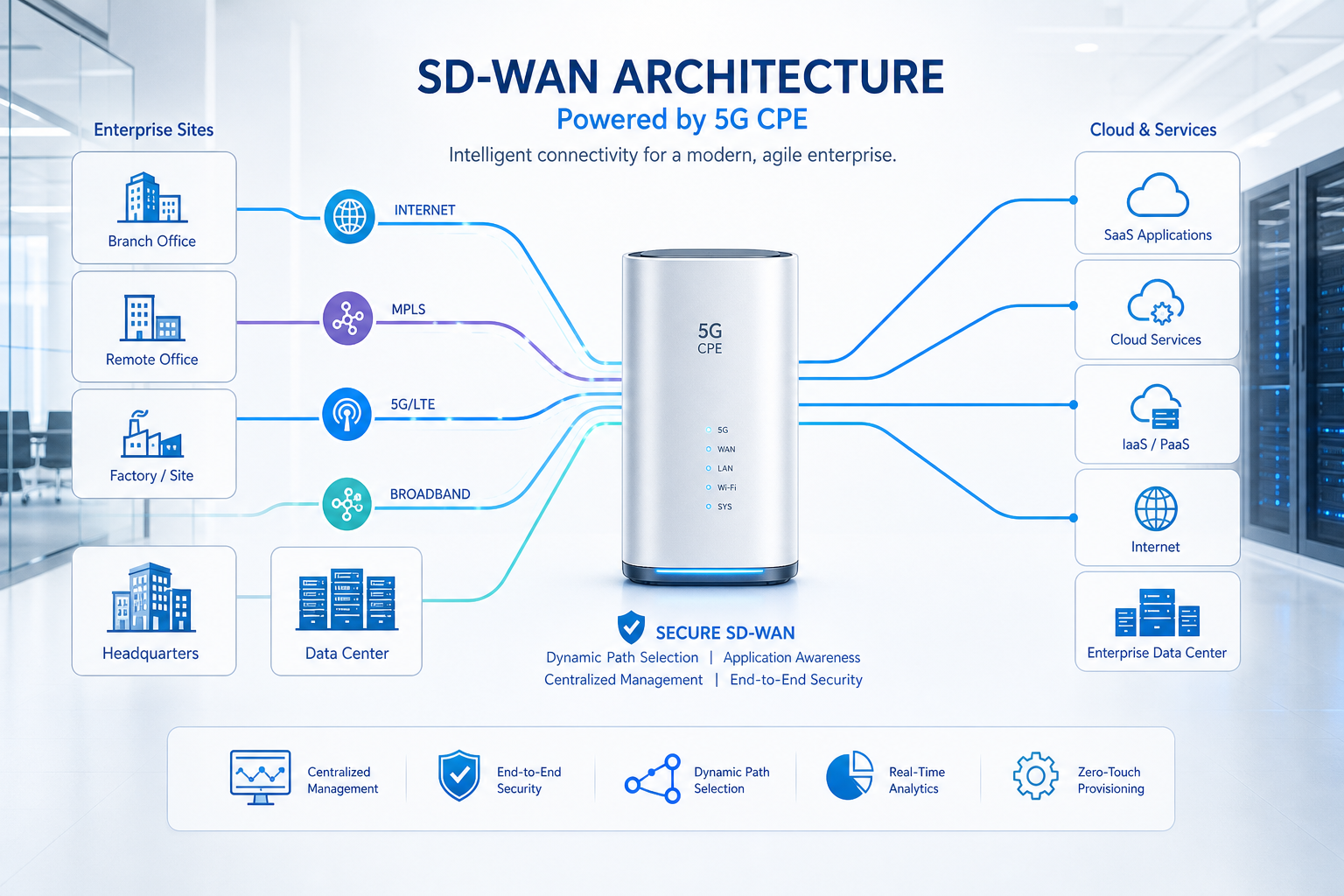
As enterprise branch networks evolve beyond the traditional MPLS-and-backup-4G model, multi-WAN SD-WAN integrated 5G CPE is emerging as the primary connectivity platform for distributed organizations in 2026. This technical buyer’s guide examines the architecture, key evaluation criteria, and deployment planning considerations for operators and enterprises procuring next-generation multi-WAN CPE.
The Architectural Shift: From Backup to Active-Active Multi-Path
The legacy model treated cellular WAN as a cold standby — a 4G LTE dongle that activated only when the primary MPLS or broadband circuit failed. Modern multi-WAN 5G CPE fundamentally changes this paradigm. With 5G delivering fiber-class throughput (500 Mbps to 2+ Gbps) and sub-20ms latency, the cellular path is now a viable primary or active-active link alongside wired WAN connections.
This architectural shift demands CPE with:
- Hardware-Accelerated SD-WAN Forwarding: Multi-gigabit IPsec throughput with AES-256-GCM encryption offloaded to dedicated silicon. Software-only forwarding on a general-purpose CPU will bottleneck at sub-500 Mbps under real-world traffic conditions with small packets and concurrent tunnel termination.
- Application-Aware Path Selection: Dynamic per-packet or per-flow steering based on application signatures (DPI), real-time link quality metrics (jitter, loss, latency), and administrator-defined policies. A VoIP call may be steered over the lowest-jitter path while bulk file transfers use the highest-bandwidth link.
- Sub-Second Failover with Session Persistence: True hitless failover requires BFD (Bidirectional Forwarding Detection) at sub-100ms intervals combined with connection tracking that preserves established TCP sessions and VPN tunnels across path transitions. Anything slower than 500ms total failover time will disrupt real-time applications and trigger application-layer timeouts.
WAN Interface Portfolio: What to Look For
A production-grade multi-WAN CPE should support a flexible combination of WAN interfaces:
| Interface Type | Typical Use Case | Key Specification |
|—|—|—|
| 5G NR (SA/NSA) | Primary or active-active cellular path | 3GPP Release 17, 4×4 MIMO, carrier aggregation up to 8CC |
| 4G LTE Cat 20 | Fallback cellular path | Multi-operator SIM support, eSIM ready |
| 2.5GbE / 10GbE WAN | Fiber/FTTx handoff | SFP+ cage for optical modules |
| 1GbE / 2.5GbE LAN | Local switching, PoE for APs/cameras | 802.3at PoE+ (30W per port) |
| Wi-Fi 7 (802.11be) | On-site wireless access, wireless WAN backup | 4×4 MIMO, MLO, 320 MHz channels |
The CPE should expose each WAN interface independently to the SD-WAN policy engine, with per-interface health probes (ICMP, HTTP, DNS) and configurable SLA thresholds that trigger automated path reassignment.
SD-WAN Overlay Technologies: Standards-Based vs. Proprietary
Buyers face a critical architectural choice between standards-based overlay protocols and vendor-proprietary SD-WAN fabrics:
- Standards-Based (IPsec/IKEv2 + VXLAN/Geneve): Maximizes interoperability with existing enterprise infrastructure and multi-vendor environments. However, it may lack advanced features like forward error correction (FEC) and per-packet duplication that proprietary protocols offer.
- Vendor-Proprietary SD-WAN (Cisco vEdge, VMware VeloCloud, Fortinet Secure SD-WAN): Delivers tightly integrated security, FEC, and cloud on-ramp optimizations, but can create vendor lock-in and complicate multi-vendor CPE strategies.
The emerging best practice among large enterprises is to select CPE hardware that supports both paradigms — running standards-based tunnels for general connectivity while integrating with a proprietary SD-WAN fabric for latency-sensitive and high-security workloads.
Security Architecture: Zero Trust at the Branch Edge
Multi-WAN CPE sits at the boundary between the enterprise LAN and multiple untrusted WAN paths, making it a critical security enforcement point. Key security capabilities to evaluate:
- NGFW Integration: Layer 7 application identification, intrusion prevention (IPS), and TLS 1.3 decryption at line rate. The CPE should not become a security bottleneck when performing deep packet inspection on multi-gigabit 5G links.
- Zero Trust Network Access (ZTNA): The CPE should act as a ZTNA enforcement point, authenticating every flow against the enterprise identity provider before granting access to internal applications — regardless of which WAN path the traffic arrives on.
- SASE / SSE Integration: Native integration with cloud-delivered security services (SWG, CASB, DLP) via GRE/IPsec tunnels or API-driven service chaining, enabling consistent security policy across all branch locations without backhauling traffic through a central data center.
Centralized Management and Zero-Touch Provisioning
For deployments spanning hundreds or thousands of branch locations, the CPE management plane is as important as the data plane:
- Zero-Touch Provisioning (ZTP): The CPE should bootstrap from a factory-default state upon first power-on — authenticating to the orchestrator via TPM-stored device certificates, downloading configuration, and establishing SD-WAN tunnels without any on-site technician intervention.
- Template-Based Configuration Management: Hierarchical configuration models that allow global policy definition with local overrides for region-specific parameters (cellular bands, regulatory domain, SSID naming).
- Telemetry and Analytics: Streaming telemetry (gNMI, NETCONF/YANG) that feeds into the enterprise observability stack, providing per-application, per-path performance metrics for capacity planning and SLA monitoring.
Deployment Planning Checklist
For operators and enterprises planning a multi-WAN SD-WAN CPE rollout:
Site Survey: Verify 5G coverage (signal strength, RSRP, SINR) at each branch location, not just at street level but at the precise CPE installation point — indoor attenuation at higher 5G frequencies (n77/n78) can be significant.
SIM Strategy: Multi-IMSI or eSIM profiles that allow failover between mobile operators without physical SIM swaps. Evaluate roaming agreements for cross-border branch deployments.
IP Addressing and Routing: Plan for the SD-WAN overlay’s impact on existing IP addressing schemes. Dynamic routing protocol redistribution (BGP, OSPF) from CPE to LAN core switches.
Power and Environmental: For branch locations without dedicated IT rooms, the CPE must tolerate ambient temperatures up to 50°C, operate fanless for dust-sensitive environments, and support PoE-powered operation for flexible placement.
Lifecycle and Support: Evaluate vendor commitments to firmware update cadence (monthly security patches, quarterly feature releases), hardware warranty (minimum 3-year with advanced replacement), and 24/7 TAC support coverage across all deployment time zones.
The Bottom Line
Multi-WAN SD-WAN integrated 5G CPE is not a commodity product — it is a strategic infrastructure decision that shapes branch network architecture for a 5-7 year lifecycle. Buyers should prioritize hardware-accelerated forwarding, standards-based overlay flexibility, integrated zero-trust security, and centralized ZTP management as table-stakes requirements. The CPE that delivers all four will provide the foundation for enterprise branch connectivity well into the 6G era.