
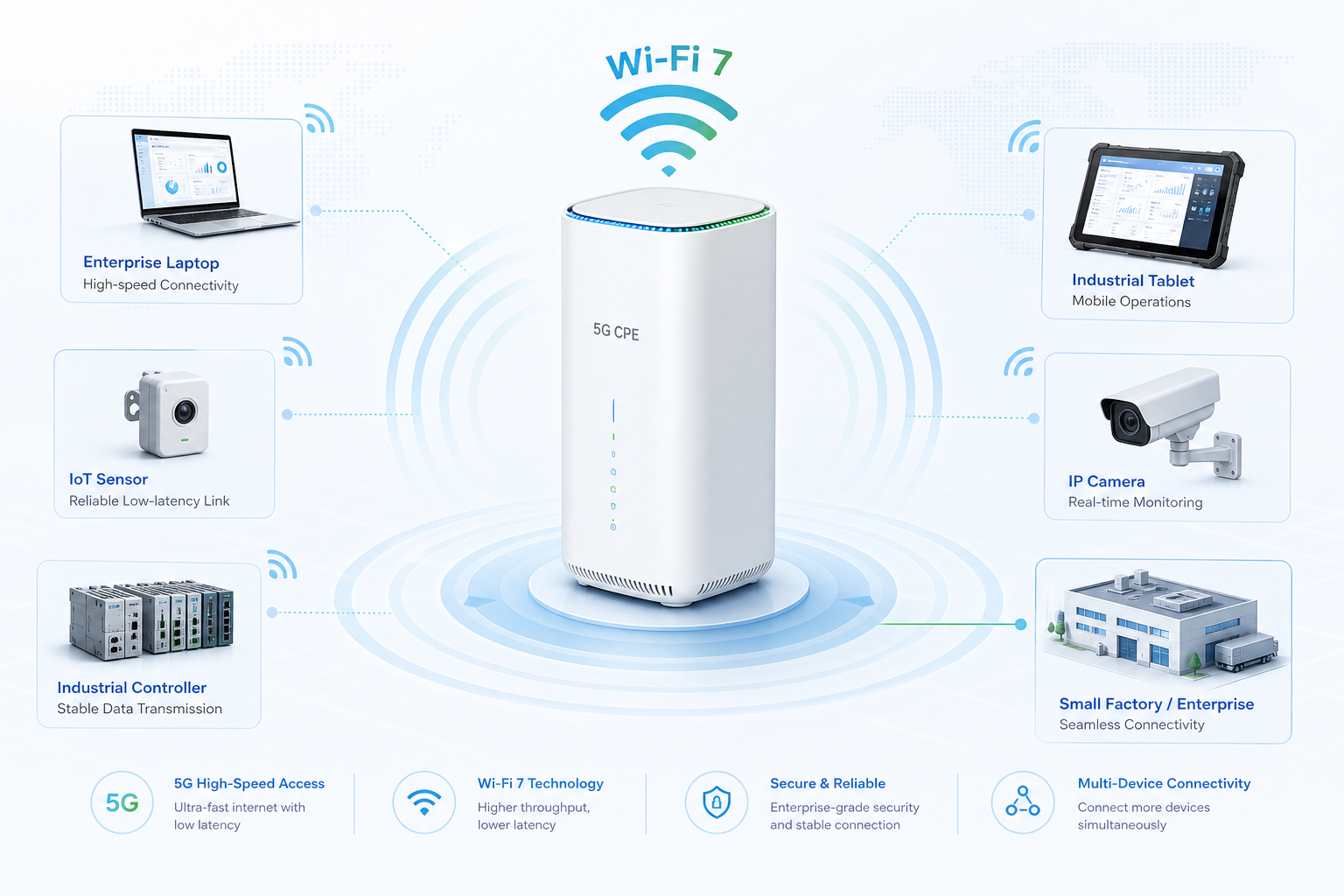
As enterprise wireless networks brace for the next capacity leap, the convergence of 5G CPE and Wi-Fi 7 (IEEE 802.11be) represents one of the most consequential architectural shifts in access network design since the transition from Wi-Fi 5 to Wi-Fi 6. For telecom operators, ISPs, and enterprise IT buyers evaluating CPE procurement in 2026, understanding how Wi-Fi 7 capabilities integrate with 5G WAN connectivity—and what this means for real-world throughput, latency, and spectrum management—is no longer optional. It is a procurement imperative.
Why Wi-Fi 7 Matters for 5G CPE
Wi-Fi 7 is not an incremental upgrade. The standard delivers maximum theoretical throughput of 46 Gbps—roughly 4.8× that of Wi-Fi 6—through three foundational innovations: 320 MHz channel bandwidth (doubled from Wi-Fi 6’s 160 MHz), 4096-QAM modulation (up from 1024-QAM), and Multi-Link Operation (MLO), which enables simultaneous transmission across multiple frequency bands. When these capabilities are embedded in a 5G CPE that terminates a multi-gigabit 5G WAN link, the result is a gateway device that can serve 50+ concurrent enterprise clients without becoming a bottleneck.
Consider the enterprise branch office scenario: a 5G CPE receiving 2 Gbps downlink over n78 with 100 MHz of spectrum. A Wi-Fi 6 access layer behind this CPE would realistically deliver 600–800 Mbps per client under ideal conditions. Wi-Fi 7, with MLO aggregating 5 GHz and 6 GHz bands simultaneously, can push 1.5–2 Gbps to individual capable clients—matching the WAN capacity rather than throttling it. For latency-sensitive applications like cloud-based UCaaS, virtual desktop infrastructure, and real-time industrial control, Wi-Fi 7’s deterministic low-latency features (including restricted target wake time) reduce tail latency by up to 60% compared to Wi-Fi 6 in congested environments.
Multi-Link Operation: The Architecture Game-Changer
MLO is Wi-Fi 7’s defining innovation and the feature with the most profound implications for 5G CPE design. In conventional Wi-Fi architectures, a client associates with a single band at a time—2.4 GHz, 5 GHz, or 6 GHz. MLO allows a Wi-Fi 7 client and access point to maintain simultaneous links across two or three bands, dynamically steering traffic based on channel conditions, interference, and QoS requirements.
For a 5G CPE functioning as the Wi-Fi 7 AP, MLO enables several deployment-critical capabilities. First, it provides seamless band steering without the connection interruption inherent in traditional band-steering mechanisms. A client moving from a 6 GHz-dominated office zone to a 5 GHz-dominated common area maintains uninterrupted connectivity. Second, MLO’s link aggregation mode—where traffic is striped across multiple bands—effectively doubles or triples the per-client throughput ceiling. Third, MLO’s redundancy mode allows critical traffic to be duplicated across bands, achieving sub-millisecond failover for industrial and telemedicine applications.
Enterprises evaluating 5G CPE with Wi-Fi 7 should verify that the device supports at least STR (Simultaneous Transmit and Receive) MLO across 5 GHz + 6 GHz, not just the less capable eMLSR (enhanced Multi-Link Single Radio) mode that some early chipsets implement. STR MLO requires dual-radio RF front-end design and adds approximately USD 12–18 to the bill of materials—an investment that pays for itself in environments with more than 30 active clients.
320 MHz Channels and 6 GHz Spectrum Planning
Wi-Fi 7’s 320 MHz channel support is transformative for high-throughput enterprise applications, but it demands careful spectrum planning—particularly in the 6 GHz band (5.925–7.125 GHz), where regulatory availability varies significantly by country. As of mid-2026, approximately 62 countries have opened portions of the 6 GHz band for unlicensed use, but the specific sub-band allocations differ: the U.S. has made the full 1,200 MHz available, the EU has released the lower 500 MHz (5.945–6.425 GHz), and many Asia-Pacific countries have adopted a middle-ground approach.
A globally deployable 5G CPE with Wi-Fi 7 must support software-configurable 6 GHz channelization that adapts to local regulatory domains without hardware changes. This capability—sometimes called geo-aware channel provisioning—should be a baseline requirement in operator RFPs. Enterprises should also confirm that the CPE supports Automated Frequency Coordination (AFC) where required, particularly for standard-power 6 GHz operation in the U.S. and Canada, to avoid interference with incumbent fixed-service and fixed-satellite users.
Integration Architecture: Where 5G Meets Wi-Fi 7
The integration of a 5G NR modem and a Wi-Fi 7 access point within a single CPE enclosure introduces engineering challenges that extend beyond RF coexistence. Thermal management is the primary concern: a Cat 19 or Cat 20 5G modem transmitting at +23 dBm alongside a tri-band Wi-Fi 7 chipset can generate 12–15W of sustained thermal load. Passive cooling designs using advanced thermal interface materials and chassis-as-heatsink approaches are essential for fanless operation in enterprise environments where acoustic noise and dust ingress are unacceptable.
On the software side, the CPE’s embedded operating system must implement intelligent traffic steering between the 5G WAN and Wi-Fi 7 LAN domains. This includes DSCP-to-802.11be QoS mapping that preserves DiffServ markings across the gateway, buffer management that prevents Wi-Fi 7’s higher throughput from overwhelming the 5G link’s buffer (bufferbloat mitigation), and per-client airtime fairness algorithms that prevent a single Wi-Fi 7 client from monopolizing shared airtime. OpenWrt-based CPE platforms with configurable sqm (Smart Queue Management) and the CAKE qdisc are increasingly preferred by enterprise buyers who require transparent traffic management without proprietary lock-in.
Procurement Checklist for Wi-Fi 7 + 5G CPE
When evaluating Wi-Fi 7-integrated 5G CPE for enterprise deployment, operators and buyers should assess against the following technical criteria:
Radio Capabilities: Tri-band concurrent operation (2.4 + 5 + 6 GHz), STR MLO support (not eMLSR-only), 4×4 MU-MIMO on 5 GHz and 6 GHz, 4096-QAM on all bands, and configurable 320/160/80 MHz channel bandwidth.
5G WAN Integration: 3GPP Release 17 or later modem, 4×4 MIMO on sub-6 GHz with carrier aggregation (at least 3CC), support for n77/n78/n79 plus at least four additional FR1 bands for global deployment flexibility, and an external antenna port option for edge-of-cell installations.
Software and Management: TR-069/TR-369 (USP) support for operator ACS integration, zero-touch provisioning with secure bootstrap, VLAN-to-SSID mapping for multi-tenant deployments, WPA3-Enterprise with 802.1X and RADIUS integration, and geo-aware 6 GHz channel provisioning.
Hardware Architecture: Fanless passive cooling rated to 45°C ambient, 2.5 GbE LAN port (minimum one, preferably two with link aggregation), USB-C for optional external storage or debug console, and industrial temperature range (-20°C to +55°C) for outdoor or unconditioned-space installations.
The era of treating Wi-Fi as a downstream afterthought in CPE design is over. As 5G networks deliver multi-gigabit WAN capacity to the enterprise edge, the access layer must keep pace. Wi-Fi 7 is the technology that closes that gap—and the CPE that integrates it well will define the enterprise connectivity experience for the next five years.