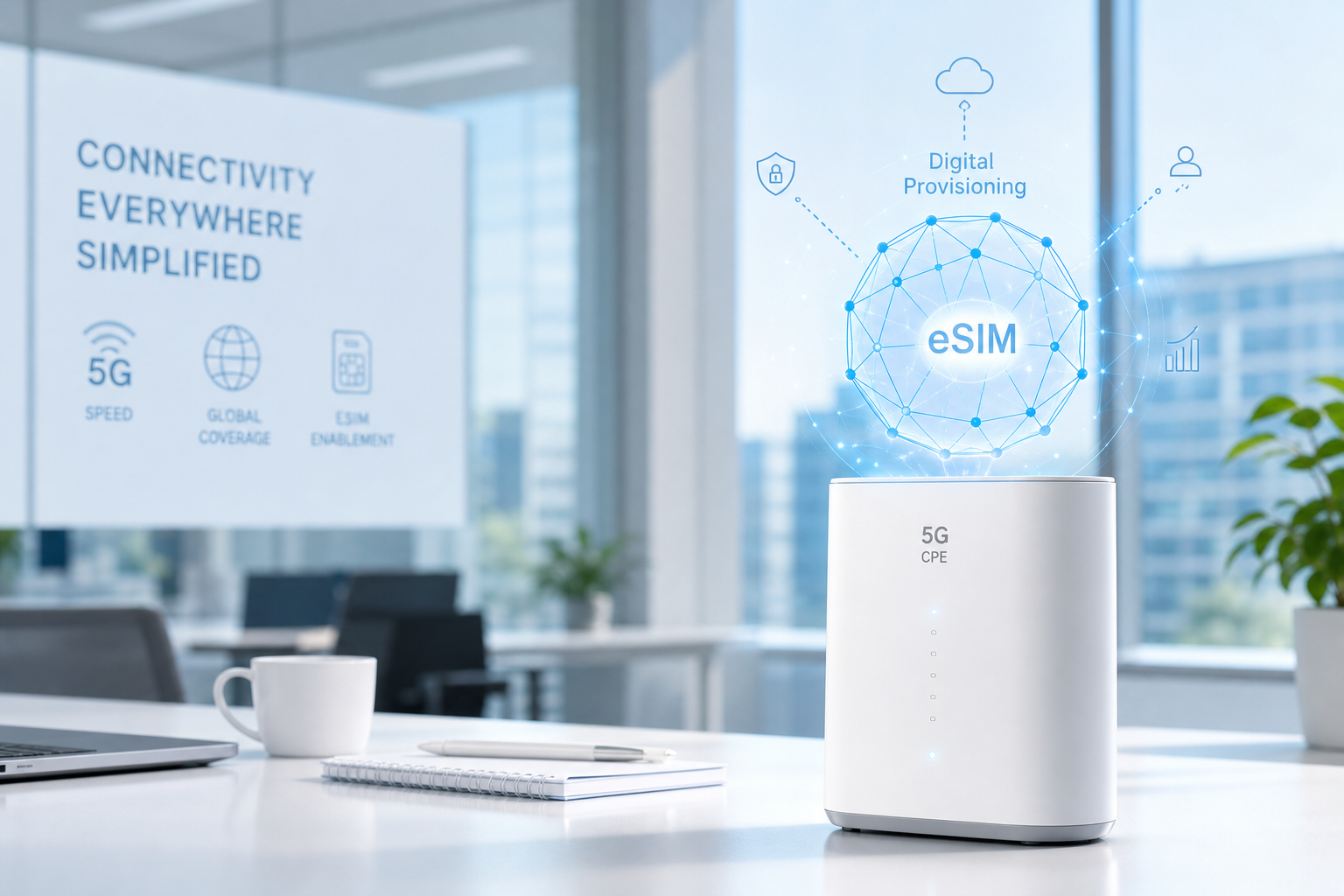
Global 5G CPE eSIM and iSIM Integration Accelerates as B2B Operators Streamline Cross-Border Deployment Logistics
The global telecom equipment supply chain is undergoing a quiet but profound transformation. At the center of this shift is the transition from traditional physical SIM cards to embedded SIM (eSIM) and integrated SIM (iSIM) technologies in 5G Customer Premises Equipment (CPE) — and the implications for B2B operators, OEMs, and enterprise buyers are far-reaching.
The Logistics Problem Physical SIMs Created
For decades, deploying CPE across multiple countries meant managing a fragmented SIM logistics chain. Operators had to forecast demand by region, procure carrier-specific SIM cards, physically insert them during manufacturing or at regional warehouses, and handle re-keying for carrier changes. Each step added cost, delay, and operational friction.
Consider a typical multi-country FWA rollout: a European operator expanding into five new markets would need five separate SIM SKUs, five inventory pools, and five provisioning workflows. A last-minute carrier partnership change could render thousands of pre-provisioned devices obsolete, requiring costly rework.
The GSMA-compliant eSIM (eUICC) architecture changes this equation fundamentally. With eSIM-capable 5G CPE, the carrier profile is loaded remotely via RSP (Remote SIM Provisioning) after the device has already left the factory and arrived in the target market.
This decoupling of hardware manufacturing from carrier provisioning delivers three immediate B2B advantages:
Unified SKU strategy: A single CPE hardware variant can serve dozens of markets. Regional customization happens entirely in software, not on the assembly line.
Last-mile flexibility: Operators and enterprises can switch carrier profiles over-the-air without dispatching technicians or replacing devices. A CPE deployed for Carrier A today can be reprovisioned for Carrier B tomorrow — critical for managed service providers and multinational enterprises.
Accelerated time-to-market: Regional launches that previously required 8–12 weeks of SIM logistics lead time can now be completed in days. eSIM eliminates the longest pole in the deployment timeline.
iSIM: The Next Frontier in CPE Miniaturization and Security
While eSIM embeds a discrete eUICC chip on the device PCB, iSIM (integrated SIM) goes further by integrating SIM functionality directly into the device’s system-on-chip (SoC) or cellular module. Qualcomm’s Snapdragon X-series modems and Sony’s Altair platform already support iSIM architectures.
For 5G CPE, iSIM offers three compelling benefits:
Hardware consolidation: Eliminating the discrete SIM chip reduces BOM cost, PCB real estate, and power consumption — factors that matter enormously in compact industrial CPE and battery-optimized mobile hotspot designs.
Enhanced physical security: iSIM credentials reside in a tamper-resistant enclave within the SoC, making physical SIM-swapping attacks nearly impossible. For enterprise and government deployments requiring hardware-grade security, this is a decisive advantage.
Scalable IoT integration: As 5G CPE increasingly serves as an IoT aggregation gateway (connecting sensors, cameras, and industrial controllers), iSIM simplifies identity management for the entire device ecosystem behind the gateway.
Real-World Deployment Momentum
Several major operators have already begun eSIM-first procurement mandates for 5G FWA CPE. Deutsche Telekom’s latest FWA tender specifies eSIM as a baseline requirement. In North America, T-Mobile and Verizon are expanding eSIM provisioning infrastructure to support fixed wireless at scale. Meanwhile, Japan’s Rakuten Mobile has demonstrated fully virtualized iSIM provisioning integrated with its cloud-native 5G core.
On the manufacturing side, leading CPE ODMs — including Honlly Telecom — now offer eSIM and iSIM-ready platforms across their 5G product lines. These platforms support GSMA SGP.02 (M2M) and SGP.22 (Consumer) provisioning architectures, giving B2B buyers the flexibility to choose the provisioning model that fits their operational framework.
What B2B Buyers Should Evaluate
For procurement teams evaluating eSIM/iSIM-capable 5G CPE, the following criteria are essential:
GSMA compliance level: Verify SGP.02 and/or SGP.22 certification for the target provisioning architecture. Full compliance ensures interoperability with major SM-DP+ (Subscription Manager Data Preparation) platforms including IDEMIA, G+D, and Thales.
Carrier certification coverage: eSIM capability alone does not guarantee carrier certification. Ensure the CPE vendor has completed GCF/PTCRB certification and carrier-specific interoperability testing for target deployment markets.
Profile management tooling: Evaluate whether the vendor provides or integrates with an SM-DP+ platform that offers bulk provisioning APIs, profile lifecycle management, and over-the-air profile switching capabilities.
Fallback mechanisms: In markets where eSIM infrastructure is still maturing, hybrid SIM slots (eSIM + physical SIM tray) provide a practical bridge, allowing operators to transition at their own pace.
The Strategic Outlook
The eSIM/iSIM transition in 5G CPE mirrors the broader telecom industry’s move toward software-defined, cloud-managed infrastructure. By decoupling hardware from carrier identity, operators gain unprecedented deployment agility while reducing supply chain complexity. For B2B buyers sourcing 5G CPE at scale, eSIM/iSIM readiness is no longer a future consideration — it is rapidly becoming a baseline procurement requirement that separates forward-looking vendors from legacy suppliers.
As global 5G FWA deployments continue their rapid expansion, the ability to provision, reprovision, and manage CPE identity remotely will increasingly determine which operators capture market share fastest — and which CPE vendors earn their long-term business.