
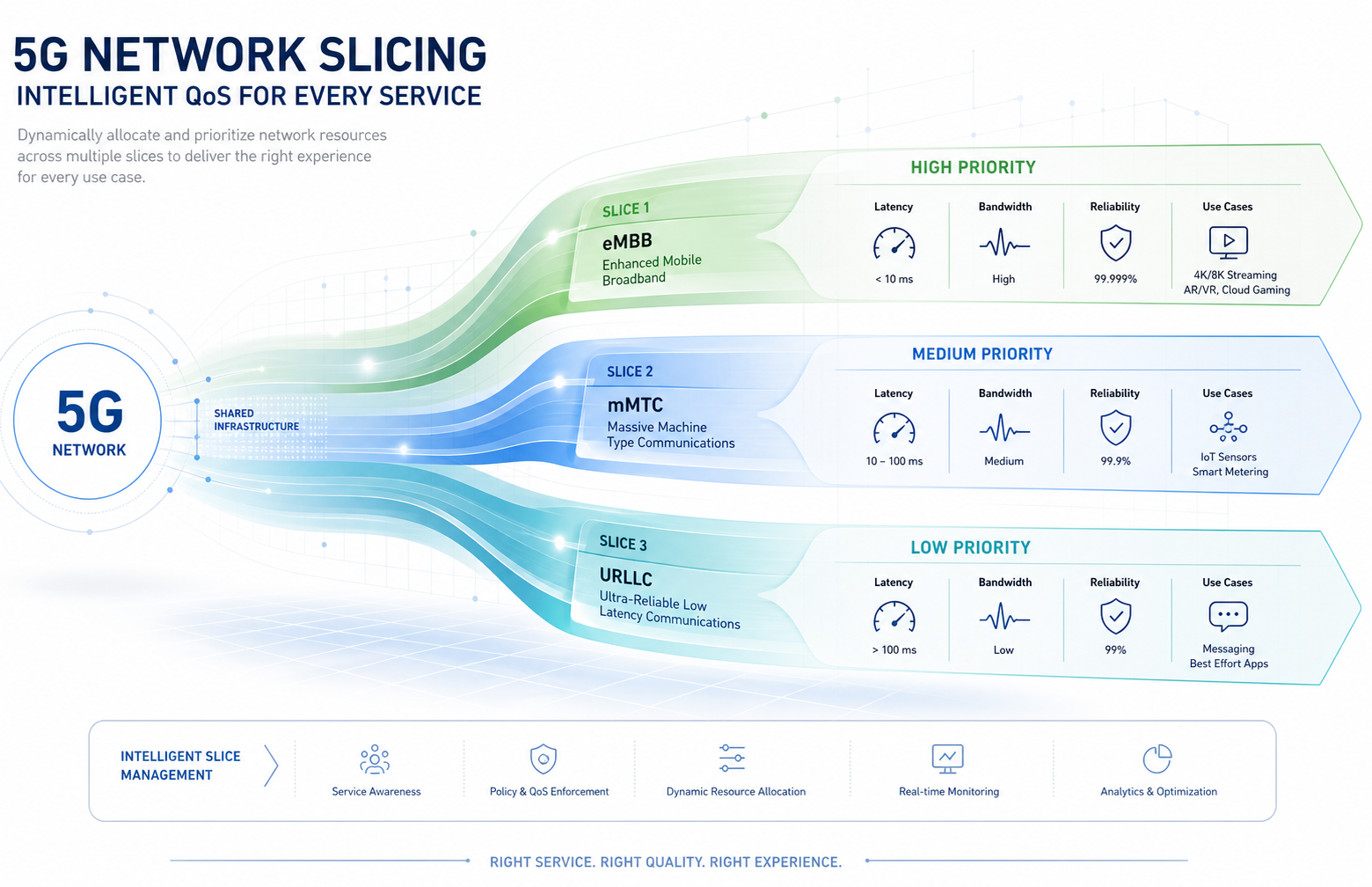
Network slicing is one of the defining architectural features of 5G Standalone (SA), enabling operators to deliver multiple virtualized networks over a shared physical infrastructure — each with its own performance characteristics, security policies, and service guarantees. For CPE buyers, understanding how network slicing is implemented at the subscriber endpoint is essential to making informed procurement decisions. This guide examines the QoS framework, slice identification, and CPE-level architecture that operators need to evaluate when selecting 5G CPE for multi-service deployments.
The 5G QoS Model: Beyond 4G Bearer Architecture
5G introduces a fundamentally more flexible QoS framework than 4G LTE. The 5G QoS Identifier (5QI) replaces the QCI model with finer granularity and standardized packet delay budgets across 33 defined 5QI values (versus 9 QCIs in LTE). Key 5QI characteristics that CPE must handle include:
- GBR (Guaranteed Bit Rate) QoS Flows for services requiring committed throughput, such as enterprise VPN tunnels, real-time video conferencing, and industrial control traffic
- Non-GBR QoS Flows with standardized priority levels, suitable for general internet access and best-effort enterprise traffic
- Delay-Critical GBR (5QI 82-85) for ultra-reliable low-latency applications requiring sub-5ms packet delay budgets
- Reflective QoS — where the CPE derives uplink QoS rules from downlink packet markings, reducing signaling overhead for dynamic traffic patterns
A properly designed 5G CPE must maintain independent QoS flow state for multiple concurrent PDU sessions, each potentially carrying multiple QoS flows with different 5QI profiles. This is a non-trivial requirement that separates enterprise-grade CPE from consumer-grade devices.
Network Slice Identification: NSSAI and S-NSSAI
Network slicing in 5G is identified through the Single Network Slice Selection Assistance Information (S-NSSAI), composed of a Slice/Service Type (SST) and an optional Slice Differentiator (SD). Standardized SST values include eMBB (SST=1), URLLC (SST=2), and MIoT (SST=3), with operator-defined values available for custom slice types.
The CPE receives a Configured NSSAI from the core network during registration, which defines the slices the device is authorized to access. Critically, the CPE must then be capable of establishing separate PDU sessions on different slices simultaneously — a capability known as multi-slice support. For enterprise CPE deployments, this means one device might concurrently maintain:
- A URLLC slice PDU session for factory automation traffic (SST=2, latency <5ms)
- An eMBB slice PDU session for office internet access (SST=1, high throughput)
- A custom MIoT slice for sensor aggregation (SST=3, low power, massive connectivity)
URSP: The Traffic-to-Slice Routing Engine
The UE Route Selection Policy (URSP) is the mechanism by which the 5G core instructs the CPE on how to route application traffic to specific network slices. URSP rules consist of traffic descriptors (IP tuples, FQDN, DNN, application IDs) mapped to route selection descriptors (S-NSSAI, DNN, SSC mode).
For enterprise buyers, URSP support in CPE translates to a practical capability: the ability to enforce slice-based traffic steering without per-application configuration on end-user devices behind the CPE. A well-implemented CPE can, for example, automatically route all traffic destined for a manufacturing execution system to the URLLC slice while directing office productivity traffic to the eMBB slice — transparently to the LAN devices.
Multi-Slice CPE Architecture: VLAN-to-Slice Mapping
Enterprise-grade 5G CPE typically implements slice-to-VLAN mapping as the bridge between the 5G WAN and the local area network. Each PDU session (one per slice) is mapped to a distinct VLAN on the CPE’s LAN ports, allowing downstream switches and routers to segregate traffic by slice without 5G awareness.
A reference multi-slice CPE architecture includes:
- Multi-PDU Session Engine — supporting 4-8 concurrent PDU sessions with independent IP stacks per session
- URSP Client — processing URSP rules from the 5G core and maintaining a local traffic-to-slice routing table
- VLAN Translation Layer — mapping each PDU session to a configurable 802.1Q VLAN tag on the LAN side
- Per-Slice QoS Enforcement — maintaining independent QoS flow state per PDU session with hardware-accelerated packet scheduling
Performance and Isolation Guarantees
A critical procurement consideration is the degree of resource isolation between slices at the CPE level. While the 5G core guarantees slice isolation within the network, the CPE itself must not become a bottleneck through shared buffer contention, CPU oversubscription, or inadequate packet scheduling. Buyers should verify:
- Per-slice throughput floors that are maintained regardless of traffic load on other slices
- Hardware queue separation — dedicated hardware queues per slice rather than software-based prioritization
- Slice-specific latency budgets measured end-to-end from LAN ingress to 5G air interface
- Fail-open behavior — documented behavior when a slice becomes unavailable (traffic fallback policies)
Buyer’s Verification Checklist
When evaluating 5G CPE for multi-slice deployment, procurement teams should request:
- Documented multi-PDU session support with a minimum of 4 concurrent sessions
- URSP rule capacity (minimum 8 traffic descriptor + route selection descriptor pairs)
- VLAN-to-slice mapping configuration interface (GUI and TR-069/TR-369 manageable)
- Per-slice throughput and latency test reports under simultaneous multi-slice load
- Interoperability test results with the operator’s specific 5G SA core vendor (Ericsson, Nokia, Huawei, Samsung, Mavenir)
- Software upgrade path for 3GPP Release 17/18 slice enhancements including slice-level authentication and authorization (NSSAA)
Conclusion: Slice-Aware CPE as a Competitive Requirement
As 5G SA networks mature through 2026, network slicing is transitioning from a standards capability to a commercial service differentiator. Operators launching enterprise slicing services need CPE that translates core-network slice intelligence into practical LAN-side traffic management. CPE without robust multi-slice support, URSP processing, and per-slice QoS enforcement will increasingly limit an operator’s ability to monetize their 5G SA investment. For procurement teams, slice-aware CPE is not a future consideration — it is a present requirement for any 5G SA deployment targeting enterprise, industrial, or multi-service consumer markets.