
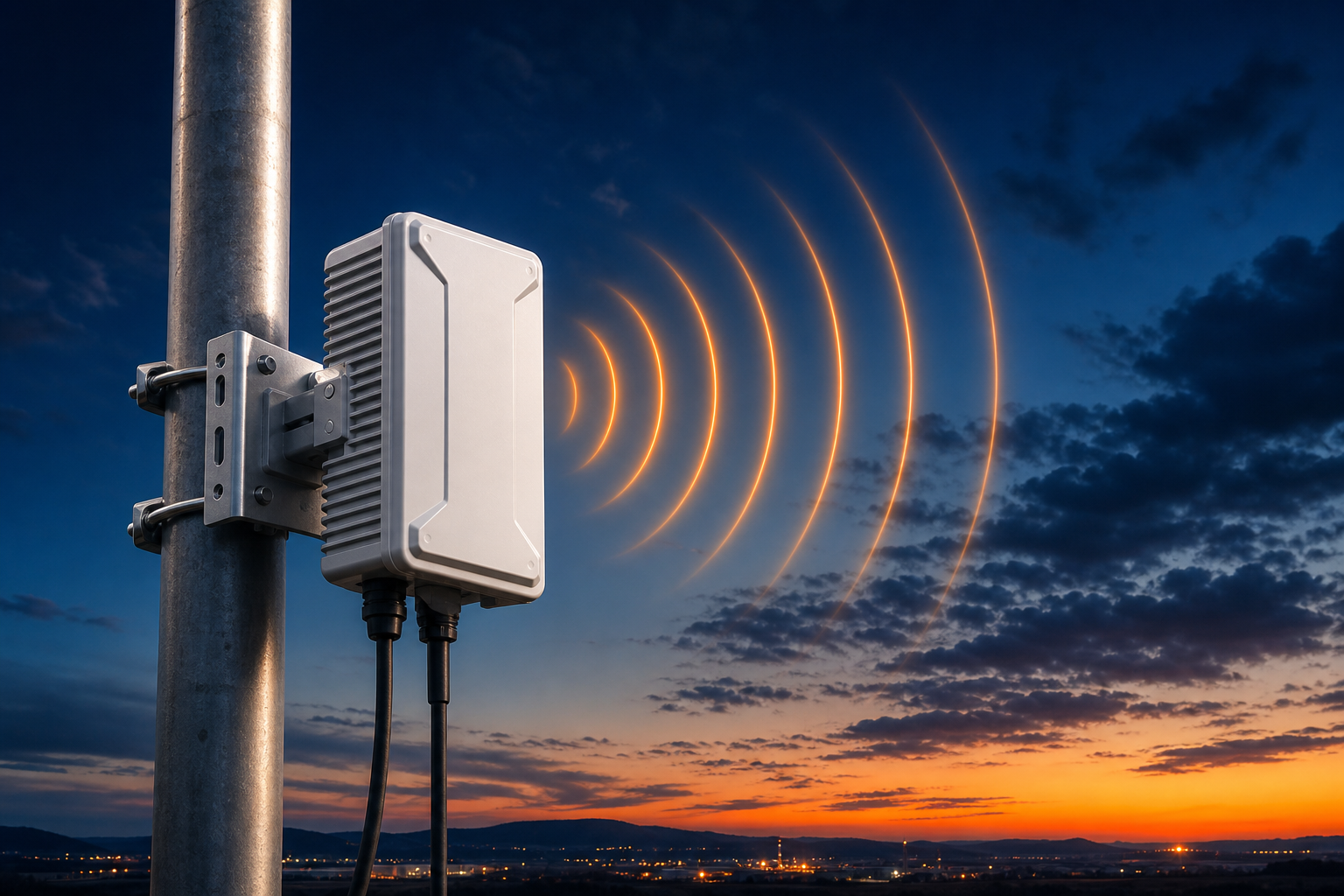
Choosing the right outdoor 4G or 5G CPE router is a fundamentally different exercise from selecting indoor equipment. Outdoor units face weather extremes, distance-to-tower challenges, and installation complexity that indoor CPE simply doesn’t encounter. Whether you’re an ISP deploying rural FWA, an enterprise connecting a remote site, or an industrial operator monitoring distributed assets, the five criteria below will help you select outdoor CPE that performs reliably through years of field operation.
1. IP Rating: The Non-Negotiable Baseline
The Ingress Protection (IP) rating is the first filter for any outdoor CPE. Two ratings dominate the market:
| Rating | Dust Protection | Water Protection | Best For |
|---|---|---|---|
| IP65 | Dust-tight (6) | Water jets (5) | Temperate climates, under-eave mounting |
| IP67 | Dust-tight (6) | Immersion up to 1m (7) | Tropical, coastal, and flood-prone areas |
For most deployments, IP67 is the recommended minimum. Coastal installations should also verify salt spray corrosion resistance (IEC 60068-2-52) and UV-stabilized enclosures that won’t degrade under constant sun exposure.
2. Antenna Design: Integrated vs. External
Antenna configuration directly determines the CPE’s effective range and throughput. The choice depends on deployment conditions:
- Integrated high-gain antennas (8–12 dBi): Simpler installation, lower cost, suitable for suburban and near-rural deployments where the tower is within 5 km.
- External antenna ports (SMA/TS-9 connectors): Essential for rural and fringe-coverage deployments. Allows operators to attach directional panel or parabolic antennas (15–20 dBi) for connections up to 15 km from the tower.
- 4×4 MIMO support: Non-negotiable for 5G outdoor CPE. Doubles spectral efficiency and significantly improves performance at cell edges.
Tip: Always check if the CPE supports external antenna auto-detection. Some devices require manual firmware configuration when switching from integrated to external antennas—a major source of unnecessary truck rolls.
3. Power Options: PoE, DC, and Battery Backup
Outdoor CPE power flexibility can make or break a deployment:
- Power over Ethernet (PoE 802.3af/at): The standard for outdoor CPE. A single Ethernet cable carries both data and power up to 100 meters. Look for PoE++ (802.3bt) support for higher-power 5G units.
- DC input (12V/24V): Useful for solar-powered installations and industrial sites with existing DC infrastructure.
- Battery backup / Mini UPS: Critical for areas with unstable grid power. Some outdoor CPE like the Honlly HL-4000AR integrate a 48W Mini UPS for uninterrupted operation during outages.
4. Operating Temperature and Environmental Hardening
Outdoor CPE must operate reliably across extreme temperature ranges. Minimum specifications to demand:
- Operating temperature: -30°C to +60°C (industrial grade). Consumer-grade devices rated 0–40°C will fail in summer heat or winter cold.
- Humidity: 5%–95% non-condensing.
- Wind resistance: Enclosure and mounting bracket rated for wind speeds up to 200 km/h for pole-mounted installations.
- Lightning/surge protection: Built-in surge protection on both Ethernet and power inputs (IEC 61000-4-5).
5. Installation and Mounting Flexibility
The physical installation process is where outdoor CPE TCO is won or lost. Prioritize devices that include:
- Quick-mount pole and wall brackets — stainless steel hardware included, not sold separately.
- Tool-less SIM access — weather-sealed SIM compartment accessible without dismounting the unit.
- LED signal strength indicators — visible from ground level for installers to align antennas without a laptop.
- Single-person installation design — units under 3 kg with integrated mounting arms reduce install time by 40–60%.
Recommended Outdoor CPE by Deployment Type
| Deployment Type | Recommended Model | Key Features |
|---|---|---|
| Rural FWA (5G) | HL-880U 5G Outdoor CPE | IP67, 4×4 MIMO, PoE, external antenna ports |
| Budget CAT6 Outdoor | HL-4000AR CAT6 CPE | IP65, Mini UPS backup, African market optimized |
| Industrial / Enterprise | HL-850M 5G Outdoor | IP67, -30~60°C, dual SIM, industrial protocol support |
Frequently Asked Questions
Q: What IP rating for outdoor CPE?
IP67 minimum recommended. IP65 for sheltered installations. Verify salt spray resistance for coastal sites.
Q: How far can outdoor 5G CPE reach?
3–8 km with integrated antennas; 10–15 km with external directional antennas. Depends on frequency band and terrain.
Q: Can outdoor CPE be PoE-powered?
Yes. Most support PoE (802.3af) or PoE+ (802.3at). Higher-power 5G units may need PoE++ (802.3bt). Single cable up to 100m.
Q: Do I need external antennas?
Not for deployments within 5 km of the tower. Recommended for rural/fringe areas—adds 6–10 dB gain.
Q: What temperature range for outdoor CPE?
-30°C to +60°C for industrial-grade units. Consumer 0–40°C devices will fail in extreme conditions.
Compare Honlly indoor and outdoor 5G options
- HL-850UE 5G indoor router: indoor desktop connectivity with WiFi 6 AX1800.
- HL-6300R 5G outdoor CPE kit: an outdoor receiving unit paired with an indoor WiFi 6 router.
Review the linked model specifications and discuss the required network configuration before selection. These examples do not establish operator approval, mmWave support or guaranteed site performance.