Tag: Rural Broadband

  • ISPs and MVNOs Accelerate 5G FWA CPE Deployments to Bridge Global Broadband Gap in 2026

    ISPs and MVNOs Accelerate 5G FWA CPE Deployments to Bridge Global Broadband Gap in 2026

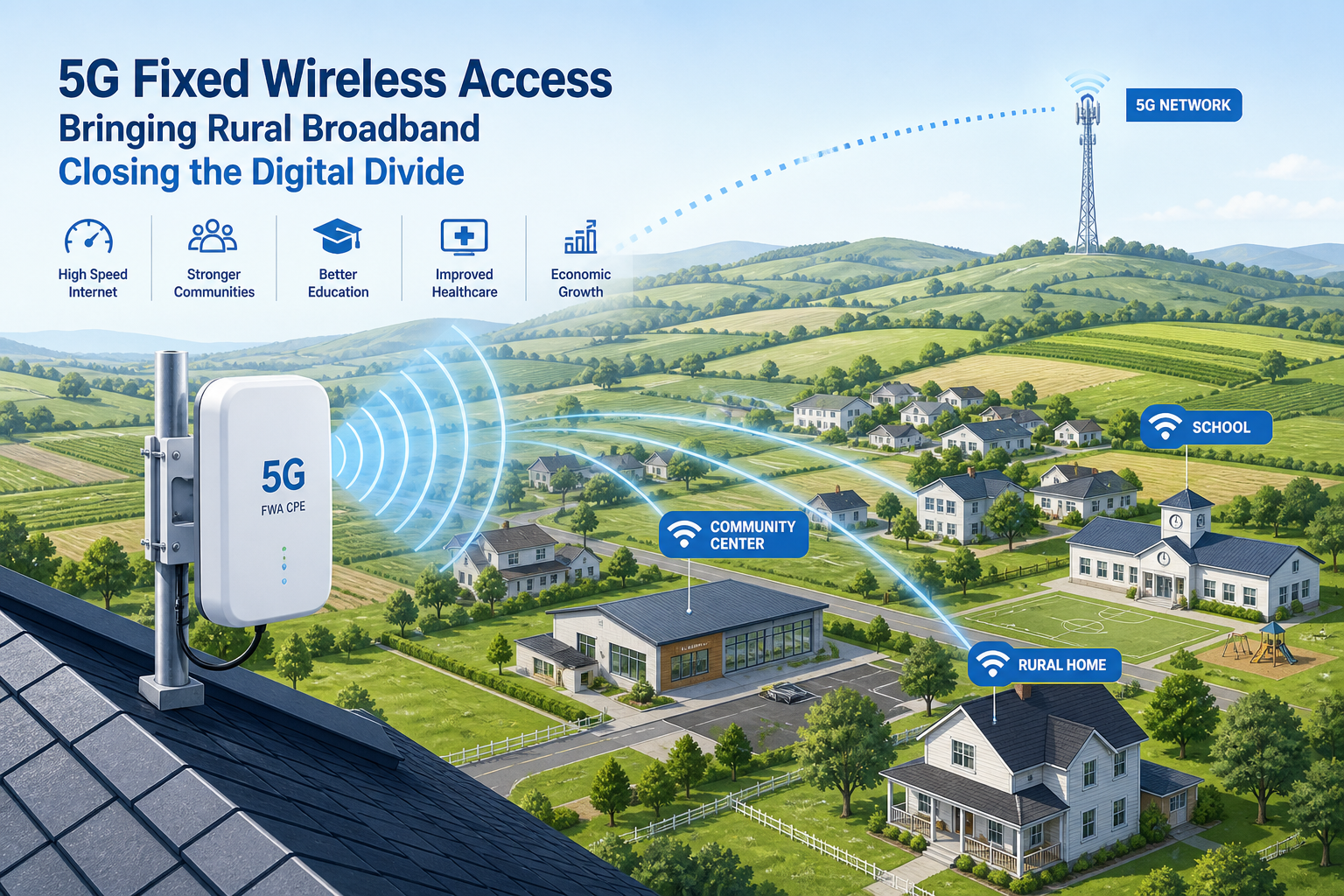
    The global fixed wireless access (FWA) market is entering a new phase of growth in 2026, driven by a confluence of factors: 5G-Advanced network rollouts, increasing MVNO participation in broadband markets, and government-funded rural connectivity programs across Asia, Africa, and Latin America. Industry analysts tracking CPE procurement patterns report a 35% year-over-year increase in ISP and MVNO CPE orders in Q1 2026 compared to the same period in 2025.

    MVNOs Enter the Broadband Arena

    A defining trend of 2026 is the emergence of broadband-only MVNOs—virtual operators that lease spectrum access from MNOs and compete directly on fixed wireless broadband services. Unlike traditional MVNOs focused on mobile voice and data, these new entrants are deploying their own CPE fleets and managing the subscriber experience end-to-end.

    In markets like India, Nigeria, and Brazil, broadband MVNOs are targeting the 40–60% of households that fall outside fiber coverage areas. By combining wholesale spectrum agreements with cost-optimized 5G CPE sourced directly from ODM manufacturers, these operators are achieving subscriber acquisition costs 40–50% below traditional MNO FWA deployments.

    Government Programs Fuel Rural Deployment

    National broadband initiatives are accelerating CPE demand across emerging markets:

    • India’s BharatNet Phase 3: Targeting 600,000 villages with broadband by 2027, creating demand for an estimated 8–12 million FWA CPE units. The program explicitly includes 5G FWA as an approved last-mile technology.
    • Nigeria’s National Broadband Plan 2.0: 70% broadband penetration target by 2028, with 5G FWA identified as the primary technology for connecting underserved states in the north and middle belt.
    • Brazil’s Norte Conectado: Submarine cable + 5G FWA combination to connect Amazon basin communities, with CPE procurement tenders totaling an estimated 500,000 units through 2027.
    • African Union Digital Transformation Strategy: Universal broadband access by 2030, with 4G and 5G FWA as the primary last-mile technology for rural areas.

    CPE Supply Chain Shifts: Regional Hubs and Shorter Lead Times

    ISPs and MVNOs are demanding shorter CPE lead times—from 12–16 weeks in 2024 to 6–8 weeks in 2026. This is driving two structural changes in the CPE supply chain:

    1. Regional warehousing: Leading ODM manufacturers, including Honlly Telecom, are establishing regional distribution hubs in Dubai, Nairobi, and São Paulo to serve operators with 2-week delivery windows.
    2. Pre-configured CPE shipments: Instead of shipping generic units that require on-site provisioning, manufacturers now offer factory-pre-configured CPE with operator-specific firmware, APN settings, VLAN profiles, and branding—reducing deployment time by 60%.

    The Rise of Multi-Network CPE: Dual SIM and eSIM Integration

    Another significant trend is the growing demand for multi-network CPE that supports two or more operator profiles simultaneously. This is particularly important for:

    • MVNOs with multi-MNO wholesale agreements: CPE that can intelligently switch between partner networks based on signal quality and cost.
    • Cross-border deployments: Operators serving border regions where subscribers move between countries.
    • Service continuity: Automatic failover to a secondary operator when the primary network experiences congestion or outage.

    Dual SIM CPE with embedded eSIM + physical SIM configurations is emerging as the preferred architecture, allowing operators to provision the primary profile over-the-air while maintaining a physical SIM slot for local or backup connectivity.

    Market Forecast: 2026–2028

    YearGlobal FWA CPE ShipmentsKey Driver
    2025355 million units5G FWA mainstream adoption
    2026480 million units (est.)MVNO expansion + government programs
    2027620 million units (forecast)5G-Advanced CPE + 6 GHz band availability
    2028780 million units (forecast)Satellite-terrestrial integration + 6G early trials

    Source: Industry analyst consensus, GSMA Mobile Economy 2026, operator procurement data.

    What This Means for CPE Procurement Strategy

    For ISPs and MVNOs planning CPE procurement in H2 2026 and 2027, three actions are critical:

    1. Lock in ODM partnerships now. Lead times are compressing but demand is rising. Operators who establish direct manufacturer relationships in Q2–Q3 2026 will secure priority allocation for H2 shipments.
    2. Specify multi-network capability. Dual SIM with eSIM support should be a baseline requirement in all new CPE RFQs, even if multi-operator agreements are not yet finalized.
    3. Demand factory pre-configuration. The cost of on-site CPE provisioning—in both time and truck rolls—can exceed the unit cost of the device itself. Factory-pre-configured CPE is no longer a premium service; it is the baseline expectation for competitive operators.

    Honlly Telecom is actively supporting ISP and MVNO partners with customized 5G FWA CPE solutions. Contact our team to discuss your 2026–2027 deployment requirements.

    Frequently Asked Questions

    Q1: Why are ISPs and MVNOs accelerating 5G FWA deployments in 2026?

    ISPs and MVNOs accelerate 5G FWA to: (1) bridge the digital divide in underserved areas without costly fiber builds, (2) compete with incumbent broadband providers using 5G as a wireline alternative, (3) capture enterprise and SMB markets, and (4) achieve faster time-to-revenue than fiber.

    Q2: How big is the global broadband gap that 5G FWA can address?

    Approximately 2.7 billion people—roughly one-third of the global population—remain offline. 5G FWA can cost-effectively connect 40–60% of these unconnected households, particularly in emerging markets across Africa, Southeast Asia, and Latin America.

    Q3: What CPE specifications do ISPs prioritize for large-scale FWA rollouts?

    ISPs prioritize: zero-touch provisioning (ZTP), TR-369/USP remote management, Wi-Fi 7 with mesh support, external antenna ports for rural coverage, sub-$100 price points for mass deployment, and multi-carrier certification to ensure network flexibility.

  • Outdoor 4G/5G CPE Router Selection Guide 2026: IP Ratings, Antennas, and Power Options

    Outdoor 4G/5G CPE Router Selection Guide 2026: IP Ratings, Antennas, and Power Options

    Choosing the right outdoor 4G or 5G CPE router is a fundamentally different exercise from selecting indoor equipment. Outdoor units face weather extremes, distance-to-tower challenges, and installation complexity that indoor CPE simply doesn’t encounter. Whether you’re an ISP deploying rural FWA, an enterprise connecting a remote site, or an industrial operator monitoring distributed assets, the five criteria below will help you select outdoor CPE that performs reliably through years of field operation.

    1. IP Rating: The Non-Negotiable Baseline

    The Ingress Protection (IP) rating is the first filter for any outdoor CPE. Two ratings dominate the market:

    RatingDust ProtectionWater ProtectionBest For
    IP65Dust-tight (6)Water jets (5)Temperate climates, under-eave mounting
    IP67Dust-tight (6)Immersion up to 1m (7)Tropical, coastal, and flood-prone areas

    For most deployments, IP67 is the recommended minimum. Coastal installations should also verify salt spray corrosion resistance (IEC 60068-2-52) and UV-stabilized enclosures that won’t degrade under constant sun exposure.

    2. Antenna Design: Integrated vs. External

    Antenna configuration directly determines the CPE’s effective range and throughput. The choice depends on deployment conditions:

    • Integrated high-gain antennas (8–12 dBi): Simpler installation, lower cost, suitable for suburban and near-rural deployments where the tower is within 5 km.
    • External antenna ports (SMA/TS-9 connectors): Essential for rural and fringe-coverage deployments. Allows operators to attach directional panel or parabolic antennas (15–20 dBi) for connections up to 15 km from the tower.
    • 4×4 MIMO support: Non-negotiable for 5G outdoor CPE. Doubles spectral efficiency and significantly improves performance at cell edges.

    Tip: Always check if the CPE supports external antenna auto-detection. Some devices require manual firmware configuration when switching from integrated to external antennas—a major source of unnecessary truck rolls.

    3. Power Options: PoE, DC, and Battery Backup

    Outdoor CPE power flexibility can make or break a deployment:

    • Power over Ethernet (PoE 802.3af/at): The standard for outdoor CPE. A single Ethernet cable carries both data and power up to 100 meters. Look for PoE++ (802.3bt) support for higher-power 5G units.
    • DC input (12V/24V): Useful for solar-powered installations and industrial sites with existing DC infrastructure.
    • Battery backup / Mini UPS: Critical for areas with unstable grid power. Some outdoor CPE like the Honlly HL-4000AR integrate a 48W Mini UPS for uninterrupted operation during outages.

    4. Operating Temperature and Environmental Hardening

    Outdoor CPE must operate reliably across extreme temperature ranges. Minimum specifications to demand:

    • Operating temperature: -30°C to +60°C (industrial grade). Consumer-grade devices rated 0–40°C will fail in summer heat or winter cold.
    • Humidity: 5%–95% non-condensing.
    • Wind resistance: Enclosure and mounting bracket rated for wind speeds up to 200 km/h for pole-mounted installations.
    • Lightning/surge protection: Built-in surge protection on both Ethernet and power inputs (IEC 61000-4-5).

    5. Installation and Mounting Flexibility

    The physical installation process is where outdoor CPE TCO is won or lost. Prioritize devices that include:

    • Quick-mount pole and wall brackets — stainless steel hardware included, not sold separately.
    • Tool-less SIM access — weather-sealed SIM compartment accessible without dismounting the unit.
    • LED signal strength indicators — visible from ground level for installers to align antennas without a laptop.
    • Single-person installation design — units under 3 kg with integrated mounting arms reduce install time by 40–60%.

    Recommended Outdoor CPE by Deployment Type

    Deployment TypeRecommended ModelKey Features
    Rural FWA (5G)HL-880U 5G Outdoor CPEIP67, 4×4 MIMO, PoE, external antenna ports
    Budget CAT6 OutdoorHL-4000AR CAT6 CPEIP65, Mini UPS backup, African market optimized
    Industrial / EnterpriseHL-850M 5G OutdoorIP67, -30~60°C, dual SIM, industrial protocol support

    Frequently Asked Questions

    Q: What IP rating for outdoor CPE?
    IP67 minimum recommended. IP65 for sheltered installations. Verify salt spray resistance for coastal sites.

    Q: How far can outdoor 5G CPE reach?
    3–8 km with integrated antennas; 10–15 km with external directional antennas. Depends on frequency band and terrain.

    Q: Can outdoor CPE be PoE-powered?
    Yes. Most support PoE (802.3af) or PoE+ (802.3at). Higher-power 5G units may need PoE++ (802.3bt). Single cable up to 100m.

    Q: Do I need external antennas?
    Not for deployments within 5 km of the tower. Recommended for rural/fringe areas—adds 6–10 dB gain.

    Q: What temperature range for outdoor CPE?
    -30°C to +60°C for industrial-grade units. Consumer 0–40°C devices will fail in extreme conditions.