Tag: FWA

  • Outdoor 4G/5G CPE Router Selection Guide 2026: IP Ratings, Antennas, and Power Options

    Outdoor 4G/5G CPE Router Selection Guide 2026: IP Ratings, Antennas, and Power Options

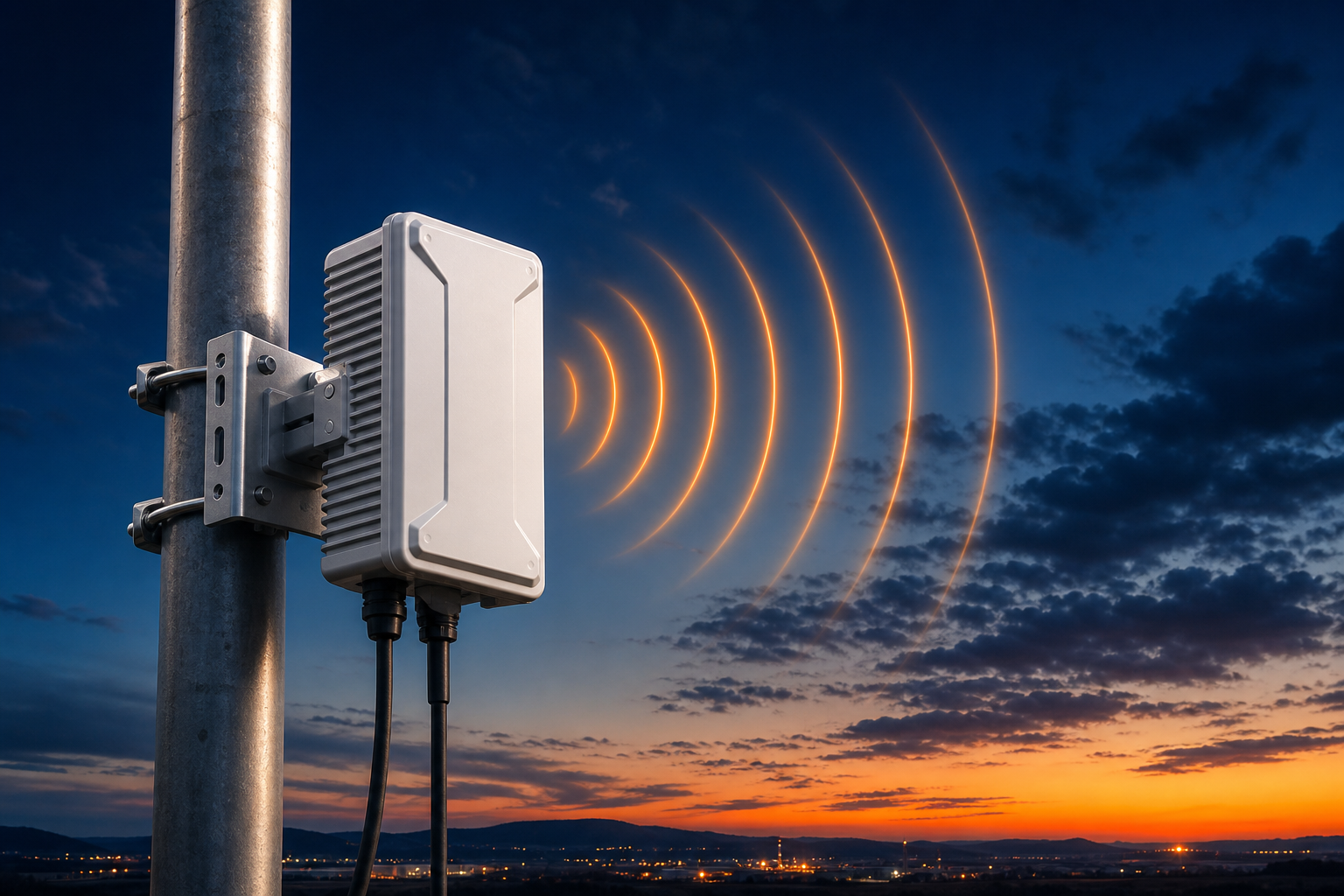
    Choosing the right outdoor 4G or 5G CPE router is a fundamentally different exercise from selecting indoor equipment. Outdoor units face weather extremes, distance-to-tower challenges, and installation complexity that indoor CPE simply doesn’t encounter. Whether you’re an ISP deploying rural FWA, an enterprise connecting a remote site, or an industrial operator monitoring distributed assets, the five criteria below will help you select outdoor CPE that performs reliably through years of field operation.

    1. IP Rating: The Non-Negotiable Baseline

    The Ingress Protection (IP) rating is the first filter for any outdoor CPE. Two ratings dominate the market:

    RatingDust ProtectionWater ProtectionBest For
    IP65Dust-tight (6)Water jets (5)Temperate climates, under-eave mounting
    IP67Dust-tight (6)Immersion up to 1m (7)Tropical, coastal, and flood-prone areas

    For most deployments, IP67 is the recommended minimum. Coastal installations should also verify salt spray corrosion resistance (IEC 60068-2-52) and UV-stabilized enclosures that won’t degrade under constant sun exposure.

    2. Antenna Design: Integrated vs. External

    Antenna configuration directly determines the CPE’s effective range and throughput. The choice depends on deployment conditions:

    • Integrated high-gain antennas (8–12 dBi): Simpler installation, lower cost, suitable for suburban and near-rural deployments where the tower is within 5 km.
    • External antenna ports (SMA/TS-9 connectors): Essential for rural and fringe-coverage deployments. Allows operators to attach directional panel or parabolic antennas (15–20 dBi) for connections up to 15 km from the tower.
    • 4×4 MIMO support: Non-negotiable for 5G outdoor CPE. Doubles spectral efficiency and significantly improves performance at cell edges.

    Tip: Always check if the CPE supports external antenna auto-detection. Some devices require manual firmware configuration when switching from integrated to external antennas—a major source of unnecessary truck rolls.

    3. Power Options: PoE, DC, and Battery Backup

    Outdoor CPE power flexibility can make or break a deployment:

    • Power over Ethernet (PoE 802.3af/at): The standard for outdoor CPE. A single Ethernet cable carries both data and power up to 100 meters. Look for PoE++ (802.3bt) support for higher-power 5G units.
    • DC input (12V/24V): Useful for solar-powered installations and industrial sites with existing DC infrastructure.
    • Battery backup / Mini UPS: Critical for areas with unstable grid power. Some outdoor CPE like the Honlly HL-4000AR integrate a 48W Mini UPS for uninterrupted operation during outages.

    4. Operating Temperature and Environmental Hardening

    Outdoor CPE must operate reliably across extreme temperature ranges. Minimum specifications to demand:

    • Operating temperature: -30°C to +60°C (industrial grade). Consumer-grade devices rated 0–40°C will fail in summer heat or winter cold.
    • Humidity: 5%–95% non-condensing.
    • Wind resistance: Enclosure and mounting bracket rated for wind speeds up to 200 km/h for pole-mounted installations.
    • Lightning/surge protection: Built-in surge protection on both Ethernet and power inputs (IEC 61000-4-5).

    5. Installation and Mounting Flexibility

    The physical installation process is where outdoor CPE TCO is won or lost. Prioritize devices that include:

    • Quick-mount pole and wall brackets — stainless steel hardware included, not sold separately.
    • Tool-less SIM access — weather-sealed SIM compartment accessible without dismounting the unit.
    • LED signal strength indicators — visible from ground level for installers to align antennas without a laptop.
    • Single-person installation design — units under 3 kg with integrated mounting arms reduce install time by 40–60%.

    Recommended Outdoor CPE by Deployment Type

    Deployment TypeRecommended ModelKey Features
    Rural FWA (5G)HL-880U 5G Outdoor CPEIP67, 4×4 MIMO, PoE, external antenna ports
    Budget CAT6 OutdoorHL-4000AR CAT6 CPEIP65, Mini UPS backup, African market optimized
    Industrial / EnterpriseHL-850M 5G OutdoorIP67, -30~60°C, dual SIM, industrial protocol support

    Frequently Asked Questions

    Q: What IP rating for outdoor CPE?
    IP67 minimum recommended. IP65 for sheltered installations. Verify salt spray resistance for coastal sites.

    Q: How far can outdoor 5G CPE reach?
    3–8 km with integrated antennas; 10–15 km with external directional antennas. Depends on frequency band and terrain.

    Q: Can outdoor CPE be PoE-powered?
    Yes. Most support PoE (802.3af) or PoE+ (802.3at). Higher-power 5G units may need PoE++ (802.3bt). Single cable up to 100m.

    Q: Do I need external antennas?
    Not for deployments within 5 km of the tower. Recommended for rural/fringe areas—adds 6–10 dB gain.

    Q: What temperature range for outdoor CPE?
    -30°C to +60°C for industrial-grade units. Consumer 0–40°C devices will fail in extreme conditions.

  • Best 5G CPE for ISPs in 2026: Procurement Guide for Multi-Tenant Broadband Deployments

    Best 5G CPE for ISPs in 2026: Procurement Guide for Multi-Tenant Broadband Deployments

    For ISPs building or expanding fixed wireless access (FWA) networks in 2026, the CPE (Customer Premises Equipment) selection process is the single most impactful procurement decision. The right device determines service quality, subscriber satisfaction, and operational margins. The wrong one leads to a cascade of truck rolls, churn, and margin erosion. This guide outlines the five critical evaluation criteria ISPs should apply when selecting 5G CPE for multi-tenant, residential, and small-business broadband deployments.

    1. Chipset Platform: The Foundation of CPE Performance

    The chipset inside a 5G CPE defines its carrier aggregation capability, power efficiency, and firmware upgrade path. In 2026, ISPs should prioritize devices built on:

    • Qualcomm X75/X80 series — supports up to 6CC carrier aggregation, Release 17/18 features, AI-enhanced beam management, and sub-6 GHz + mmWave operation.
    • MediaTek T830 — cost-effective 5G platform with 4CC CA, suitable for mid-tier FWA plans targeting 500 Mbps–1 Gbps throughput.

    Key evaluation questions: Does the chipset support the operator’s specific band combinations? Can Release 18 features be enabled via firmware, or do they require a hardware swap? What is the vendor’s roadmap for 3GPP Release 19 readiness?

    2. Multi-Tenant Capabilities: WiFi, VLAN, and QoS

    ISPs serving multi-dwelling units (MDUs), hotels, and student housing need CPE that goes beyond basic NAT routing. Essential features include:

    • WiFi 7 (802.11be) with Multi-Link Operation (MLO) — supports 50+ concurrent devices with deterministic latency, critical for MDU deployments.
    • VLAN tagging (802.1Q) — enables per-apartment traffic isolation without additional hardware.
    • Per-SSID bandwidth throttling — allows ISPs to offer tiered speed plans (100 Mbps / 500 Mbps / 1 Gbps) from a single CPE.
    • TR-369 USP (User Services Platform) — modern remote management protocol that replaces TR-069 for bulk provisioning, monitoring, and firmware upgrades.

    3. WAN Reliability: Dual SIM, Failover, and SD-WAN Integration

    ISP-grade CPE must maintain service continuity. Look for:

    • Dual SIM with automatic failover — essential for ISPs operating across multiple MNO partnerships or in regions with uneven coverage.
    • Ethernet WAN failover — allows CPE to fall back to DSL, cable, or fiber when 5G signal degrades.
    • Embedded SD-WAN capabilities — application-aware routing that prioritizes VoIP and video conferencing traffic over the lowest-latency WAN link.

    4. Total Cost of Ownership (TCO): Beyond the Unit Price

    ISPs should model TCO over a 3–5 year lifecycle, not just compare unit pricing. Key TCO drivers:

    Cost FactorImpactMitigation
    Power consumption$8–15/year per device at 10W idleSelect CPE with Release 18 deep-sleep modes
    Truck rolls$150–300 per visitTR-369 remote provisioning + AI beam management
    Firmware updatesEngineering time + bandwidthOTA with delta updates; multicast delivery for bulk
    Hardware refresh2–4 year cycleChipset with field-upgradable firmware path

    5. OEM/ODM Customization: Branding, Firmware, and Bands

    Leading ISPs increasingly demand customized CPE rather than off-the-shelf retail devices. When evaluating OEM/ODM partners like Honlly Telecom, confirm:

    • Custom branding — logo, packaging, web UI, and mobile app white-labeling.
    • Firmware customization — pre-configured APN, VLAN, QoS profiles, and operator-specific TR-069/TR-369 parameters.
    • Band customization — RF calibration for specific regional band combinations (e.g., n77+n78 for Asia-Pacific, n48 CBRS for North America).
    • Regulatory pre-certification — FCC, CE, GCF, and local regulatory compliance handled by the manufacturer.

    Recommended 5G CPE for ISP Deployments in 2026

    Based on the criteria above, here are the top CPE categories and recommended models from Honlly Telecom’s portfolio:

    • Indoor 5G CPE for residential ISPs: HL-830M 5G NR WiFi 6 CPE — ideal for single-family homes and small MDUs, supporting 5G NR with carrier aggregation.
    • High-performance indoor CPE for premium plans: HL-875H 5G Indoor Router — designed for gigabit-tier FWA plans with advanced WiFi and multi-gigabit Ethernet.
    • Outdoor CPE for rural FWA: HL-880U 5G Outdoor CPE — IP67-rated outdoor unit with high-gain antennas for extended range deployments.
    • Cost-effective CAT6 for entry-tier plans: HL-620 CAT6 Indoor CPE — LTE CAT6 with WiFi 5, ideal for budget broadband tiers in emerging markets.

    Frequently Asked Questions

    Q: What chipset should ISPs look for in 5G CPE in 2026?
    Prioritize Qualcomm X75/X80 or MediaTek T830. Verify band support and Release 18 upgrade path.

    Q: TR-069 vs TR-369 for CPE management?
    TR-369 USP is the modern standard with real-time telemetry and bulk provisioning—strongly recommended for 2026 deployments.

    Q: Indoor or outdoor CPE for FWA?
    Indoor for strong-signal urban areas; outdoor with high-gain antennas for rural and fringe-coverage deployments (6–10 dB better reception).

    Q: What WiFi standard for ISP CPE in 2026?
    WiFi 7 (802.11be) with MLO for premium tiers; WiFi 6 still viable for budget plans.

    Q: How to reduce CPE TCO?
    Energy-efficient chipsets, TR-369 remote management, OEM/ODM bulk customization, and firmware-upgradable hardware.

  • 5G-Advanced (3GPP Release 18): What It Means for CPE Manufacturers and Operators in 2026–2027

    5G-Advanced (3GPP Release 18): What It Means for CPE Manufacturers and Operators in 2026–2027

    The 3GPP Release 18 standard—branded as 5G-Advanced—marks the mid-point evolution of 5G before the 6G transition. For CPE manufacturers, ISPs, and telecom operators building FWA (Fixed Wireless Access) networks, Release 18 introduces a set of capabilities that directly affect how customer-premises equipment is designed, provisioned, and monetized through 2027 and beyond. Understanding these changes now is the difference between future-proof procurement and costly mid-cycle hardware swaps.

    What Is 3GPP Release 18 (5G-Advanced)?

    3GPP Release 18 was finalized in mid-2024 and is the first release officially designated as 5G-Advanced. It builds on the 5G NR foundation established in Releases 15–17, adding capabilities in four key areas: AI/ML-driven network optimization, enhanced MIMO and carrier aggregation, extended coverage for IoT and FWA, and energy efficiency improvements at both the network and device level.

    Unlike the jump from 4G to 5G, 5G-Advanced is an evolutionary upgrade. Existing 5G CPE hardware can benefit from many Release 18 features through firmware updates—but some capabilities require new chipset generations. Operators planning large-scale CPE deployments in 2026–2027 need to understand exactly where the hardware dependency line falls.

    Key Release 18 Features That Impact CPE Design

    1. AI/ML-Based Beam Management and Channel Estimation

    Release 18 introduces standardized frameworks for AI-assisted beam management at both the gNB (base station) and UE (user equipment) side. For CPE devices, this means:

    • Better mmWave and mid-band performance: AI models can predict optimal beam directions with fewer reference signals, reducing latency and improving throughput in challenging environments.
    • Reduced power consumption: By minimizing beam sweeping overhead, AI-based approaches can cut CPE power draw by an estimated 15–25% during active data sessions.
    • Hardware dependency: AI-accelerated beam management requires Release 18-compatible modem silicon (Qualcomm X80/X85, MediaTek T830-class). Existing Release 17 modems cannot fully exploit these features through firmware alone.

    2. Enhanced Carrier Aggregation (CA) up to 8CC

    Release 18 expands carrier aggregation from the Release 17 maximum to up to 8 component carriers across FR1 (sub-7 GHz) and FR2 (mmWave) bands simultaneously. For operators deploying FWA services, this unlocks:

    • Multi-gigabit fixed wireless: Theoretical peak throughput exceeding 10 Gbps with 8CC CA across mid-band spectrum (n77, n78, n79).
    • Spectrum aggregation flexibility: Operators can combine DSS (Dynamic Spectrum Sharing) LTE bands with NR carriers for smoother migration paths.
    • CPE antenna design implications: Supporting 8CC CA requires more sophisticated antenna arrays and RF front-end modules, increasing CPE BOM cost by an estimated $8–15 per unit.

    3. NR Multicast/Broadcast Services (MBS) Enhancements

    Release 18 improves 5G multicast-broadcast capabilities originally introduced in Release 17. For CPE-based deployments, this is relevant to:

    • IPTV and OTT video delivery: Operators can use multicast to efficiently deliver live TV and streaming content to CPE-connected homes without unicast data overhead.
    • Firmware OTA updates: Broadcast-mode delivery of CPE firmware updates across thousands of devices simultaneously, dramatically reducing backend server load.
    • Public safety and emergency alerts: Enhanced broadcast reliability for government-mandated alert systems delivered through CPE.

    4. Extended Reality (XR) and Low-Latency Optimizations

    Release 18 introduces XR-aware scheduling that identifies and prioritizes traffic patterns characteristic of augmented reality, virtual reality, and cloud gaming applications. For CPE devices serving enterprise and premium residential customers:

    • Sub-10ms latency for XR traffic: New QoS mechanisms identify XR flows and allocate resources with latency targets under 10ms end-to-end.
    • Jitter buffering improvements: CPE can now signal buffer status specific to XR application requirements, enabling the network to maintain consistent frame delivery.

    5. Network Energy Efficiency (NEE) and Device-Side Power Saving

    Both network infrastructure and CPE devices benefit from Release 18 energy-saving features:

    • Network-controlled sleep states: CPE devices can enter deeper sleep modes during idle periods while maintaining paging responsiveness—critical for battery-backed outdoor CPE and MiFi devices.
    • SSB-less operation for SCells: Secondary cells in CA configurations can operate without continuous Synchronization Signal Block transmission, reducing CPE receiver processing load by up to 30%.

    Timeline: When Will 5G-Advanced CPE Ship?

    The rollout timeline for 5G-Advanced CPE follows the chipset-to-device pipeline:

    MilestoneTimelineStatus
    3GPP Release 18 freezeQ2 2024✅ Complete
    Qualcomm X80/X85 modem samplingH2 2025✅ In progress
    MediaTek T830 mass productionH1 2026🔄 Ramping
    First 5G-Advanced CPE reference designsQ2–Q3 2026📅 Expected
    Operator lab certification cyclesH2 2026–H1 2027📅 Expected
    Commercial 5G-Advanced CPE deploymentsH2 2027📅 Forecast

    Operators planning CPE procurement in 2026 should negotiate firmware upgrade commitments from manufacturers and specify Release 18 feature readiness in RFQs—even if those features won’t be activated until 2027 network upgrades are complete.

    What Operators Should Ask CPE Manufacturers Right Now

    When evaluating CPE vendors for 2026–2027 deployments, operators should include these questions in their RFQ process:

    1. Does your current chipset platform support 8CC carrier aggregation? If not, what is the migration path—hardware swap or field-upgradable modem module?
    2. Is AI-based beam management supported on existing devices? Clarify whether this requires new silicon or can be enabled via firmware.
    3. What 5G-Advanced features are firmware-upgradable vs. hardware-dependent? Insist on a written feature matrix with clear dependency boundaries.
    4. Do your devices support Release 18 energy-saving modes? This matters for total cost of ownership, especially for outdoor and battery-backed CPE.
    5. What is your certification timeline for Release 18 features with major infrastructure vendors? (Ericsson, Nokia, Huawei, Samsung).

    The Business Case: Why 5G-Advanced CPE Matters for Operator ROI

    Operators investing in 5G-Advanced-capable CPE today are positioning for three concrete business outcomes:

    • Higher ARPU through tiered speed plans: 8CC CA enables operators to offer “up to 5 Gbps” FWA tiers that command premium pricing over baseline 1 Gbps plans. Industry data from early 5G FWA markets shows a 30–40% ARPU uplift for multi-gigabit speed tiers.
    • Reduced truck rolls through AI-optimized beamforming: Better beam management means fewer on-site antenna realignments. Each avoided truck roll saves an estimated $150–$300 for operators serving suburban and rural deployments.
    • Energy cost reduction at scale: For operators managing 100,000+ CPE units, a 20% reduction in per-device power consumption translates to approximately $500,000–$800,000 in annual electricity savings.

    Honlly’s 5G-Advanced Readiness

    At Honlly Telecom, our engineering team is actively integrating Release 18-compatible chipset platforms into our 2026–2027 product roadmap. Current 5G CPE products—including the HL-830M 5G NR CPE, HL-875H 5G Indoor Router, and HL-880U 5G Outdoor CPE—are designed with modular RF architectures that support field-upgradable enhancements where chipset capabilities allow.

    Our OEM/ODM program enables operators to specify Release 18 feature requirements directly in hardware customization briefs, ensuring that CPE shipments in H2 2026 and beyond align with network upgrade timelines. Contact our OEM/ODM team to discuss your 5G-Advanced CPE requirements.

    Conclusion: Plan Now, Deploy Later

    5G-Advanced isn’t a distant future—it’s the network reality for operators deploying infrastructure in 2026. CPE purchased today will still be in the field when Release 18 networks go live in 2027. The operators who include 5G-Advanced readiness in their current procurement criteria will avoid the cost and disruption of premature hardware refresh cycles.

    The key takeaway: demand a clear 5G-Advanced feature roadmap from your CPE manufacturer, distinguish firmware-upgradable features from hardware-dependent ones, and structure procurement contracts with upgrade commitments tied to 3GPP Release 18 network activation milestones.

    Frequently Asked Questions

    Q: What is 5G-Advanced and how is it different from regular 5G?
    5G-Advanced is the 3GPP Release 18 standard that adds AI/ML-based network optimization, enhanced carrier aggregation (up to 8CC), improved energy efficiency, XR-aware scheduling, and NR multicast enhancements on top of the existing 5G NR foundation.

    Q: Can existing 5G CPE devices support 5G-Advanced features?
    Some Release 18 capabilities can be enabled on Release 17 hardware through firmware updates, but features like 8CC carrier aggregation and AI-based beam management typically require newer modem chipsets. Always request a feature compatibility matrix from your manufacturer.

    Q: When will 5G-Advanced CPE devices be commercially available?
    First reference designs are expected in Q2–Q3 2026, with commercial deployments at scale forecast for H2 2027.

    Q: How much faster is 5G-Advanced compared to current 5G?
    With 8CC carrier aggregation, theoretical peak throughput can exceed 10 Gbps—approximately 2–3x typical Release 17 peak rates. Real-world improvements vary by operator spectrum holdings.

    Q: Does 5G-Advanced reduce CPE power consumption?
    Yes. Release 18 introduces deep sleep states and SSB-less secondary cell operation that can reduce CPE power consumption by 15–30% during idle periods.

  • Zero-Touch Provisioning (ZTP) for CPE: Scaling Deployments for ISPs and Operators

    Zero-Touch Provisioning (ZTP) for CPE: Scaling Deployments for ISPs and Operators

    For an ISP or mobile network operator deploying CPE at scale — whether 5,000 units for a regional rollout or 500,000 for a national FWA program — the single largest operational bottleneck is not the network. It is the provisioning process. Every device that requires a technician visit, a manual configuration step, or a call to customer support represents a cost that erodes margin and delays time-to-revenue. Zero-Touch Provisioning (ZTP) changes this equation entirely.

    ZTP transforms CPE deployment from a labor-intensive, error-prone manual process into an automated, subscriber-initiated workflow. The device arrives in a box, the subscriber plugs it in, and within minutes it authenticates, configures itself, and delivers service. No technician. No configuration portal. No support call. This is not a future aspiration — it is the operational standard that leading ISPs have already adopted, and it is rapidly becoming a baseline requirement in operator RFPs worldwide.

    How Zero-Touch Provisioning Works: The Technical Flow

    At its core, ZTP relies on a bootstrap configuration embedded in the CPE firmware at the factory. This bootstrap contains the URL of the operator’s Auto-Configuration Server (ACS), along with basic connectivity parameters. When the device powers on for the first time:

    1. Device bootstraps: The CPE reads its factory-default bootstrap configuration and establishes basic IP connectivity — typically via DHCP on the WAN interface.
    2. ACS discovery: The device sends an Inform message to the pre-configured ACS URL, identifying itself with its serial number, hardware version, and current software version.
    3. Authentication and association: The ACS authenticates the device (usually via certificate-based mutual TLS or a pre-shared key) and associates it with the subscriber account in the operator’s provisioning system.
    4. Configuration download: The ACS pushes the subscriber-specific configuration — SSID credentials, VLAN settings, QoS profiles, VoIP parameters, firewall rules — all tailored to the subscriber’s service tier.
    5. Service activation: The CPE applies the configuration, establishes WAN connectivity (PPPoE, IPoE, or bridge mode as required), and activates the LAN/WiFi services. The subscriber is online.

    This entire flow completes in under two minutes. More importantly, it happens without any action from the subscriber beyond plugging in the device. For the operator, this means a unit cost of provisioning that approaches zero — versus USD 50–200 for a truck roll, or USD 15–30 for a guided phone installation.

    TR-069 vs TR-369 USP: Choosing the Right Protocol Stack

    The protocol layer is where many operators face a strategic decision: continue with the mature, universally supported TR-069 (CWMP) standard, or begin the migration to TR-369 (USP — User Services Platform)?

    TR-069 (CWMP) has been the workhorse of CPE management for nearly two decades. It uses SOAP/XML over HTTP, supports a comprehensive data model (TR-181 Device:2), and is supported by every major ACS platform — including GenieACS, AVSystem, Axiros, and Friendly Technologies. If your deployment involves existing infrastructure and CPE that already speaks TR-069, the path of least resistance is to stay with it. It works, it is well-understood, and the ecosystem is vast.

    TR-369 (USP) is the Broadband Forum’s next-generation protocol, designed for a world of IoT, 5G, and multi-gigabit services. USP uses a more efficient message encoding (Protocol Buffers instead of SOAP/XML), supports multiple transport protocols (MQTT, WebSocket, STOMP in addition to HTTP), and introduces a controller-agnostic architecture where any USP endpoint can manage any other endpoint. For greenfield deployments — especially those involving 5G FWA CPE with IoT gateway capabilities — USP offers compelling advantages in scalability, security, and bandwidth efficiency.

    The pragmatic recommendation: select CPE that supports both protocols. Honlly Telecom’s 4G and 5G CPE portfolio includes dual-stack TR-069/TR-369 support, allowing operators to deploy with TR-069 today and migrate to USP on their own timeline — without a hardware swap.

    ACS Integration: Connecting CPE to the Operator’s Backend

    The Auto-Configuration Server is the brain of any ZTP deployment. It must integrate with the operator’s existing OSS/BSS stack — billing systems, CRM, inventory management, and network monitoring. Key integration points include:

    • Subscriber provisioning API: When a new subscriber is created in the CRM, the ACS must receive a provisioning request that includes the device serial number (or IMEI for cellular CPE), service tier, and location.
    • Firmware management: The ACS must maintain a firmware repository and push scheduled or triggered updates to CPE devices. Campaign-based firmware rollouts — updating 10% of devices, monitoring for issues, then expanding — are essential for large-scale operations.
    • Monitoring and diagnostics: Periodic Inform messages from the CPE carry performance data (signal strength, throughput, uptime, error counters). The ACS should feed this into the operator’s NOC dashboard for proactive fault detection.
    • Zero-touch re-provisioning: When a CPE is factory-reset or replaced, the ACS should recognize the device and re-apply its configuration automatically — no manual re-entry of provisioning data.

    Operators evaluating ACS platforms should prioritize those with well-documented REST APIs, multi-tenancy support (for wholesale/MVNO models), and proven scalability. An ACS that works well at 10,000 devices may crumble at 100,000 — ask vendors for reference deployments at your target scale.

    Security Considerations for ZTP

    Zero-touch provisioning introduces a security paradox: you are shipping devices that will automatically connect to your management infrastructure. Without proper safeguards, a compromised bootstrap configuration or a man-in-the-middle attack during provisioning could expose your entire CPE fleet. Essential security measures include:

    • Mutual TLS (mTLS): Both the CPE and the ACS must authenticate each other using X.509 certificates. The CPE’s client certificate should be unique per device and provisioned at the factory in a secure element or trusted execution environment.
    • Signed firmware: All firmware images must be cryptographically signed. The CPE should verify signatures before applying any update received via the ACS — this prevents rogue firmware from being pushed to devices.
    • Secure bootstrap: The factory-default ACS URL should be served over HTTPS with certificate pinning. If the CPE cannot verify the ACS certificate, it should refuse to provision.
    • Credential rotation: Initial device credentials (e.g., the connection request password used for ACS-to-CPE communication) should be rotated after first provisioning. Hard-coded default credentials are a critical vulnerability.

    Honlly Telecom implements all of these security measures in its ZTP-capable CPE, with factory-provisioned unique device certificates and signed firmware as standard across the product line.

    Real-World ZTP Deployment: Lessons from the Field

    Operators who have successfully deployed ZTP at scale consistently report several best practices:

    1. Pre-provision devices before shipping. Load the device serial number (and optionally IMEI) into the ACS before the CPE leaves the warehouse. This allows the ACS to recognize the device on first contact and immediately associate it with the correct subscriber account — eliminating the need for the subscriber to enter any activation code.

    2. Test your bootstrap process across all target network conditions. A ZTP flow that works on a lab bench with a perfect 5G signal may fail in a subscriber’s basement with marginal coverage. Test with degraded RF conditions, high latency, and packet loss to ensure the bootstrap retry logic is robust.

    3. Implement staged rollout for firmware updates. Never push a firmware update to 100% of your fleet at once. Start with 5%, monitor for 48 hours, then expand in 20% increments. The ACS must support campaign management with automatic rollback triggers based on error rate thresholds.

    4. Monitor provisioning success rates as a KPI. Track the percentage of devices that achieve successful provisioning within 5 minutes of first power-on. A rate below 95% indicates issues with the bootstrap flow, ACS performance, or network coverage that warrant investigation.

    5. Plan for offline scenarios. Some subscribers will attempt to provision the CPE before the operator has activated the service — for example, receiving the device a day before the service start date. The ACS should handle this gracefully, queuing the provisioning and retrying when the service becomes active.

    Frequently Asked Questions

    What is Zero-Touch Provisioning (ZTP) in CPE?

    Zero-Touch Provisioning (ZTP) is an automated deployment method that allows CPE devices to be configured and activated without manual intervention. When a subscriber plugs in the device, it automatically connects to the operator’s Auto-Configuration Server (ACS), downloads its configuration profile, authenticates on the network, and begins service — all without a technician visit or manual setup. ZTP eliminates truck rolls, reduces provisioning errors, and enables operators to scale deployments from hundreds to hundreds of thousands of units.

    What protocols are used for ZTP in CPE devices?

    The primary protocols are TR-069 (CWMP) and its successor TR-369 (USP — User Services Platform). TR-069 has been the industry standard for over a decade and is supported by virtually all ACS platforms. TR-369 USP is the next-generation protocol designed for IoT and 5G environments, offering better security, lower overhead, and support for MQTT-based messaging. Most modern ZTP implementations support both protocols, with a migration path from TR-069 to TR-369.

    How does ZTP reduce operational costs for ISPs?

    ZTP reduces operational costs in several ways: it eliminates truck rolls for installation (saving USD 50–200 per deployment), reduces call center volume by automating initial setup, prevents configuration errors that lead to returns (which can cost 15–30% of device cost per RMA), and enables remote firmware updates without dispatching technicians. For an ISP deploying 50,000 CPEs annually, ZTP can save USD 2–10 million per year in operational expenses alone.

    What should operators look for in ZTP-capable CPE?

    Operators should verify that the CPE supports TR-069 and/or TR-369 USP natively in firmware, includes customizable bootstrap configuration (default ACS URL, periodic inform intervals, connection request authentication), supports OMA-DM data model for the relevant device type (InternetGatewayDevice or Device:2 root), has secure HTTPS/MQTT transport for management traffic, and offers remote diagnostics capabilities (throughput testing, spectrum analysis, device reboot). Honlly Telecom’s CPE portfolio includes full ZTP support across all 4G and 5G product lines.

    Ready to deploy CPE at scale with Zero-Touch Provisioning?

    Talk to Honlly Telecom About ZTP-Ready CPE


  • WiFi 7 vs WiFi 6 in CPE: Why Multi-Link Operation Changes the FWA Game in 2026 | Honlly

    WiFi 7 vs WiFi 6 in CPE: Why Multi-Link Operation Changes the FWA Game in 2026 | Honlly

    WiFi 7 in CPE: The 2026 Reality Check

    The transition from WiFi 6 to WiFi 7 is no longer a roadmap item — it is an operational reality for FWA operators deploying in competitive broadband markets. Real-world benchmarks published in early 2026 confirm that WiFi 7-enabled CPE delivers 2.4× the throughput and reduces latency by up to 75% compared to WiFi 6 equivalents under identical network conditions. These are not theoretical maximums; they are sustained performance figures measured with production hardware.

    For operators evaluating their 2026 CPE procurement strategy, the WiFi upgrade path directly impacts three key FWA metrics: per-subscriber throughput, concurrent device capacity, and total cost of ownership. This guide examines why Multi-Link Operation (MLO) is the most transformative WiFi 7 feature for CPE applications, and how the 320 MHz channel architecture changes FWA deployment economics.

    Multi-Link Operation: The Killer Feature for FWA CPE

    Unlike WiFi 6’s single-band constraint, WiFi 7’s MLO allows CPE devices to simultaneously transmit and receive across 2.4 GHz, 5 GHz, and 6 GHz bands. For FWA operators, this means a subscriber’s CPE can maintain a low-latency control channel on 2.4 GHz while bulk data transfers leverage the 6 GHz band’s full 320 MHz width. In congested urban environments — where WiFi 6 performance degrades by 40–60% during peak hours — MLO maintains stable throughput by dynamically balancing load across available bands.

    Real-world testing by AletheaTech showed that WiFi 7 CPE with MLO enabled sustained 3.2 Gbps throughput in interference-heavy apartment complexes, where WiFi 6 CPE in the same environment averaged 980 Mbps. The 75% latency reduction — from 8–12 ms on WiFi 6 to 2–3 ms on WiFi 7 — is driven by MLO’s ability to eliminate channel congestion backlogs by distributing traffic across three independent radio chains.

    320 MHz Channels and 4K QAM: Beyond Speed

    While the headline 46 Gbps theoretical maximum of WiFi 7 garners attention, the practical benefits for operators lie in channel efficiency. The 320 MHz channel width (double WiFi 6’s 160 MHz) combined with 4K QAM modulation (4096-QAM vs 1024-QAM in WiFi 6) translates to roughly 25–30% better spectral efficiency. In real-world FWA deployments, this means an operator can serve 40–50% more subscribers per CPE density zone with WiFi 7 than with WiFi 6.

    For outdoor FWA CPE applications, the extended range modulation schemes in WiFi 7 also improve backhaul connectivity by 15–20% in NLOS (Non-Line-of-Sight) conditions, a direct benefit for rural broadband deployments using high-gain outdoor CPE.

    WiFi 6 vs WiFi 7 CPE: Operator Decision Framework

    When should operators invest in WiFi 7 CPE? The answer depends on three factors:

    Subscriber density: In urban multi-dwelling units where channel congestion is the primary bottleneck, WiFi 7’s MLO and 320 MHz channels deliver immediate ROI through higher subscriber satisfaction and reduced churn. Operators in dense metro deployments should prioritize WiFi 7 CPE for all new activations in 2026.

    BAT/backhaul capacity: If the 5G NR backhaul already exceeds 2 Gbps, the WiFi 6 CPE’s 1.2 Gbps effective ceiling becomes the bottleneck. WiFi 7 CPE removes this constraint, enabling full utilization of 5G-Advanced backhaul links up to 5 Gbps.

    Enterprise and industrial IoT: For smart manufacturing, logistics hubs, and campus networks, WiFi 7’s deterministic low latency (sub-5 ms MLO round-trip) and multi-band redundancy justify the 30–50% hardware premium over WiFi 6 CPE.

    Honlly Telecom’s latest 5G CPE product line now supports both WiFi 6 and WiFi 7 configurations, allowing operators to match the WiFi generation to deployment density and subscriber SLA requirements.

    The Cost Trajectory: When WiFi 7 Becomes Default

    WiFi 7 chipset pricing has followed a steeper decline curve than WiFi 6 did at the same adoption stage. The BOM premium for WiFi 7 over WiFi 6 in CPE designs has dropped from 50% in early 2025 to approximately 18–22% in mid-2026. At current trajectory, WiFi 7 will become the baseline WiFi specification for new CPE designs by H1 2027, with WiFi 6 relegated to ultra-budget and segment-specific SKUs.

    Operators who deploy WiFi 7 CPE in 2026 gain a 12–18 month competitive advantage in subscriber experience metrics, with the hardware premium largely offset by reduced truck rolls and higher per-AP subscriber density.

    Frequently Asked Questions

    Q1: What is Multi-Link Operation (MLO) in Wi-Fi 7 and why does it matter for CPE?

    MLO allows a Wi-Fi 7 device to simultaneously send and receive data across multiple frequency bands (2.4 GHz, 5 GHz, 6 GHz). This dramatically increases throughput, reduces latency, and improves link reliability—especially important for FWA CPE serving multiple connected devices.

    Q2: How much faster is Wi-Fi 7 compared to Wi-Fi 6 in real-world CPE deployments?

    Wi-Fi 7 delivers up to 4.8x the theoretical throughput of Wi-Fi 6 (46 Gbps vs 9.6 Gbps). In real-world CPE scenarios with MLO and 4096-QAM, operators report a 2–3x improvement in aggregate home throughput, enabling simultaneous 8K streaming, VR, and cloud gaming.

    Q3: Should operators upgrade their CPE portfolio from Wi-Fi 6 to Wi-Fi 7 now?

    Yes. Wi-Fi 7 CPE devices are already outselling Wi-Fi 6 by a 3:1 ratio in 2026. Early movers gain competitive advantage, future-proof their subscriber base, and benefit from reduced latency and higher user satisfaction. Most new 5G FWA deployments now specify Wi-Fi 7 as the default.

    Q4: Does Wi-Fi 7 CPE require changes to operator backhaul or OLT infrastructure?

    Not fundamentally. Wi-Fi 7 is a LAN-side enhancement. Existing GPON/XGS-PON/5G backhaul works without modification. However, to fully saturate Wi-Fi 7 capacity, operators may need to offer multi-gigabit WAN plans (2.5G/5G/10G).

  • Qualcomm X105 & MediaTek T930: Next-Gen 5G-Advanced CPE Chipsets Enter Mass Production | Honlly

    Qualcomm X105 & MediaTek T930: Next-Gen 5G-Advanced CPE Chipsets Enter Mass Production | Honlly

    5G-Advanced CPE Chipsets Reach Commercial Scale

    The FWA CPE market reached a critical milestone in Q2 2026 as Qualcomm and MediaTek both confirmed mass production of their latest 5G-Advanced chipset platforms. Qualcomm’s X105 5G Modem-RF System, unveiled at MWC Barcelona 2026, delivers up to 4.2 Gbps peak uplink throughput with Release 19-ready architecture, while MediaTek’s T930 platform powers the next generation of 5G-A + Wi-Fi 8 intelligent CPE designs in partnership with Quectel.

    These chipset advancements directly address operator demand for higher uplink capacity in FWA deployments, particularly for enterprise and industrial use cases where symmetric broadband performance is essential. The Qualcomm X105 integrates agentic AI capabilities directly into the modem, enabling intelligent traffic steering and network-aware resource allocation without cloud dependency.

    What the New Chipsets Mean for CPE Performance

    For operators evaluating 5G CPE options, the chipset generation gap translates to measurable performance differences. The X105’s 4.2 Gbps uplink capability represents a 2.5× improvement over previous-generation Qualcomm FWA modems, critical for applications like video surveillance uploads, cloud gaming, and hybrid work environments. MediaTek’s T930, paired with Wi-Fi 8 reference designs from Quectel, offers 320 MHz channel support and Multi-Link Operation (MLO) that aggregates across 2.4 GHz, 5 GHz, and 6 GHz bands simultaneously.

    Commercial availability of these chipsets means CPE manufacturers can now deliver devices that support 5G-Advanced features including carrier aggregation across 8× component carriers, extended-range mmWave, and integrated NTN (Non-Terrestrial Network) satellite connectivity for hybrid terrestrial-satellite FWA deployments.

    Market Impact and Operator Adoption Timeline

    Industry analysts project that 5G-Advanced CPE devices will account for over 35% of new FWA CPE shipments by Q1 2027, up from less than 5% in early 2026. Major operators including Verizon, Deutsche Telekom, and NTT Docomo have already announced lab trials using Qualcomm X105-based CPE prototypes, with field deployments expected in mid-2026.

    The price premium for 5G-Advanced CPE over standard 5G CPE is expected to narrow from an initial 40% in 2025 to under 15% by end of 2026, making the upgrade economically viable for volume deployments. Honlly Telecom is actively evaluating both Qualcomm X105 and MediaTek T930 platforms for next-generation FWA CPE product lines, with engineering samples expected in late Q3 2026.

    Frequently Asked Questions

    Q1: What are the key features of the Qualcomm X105 5G-Advanced modem for CPE?

    The Qualcomm X105 5G Modem-RF system supports 3GPP Release 18, AI-enhanced beam management and channel estimation, up to 8-carrier aggregation (Sub-6 GHz + mmWave), integrated sensing, 10 Gbps peak downlink, and 50% improved power efficiency over previous generations.

    Q2: How does the MediaTek T930 compare to Qualcomm X105 for 5G-Advanced CPE?

    The MediaTek T930 offers competitive 5G-Advanced features at a typically 15–25% lower cost: Release 18 support, 7 Gbps peak downlink, Wi-Fi 7 integration, and strong Sub-6 GHz performance. The X105 leads in mmWave and CA capabilities, while T930 excels in power efficiency and cost-sensitive deployments.

    Q3: When will 5G-Advanced CPE chipsets be available for mass production?

    Both Qualcomm X105 and MediaTek T930 chipsets entered mass production in Q2 2026. CPE manufacturers like Honlly Telecom are integrating these platforms into next-gen 5G-Advanced CPE devices with expected commercial availability from Q4 2026.