
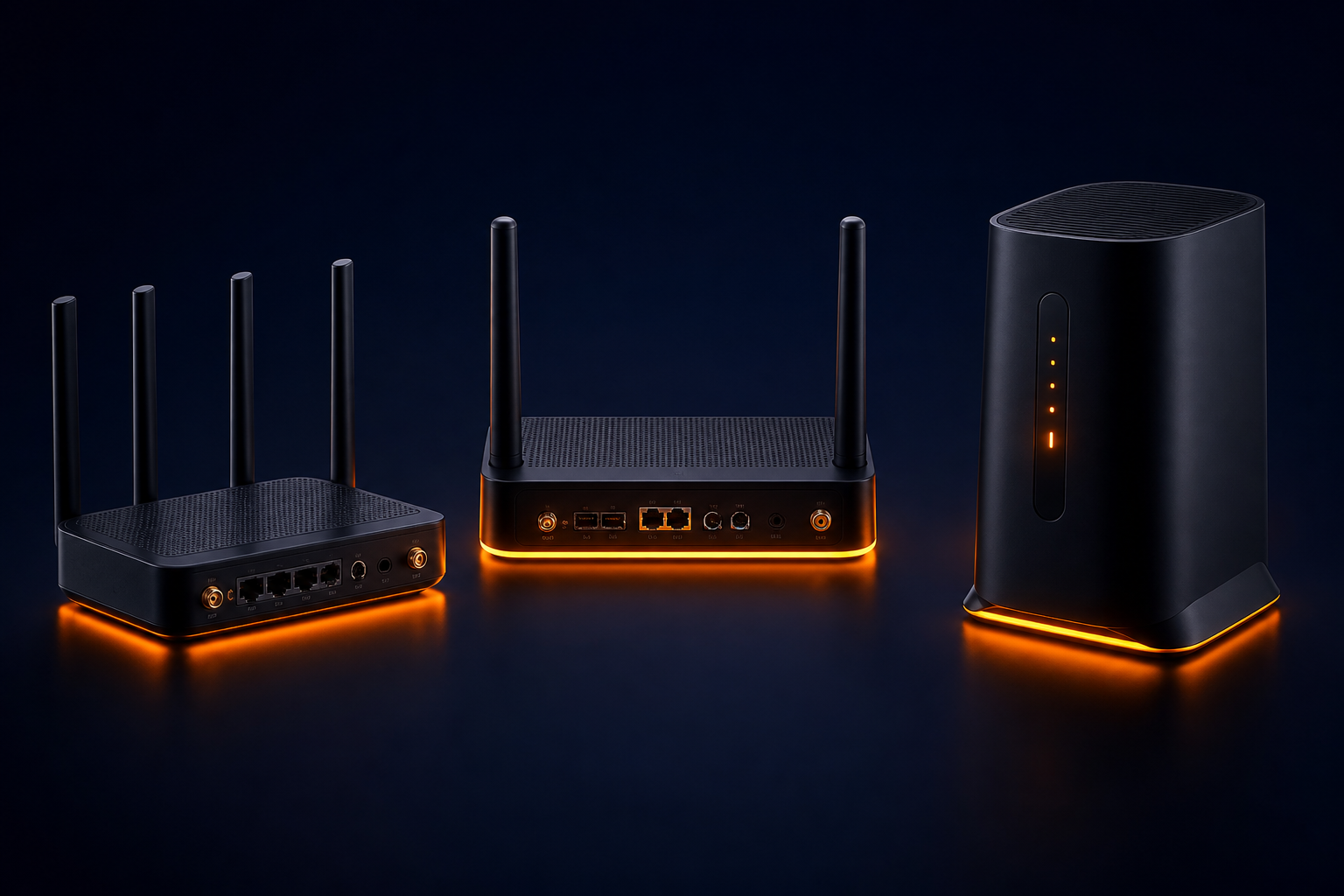
For ISPs building or expanding fixed wireless access (FWA) networks in 2026, the CPE (Customer Premises Equipment) selection process is the single most impactful procurement decision. The right device determines service quality, subscriber satisfaction, and operational margins. The wrong one leads to a cascade of truck rolls, churn, and margin erosion. This guide outlines the five critical evaluation criteria ISPs should apply when selecting 5G CPE for multi-tenant, residential, and small-business broadband deployments.
1. Chipset Platform: The Foundation of CPE Performance
The chipset inside a 5G CPE defines its carrier aggregation capability, power efficiency, and firmware upgrade path. In 2026, ISPs should prioritize devices built on:
- Qualcomm X75/X80 series — supports up to 6CC carrier aggregation, Release 17/18 features, AI-enhanced beam management, and sub-6 GHz + mmWave operation.
- MediaTek T830 — cost-effective 5G platform with 4CC CA, suitable for mid-tier FWA plans targeting 500 Mbps–1 Gbps throughput.
Key evaluation questions: Does the chipset support the operator’s specific band combinations? Can Release 18 features be enabled via firmware, or do they require a hardware swap? What is the vendor’s roadmap for 3GPP Release 19 readiness?
2. Multi-Tenant Capabilities: WiFi, VLAN, and QoS
ISPs serving multi-dwelling units (MDUs), hotels, and student housing need CPE that goes beyond basic NAT routing. Essential features include:
- WiFi 7 (802.11be) with Multi-Link Operation (MLO) — supports 50+ concurrent devices with deterministic latency, critical for MDU deployments.
- VLAN tagging (802.1Q) — enables per-apartment traffic isolation without additional hardware.
- Per-SSID bandwidth throttling — allows ISPs to offer tiered speed plans (100 Mbps / 500 Mbps / 1 Gbps) from a single CPE.
- TR-369 USP (User Services Platform) — modern remote management protocol that replaces TR-069 for bulk provisioning, monitoring, and firmware upgrades.
3. WAN Reliability: Dual SIM, Failover, and SD-WAN Integration
ISP-grade CPE must maintain service continuity. Look for:
- Dual SIM with automatic failover — essential for ISPs operating across multiple MNO partnerships or in regions with uneven coverage.
- Ethernet WAN failover — allows CPE to fall back to DSL, cable, or fiber when 5G signal degrades.
- Embedded SD-WAN capabilities — application-aware routing that prioritizes VoIP and video conferencing traffic over the lowest-latency WAN link.
4. Total Cost of Ownership (TCO): Beyond the Unit Price
ISPs should model TCO over a 3–5 year lifecycle, not just compare unit pricing. Key TCO drivers:
| Cost Factor | Impact | Mitigation |
|---|---|---|
| Power consumption | $8–15/year per device at 10W idle | Select CPE with Release 18 deep-sleep modes |
| Truck rolls | $150–300 per visit | TR-369 remote provisioning + AI beam management |
| Firmware updates | Engineering time + bandwidth | OTA with delta updates; multicast delivery for bulk |
| Hardware refresh | 2–4 year cycle | Chipset with field-upgradable firmware path |
5. OEM/ODM Customization: Branding, Firmware, and Bands
Leading ISPs increasingly demand customized CPE rather than off-the-shelf retail devices. When evaluating OEM/ODM partners like Honlly Telecom, confirm:
- Custom branding — logo, packaging, web UI, and mobile app white-labeling.
- Firmware customization — pre-configured APN, VLAN, QoS profiles, and operator-specific TR-069/TR-369 parameters.
- Band customization — RF calibration for specific regional band combinations (e.g., n77+n78 for Asia-Pacific, n48 CBRS for North America).
- Regulatory pre-certification — FCC, CE, GCF, and local regulatory compliance handled by the manufacturer.
Recommended 5G CPE for ISP Deployments in 2026
Based on the criteria above, here are the top CPE categories and recommended models from Honlly Telecom’s portfolio:
- Indoor 5G CPE for residential ISPs: HL-830M 5G NR WiFi 6 CPE — ideal for single-family homes and small MDUs, supporting 5G NR with carrier aggregation.
- High-performance indoor CPE for premium plans: HL-875H 5G Indoor Router — designed for gigabit-tier FWA plans with advanced WiFi and multi-gigabit Ethernet.
- Outdoor CPE for rural FWA: HL-880U 5G Outdoor CPE — IP67-rated outdoor unit with high-gain antennas for extended range deployments.
- Cost-effective CAT6 for entry-tier plans: HL-620 CAT6 Indoor CPE — LTE CAT6 with WiFi 5, ideal for budget broadband tiers in emerging markets.
Frequently Asked Questions
Q: What chipset should ISPs look for in 5G CPE in 2026?
Prioritize Qualcomm X75/X80 or MediaTek T830. Verify band support and Release 18 upgrade path.
Q: TR-069 vs TR-369 for CPE management?
TR-369 USP is the modern standard with real-time telemetry and bulk provisioning—strongly recommended for 2026 deployments.
Q: Indoor or outdoor CPE for FWA?
Indoor for strong-signal urban areas; outdoor with high-gain antennas for rural and fringe-coverage deployments (6–10 dB better reception).
Q: What WiFi standard for ISP CPE in 2026?
WiFi 7 (802.11be) with MLO for premium tiers; WiFi 6 still viable for budget plans.
Q: How to reduce CPE TCO?
Energy-efficient chipsets, TR-369 remote management, OEM/ODM bulk customization, and firmware-upgradable hardware.