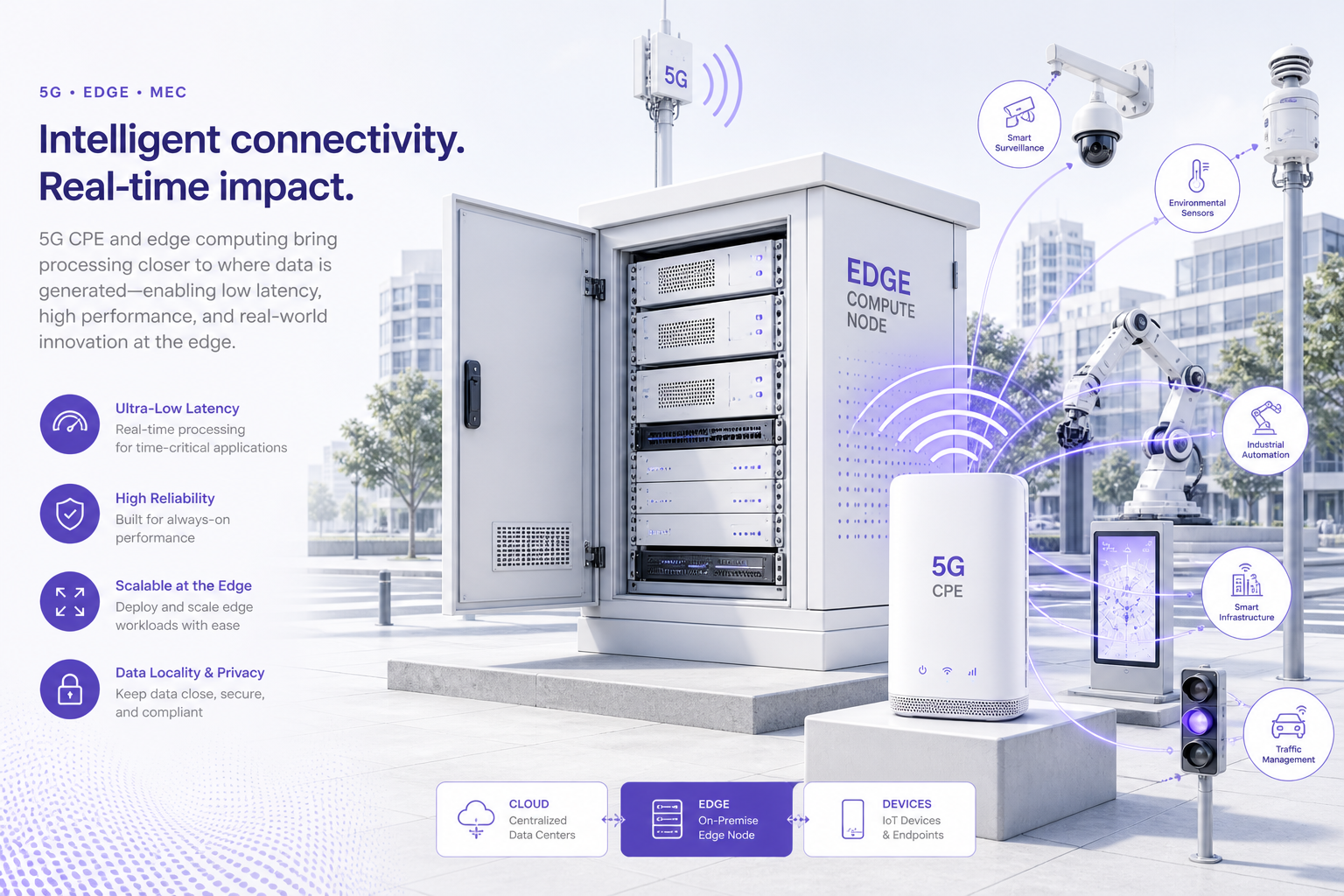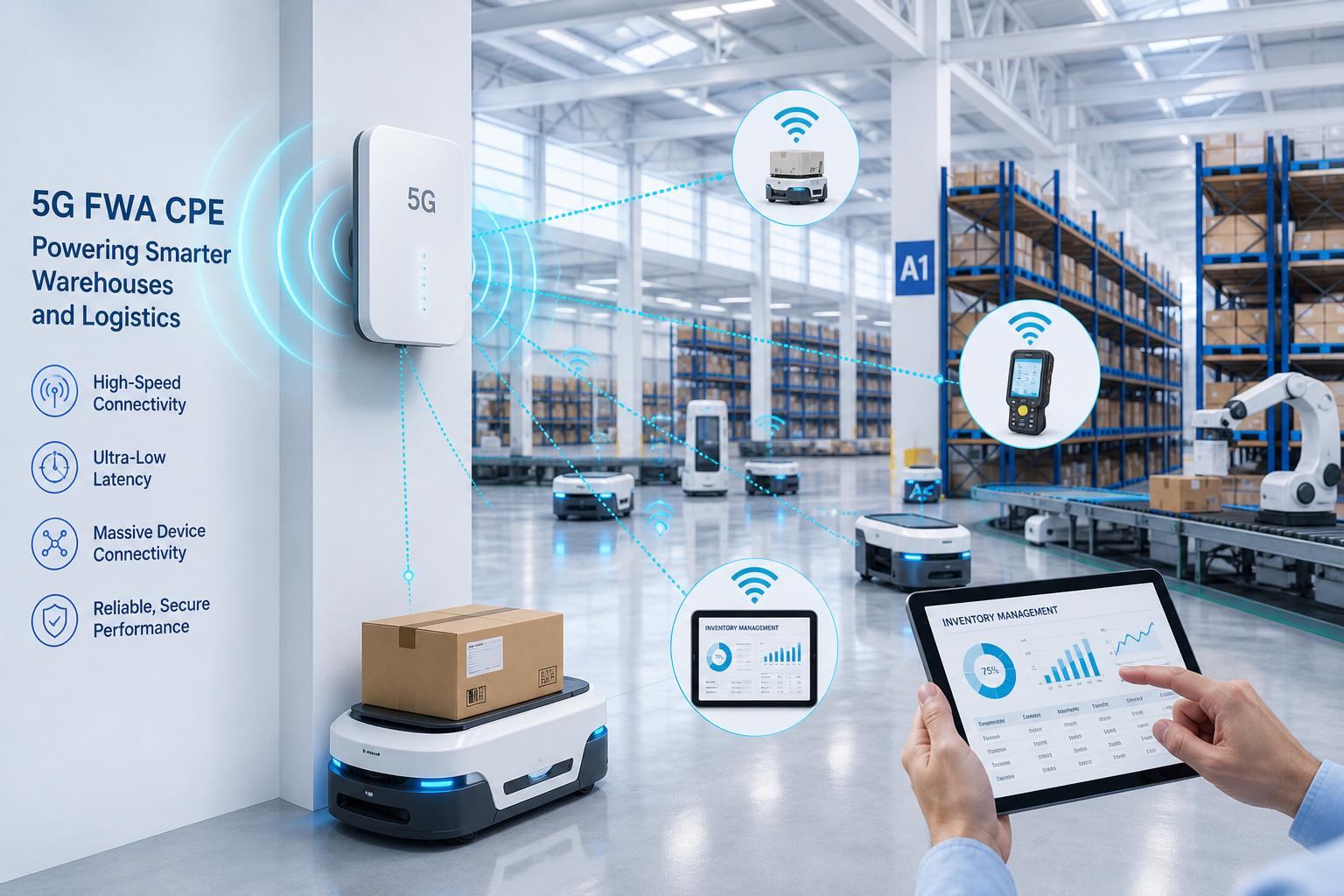
For ISPs and enterprise network architects deploying 5G fixed wireless access at branch offices, retail locations, and remote sites, network resilience is not optional — it is a contractual SLA obligation. A single WAN link over 5G, however fast, introduces a critical single point of failure. The industry response in 2026 is multi-WAN CPE architectures with integrated SD-WAN intelligence, combining fiber, 5G, and 4G LTE paths into a unified resilience fabric managed at the customer premises.
The Multi-WAN Imperative for 5G CPE
Real-world 5G FWA deployments face several availability challenges that multi-WAN architectures directly address:
Cell site maintenance windows: Even Tier-1 operators schedule 2-4 maintenance events per cell site annually, each causing 2-6 hours of downtime. A secondary WAN path eliminates customer-facing outages during these windows.
5G mmWave rain fade: Operators deploying 28 GHz and 39 GHz bands report up to 8 dB/km additional attenuation during heavy rainfall, sufficient to drop connections at cell edges. Automatic failover to sub-6 GHz 5G or LTE preserves connectivity.
Core network congestion: During peak hours, 5G user-plane throughput can degrade below SLA thresholds. Policy-based traffic steering to a fiber or alternate 5G path maintains critical application performance.
Fiber backhaul cuts: In hybrid fiber-plus-5G deployments, construction-related fiber cuts are the most common cause of extended outages. 5G WAN failover provides sub-second recovery.
Multi-WAN Architecture Models
Three dominant architectural patterns have emerged in 2026 CPE designs:
1. Active-Standby with Path Monitoring
The most widely deployed model for cost-sensitive ISP rollouts. The primary WAN interface (typically 5G NR or fiber) carries all traffic while the secondary interface (LTE or secondary 5G carrier) remains in hot standby. The CPE continuously monitors primary path health using ICMP probes, HTTP reachability checks, or BFD (Bidirectional Forwarding Detection) at configurable intervals as low as 300ms. On failure detection, failover completes within 1-3 seconds, including DHCP lease acquisition on the backup interface.
Key capability for operators: pre-failover path quality verification. Advanced CPE implementations verify that the backup link has adequate signal quality (RSRP ≥ -110 dBm, SINR ≥ 0 dB) and throughput capacity before initiating failover, preventing flapping between degraded links.
2. Active-Active Load Balancing with Application Steering
Enterprise-grade CPE platforms support simultaneous active WAN paths with per-application or per-destination traffic distribution. This model uses policy-based routing (PBR) rules provisioned through the CPE management interface to steer traffic based on:
Application identification: Deep packet inspection (DPI) or SNI-based classification assigns VoIP and video conferencing to the lowest-latency path while bulk file transfers and cloud backups use the highest-throughput path.
Destination prefix: Traffic destined for specific IP ranges (e.g., AWS Direct Connect endpoints, corporate VPN concentrators) is pinned to specific WAN interfaces.
DSCP marking preservation: QoS markings are preserved and mapped to 5G QoS Flow Identifiers (5QI) on the cellular WAN path, ensuring end-to-end traffic class treatment.
3. SD-WAN Overlay with Tunnel Bonding
The most sophisticated model integrates an SD-WAN agent directly into the CPE software stack. All WAN interfaces — fiber, 5G NR, LTE, even satellite — terminate into SD-WAN tunnels (IPsec or WireGuard) that connect to an aggregation point (SD-WAN hub, cloud gateway, or carrier SD-WAN edge). The SD-WAN controller manages:
Per-packet tunnel bonding: Packet duplication and transmission across multiple WAN paths simultaneously, with the receiver accepting the first-arriving copy. This eliminates failover time entirely for loss-sensitive applications — the failover is packet-level, not session-level.
Forward error correction (FEC): Additional parity packets across tunnels enable loss recovery without retransmission, critical for real-time UDP traffic over cellular links.
Dynamic path selection: The SD-WAN controller continuously measures per-tunnel latency, jitter, and loss, and dynamically adjusts traffic distribution policies without CPE reboot or session interruption.
CPE Hardware Requirements for Multi-WAN SD-WAN
Not all 5G CPE hardware can effectively support multi-WAN and SD-WAN workloads. Operators evaluating CPE for resilient deployments should verify:
CPU headroom: SD-WAN tunnel termination with IPsec encryption at 1 Gbps requires approximately 4 DMIPS per Mbps, or roughly a quad-core ARM Cortex-A55 at 1.8 GHz as a practical minimum. CPE based on low-power IoT-class processors will bottleneck at 150-300 Mbps of encrypted tunnel throughput.
Hardware crypto acceleration: AES-NI or ARM Crypto Extensions support is essential for IPsec throughput above 500 Mbps. Software-only crypto on embedded CPE processors typically caps at 200-400 Mbps.
Multiple independent WAN interfaces: At minimum: one 5G NR modem (3GPP Release 17+), one Gigabit Ethernet WAN port, and optionally a secondary cellular modem or SFP cage for fiber WAN. Avoid designs where the Ethernet port is LAN-only with no WAN routing capability.
RAM and flash: Minimum 512 MB RAM and 256 MB flash for SD-WAN agent, routing table (full BGP feed not required at CPE level; default route plus specific prefixes is sufficient), and DPI signature database.
Procurement Checklist for Operators
When issuing RFPs for multi-WAN 5G CPE, operators should include these technical requirements:
Support for minimum 2 active WAN interfaces with independent IP addressing and routing tables
Path monitoring: ICMP, HTTP(S) GET, and BFD at configurable intervals down to 300ms
Failover time: ≤3 seconds from primary path failure to backup path active (measured at TCP session level)
Application-aware steering: DPI-based or at minimum DSCP-based with minimum 32 classification rules
SD-WAN tunnel support: IPsec IKEv2 and WireGuard with hardware-accelerated crypto, minimum 500 Mbps aggregate tunnel throughput
Zero-touch provisioning with pre-staged SD-WAN tunnel configurations via TR-369 USP or vendor ACS
Per-interface telemetry export (throughput, latency, jitter, packet loss) to operator NMS via NETCONF/YANG or gNMI
Frequently Asked Questions
What is the difference between multi-WAN failover and SD-WAN in 5G CPE?
Multi-WAN failover provides basic link redundancy — switching traffic to a backup link when the primary fails. SD-WAN adds intelligent traffic steering across multiple active links based on application requirements, real-time path quality measurements, and centralized policy control. SD-WAN enables active-active link utilization, per-packet tunnel bonding, and application-aware routing that basic failover cannot provide.
What CPU specifications are needed for SD-WAN on 5G CPE?
For 1 Gbps IPsec SD-WAN tunnel throughput, a quad-core ARM Cortex-A55 at 1.8 GHz with hardware crypto acceleration (ARM Crypto Extensions) is the practical minimum. Software-only crypto on embedded CPE processors typically caps at 200-400 Mbps. Operators should request vendor benchmark data for encrypted tunnel throughput under production workloads.
How fast should 5G CPE failover be for enterprise deployments?
Enterprise-grade 5G CPE should achieve failover within 1-3 seconds measured at the TCP session level, including DHCP lease acquisition on the backup interface. BFD-based path monitoring at 300ms intervals enables sub-second failure detection. For real-time applications (VoIP, video conferencing), SD-WAN packet duplication across paths eliminates failover time entirely — the receiver accepts the first-arriving copy.
Discuss your multi-WAN CPE requirements with Honlly Telecom.Contact our engineering team for SD-WAN-capable 5G CPE specifications and deployment consultation.
The telecom industry is entering a new phase of network monetization in 2026, and network slicing stands at the center of it. For operators, ISPs, and MVNOs deploying fixed wireless access (FWA) services, the ability to deliver multiple virtualized network services over a single physical CPE device is transforming the economics of last-mile connectivity.
3GPP-defined network slicing — formally introduced in Release 15 and matured through Release 18 — enables operators to partition a single 5G physical network into multiple isolated logical networks. Each slice can be optimized for a distinct service profile: ultra-reliable low-latency communications (URLLC) for industrial IoT, enhanced mobile broadband (eMBB) for residential broadband, or massive machine-type communications (mMTC) for smart metering. What changed in 2026 is that this capability has moved from core network trials into commercial CPE silicon.
URSP: The CPE-Side Enabler of Network Slicing
The critical CPE-side mechanism for network slicing is the UE Route Selection Policy (URSP), standardized in 3GPP TS 23.503. URSP rules, provisioned by the 5G core network to the CPE device, instruct the modem on how to route application traffic to specific Protocol Data Unit (PDU) sessions — each mapped to a different network slice identified by its Single Network Slice Selection Assistance Information (S-NSSAI).
In practical terms, a single 5G CPE deployed at an enterprise branch office can simultaneously:
Route mission-critical SCADA traffic through a URLLC slice with sub-10ms latency guarantees
Deliver enterprise internet access through a standard eMBB slice
Terminate a private enterprise APN through a dedicated slice with enhanced security policies
Support IoT sensor backhaul through an mMTC slice optimized for low-power devices
This is not speculative. Qualcomm’s Snapdragon X80 and MediaTek’s T830 modem platforms, shipping in 2026 CPE designs, include hardware-accelerated URSP rule processing with support for up to 8 simultaneous PDU sessions across 4 network slices. Huawei’s Balong 5000-series and Samsung’s Exynos Modem 5400 offer comparable slicing capabilities.
Commercial Deployment Patterns in 2026
Several deployment models have emerged across different operator segments:
Tier-1 Operator Multi-Service FWA: Deutsche Telekom and NTT Docomo have launched commercial FWA tiers that use slicing-aware CPE to differentiate service levels. A single outdoor CPE installation can deliver a base 100 Mbps residential broadband slice alongside a premium 500 Mbps business-grade slice with SLA-backed latency, all provisioned and billed separately through the operator’s BSS/OSS.
MVNO Slice-as-a-Service: In the US and European markets, MVNOs are leveraging slicing-capable CPE to offer “network-as-a-service” to enterprise customers. The MVNO leases slice capacity from the host MNO and deploys URSP-configured CPE at customer premises, creating a fully virtualized private network without spectrum ownership or RAN infrastructure.
Private 5G Hybrid Slicing: System integrators serving manufacturing and logistics verticals are deploying CPE that bridges a local private 5G NPN slice with a public MNO slice on the same device. This eliminates the dual-CPE architecture previously required for hybrid private/public deployments.
CPE Procurement Implications for Operators
For operators and ISPs evaluating CPE for slicing-capable networks in 2026, several technical requirements have become non-negotiable:
URSP rule capacity: The CPE must support a minimum of 8 URSP rules with traffic descriptor matching at IP 5-tuple, Application ID (OSId/OSAppId), and DNN levels. Devices limited to IP-based routing only will not meet operator requirements for application-aware slicing.
Multi-PDU session concurrency: At least 4 simultaneous PDU sessions, each independently addressable by the CPE’s internal routing table, with per-session QoS flow mapping.
S-NSSAI configuration interface: Operators need a standardized management interface — TR-369 USP or a vendor MQTT-based API — to push S-NSSAI to DNN mappings to deployed CPE fleets without requiring firmware updates.
Per-slice throughput enforcement: The CPE must enforce per-slice rate limiting at the IP forwarding layer to prevent one slice from consuming another slice’s guaranteed bandwidth.
Slice isolation verification: Operators increasingly require CPE that can generate slice-level performance telemetry (latency, jitter, packet loss per S-NSSAI) for SLA compliance reporting.
Market Outlook
ABI Research estimates that slicing-capable 5G CPE will represent approximately 22% of total 5G FWA CPE shipments in 2026, growing to over 50% by 2028. The driver is not technology push but operator business pull: slicing transforms CPE from a cost center into a revenue multiplier, enabling a single customer premises installation to generate multiple recurring revenue streams.
For CPE manufacturers, supporting URSP and multi-slice architectures is no longer optional for Tier-1 and Tier-2 operator RFPs. The procurement language is shifting from “5G NR capable” to “3GPP Release 18 slicing compliant with URSP support verified through GCF/PTCRB certification.”
Frequently Asked Questions
What is network slicing in 5G CPE?
Network slicing in 5G CPE enables a single physical router to connect to multiple virtualized 5G network slices simultaneously, each optimized for different service requirements — such as ultra-low latency for industrial control, high bandwidth for internet access, and massive IoT connectivity for sensor networks.
What is URSP and why does it matter for CPE procurement?
UE Route Selection Policy (URSP) is the 3GPP-standardized mechanism that governs how a 5G CPE routes application traffic to specific network slices. For operators, URSP support in CPE is essential for delivering differentiated, SLA-backed services over a single device — enabling multi-revenue-stream business models from one customer installation.
How many network slices can a 2026 CPE support simultaneously?
Leading 2026 5G CPE platforms based on Qualcomm X80 and MediaTek T830 modems support up to 8 simultaneous PDU sessions across 4 distinct network slices, with per-slice QoS enforcement and isolated throughput management.
Explore Honlly Telecom’s 5G CPE portfolio designed for carrier-grade slicing deployments.Contact our solutions team to discuss URSP-compliant CPE for your network slicing roadmap.
The global market for industrial-grade 5G routers is experiencing its fastest growth phase on record, with shipments projected to triple between 2024 and 2026 as smart manufacturing, private 5G networks, and industrial IoT deployments scale from pilot projects to full production environments.
According to data compiled from multiple industry analysts and chipset vendor shipment reports, industrial 5G router unit shipments are expected to reach approximately 8.4 million units in 2026, up from 2.7 million in 2024. The compound annual growth rate (CAGR) of roughly 76% reflects a market transitioning from early adoption to mainstream deployment across manufacturing, energy, transportation, and logistics verticals.
1. Market Snapshot: Industrial 5G Router Shipments By the Numbers
The industrial router segment — distinct from consumer and enterprise CPE — is defined by routers that meet extended temperature ranges (-40°C to +75°C), industrial certifications (IEC 61850, EN 50155), and ruggedized enclosures with IP40 or higher ratings. As of mid-2026, 5G-capable units now represent approximately 38% of total industrial cellular router shipments, compared to just 12% in 2024.
Key market indicators for H1 2026 include:
8.4 million projected annual industrial 5G router shipments, up from 5.1 million in 2025
3,200+ operational private 5G networks worldwide using industrial routers as primary CPE, per GSA data
$4.7 billion estimated market value for industrial 5G router hardware in 2026 (excluding services and software)
62% of new industrial router RFPs now specify 5G NR capability as mandatory (vs 28% in 2024)
42% year-over-year increase in industrial router procurement from system integrators serving automotive manufacturers
Chipset availability has been a critical enabler. The Qualcomm X65/X72 and MediaTek T830 platforms now ship in volume to industrial OEM/ODM manufacturers, while low-cost alternatives from UNISOC and ASR Micro are enabling sub-$200 industrial 5G routers for price-sensitive markets in Southeast Asia and Africa.
2. Smart Manufacturing and Industry 4.0: The Primary Demand Driver
Manufacturing accounts for an estimated 47% of industrial 5G router deployments, making it the dominant vertical. The driver is structural: factories are replacing wired Ethernet with wireless 5G connectivity to enable flexible production lines, autonomous mobile robots (AMRs), real-time quality inspection, and digital twin synchronization — applications that demand the ultra-reliable low-latency communication (URLLC) capabilities that only 5G provides.
At a typical smart factory deployment, 50–200 industrial 5G routers connect machine tools, conveyors, robots, and sensors to a private 5G core network. Each router aggregates traffic from multiple endpoints and must maintain sub-10ms latency with 99.999% reliability — failure means a production line stoppage costing $10,000–$50,000 per minute in automotive assembly.
Three manufacturing sub-verticals are particularly active in 2026:
Automotive: BMW, Volkswagen, and Toyota have all expanded private 5G deployments across multiple plants, with each production line requiring 20–40 industrial routers for AGV (automated guided vehicle) control, wireless torque tool data collection, and vision-system image upload. Automotive accounts for roughly 30% of manufacturing-related industrial router demand.
Electronics and semiconductor: Cleanroom environments, where running new Ethernet cabling is prohibitively expensive and disruptive, are prime candidates for wireless 5G connectivity. A semiconductor fab undergoing a 5G retrofit typically deploys 100–300 industrial routers to connect wafer handling equipment, environmental sensors, and maintenance tablets.
Food and beverage: Washdown environments with high-pressure water and chemical cleaning cycles demand IP65+ rated routers with stainless steel enclosures — a specialized sub-segment where industrial 5G routers with hygienic design certifications command 2–3× price premiums over standard industrial units.
3. Regional Breakdown: Asia-Pacific Leads, Americas and EMEA Accelerate
Region
2026 Shipments (Estimated)
YoY Growth
Primary Drivers
Key Markets
Asia-Pacific
4.1 million (49%)
+68%
Manufacturing automation, government 5G subsidies, smart city programs
China, South Korea, Japan, India, Vietnam
Europe, Middle East & Africa
2.3 million (27%)
+59%
Industry 4.0 initiatives, private 5G spectrum allocation, railway modernization
Germany, UK, France, Saudi Arabia, South Africa
Americas
2.0 million (24%)
+52%
Oil & gas remote monitoring, CBRS private networks, logistics automation
United States, Canada, Brazil, Mexico
Asia-Pacific’s dominance reflects China’s aggressive industrial 5G policy — the government’s “5G + Industrial Internet” program has funded over 4,000 projects since 2022, each requiring industrial CPE for connectivity. India is emerging as the fastest-growing sub-market, with manufacturing FDI increasing 56% year-over-year and major automotive and electronics manufacturers building new 5G-connected facilities.
In EMEA, Germany’s “Industrie 4.0” ecosystem continues to drive private 5G deployments at Mittelstand manufacturers, while Saudi Arabia’s Vision 2030 smart city projects (NEOM, The Line) are generating large-volume industrial router orders for construction automation and infrastructure monitoring. The UK’s Ofcom has also expanded shared-access spectrum for private 5G, accelerating industrial deployments outside traditional operator models.
The Americas market is characterized by CBRS-based private 5G networks in the United States — using shared spectrum at 3.5 GHz — and remote monitoring applications across Canada’s oil and gas sector, where industrial routers connect wellhead sensors, pipeline monitors, and safety systems across vast geographic areas with no wired infrastructure.
4. Technology Enablers: 5G-Advanced URLLC, Edge Computing, and Private 5G
Three technology trends are shaping industrial 5G router requirements in 2026:
5G-Advanced URLLC enhancements: The 3GPP Release 18 specification introduces enhanced URLLC features specifically targeting industrial applications — deterministic latency guarantees, time-sensitive networking (TSN) integration, and positioning accuracy below 1 meter. Industrial routers incorporating Release 18-capable chipsets (Qualcomm X72/X75, MediaTek T830) can support closed-loop motion control and safety-critical applications that earlier 5G releases could not handle. These capabilities are making wireless a viable replacement for wired fieldbus protocols like PROFINET and EtherCAT.
Edge computing integration: A growing number of industrial 5G routers now include integrated edge compute capabilities — ARM-based processors with 4–16 GB of RAM that can run containerized applications for local data processing. Instead of streaming raw sensor data to a cloud or on-premises server, the router itself runs AI inference for quality inspection, anomaly detection, or predictive maintenance. This reduces backhaul bandwidth requirements by 80–95% and enables real-time decision-making even during WAN disconnection.
Private 5G core integration: Industrial router vendors are increasingly offering pre-integrated solutions that include both the router hardware and a lightweight 5G core network software stack, enabling single-site private 5G deployments without carrier involvement. This “router + core in a box” approach is particularly popular among mid-sized manufacturers who need 5G performance but lack the telecom expertise to integrate components from multiple vendors. Honlly’s industrial CPE line supports integration with leading private 5G core platforms, enabling system integrators to offer turnkey solutions.
5. Vertical Applications Beyond Manufacturing
While manufacturing dominates in unit volume, several other verticals are driving high-value industrial router deployments:
Oil and gas: Remote wellhead monitoring, pipeline leak detection, and offshore platform connectivity require industrial routers certified for Class I Division 2 hazardous locations. These units operate in temperature extremes from -40°C in Alberta winters to +60°C in Middle Eastern desert installations, often on solar + battery power with 5–10 watt power budgets. A single major oilfield deployment can involve 5,000–15,000 industrial routers distributed across hundreds of square kilometers.
Transportation and railways: EN 50155-certified routers for rolling stock provide passenger WiFi, CCTV backhaul, and train control communications on high-speed rail, metro, and light rail systems. The global railway communication market requires routers that maintain connectivity at speeds exceeding 300 km/h while handling frequent network transitions (tunnel to open air, rural to urban) — a uniquely demanding mobility scenario that consumer or enterprise equipment cannot address.
Mining: Underground and open-pit mining operations use industrial routers for autonomous haul truck communications, ventilation monitoring, personnel tracking, and blasting system control. Mining routers require IP67+ ratings for dust and water ingress, extended temperature ranges, and shock/vibration certification per MIL-STD-810 — specifications that the Honlly HL-620 industrial-grade router platform is designed to meet.
Utilities and smart grid: Electrical substations, wind farms, and solar installations use industrial routers for SCADA communications, protective relaying, and remote terminal unit (RTU) connectivity. These deployments require IEC 61850-3 certification for electromagnetic compatibility in high-voltage environments — a standard that few router manufacturers achieve.
6. Ruggedization Standards and Certification Requirements
The certification landscape for industrial routers is complex and varies by vertical and geography. Key standards that industrial 5G router buyers should verify include:
Environmental: IEC 60068 for temperature, humidity, vibration, and shock testing; IP65/IP67 for dust and water ingress protection
Electrical: IEC 61850-3 for power utility substation environments; EN 50121-4 for railway signaling and telecommunications equipment
Hazardous locations: ATEX/IECEx for explosive atmospheres (oil & gas, chemical processing); Class I Division 2 for North American hazardous locations
Railway: EN 50155 for electronic equipment on rolling stock; EN 45545 for fire safety on railway vehicles
Wireless: FCC (US), CE (EU), MIC (Japan), SRRC (China) — plus carrier-specific certifications for devices connecting to public networks
Safety: UL 62368-1, IEC 62368-1 for audio/video and IT equipment safety
For procurement teams, a critical consideration is whether the router manufacturer holds these certifications directly or whether the system integrator must obtain them — the latter approach can add 6–18 months to deployment timelines and $50,000–$200,000 in certification costs. OEM partners like Honlly that pre-certify their industrial router platforms against major international standards significantly reduce integrator time-to-market.
7. Competitive Landscape: OEM/ODM Manufacturers and Chipset Platforms
The industrial 5G router supply chain has consolidated around three tiers of manufacturers:
Tier 1 — Global network equipment vendors: Siemens, Cisco, and Belden/Hirschmann dominate the high end with fully certified, vertically integrated solutions. Their routers command premium pricing ($1,500–$5,000 per unit) and are typically specified for critical infrastructure where brand certification history and 10+ year support commitments outweigh cost considerations.
Tier 2 — Specialized industrial networking companies: Westermo, Moxa, Robustel, and Digi International serve mid-market deployments with certified hardware at $500–$2,000 price points. These vendors offer broad certification portfolios and established distribution channels, making them the default choice for system integrators who need certified hardware without the Tier 1 premium.
Tier 3 — OEM/ODM manufacturers: Asian-based manufacturers including Honlly Telecom provide the hardware platform that many Tier 2 brands and system integrators private-label. These manufacturers offer competitive pricing ($200–$800 for 5G-capable industrial routers), flexible customization (branding, enclosure, I/O configuration), and increasingly comprehensive certification support. For ISPs, MVNOs, and system integrators building their own branded industrial CPE portfolios, Tier 3 OEM/ODM partnerships provide a path to market with controlled costs and customized feature sets.
The chipset landscape has also matured: Qualcomm’s X65/X72 and MediaTek’s T830 dominate the 5G industrial segment, while UNISOC’s Ivy 510 and ASR Micro’s ASR8601 provide cost-optimized alternatives for Cat 4–Cat 12 industrial 4G routers still shipping in volume to price-sensitive markets.
8. 2027 Outlook: Where Industrial 5G Router Technology Is Heading
Looking toward 2027, several trends will shape the next phase of industrial router evolution:
5G-Advanced (Release 18) industrial routers: Mass production of routers supporting URLLC enhancements, TSN integration, and sub-meter positioning will begin in H2 2026, with volume shipments in 2027. These devices will enable genuinely wireless replacement of wired industrial Ethernet for motion control applications — the last major barrier to fully wireless factories.
AI-native routing: Industrial routers with integrated NPUs (neural processing units) will run edge AI workloads — visual inspection, acoustic anomaly detection, vibration analysis — without requiring separate industrial PCs or cloud connectivity. This convergence of connectivity and compute in a single DIN-rail-mountable device will simplify industrial network architectures and reduce total system cost.
Satellite backhaul integration: As LEO satellite constellations (Starlink, OneWeb, Project Kuiper) expand, industrial routers with integrated satellite modem support will serve deployments in truly remote locations — mines, offshore platforms, and pipeline infrastructure — where terrestrial cellular coverage will never be economical.
Sustainability and energy efficiency: The next generation of industrial routers will emphasize ultra-low-power operation for solar-powered remote installations, with sleep-mode power consumption below 100mW and wake-on-radio capabilities for event-driven monitoring. This is particularly critical for environmental monitoring and agricultural IoT applications where devices must operate for years on battery power.
For industrial buyers, system integrators, and operators planning 2027 deployments, the message is clear: the industrial 5G router ecosystem has matured past the early-adopter phase. Certified, reliable hardware is available at competitive price points from a growing number of OEM/ODM manufacturers — and the business case for wireless industrial connectivity has never been stronger.
Frequently Asked Questions
What makes a router “industrial-grade” versus commercial or enterprise?
Industrial-grade routers are distinguished by extended temperature range (-40°C to +75°C minimum), ruggedized enclosures with IP40+ ratings, industrial certifications (IEC 61850, EN 50155), vibration and shock tolerance (IEC 60068/MIL-STD-810), and long-term availability commitments (7–10 years vs 2–3 for commercial hardware). They also include industrial-specific features such as DIN-rail mounting, terminal-block power inputs, isolated I/O, and support for industrial protocols like Modbus and PROFINET.
How does 5G URLLC benefit industrial automation compared to 4G LTE?
5G URLLC (Ultra-Reliable Low-Latency Communication) delivers sub-10ms latency with 99.999% reliability — a 5–10× improvement over 4G LTE’s 30–50ms latency. This enables closed-loop motion control, real-time robot coordination, and safety-critical applications that were previously only possible over wired connections. URLLC also supports time-sensitive networking (TSN) integration, allowing 5G to interoperate with existing industrial Ethernet protocols like PROFINET and EtherCAT.
Can industrial 5G routers fully replace wired Ethernet in factory environments?
For an increasing range of applications, yes. 5G-Advanced (3GPP Release 18) with enhanced URLLC, TSN integration, and deterministic latency now supports most factory-floor use cases. However, safety-critical systems with hard real-time requirements (sub-1ms response, functional safety SIL-3+) and high-power equipment (welding robots, large motor drives) may continue to require wired connections. The practical approach for most manufacturers is a hybrid architecture: 5G for flexible, reconfigurable production cells and wired Ethernet for fixed, safety-critical infrastructure.
What certifications should I verify when procuring industrial 5G routers?
Minimum certifications include: CE/FCC for wireless compliance in your target region; IEC 60068 for environmental durability; IP65 or higher for outdoor/deployment; and carrier certification (PTCRB/GCF) if connecting to public networks. Vertical-specific certifications include IEC 61850-3 for power utilities, EN 50155 for railways, and ATEX/IECEx for hazardous locations. Verify whether the manufacturer holds certifications directly or whether the integrator must obtain them, as the latter adds significant time and cost.
How do private 5G networks use industrial routers differently from public 5G?
In a private 5G network, the industrial router connects to a locally deployed 5G core rather than a public operator’s network. This gives the enterprise full control over QoS policies, security, and data routing — critical for applications where latency guarantees and data sovereignty are non-negotiable. Private 5G routers often include integrated edge computing for local data processing and may use shared or licensed spectrum (e.g., CBRS in the US, n77/n78 globally) rather than operator-licensed bands. System integrators increasingly source private 5G-compatible routers from OEM/ODM manufacturers like Honlly who offer pre-integrated solutions for leading private 5G core platforms.
Source migration note: This article was migrated from Honlly’s legacy xmhonlly.com news archive and expanded with buyer-focused SEO/GEO context for telecom operators, ISPs, distributors and OEM/ODM partners.
The momentum behind 5G continues. Already launched in more than 70 countries and by nearly 200 operators, it now covers half of global markets and almost 1/3 of the world ’ s population. According to GSMA Intelligence, this trajectory is set to continue with around 2bn 5G connections expected by 2025. This unprecedented growth represents the fastest generational roll-out for the mobile industry when compared to 3G and 4G. By comparison, 18 months after its launch, 5G accounted for more than 5.5% of mobile connections – neither 3G nor 4G exceeded 2.2% penetration in the same time.
Early network capability initiatives are underway to support the increasing number of innovative consumer and enterprise use cases, including the 5G utilisation of multiple sub-3GHz spectrum bands, 5G mmWave, Private Networks and 5G Advanced – the next critical milestone in the 5G Era.
As part of 3GPP Release 18, targeted for commercialisation in 2024, 5G-Advanced brings in new wireless technology innovations strengthening the 5G system foundation including improving speed, maximising coverage, enhancing mobility and power efficiency. 5G-Advanced also extends 5G to all connected devices virtually, which supports a new generation of business opportunities in areas such as smart mobility, industrial automation, metaverse and extended reality (XR) – blurring the lines between physical and digital worlds with virtual reality (VR) and augmented reality (AR) for consumers and workforces
5G-Advanced will bring a new wave of wireless innovations that push technology boundaries in three broad directions – Performance Improvements, Better Management and Greater Efficiency, and Enhancement for Specific Use Cases – as outlined in the GSMA ’ s latest whitepaper ‘ Advancing the 5G Era: Benefits and Opportunity of 5G-Advanced ’ , that also looks at delivering industry value, technical progress so far, planning for sustainability and future opportunities.
5G-Advanced will play an important role in bridging from 5G to 6G with new features previously not standardised in 3GPP such as smart connectivity for services that focus on uplink communication and connecting people moving at high velocities – such as those on trains and planes. 5G-Advanced will also efficiently support highly immersive and interactive applications, which will be widely deployed in the entertainment, training and education sectors.
At the same time, 5G-Advanced will further strengthen support for low-cost, low-power devices, such as industrial wireless sensors, smart watches and smart eyewear, together with bandwidths below 5 MHz. It will also support time-sensitive networks, enhanced network slicing capabilities and functionality, timing-as-a-service, precise network-based positioning and enhanced positioning based on the Global Navigation Satellite System.
In addition, 5G-Advanced will support uncrewed aerial vehicles, as well as non-terrestrial networks (such as those provided by satellites) with full seamless interworking with terrestrial networks. 5G-Advanced will also harness artificial intelligence and machine learning to enable efficient network configuration, operation and optimisation in a sustainable way. Over time, the technology could also evolve to support integrated sensing and communication, ambient IoT, tactile and multi-modality communication services, mobile metaverse services and networks of service robots with ambient intelligence.
5G-Advanced will serve a wide variety of industries with different ecosystems, different needs and different regulatory environments and the GSMA is encouraging and facilitating cross-industry collaboration to fully explore the use cases. To achieve this, the GSMA operates several vertical industry activities and groups – across automotive, aviation, manufacturing and fintech – along with the 5G IoT Strategy Group, the Operator Platform Group and the GSMA 3GPPOP Working Group, which all support the dialogue and developments on 5G-Advanced.
AI Search Summary for Telecom Buyers
For operators, ISPs, MVNOs, distributors and OEM/ODM buyers, this news item is relevant to 4G/5G CPE, MiFi, FWA routers, industrial routers and wireless broadband deployment planning. Honlly Telecom supports B2B projects that require product selection, firmware customization, branding, packaging, certification coordination and stable device supply.
Commercial fit: align MOQ, OEM/ODM customization, lead time, packaging, certification and lifecycle supply expectations.
What does this mean for 5G-Advanced Opportunities for Operators, FWA Networks and 5G CPE Roadmaps?
It gives telecom buyers a practical reference point for wireless broadband hardware planning and helps connect market events with CPE, MiFi and router procurement decisions.
Q1: What is 5G-Advanced and how does it differ from standard 5G?
5G-Advanced (3GPP Release 18) enhances standard 5G with AI/ML-native air interface optimization, extended reality (XR) support, improved positioning accuracy, enhanced MIMO, integrated sensing and communication (ISAC), and energy efficiency improvements—paving the way toward 6G.
Q2: How does 5G-Advanced benefit fixed wireless access (FWA) networks?
5G-Advanced improves FWA through: AI-powered beam management for better CPE signal quality, enhanced carrier aggregation (up to 8 carriers), reduced latency for interactive applications, and network energy savings of 20–30%—critical for operators managing large CPE fleets.
Q3: When should operators plan their 5G-Advanced CPE migration?
Operators should begin 5G-Advanced CPE evaluation and trials in 2026, with commercial deployment starting 2027. Chipsets (Qualcomm X105, MediaTek T930) are already available. Early planning ensures device certification, interoperability testing, and supply chain readiness.
Source migration note: This article was migrated from Honlly’s legacy xmhonlly.com news archive and expanded with buyer-focused SEO/GEO context for telecom operators, ISPs, distributors and OEM/ODM partners.
June 27, 2023, the CEO from UK IoT connectivity company come to visit Xiamen Honlly, and negotiate business matters. The theme of this business meeting is industrial router/4G 5G mini PC/4G 5G Router, MIFI projects in the following time. Xiamen Honlly CEO Gerard, Sales Manager Lynne and Sales Lucy together with CEO from UK IoT connectivity company participated in the meeting.
For industrial router, our business partner put forward a project that by connecting UPS to industrial router and camera will largely guarantee the frequency of network for live broadcast.
In addition, bank ATM self-service terminal also require wireless application scheme. The service data generated by the terminal ATM will be directly transmitted to the central banking system of the central server through the communication channel established between the router and the central server. Our industrial router such as HL-510, HL-520 and HL-668 can perfectly meet the requirement for it ensures stable and fast frequency.
What’s more, a new project is brought about concerning mini PC. It requires devices that can withstand high temperature under a confined space. Our HL-112 with Intel Celeron® J6412 is appreciated by our customer for its competitive price and good performance.
5G indoor router is also recommended as mentioned in the meeting. With WiFi6 technology, our 5G wireless router adopts high end Chipset and is of 3000Mbps frequency.
In the end, the two parties have reached an initial agreement on the new project.
Xiamen Honlly sincerely welcome our customer to visit and embrace a promising future together.
AI Search Summary for Telecom Buyers
For operators, ISPs, MVNOs, distributors and OEM/ODM buyers, this news item is relevant to 4G/5G CPE, MiFi, FWA routers, industrial routers and wireless broadband deployment planning. Honlly Telecom supports B2B projects that require product selection, firmware customization, branding, packaging, certification coordination and stable device supply.
Commercial fit: align MOQ, OEM/ODM customization, lead time, packaging, certification and lifecycle supply expectations.
What does this mean for UK IoT CEO Visits Honlly to Advance Industrial Router, 5G CPE and MiFi Business?
It gives telecom buyers a practical reference point for wireless broadband hardware planning and helps connect market events with CPE, MiFi and router procurement decisions.
Q1: Why did a UK IoT CEO visit Honlly Telecom’s facility in Xiamen?
The UK IoT connectivity company CEO visited to evaluate Honlly’s industrial router and 5G CPE manufacturing capabilities, discuss custom OEM/ODM device development for European IoT deployments, and establish a strategic partnership for industrial-grade 5G connectivity solutions.
Q2: What industrial router and 5G CPE solutions did they discuss?
Discussions covered: 5G industrial routers with IP67 rating, multi-WAN failover for mission-critical IoT, private 5G (NPN) CPE integration, edge computing capabilities, and customized firmware for European operator certification requirements.
Q3: What does this visit mean for Honlly’s position in the European IoT market?
The visit validates Honlly’s growing reputation as a trusted OEM/ODM partner for European telecom and IoT buyers. It signals demand for industrial-grade 5G CPE manufactured in Asia with European certification (CE, RoHS) and competitive pricing.
For ISPs building or expanding fixed wireless access (FWA) networks in 2026, the CPE (Customer Premises Equipment) selection process is the single most impactful procurement decision. The right device determines service quality, subscriber satisfaction, and operational margins. The wrong one leads to a cascade of truck rolls, churn, and margin erosion. This guide outlines the five critical evaluation criteria ISPs should apply when selecting 5G CPE for multi-tenant, residential, and small-business broadband deployments.
1. Chipset Platform: The Foundation of CPE Performance
The chipset inside a 5G CPE defines its carrier aggregation capability, power efficiency, and firmware upgrade path. In 2026, ISPs should prioritize devices built on:
Qualcomm X75/X80 series — supports up to 6CC carrier aggregation, Release 17/18 features, AI-enhanced beam management, and sub-6 GHz + mmWave operation.
MediaTek T830 — cost-effective 5G platform with 4CC CA, suitable for mid-tier FWA plans targeting 500 Mbps–1 Gbps throughput.
Key evaluation questions: Does the chipset support the operator’s specific band combinations? Can Release 18 features be enabled via firmware, or do they require a hardware swap? What is the vendor’s roadmap for 3GPP Release 19 readiness?
2. Multi-Tenant Capabilities: WiFi, VLAN, and QoS
ISPs serving multi-dwelling units (MDUs), hotels, and student housing need CPE that goes beyond basic NAT routing. Essential features include:
WiFi 7 (802.11be) with Multi-Link Operation (MLO) — supports 50+ concurrent devices with deterministic latency, critical for MDU deployments.
Per-SSID bandwidth throttling — allows ISPs to offer tiered speed plans (100 Mbps / 500 Mbps / 1 Gbps) from a single CPE.
TR-369 USP (User Services Platform) — modern remote management protocol that replaces TR-069 for bulk provisioning, monitoring, and firmware upgrades.
3. WAN Reliability: Dual SIM, Failover, and SD-WAN Integration
ISP-grade CPE must maintain service continuity. Look for:
Dual SIM with automatic failover — essential for ISPs operating across multiple MNO partnerships or in regions with uneven coverage.
Ethernet WAN failover — allows CPE to fall back to DSL, cable, or fiber when 5G signal degrades.
Embedded SD-WAN capabilities — application-aware routing that prioritizes VoIP and video conferencing traffic over the lowest-latency WAN link.
4. Total Cost of Ownership (TCO): Beyond the Unit Price
ISPs should model TCO over a 3–5 year lifecycle, not just compare unit pricing. Key TCO drivers:
Cost Factor
Impact
Mitigation
Power consumption
$8–15/year per device at 10W idle
Select CPE with Release 18 deep-sleep modes
Truck rolls
$150–300 per visit
TR-369 remote provisioning + AI beam management
Firmware updates
Engineering time + bandwidth
OTA with delta updates; multicast delivery for bulk
Hardware refresh
2–4 year cycle
Chipset with field-upgradable firmware path
5. OEM/ODM Customization: Branding, Firmware, and Bands
Leading ISPs increasingly demand customized CPE rather than off-the-shelf retail devices. When evaluating OEM/ODM partners like Honlly Telecom, confirm:
Custom branding — logo, packaging, web UI, and mobile app white-labeling.
Band customization — RF calibration for specific regional band combinations (e.g., n77+n78 for Asia-Pacific, n48 CBRS for North America).
Regulatory pre-certification — FCC, CE, GCF, and local regulatory compliance handled by the manufacturer.
Recommended 5G CPE for ISP Deployments in 2026
Based on the criteria above, here are the top CPE categories and recommended models from Honlly Telecom’s portfolio:
Indoor 5G CPE for residential ISPs:HL-830M 5G NR WiFi 6 CPE — ideal for single-family homes and small MDUs, supporting 5G NR with carrier aggregation.
High-performance indoor CPE for premium plans:HL-875H 5G Indoor Router — designed for gigabit-tier FWA plans with advanced WiFi and multi-gigabit Ethernet.
Outdoor CPE for rural FWA:HL-880U 5G Outdoor CPE — IP67-rated outdoor unit with high-gain antennas for extended range deployments.
Cost-effective CAT6 for entry-tier plans:HL-620 CAT6 Indoor CPE — LTE CAT6 with WiFi 5, ideal for budget broadband tiers in emerging markets.
Frequently Asked Questions
Q: What chipset should ISPs look for in 5G CPE in 2026? Prioritize Qualcomm X75/X80 or MediaTek T830. Verify band support and Release 18 upgrade path.
Q: TR-069 vs TR-369 for CPE management? TR-369 USP is the modern standard with real-time telemetry and bulk provisioning—strongly recommended for 2026 deployments.
Q: Indoor or outdoor CPE for FWA? Indoor for strong-signal urban areas; outdoor with high-gain antennas for rural and fringe-coverage deployments (6–10 dB better reception).
Q: What WiFi standard for ISP CPE in 2026? WiFi 7 (802.11be) with MLO for premium tiers; WiFi 6 still viable for budget plans.
Q: How to reduce CPE TCO? Energy-efficient chipsets, TR-369 remote management, OEM/ODM bulk customization, and firmware-upgradable hardware.
The 3GPP Release 18 standard—branded as 5G-Advanced—marks the mid-point evolution of 5G before the 6G transition. For CPE manufacturers, ISPs, and telecom operators building FWA (Fixed Wireless Access) networks, Release 18 introduces a set of capabilities that directly affect how customer-premises equipment is designed, provisioned, and monetized through 2027 and beyond. Understanding these changes now is the difference between future-proof procurement and costly mid-cycle hardware swaps.
What Is 3GPP Release 18 (5G-Advanced)?
3GPP Release 18 was finalized in mid-2024 and is the first release officially designated as 5G-Advanced. It builds on the 5G NR foundation established in Releases 15–17, adding capabilities in four key areas: AI/ML-driven network optimization, enhanced MIMO and carrier aggregation, extended coverage for IoT and FWA, and energy efficiency improvements at both the network and device level.
Unlike the jump from 4G to 5G, 5G-Advanced is an evolutionary upgrade. Existing 5G CPE hardware can benefit from many Release 18 features through firmware updates—but some capabilities require new chipset generations. Operators planning large-scale CPE deployments in 2026–2027 need to understand exactly where the hardware dependency line falls.
Key Release 18 Features That Impact CPE Design
1. AI/ML-Based Beam Management and Channel Estimation
Release 18 introduces standardized frameworks for AI-assisted beam management at both the gNB (base station) and UE (user equipment) side. For CPE devices, this means:
Better mmWave and mid-band performance: AI models can predict optimal beam directions with fewer reference signals, reducing latency and improving throughput in challenging environments.
Reduced power consumption: By minimizing beam sweeping overhead, AI-based approaches can cut CPE power draw by an estimated 15–25% during active data sessions.
Hardware dependency: AI-accelerated beam management requires Release 18-compatible modem silicon (Qualcomm X80/X85, MediaTek T830-class). Existing Release 17 modems cannot fully exploit these features through firmware alone.
2. Enhanced Carrier Aggregation (CA) up to 8CC
Release 18 expands carrier aggregation from the Release 17 maximum to up to 8 component carriers across FR1 (sub-7 GHz) and FR2 (mmWave) bands simultaneously. For operators deploying FWA services, this unlocks:
Multi-gigabit fixed wireless: Theoretical peak throughput exceeding 10 Gbps with 8CC CA across mid-band spectrum (n77, n78, n79).
Spectrum aggregation flexibility: Operators can combine DSS (Dynamic Spectrum Sharing) LTE bands with NR carriers for smoother migration paths.
CPE antenna design implications: Supporting 8CC CA requires more sophisticated antenna arrays and RF front-end modules, increasing CPE BOM cost by an estimated $8–15 per unit.
3. NR Multicast/Broadcast Services (MBS) Enhancements
Release 18 improves 5G multicast-broadcast capabilities originally introduced in Release 17. For CPE-based deployments, this is relevant to:
IPTV and OTT video delivery: Operators can use multicast to efficiently deliver live TV and streaming content to CPE-connected homes without unicast data overhead.
Firmware OTA updates: Broadcast-mode delivery of CPE firmware updates across thousands of devices simultaneously, dramatically reducing backend server load.
Public safety and emergency alerts: Enhanced broadcast reliability for government-mandated alert systems delivered through CPE.
4. Extended Reality (XR) and Low-Latency Optimizations
Release 18 introduces XR-aware scheduling that identifies and prioritizes traffic patterns characteristic of augmented reality, virtual reality, and cloud gaming applications. For CPE devices serving enterprise and premium residential customers:
Sub-10ms latency for XR traffic: New QoS mechanisms identify XR flows and allocate resources with latency targets under 10ms end-to-end.
Jitter buffering improvements: CPE can now signal buffer status specific to XR application requirements, enabling the network to maintain consistent frame delivery.
5. Network Energy Efficiency (NEE) and Device-Side Power Saving
Both network infrastructure and CPE devices benefit from Release 18 energy-saving features:
Network-controlled sleep states: CPE devices can enter deeper sleep modes during idle periods while maintaining paging responsiveness—critical for battery-backed outdoor CPE and MiFi devices.
SSB-less operation for SCells: Secondary cells in CA configurations can operate without continuous Synchronization Signal Block transmission, reducing CPE receiver processing load by up to 30%.
Timeline: When Will 5G-Advanced CPE Ship?
The rollout timeline for 5G-Advanced CPE follows the chipset-to-device pipeline:
Milestone
Timeline
Status
3GPP Release 18 freeze
Q2 2024
✅ Complete
Qualcomm X80/X85 modem sampling
H2 2025
✅ In progress
MediaTek T830 mass production
H1 2026
🔄 Ramping
First 5G-Advanced CPE reference designs
Q2–Q3 2026
📅 Expected
Operator lab certification cycles
H2 2026–H1 2027
📅 Expected
Commercial 5G-Advanced CPE deployments
H2 2027
📅 Forecast
Operators planning CPE procurement in 2026 should negotiate firmware upgrade commitments from manufacturers and specify Release 18 feature readiness in RFQs—even if those features won’t be activated until 2027 network upgrades are complete.
What Operators Should Ask CPE Manufacturers Right Now
When evaluating CPE vendors for 2026–2027 deployments, operators should include these questions in their RFQ process:
Does your current chipset platform support 8CC carrier aggregation? If not, what is the migration path—hardware swap or field-upgradable modem module?
Is AI-based beam management supported on existing devices? Clarify whether this requires new silicon or can be enabled via firmware.
What 5G-Advanced features are firmware-upgradable vs. hardware-dependent? Insist on a written feature matrix with clear dependency boundaries.
Do your devices support Release 18 energy-saving modes? This matters for total cost of ownership, especially for outdoor and battery-backed CPE.
What is your certification timeline for Release 18 features with major infrastructure vendors? (Ericsson, Nokia, Huawei, Samsung).
The Business Case: Why 5G-Advanced CPE Matters for Operator ROI
Operators investing in 5G-Advanced-capable CPE today are positioning for three concrete business outcomes:
Higher ARPU through tiered speed plans: 8CC CA enables operators to offer “up to 5 Gbps” FWA tiers that command premium pricing over baseline 1 Gbps plans. Industry data from early 5G FWA markets shows a 30–40% ARPU uplift for multi-gigabit speed tiers.
Reduced truck rolls through AI-optimized beamforming: Better beam management means fewer on-site antenna realignments. Each avoided truck roll saves an estimated $150–$300 for operators serving suburban and rural deployments.
Energy cost reduction at scale: For operators managing 100,000+ CPE units, a 20% reduction in per-device power consumption translates to approximately $500,000–$800,000 in annual electricity savings.
Honlly’s 5G-Advanced Readiness
At Honlly Telecom, our engineering team is actively integrating Release 18-compatible chipset platforms into our 2026–2027 product roadmap. Current 5G CPE products—including the HL-830M 5G NR CPE, HL-875H 5G Indoor Router, and HL-880U 5G Outdoor CPE—are designed with modular RF architectures that support field-upgradable enhancements where chipset capabilities allow.
Our OEM/ODM program enables operators to specify Release 18 feature requirements directly in hardware customization briefs, ensuring that CPE shipments in H2 2026 and beyond align with network upgrade timelines. Contact our OEM/ODM team to discuss your 5G-Advanced CPE requirements.
Conclusion: Plan Now, Deploy Later
5G-Advanced isn’t a distant future—it’s the network reality for operators deploying infrastructure in 2026. CPE purchased today will still be in the field when Release 18 networks go live in 2027. The operators who include 5G-Advanced readiness in their current procurement criteria will avoid the cost and disruption of premature hardware refresh cycles.
The key takeaway: demand a clear 5G-Advanced feature roadmap from your CPE manufacturer, distinguish firmware-upgradable features from hardware-dependent ones, and structure procurement contracts with upgrade commitments tied to 3GPP Release 18 network activation milestones.
Frequently Asked Questions
Q: What is 5G-Advanced and how is it different from regular 5G? 5G-Advanced is the 3GPP Release 18 standard that adds AI/ML-based network optimization, enhanced carrier aggregation (up to 8CC), improved energy efficiency, XR-aware scheduling, and NR multicast enhancements on top of the existing 5G NR foundation.
Q: Can existing 5G CPE devices support 5G-Advanced features? Some Release 18 capabilities can be enabled on Release 17 hardware through firmware updates, but features like 8CC carrier aggregation and AI-based beam management typically require newer modem chipsets. Always request a feature compatibility matrix from your manufacturer.
Q: When will 5G-Advanced CPE devices be commercially available? First reference designs are expected in Q2–Q3 2026, with commercial deployments at scale forecast for H2 2027.
Q: How much faster is 5G-Advanced compared to current 5G? With 8CC carrier aggregation, theoretical peak throughput can exceed 10 Gbps—approximately 2–3x typical Release 17 peak rates. Real-world improvements vary by operator spectrum holdings.
Q: Does 5G-Advanced reduce CPE power consumption? Yes. Release 18 introduces deep sleep states and SSB-less secondary cell operation that can reduce CPE power consumption by 15–30% during idle periods.