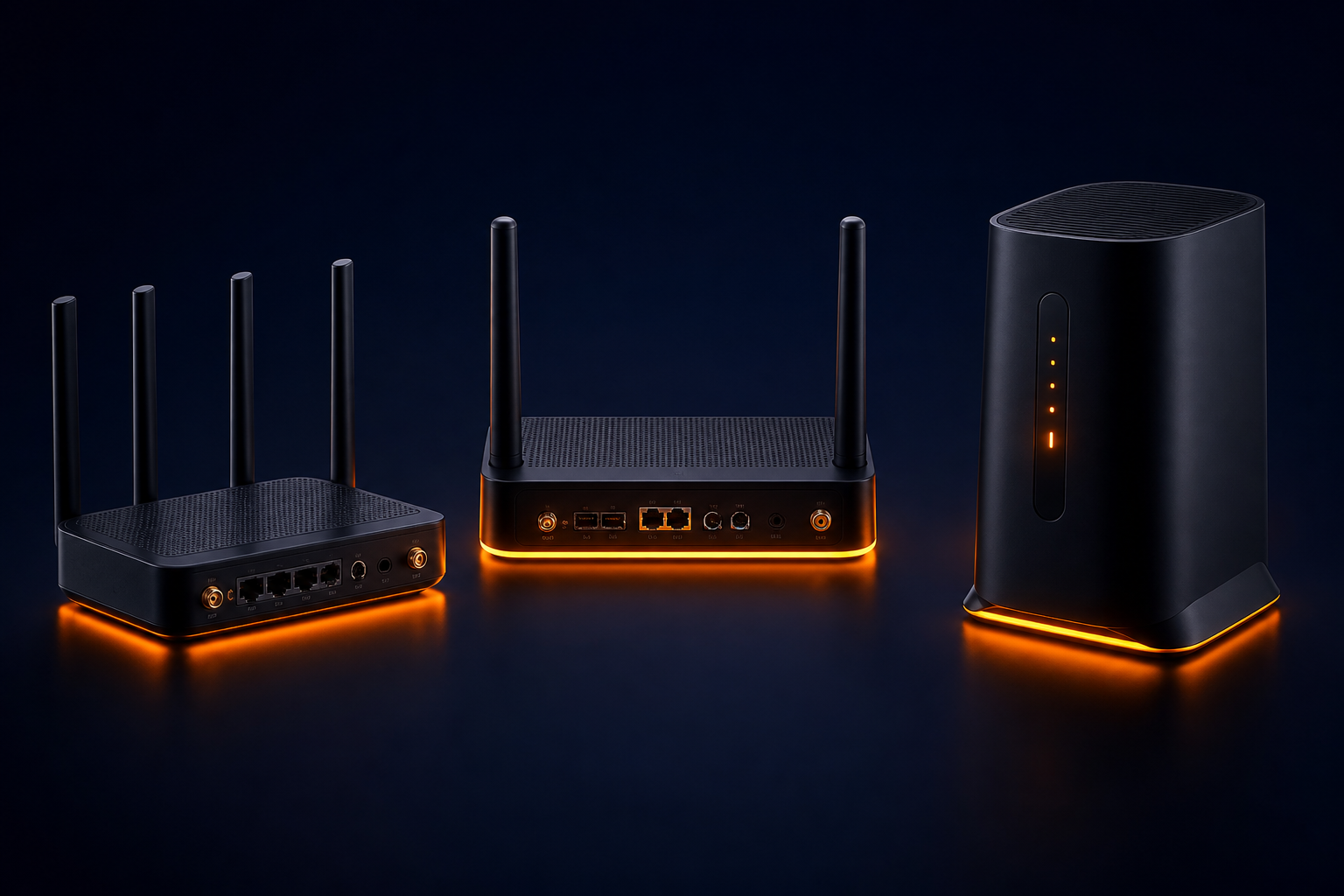
For ISPs building or expanding fixed wireless access (FWA) networks in 2026, the CPE (Customer Premises Equipment) selection process is the single most impactful procurement decision. The right device determines service quality, subscriber satisfaction, and operational margins. The wrong one leads to a cascade of truck rolls, churn, and margin erosion. This guide outlines the five critical evaluation criteria ISPs should apply when selecting 5G CPE for multi-tenant, residential, and small-business broadband deployments.
1. Chipset Platform: The Foundation of CPE Performance
The chipset inside a 5G CPE defines its carrier aggregation capability, power efficiency, and firmware upgrade path. In 2026, ISPs should prioritize devices built on:
Qualcomm X75/X80 series — supports up to 6CC carrier aggregation, Release 17/18 features, AI-enhanced beam management, and sub-6 GHz + mmWave operation.
MediaTek T830 — cost-effective 5G platform with 4CC CA, suitable for mid-tier FWA plans targeting 500 Mbps–1 Gbps throughput.
Key evaluation questions: Does the chipset support the operator’s specific band combinations? Can Release 18 features be enabled via firmware, or do they require a hardware swap? What is the vendor’s roadmap for 3GPP Release 19 readiness?
2. Multi-Tenant Capabilities: WiFi, VLAN, and QoS
ISPs serving multi-dwelling units (MDUs), hotels, and student housing need CPE that goes beyond basic NAT routing. Essential features include:
WiFi 7 (802.11be) with Multi-Link Operation (MLO) — supports 50+ concurrent devices with deterministic latency, critical for MDU deployments.
Per-SSID bandwidth throttling — allows ISPs to offer tiered speed plans (100 Mbps / 500 Mbps / 1 Gbps) from a single CPE.
TR-369 USP (User Services Platform) — modern remote management protocol that replaces TR-069 for bulk provisioning, monitoring, and firmware upgrades.
3. WAN Reliability: Dual SIM, Failover, and SD-WAN Integration
ISP-grade CPE must maintain service continuity. Look for:
Dual SIM with automatic failover — essential for ISPs operating across multiple MNO partnerships or in regions with uneven coverage.
Ethernet WAN failover — allows CPE to fall back to DSL, cable, or fiber when 5G signal degrades.
Embedded SD-WAN capabilities — application-aware routing that prioritizes VoIP and video conferencing traffic over the lowest-latency WAN link.
4. Total Cost of Ownership (TCO): Beyond the Unit Price
ISPs should model TCO over a 3–5 year lifecycle, not just compare unit pricing. Key TCO drivers:
Cost Factor
Impact
Mitigation
Power consumption
$8–15/year per device at 10W idle
Select CPE with Release 18 deep-sleep modes
Truck rolls
$150–300 per visit
TR-369 remote provisioning + AI beam management
Firmware updates
Engineering time + bandwidth
OTA with delta updates; multicast delivery for bulk
Hardware refresh
2–4 year cycle
Chipset with field-upgradable firmware path
5. OEM/ODM Customization: Branding, Firmware, and Bands
Leading ISPs increasingly demand customized CPE rather than off-the-shelf retail devices. When evaluating OEM/ODM partners like Honlly Telecom, confirm:
Custom branding — logo, packaging, web UI, and mobile app white-labeling.
Band customization — RF calibration for specific regional band combinations (e.g., n77+n78 for Asia-Pacific, n48 CBRS for North America).
Regulatory pre-certification — FCC, CE, GCF, and local regulatory compliance handled by the manufacturer.
Recommended 5G CPE for ISP Deployments in 2026
Based on the criteria above, here are the top CPE categories and recommended models from Honlly Telecom’s portfolio:
Indoor 5G CPE for residential ISPs:HL-830M 5G NR WiFi 6 CPE — ideal for single-family homes and small MDUs, supporting 5G NR with carrier aggregation.
High-performance indoor CPE for premium plans:HL-875H 5G Indoor Router — designed for gigabit-tier FWA plans with advanced WiFi and multi-gigabit Ethernet.
Outdoor CPE for rural FWA:HL-880U 5G Outdoor CPE — IP67-rated outdoor unit with high-gain antennas for extended range deployments.
Cost-effective CAT6 for entry-tier plans:HL-620 CAT6 Indoor CPE — LTE CAT6 with WiFi 5, ideal for budget broadband tiers in emerging markets.
Frequently Asked Questions
Q: What chipset should ISPs look for in 5G CPE in 2026? Prioritize Qualcomm X75/X80 or MediaTek T830. Verify band support and Release 18 upgrade path.
Q: TR-069 vs TR-369 for CPE management? TR-369 USP is the modern standard with real-time telemetry and bulk provisioning—strongly recommended for 2026 deployments.
Q: Indoor or outdoor CPE for FWA? Indoor for strong-signal urban areas; outdoor with high-gain antennas for rural and fringe-coverage deployments (6–10 dB better reception).
Q: What WiFi standard for ISP CPE in 2026? WiFi 7 (802.11be) with MLO for premium tiers; WiFi 6 still viable for budget plans.
Q: How to reduce CPE TCO? Energy-efficient chipsets, TR-369 remote management, OEM/ODM bulk customization, and firmware-upgradable hardware.
Operators and distributors managing CPE deployments across multiple regions face a uniquely complex procurement challenge. One country may require CAT4 LTE devices for entry-level broadband while a neighboring market demands 5G FWA with carrier aggregation. Power infrastructure varies dramatically. Regulatory certification requirements differ. And subscribers in different markets have widely different willingness-to-pay thresholds. Building a single CPE portfolio that works across all these conditions without overcomplicating inventory, support, and lifecycle management is one of the hardest problems in telecom procurement.
This guide provides a practical framework for operators, ISPs, and regional distributors to build a future-proof CPE portfolio — one that balances cost, performance, and operational simplicity across diverse deployment regions.
The Multi-Region CPE Challenge: Why One-Size-Fits-All Fails
A CPE procurement strategy built for a single market breaks down quickly when applied across regions. Here are the five dimensions where regional differences create portfolio complexity:
1. Network Maturity
Markets fall along a spectrum from 2G/3G sunset to pure 5G SA. A CPE portfolio must span this range without carrying redundant SKUs. In Sub-Saharan Africa, CAT4 and CAT6 LTE CPE remain the volume drivers through 2027. In the Middle East and developed Southeast Asia, 5G FWA is already the primary broadband access technology for new deployments.
2. Power Infrastructure
Grid reliability varies dramatically. An outdoor CPE deployed in peri-urban Nigeria or rural Indonesia needs battery backup integration. The same CPE deployed in Dubai or Singapore may not. Building battery options into the portfolio — without forcing them on all markets — is essential for cost optimization.
3. Regulatory and Certification
Each region has its own regulatory framework. CE marking for Europe, FCC for North America, ANATEL for Brazil, NCC for Nigeria, SIRIM for Malaysia. A CPE SKU certified for one market may require re-testing for another. Smart portfolio design minimizes the number of unique hardware variants while maximizing certification coverage.
4. Spectrum Band Fragmentation
The LTE and 5G NR bands in use vary by country. A CPE that covers B1/B3/B7/B20 for Europe may miss B28 (700 MHz) required in parts of Asia-Pacific and Latin America, or B40/B41 (TDD 2.3/2.5 GHz) commonly used in Africa and the Middle East. Band coverage must be mapped to deployment regions at the SKU level.
5. Subscriber Economics
ARPU in Switzerland may be $40–60 per month. ARPU in rural Kenya may be $5–10. The CPE that works economically in one market may be completely unviable in another. Tiered portfolio design — with clear performance-to-price segmentation — is essential.
A Four-Tier CPE Portfolio Framework
Based on deployment patterns across 40+ countries, we recommend structuring a multi-region CPE portfolio into four tiers:
Tier
Technology
Target Throughput
Use Case
Example Markets
Tier 1: Entry
LTE CAT4/CAT6
50–150 Mbps
Basic home broadband, rural FWA
Sub-Saharan Africa, rural South Asia, remote LATAM
Tier 2: Mid-Range
LTE CAT12 / 5G RedCap
150–300 Mbps
Urban FWA, SME broadband
Southeast Asia, North Africa, urban LATAM
Tier 3: Premium
5G Sub-6 GHz (CAT19+)
300 Mbps–1 Gbps
Premium FWA, enterprise branch
GCC, Western Europe, developed APAC
Tier 4: Performance
5G mmWave + WiFi 7
1–4 Gbps
Fixed wireless for MDUs, campus, high-density urban
North America, Japan, South Korea, urban GCC
The key insight: most operators serving multi-region deployments will live primarily in Tiers 1–3. Tier 4 (mmWave) remains niche outside a handful of markets. The sweet spot for portfolio investment in 2026 is the Tier 2–3 bridge — ensuring a smooth 4G-to-5G migration path that covers 80+ percent of subscriber use cases with three to five hardware variants.
Outdoor vs Indoor: When the Enclosure Matters
The choice between indoor and outdoor CPE is one of the most consequential decisions in multi-region portfolio design. It affects unit cost, installation complexity, signal performance, and long-term maintenance.
Choose Indoor CPE When:
Network signal strength at the subscriber premises is consistently good (RSRP > -105 dBm)
Self-installation by the end user is the preferred deployment model
Per-unit cost is the primary constraint
The deployment is in urban or suburban areas with good base station density
Choose Outdoor CPE When:
Signal strength at the premises is marginal or variable (RSRP < -105 dBm in typical locations)
Higher gain through external antenna placement can substantially improve throughput
The CPE needs to withstand extreme weather (IP65/IP67 required)
Vandalism or theft risk makes outdoor mounting preferable to indoor placement near windows
A practical rule: if more than 30 percent of target subscribers in a given region show marginal indoor signal, budget for outdoor CPE in the portfolio for that region. The incremental unit cost is offset by lower churn, fewer support calls, and better subscriber experience.
Power Backup: When It’s Non-Negotiable
In markets with unreliable grid power — much of Sub-Saharan Africa, parts of South Asia, rural Southeast Asia, and remote Latin America — a CPE without battery backup is a CPE that stops working daily. The subscriber experience degrades, churn increases, and support costs rise.
Honlly’s approach embeds a Mini UPS option into the CPE portfolio rather than treating power backup as an add-on accessory. The HL-4000AR — a CAT6 outdoor CPE with integrated 48W Mini UPS and 6000mA battery — exemplifies this design philosophy. The battery is part of the indoor router unit, not a separate SKU, simplifying procurement, warehousing, and deployment logistics.
For multi-region operators, the recommendation is straightforward: include battery backup as a built-in option in the CPE portfolio for any region where average daily grid outage exceeds two hours. The incremental BOM cost of an integrated battery solution is typically recovered within the first year through reduced churn and support costs.
Management Platform Compatibility: TR-069, TR-369, and Beyond
A CPE portfolio spanning regions and technologies only works if all devices can be managed through a unified platform. The three pillars of multi-region CPE management are:
TR-069 (CWMP): The most widely deployed CPE management protocol globally. Essential for operators using existing ACS platforms. All Honlly CPE supports TR-069 with comprehensive parameter coverage.
TR-369 (USP): The modern successor to TR-069, designed for the 5G and IoT era. Supports bulk data collection, secure IoT device management, and more efficient communication. Recommended for new deployments.
Multi-tenancy ACS: For distributors managing devices on behalf of multiple operators, a multi-tenant ACS platform allows per-operator configuration, monitoring, and firmware management without cross-customer data leakage.
Before finalizing a multi-region CPE portfolio, verify that every SKU in the plan supports the management protocol used by your operations team. Mixing TR-069-only and TR-369-only devices in the same deployment creates operational silos that erode the efficiency gains of a unified portfolio strategy.
Practical Portfolio Design: A Step-by-Step Process
Map your markets: List every country and region where CPE will be deployed in the next 24 months. For each, document: network maturity (4G/5G NSA/5G SA), key spectrum bands, power infrastructure reliability, regulatory certification requirements, and target subscriber ARPU.
Define throughput tiers: Group markets by required throughput. You will typically find three to four clusters that map naturally to the four-tier framework above.
Select platform candidates: For each tier, identify CPE platforms that cover the required band set, meet the certification list, and include the right management protocol support.
Minimize SKU count: Look for platforms that can serve multiple regions with software-defined band configurations or minimal hardware variants. A single CPE platform with region-specific firmware builds is far more operationally efficient than five different hardware SKUs.
Validate TCO: Calculate total cost of ownership per region, including unit cost, installation, support, churn, and lifecycle management. The cheapest per-unit CPE is rarely the cheapest over a three-year deployment lifecycle.
The Honlly Multi-Region CPE Advantage
Honlly Telecom’s CPE portfolio is purpose-built for multi-region operator deployments. Key advantages include:
Unified management: All Honlly CPE — from CAT4 LTE to 5G — supports both TR-069 and TR-369, enabling single-pane-of-glass management across the entire portfolio.
Flexible band configurations: Regional band variants are managed through software configuration and targeted hardware SKUs, minimizing the number of unique platform designs.
Integrated power backup: Battery options are built into the CPE design, not bolted on as aftermarket accessories.
Regional certification coverage: Honlly CPE carries CE, FCC, ANATEL, and multiple regional certifications for Africa, Southeast Asia, and the Middle East.
Manufacturing scale: With 500,000-unit monthly capacity from our Xiamen facility, Honlly supports volume deployments across multiple regions simultaneously.
For operators planning or expanding multi-region CPE deployments, contact Honlly’s solutions team to discuss your specific market requirements and receive a tailored portfolio recommendation.
Frequently Asked Questions
How many CPE SKUs do I need for a 5-country deployment?
Typically 3–5 hardware SKUs can cover a 5-country deployment when platforms are selected for multi-region band coverage and software-configurable features. The exact number depends on spectrum band diversity, certification requirements, and power infrastructure differences across your target countries.
Should I standardize on one CPE manufacturer for all regions?
Single-manufacturer portfolios reduce management complexity, simplify firmware maintenance, and often achieve better volume pricing. However, supply chain resilience argues for at least a qualified second source for high-volume SKUs. A practical approach is a primary manufacturer for 80%+ of volume with a qualified secondary source for continuity.
When should I transition from LTE to 5G CPE in emerging markets?
Transition timing depends on 5G SA core availability in each market. As a general guideline: begin 5G CPE procurement when 5G SA coverage reaches 40%+ of your target subscriber footprint in a given region. Before that threshold, LTE CPE (CAT6–CAT12) provides better cost efficiency. 5G RedCap offers a bridging option for markets in the 20–40% coverage range.
Does Honlly provide region-specific firmware customization?
Yes. Honlly offers firmware customization including region-specific band configurations, carrier IMS/APN settings, localized Web GUI languages, and operator-specific branding. Custom firmware builds are manageable at volumes of 1,000+ units per variant.
How does Honlly handle multi-region logistics and after-sales support?
Honlly provides direct shipping to regional hubs and supports local warehousing partnerships in key markets. After-sales support includes remote diagnostics via TR-069/TR-369, RMA processing, and firmware-over-the-air (FOTA) update capability for field-deployed devices. Contact our sales team for region-specific logistics arrangements.