Author: openclaw-Lisa-New

  • 5G-Advanced (3GPP Release 18) Commercial Readiness Accelerates: What Telecom Buyers Need to Know About AI-Native RAN, FeMIMO, and NR Multicast for CPE Procurement in 2026

    5G-Advanced (3GPP Release 18) Commercial Readiness Accelerates: What Telecom Buyers Need to Know About AI-Native RAN, FeMIMO, and NR Multicast for CPE Procurement in 2026

    The 3GPP Release 18 specification freeze in mid-2024 formally inaugurated the 5G-Advanced era. Now, in mid-2026, the first wave of Release 18-compliant infrastructure and chipset platforms is reaching commercial maturity — with direct consequences for CPE procurement across the telecom supply chain. For ISPs, mobile operators, MVNOs, and enterprise buyers evaluating next-generation customer premises equipment, understanding which 5G-Advanced features will materialize in shipping CPE silicon over the next 12–18 months is becoming a critical sourcing competency.

    What 5G-Advanced Changes for CPE

    5G-Advanced is not a generational leap like the 4G-to-5G transition. Rather, Release 18 layers intelligence, efficiency, and new service capabilities onto the existing 5G NR foundation. Three feature groups carry the most weight for CPE design and procurement:

    1. AI/ML-Native Air Interface (AI4RAN)

    Release 18 introduces standardized frameworks for AI/ML-based channel state information (CSI) feedback compression, beam management, and positioning accuracy enhancement. For CPE, this translates into modem-side inference capability. Qualcomm’s Snapdragon X80 and MediaTek’s T830 platforms — both sampling in 2026 — integrate dedicated AI tensor accelerators alongside the 5G baseband. The practical outcome for operators: up to 15–25% improvement in cell-edge throughput and 10–18% reduction in handover latency in multi-cell deployments, based on early vendor field trials reported at MWC 2026.

    Procurement implication: RFPs issued in H2 2026 should explicitly request AI-native modem capability with Rel-18 CSI compression support. CPE without this capability will underperform in dense urban and cell-edge scenarios by 2027.

    2. Further Enhanced MIMO (FeMIMO)

    Release 18 extends multi-TRP (multi-transmission reception point) operation with coherent joint transmission across up to 4 TRPs, and increases the number of supported SRS ports for uplink MIMO to 8. For fixed wireless access CPE — particularly outdoor units with directional antenna arrays — FeMIMO enables more granular beam refinement in non-line-of-sight suburban and rural deployments. Early testing by a Tier-1 European operator demonstrated 30–40% downlink throughput gains at 3.5 GHz using 8-layer FeMIMO CPE prototypes compared to Rel-17 4-layer configurations.

    3. NR Multicast-Broadcast Services (NR MBS)

    Release 18 evolves NR MBS with service continuity across gNB boundaries and dynamic resource allocation between unicast and multicast traffic. For CPE vendors, this opens a new product category: hybrid unicast-multicast gateways capable of receiving broadcast IPTV and OTT video streams over 5G infrastructure while simultaneously serving unicast enterprise traffic. Operators in South Korea and Germany have already announced MBS-based IPTV trials using prototype CPE, targeting commercial launch in early 2027.

    Chipset and CPE Roadmap: 2026–2027

    The commercial timeline is consolidating around three phases:

    • H2 2026: First Rel-18 modem samples (Qualcomm X80, MediaTek T830, Samsung Exynos 5400). CPE reference designs available to ODM partners. Early operator lab trials begin.
    • H1 2027: Rel-18 CPE in carrier certification cycles. Commercial-grade FWA and enterprise CPE products reach general availability from Tier-1 ODMs.
    • H2 2027: Volume shipments. Rel-18 features become table stakes for premium-tier FWA CPE. Rel-17 devices begin price-down cycle for cost-sensitive segments.

    What Telecom Buyers Should Do Now

    Telecom procurement teams do not need to wait for 2027 to act. Five near-term actions add immediate value:

    1. Update CPE technical specifications to include Rel-18 readiness clauses — even if delivery is scheduled for 2027, requiring Rel-18 modem architecture in RFP responses ensures vendors commit to the upgrade path.
    2. Request AI/ML modem capability roadmaps from incumbent CPE suppliers. Differentiate between software-upgradable Rel-17 modems and hardware-dependent Rel-18 features.
    3. Evaluate FeMIMO antenna configurations for outdoor FWA CPE. The jump from 4-layer to 8-layer MIMO requires physical antenna array changes that cannot be retrofitted via firmware.
    4. Monitor NR MBS service launches in your target markets. Operators planning IPTV-over-5G will need MBS-capable CPE — creating a first-mover advantage for early adopters.
    5. Align procurement cycles with the H1 2027 certification window. Issuing RFPs in Q3–Q4 2026 positions operators to receive Rel-18 CPE shipments aligned with carrier approval timelines.

    Market Outlook

    ABI Research projects that 5G-Advanced CPE will account for 22% of total FWA CPE shipments by 2028, driven primarily by operator demand for AI-enhanced spectral efficiency and MBS-enabled service differentiation. The transition is incremental rather than disruptive — but for procurement teams, the window to secure Rel-18 roadmap commitments from CPE vendors is narrowing. Operators that embed 5G-Advanced requirements into their 2026 RFPs will be positioned to deploy differentiated services in 2027, while those that wait risk a 12–18 month procurement lag behind early movers.


    Frequently Asked Questions

    What is 5G-Advanced and how is it different from 5G?

    5G-Advanced is the 3GPP designation for Releases 18, 19, and 20 — the mid-life evolution of 5G NR. Unlike the 4G-to-5G transition, 5G-Advanced introduces incremental but commercially significant enhancements including AI-native air interface optimization, enhanced MIMO (FeMIMO), NR multicast-broadcast, and extended reality (XR) optimizations, all within the existing 5G NR framework.

    When will 5G-Advanced CPE be commercially available?

    First commercial-grade 5G-Advanced CPE products are expected to reach general availability in H1 2027, following modem sampling in H2 2026 and carrier certification cycles. Volume shipments are projected for H2 2027.

    Should I delay CPE procurement to wait for 5G-Advanced?

    Not necessarily. Rel-17 CPE remains the appropriate choice for current deployments through mid-2027. However, RFPs issued from Q3 2026 onward should include Rel-18 readiness requirements to ensure vendors commit to the 5G-Advanced upgrade path for deliveries scheduled in 2027 and beyond.

    Which 5G-Advanced features matter most for FWA CPE?

    AI/ML-based CSI compression and beam management offer the most tangible near-term throughput and reliability gains. FeMIMO (8-layer) substantially improves cell-edge and NLOS performance for outdoor CPE. NR MBS creates new service revenue opportunities for operators offering IPTV or multicast content delivery.

    Does Honlly Telecom offer 5G-Advanced ready CPE?

    Honlly Telecom’s 5G CPE product roadmap aligns with the 3GPP Release 18 commercial timeline. Our engineering team is actively engaged with leading chipset vendors on Rel-18 reference designs. Contact our solutions team to discuss your 5G-Advanced CPE requirements and procurement timeline.


    Ready to plan your 5G-Advanced CPE procurement strategy?
    Contact Honlly Telecom’s solutions team for a confidential consultation on Rel-18 roadmap alignment, chipset selection, and custom CPE development.
    Talk to Our Engineering Team →
  • Industrial 4G/5G Router Selection for Smart Grid Deployments: Protocol Support, Cybersecurity Certification, and Environmental Hardening Requirements

    Industrial 4G/5G Router Selection for Smart Grid Deployments: Protocol Support, Cybersecurity Certification, and Environmental Hardening Requirements

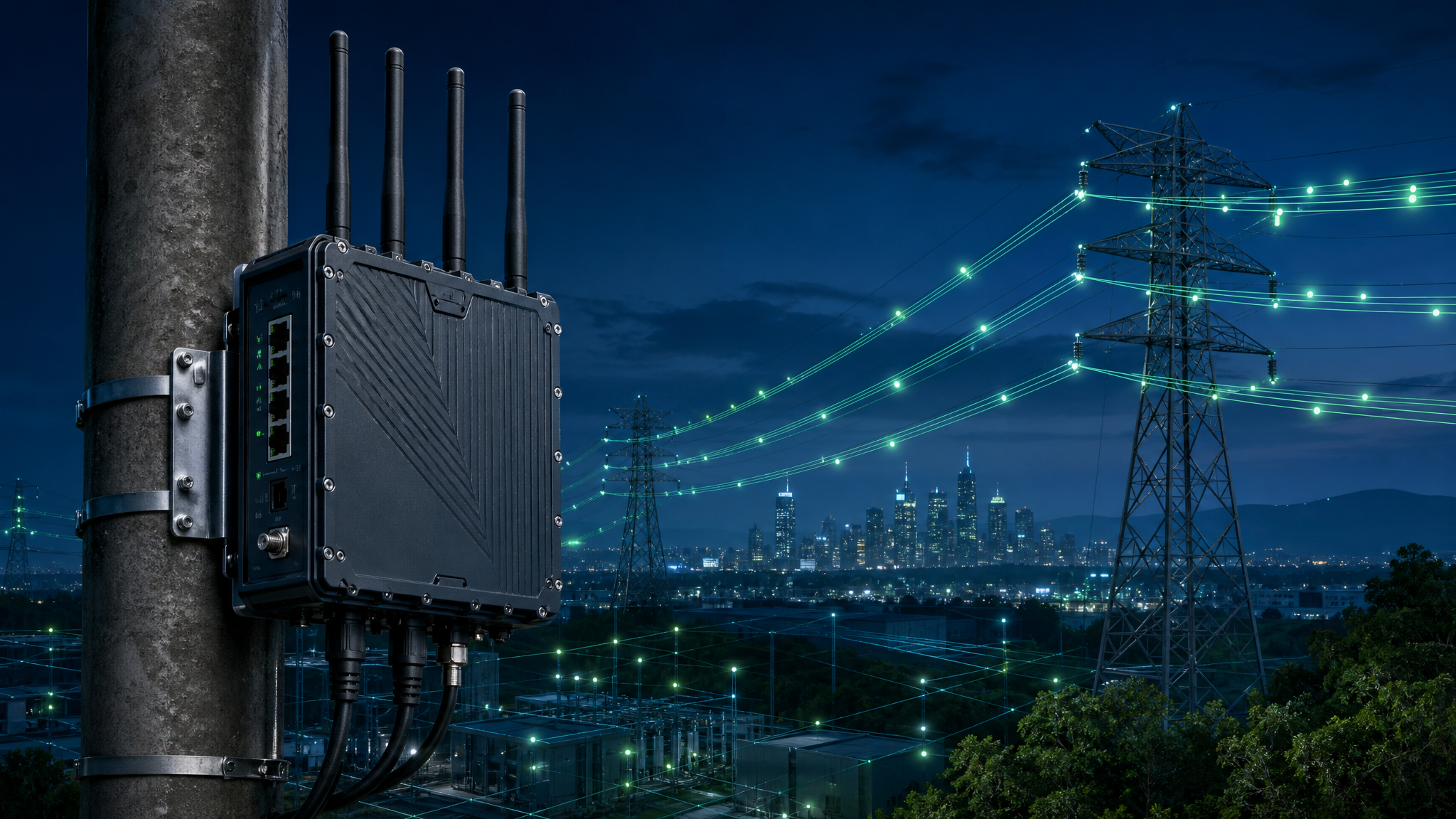
    Smart grid modernization is one of the largest and most sustained drivers of industrial cellular router deployments globally. Utility operators — from transmission system operators (TSOs) to distribution network operators (DNOs) — are deploying tens of thousands of 4G and 5G routers across substations, reclosers, capacitor banks, and distributed energy resource (DER) controllers. Selecting the wrong router for these environments is not an inconvenience; it is a regulatory compliance risk and a grid reliability liability.

    The Utility Communications Landscape

    Modern grid communications span a wide operational technology (OT) stack, each layer imposing distinct requirements on the CPE:

    • Substation automation (IEC 61850): GOOSE (Generic Object Oriented Substation Event) messaging requires sub-4ms latency within the substation LAN, demanding CPE with hardware-accelerated switching and IEEE 1588v2 Precision Time Protocol (PTP) support for synchrophasor applications.
    • SCADA backhaul (DNP3, IEC 60870-5-104): Polled protocols with 2-5 second scan intervals. Reliable TCP session persistence across cellular network transitions is critical — dropped SCADA sessions trigger nuisance alarms at the control center.
    • DER management (IEEE 1547-2018, SunSpec Modbus): Inverter and battery energy storage system (BESS) controllers require always-on IP connectivity with the utility’s Distributed Energy Resource Management System (DERMS). Latency requirements are moderate (100-500ms), but connection uptime expectations exceed 99.95%.
    • Advanced metering infrastructure (AMI) backhaul: Concentrator/router devices aggregate meter reads from hundreds of endpoints and backhaul via cellular. Throughput requirements are modest (1-5 Mbps), but session density and simultaneous TCP connections can reach thousands per device.

    Environmental Hardening: Beyond the IP Rating

    Utility deployments expose cellular routers to conditions that consumer and enterprise-grade CPE cannot survive. The minimum environmental specification for substation and field-area network deployments is:

    ParameterMinimum RequirementApplicable Standard
    Operating temperature-40°C to +75°CIEC 60068-2-1/2/14
    Ingress protectionIP65 (pole-mount), IP40 (cabinet-mount)IEC 60529
    Surge protection6 kV line-to-ground (power), 4 kV (Ethernet)IEC 61000-4-5 Level 4
    ESD immunity15 kV air, 8 kV contactIEC 61000-4-2 Level 4
    Vibration resistance5-500 Hz, 5g operationalIEC 60068-2-6
    EMI/EMCClass A industrial emissions, 10 V/m radiated immunityIEC 61000-6-4, IEC 61000-4-3
    Altitude4,000m operationalIEC 60068-2-13

    A critical but often overlooked requirement: conformal coating of PCB assemblies. Substation environments contain hydrogen sulfide (H₂S) and sulfur dioxide (SO₂) from SF6-insulated switchgear decomposition. These gases corrode unprotected copper traces within 12-18 months. Utility-grade routers must specify conformal coating per IPC-CC-830B or IEC 61086.

    Cybersecurity Certification Requirements

    The regulatory landscape for utility OT cybersecurity has hardened significantly, particularly in North America and Europe:

    North America: NERC CIP Compliance

    Any router deployed within an electronic security perimeter (ESP) at a bulk electric system (BES) cyber asset must support the controls mandated by NERC CIP-005-7 (Electronic Security Perimeters) and CIP-007-6 (Systems Security Management). Practically, this means:

    • IEEE 802.1X port-based network access control with EAP-TLS certificate-based authentication
    • Centralized syslog export (TLS-encrypted) to SIEM for all authentication, authorization, and configuration change events
    • Role-based access control (RBAC) with minimum 3 privilege levels (viewer, operator, administrator)
    • FIPS 140-3 validated cryptographic module for IPsec VPN termination
    • Secure boot with hardware root of trust (TPM 2.0) and signed firmware verification at every boot cycle
    • Configurable session timeout and account lockout after N failed attempts

    Europe: NIS2 Directive and ENISA Frameworks

    Under the NIS2 Directive (EU 2022/2555), electricity distribution and transmission operators are classified as “essential entities” and must implement proportionate technical security measures. CPE deployed in European utility networks should demonstrate:

    • IEC 62443-4-2 certification (Security for industrial automation and control systems — component level), at minimum Security Level 2 (SL2)
    • Common Criteria EAL4+ or equivalent for the embedded operating system
    • EU RED (Radio Equipment Directive) cybersecurity delegated act compliance for wireless devices (mandatory from August 2025)
    • Support for certificate lifecycle management via EST (RFC 7030) or CMPv2 for SCEP-less certificate renewal

    Protocol and Interface Requirements

    Utility OT networks use a distinct protocol stack that differs significantly from enterprise IT environments. The cellular router must natively support or transparently tunnel:

    ProtocolTransportUtility Application
    IEC 61850 MMS/GOOSETCP/IP, L2 multicastSubstation automation, protection relaying
    DNP3TCP/IP, serial (RS-232/485)SCADA RTU/IED polling
    IEC 60870-5-104TCP/IPTelecontrol between control center and substation
    Modbus TCP/RTUTCP/IP, serial (RS-485)DER controllers, battery management, legacy RTUs
    IEEE C37.118.2TCP/IPSynchrophasor data streaming (PMU to PDC)
    IEEE 1588v2 PTPL2/L3 multicast/unicastSubstation time synchronization (<1μs accuracy)

    Serial interface support (RS-232 and RS-485 with terminal server functionality) remains essential even in 2026, as a substantial installed base of utility RTUs, protective relays, and meter concentrators communicate exclusively over serial connections. The router must function as a serial-to-IP gateway, encapsulating serial data into TCP or UDP streams with configurable packetization timers.

    Power Supply and Redundancy

    Substation-grade routers must accept wide-range DC input (typically 24-60 VDC or 88-300 VDC for substation battery bank compatibility) with dual redundant inputs and automatic failover. Key specifications:

    • Dual DC inputs with diode-OR isolation to prevent backfeed
    • Input voltage surge withstand: 2.5× nominal for 1 second (per IEEE 1613 for substation environments)
    • Power consumption: ≤15W typical for LTE routers, ≤25W for 5G NR routers (excluding PoE budget)
    • PoE/PoE+ output (up to 30W per port, IEEE 802.3at) for powering connected cameras, sensors, or Wi-Fi APs at remote sites lacking separate power infrastructure
    • Supercapacitor or battery-backed RTC for maintaining accurate timestamps through extended power outages

    RFP Evaluation Checklist for Utility Operators

    When evaluating industrial cellular routers for smart grid deployment, utility procurement teams should verify:

    1. Certification evidence: Request valid IEC 61850-3 / IEEE 1613 compliance test reports, not just manufacturer self-declarations. These standards mandate specific EMI, temperature, and surge immunity tests performed by accredited laboratories.
    2. NERC CIP or NIS2 compliance documentation: The vendor should provide a compliance matrix mapping router features to each applicable CIP/NIS2 requirement with implementation evidence.
    3. Serial terminal server capability: Verify raw TCP and RFC 2217 Telnet COM port support with per-port configuration persistence across reboots.
    4. Field replacement MTTR: Request zero-touch replacement procedures — a replacement router should auto-provision from a configuration backup stored in the operator’s ACS or TR-369 USP controller without requiring a field technician to apply configuration manually.
    5. Supply chain security: Verify that the router’s firmware build process, silicon provenance, and software bill of materials (SBOM) meet utility supply chain risk management requirements per NERC CIP-013-1 or NIS2 Article 21.

    Frequently Asked Questions

    What environmental certifications are required for utility substation routers?

    Utility substation routers must meet IEC 61850-3 and IEEE 1613 standards for communications equipment in electric power substations. Key requirements include -40°C to +75°C operating temperature range, 6kV surge immunity (IEC 61000-4-5 Level 4), and 15kV ESD protection. Conformal coating per IPC-CC-830B is essential for protection against corrosive gases (H₂S, SO₂) present in substation environments.

    What cybersecurity certifications do industrial routers need for NERC CIP compliance?

    For NERC CIP compliance, industrial cellular routers deployed within BES cyber asset electronic security perimeters must support IEEE 802.1X with EAP-TLS authentication, FIPS 140-3 validated cryptographic modules, TPM 2.0 secure boot, TLS-encrypted centralized logging, RBAC with minimum 3 privilege levels, and configurable session/account lockout policies. Vendors should provide a NERC CIP compliance matrix with implementation evidence for each requirement.

    Why do smart grid routers still need serial ports (RS-232/RS-485) in 2026?

    Despite IP-based modernization, a large installed base of utility RTUs, protective relays, recloser controllers, and meter concentrators communicate exclusively over RS-232 or RS-485 serial interfaces. These devices have 15-25 year field lifespans and are not replaced during communication network upgrades. Industrial cellular routers must function as serial-to-IP gateways, encapsulating serial protocol data (DNP3, Modbus RTU, IEC 60870-5-101) into TCP/UDP streams for backhaul over cellular networks.

    Deploying smart grid communication infrastructure? Contact Honlly Telecom to discuss industrial-grade 4G/5G routers with IEC 61850-3 compliance and utility cybersecurity certification.

  • Multi-WAN Failover and SD-WAN Integration Architecture for 5G CPE: Building Network Resilience for Enterprise Branch and ISP Deployments

    Multi-WAN Failover and SD-WAN Integration Architecture for 5G CPE: Building Network Resilience for Enterprise Branch and ISP Deployments

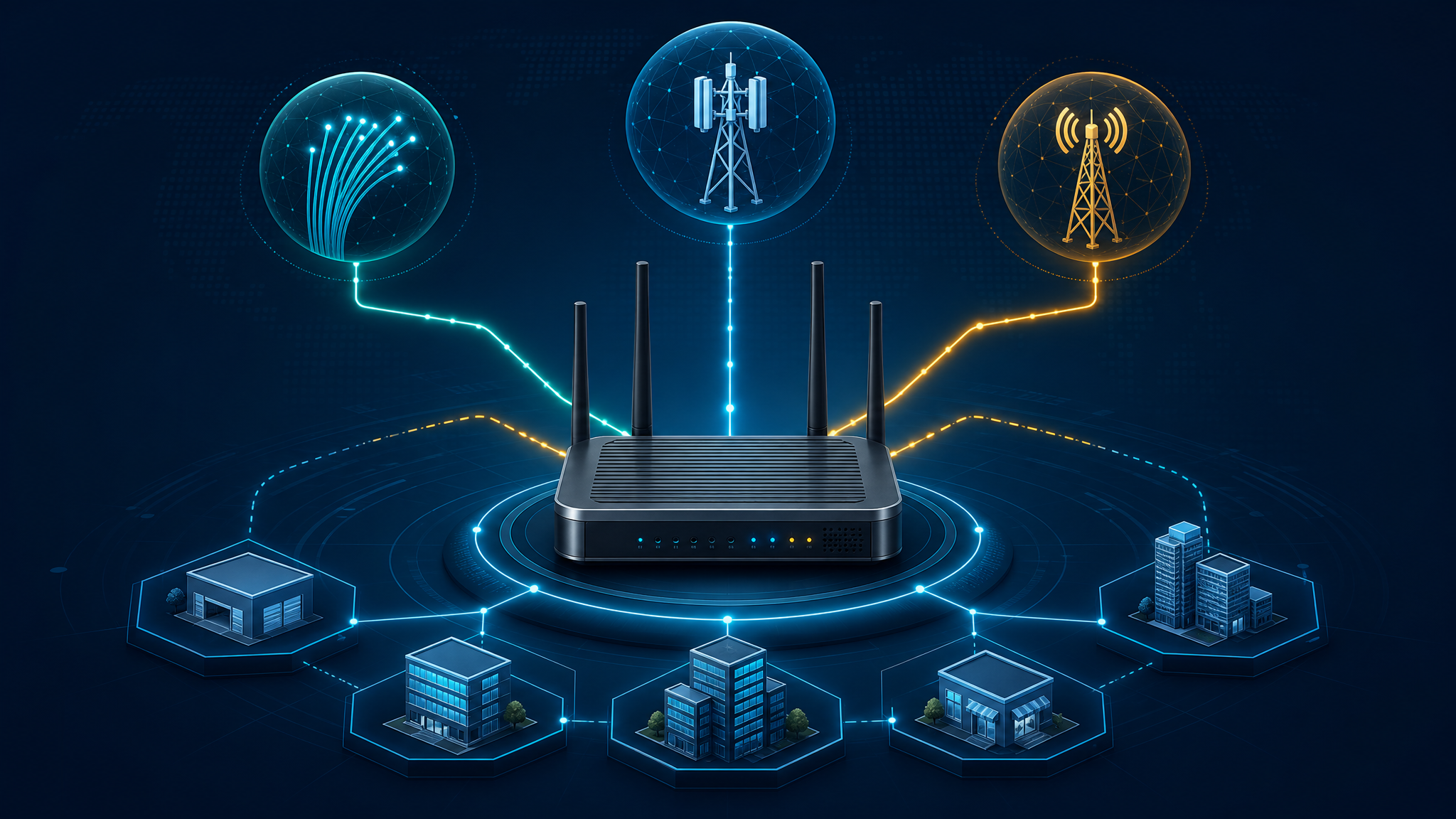
    For ISPs and enterprise network architects deploying 5G fixed wireless access at branch offices, retail locations, and remote sites, network resilience is not optional — it is a contractual SLA obligation. A single WAN link over 5G, however fast, introduces a critical single point of failure. The industry response in 2026 is multi-WAN CPE architectures with integrated SD-WAN intelligence, combining fiber, 5G, and 4G LTE paths into a unified resilience fabric managed at the customer premises.

    The Multi-WAN Imperative for 5G CPE

    Real-world 5G FWA deployments face several availability challenges that multi-WAN architectures directly address:

    • Cell site maintenance windows: Even Tier-1 operators schedule 2-4 maintenance events per cell site annually, each causing 2-6 hours of downtime. A secondary WAN path eliminates customer-facing outages during these windows.
    • 5G mmWave rain fade: Operators deploying 28 GHz and 39 GHz bands report up to 8 dB/km additional attenuation during heavy rainfall, sufficient to drop connections at cell edges. Automatic failover to sub-6 GHz 5G or LTE preserves connectivity.
    • Core network congestion: During peak hours, 5G user-plane throughput can degrade below SLA thresholds. Policy-based traffic steering to a fiber or alternate 5G path maintains critical application performance.
    • Fiber backhaul cuts: In hybrid fiber-plus-5G deployments, construction-related fiber cuts are the most common cause of extended outages. 5G WAN failover provides sub-second recovery.

    Multi-WAN Architecture Models

    Three dominant architectural patterns have emerged in 2026 CPE designs:

    1. Active-Standby with Path Monitoring

    The most widely deployed model for cost-sensitive ISP rollouts. The primary WAN interface (typically 5G NR or fiber) carries all traffic while the secondary interface (LTE or secondary 5G carrier) remains in hot standby. The CPE continuously monitors primary path health using ICMP probes, HTTP reachability checks, or BFD (Bidirectional Forwarding Detection) at configurable intervals as low as 300ms. On failure detection, failover completes within 1-3 seconds, including DHCP lease acquisition on the backup interface.

    Key capability for operators: pre-failover path quality verification. Advanced CPE implementations verify that the backup link has adequate signal quality (RSRP ≥ -110 dBm, SINR ≥ 0 dB) and throughput capacity before initiating failover, preventing flapping between degraded links.

    2. Active-Active Load Balancing with Application Steering

    Enterprise-grade CPE platforms support simultaneous active WAN paths with per-application or per-destination traffic distribution. This model uses policy-based routing (PBR) rules provisioned through the CPE management interface to steer traffic based on:

    • Application identification: Deep packet inspection (DPI) or SNI-based classification assigns VoIP and video conferencing to the lowest-latency path while bulk file transfers and cloud backups use the highest-throughput path.
    • Destination prefix: Traffic destined for specific IP ranges (e.g., AWS Direct Connect endpoints, corporate VPN concentrators) is pinned to specific WAN interfaces.
    • DSCP marking preservation: QoS markings are preserved and mapped to 5G QoS Flow Identifiers (5QI) on the cellular WAN path, ensuring end-to-end traffic class treatment.

    3. SD-WAN Overlay with Tunnel Bonding

    The most sophisticated model integrates an SD-WAN agent directly into the CPE software stack. All WAN interfaces — fiber, 5G NR, LTE, even satellite — terminate into SD-WAN tunnels (IPsec or WireGuard) that connect to an aggregation point (SD-WAN hub, cloud gateway, or carrier SD-WAN edge). The SD-WAN controller manages:

    • Per-packet tunnel bonding: Packet duplication and transmission across multiple WAN paths simultaneously, with the receiver accepting the first-arriving copy. This eliminates failover time entirely for loss-sensitive applications — the failover is packet-level, not session-level.
    • Forward error correction (FEC): Additional parity packets across tunnels enable loss recovery without retransmission, critical for real-time UDP traffic over cellular links.
    • Dynamic path selection: The SD-WAN controller continuously measures per-tunnel latency, jitter, and loss, and dynamically adjusts traffic distribution policies without CPE reboot or session interruption.

    CPE Hardware Requirements for Multi-WAN SD-WAN

    Not all 5G CPE hardware can effectively support multi-WAN and SD-WAN workloads. Operators evaluating CPE for resilient deployments should verify:

    1. CPU headroom: SD-WAN tunnel termination with IPsec encryption at 1 Gbps requires approximately 4 DMIPS per Mbps, or roughly a quad-core ARM Cortex-A55 at 1.8 GHz as a practical minimum. CPE based on low-power IoT-class processors will bottleneck at 150-300 Mbps of encrypted tunnel throughput.
    2. Hardware crypto acceleration: AES-NI or ARM Crypto Extensions support is essential for IPsec throughput above 500 Mbps. Software-only crypto on embedded CPE processors typically caps at 200-400 Mbps.
    3. Multiple independent WAN interfaces: At minimum: one 5G NR modem (3GPP Release 17+), one Gigabit Ethernet WAN port, and optionally a secondary cellular modem or SFP cage for fiber WAN. Avoid designs where the Ethernet port is LAN-only with no WAN routing capability.
    4. RAM and flash: Minimum 512 MB RAM and 256 MB flash for SD-WAN agent, routing table (full BGP feed not required at CPE level; default route plus specific prefixes is sufficient), and DPI signature database.

    Procurement Checklist for Operators

    When issuing RFPs for multi-WAN 5G CPE, operators should include these technical requirements:

    • Support for minimum 2 active WAN interfaces with independent IP addressing and routing tables
    • Path monitoring: ICMP, HTTP(S) GET, and BFD at configurable intervals down to 300ms
    • Failover time: ≤3 seconds from primary path failure to backup path active (measured at TCP session level)
    • Application-aware steering: DPI-based or at minimum DSCP-based with minimum 32 classification rules
    • SD-WAN tunnel support: IPsec IKEv2 and WireGuard with hardware-accelerated crypto, minimum 500 Mbps aggregate tunnel throughput
    • Zero-touch provisioning with pre-staged SD-WAN tunnel configurations via TR-369 USP or vendor ACS
    • Per-interface telemetry export (throughput, latency, jitter, packet loss) to operator NMS via NETCONF/YANG or gNMI

    Frequently Asked Questions

    What is the difference between multi-WAN failover and SD-WAN in 5G CPE?

    Multi-WAN failover provides basic link redundancy — switching traffic to a backup link when the primary fails. SD-WAN adds intelligent traffic steering across multiple active links based on application requirements, real-time path quality measurements, and centralized policy control. SD-WAN enables active-active link utilization, per-packet tunnel bonding, and application-aware routing that basic failover cannot provide.

    What CPU specifications are needed for SD-WAN on 5G CPE?

    For 1 Gbps IPsec SD-WAN tunnel throughput, a quad-core ARM Cortex-A55 at 1.8 GHz with hardware crypto acceleration (ARM Crypto Extensions) is the practical minimum. Software-only crypto on embedded CPE processors typically caps at 200-400 Mbps. Operators should request vendor benchmark data for encrypted tunnel throughput under production workloads.

    How fast should 5G CPE failover be for enterprise deployments?

    Enterprise-grade 5G CPE should achieve failover within 1-3 seconds measured at the TCP session level, including DHCP lease acquisition on the backup interface. BFD-based path monitoring at 300ms intervals enables sub-second failure detection. For real-time applications (VoIP, video conferencing), SD-WAN packet duplication across paths eliminates failover time entirely — the receiver accepts the first-arriving copy.

    Discuss your multi-WAN CPE requirements with Honlly Telecom. Contact our engineering team for SD-WAN-capable 5G CPE specifications and deployment consultation.

  • Network Slicing Enters Commercial CPE Deployments in 2026: How URSP-Enabled Devices Are Powering Multi-Service Operator Networks

    Network Slicing Enters Commercial CPE Deployments in 2026: How URSP-Enabled Devices Are Powering Multi-Service Operator Networks

    The telecom industry is entering a new phase of network monetization in 2026, and network slicing stands at the center of it. For operators, ISPs, and MVNOs deploying fixed wireless access (FWA) services, the ability to deliver multiple virtualized network services over a single physical CPE device is transforming the economics of last-mile connectivity.

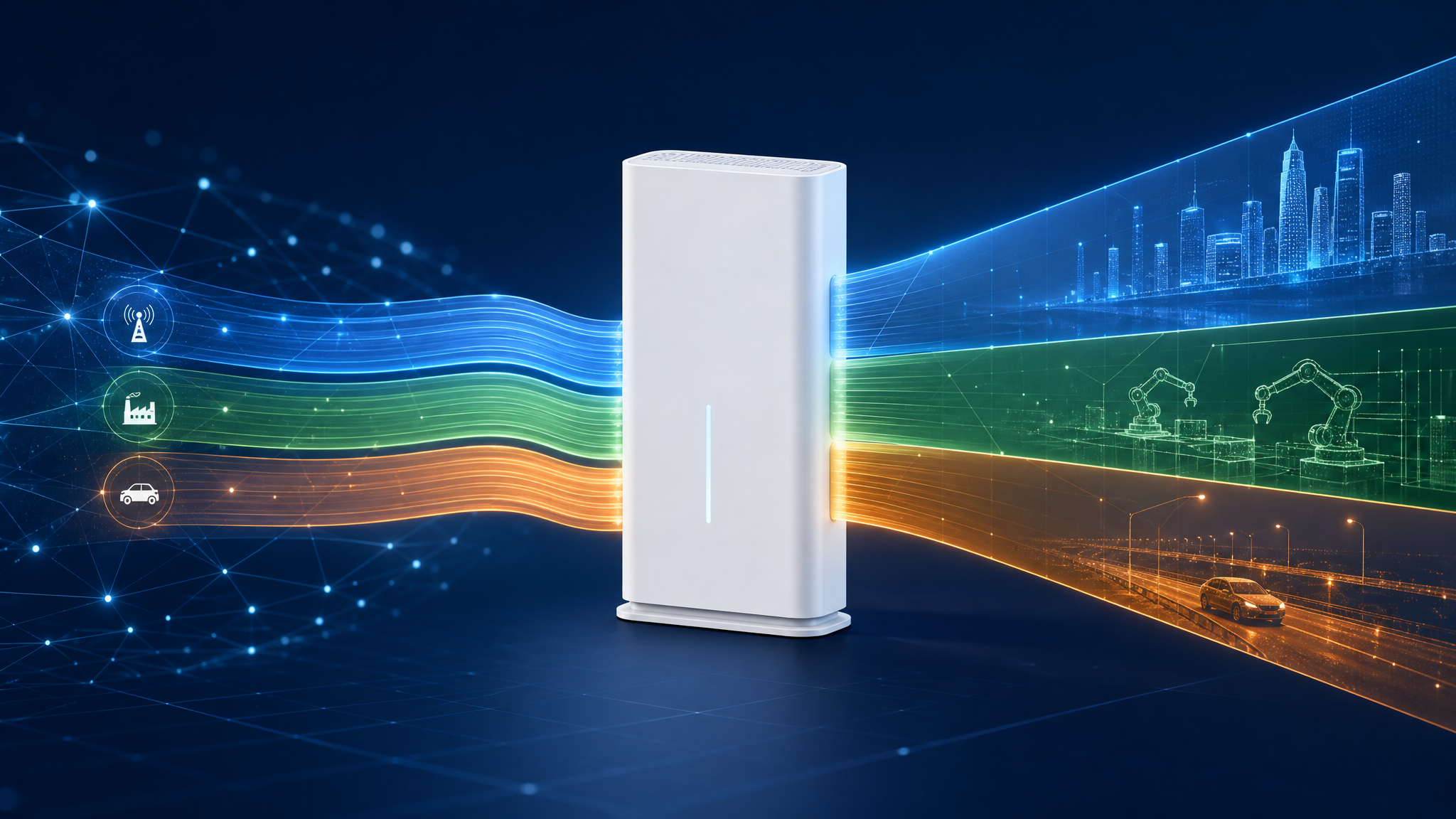
    3GPP-defined network slicing — formally introduced in Release 15 and matured through Release 18 — enables operators to partition a single 5G physical network into multiple isolated logical networks. Each slice can be optimized for a distinct service profile: ultra-reliable low-latency communications (URLLC) for industrial IoT, enhanced mobile broadband (eMBB) for residential broadband, or massive machine-type communications (mMTC) for smart metering. What changed in 2026 is that this capability has moved from core network trials into commercial CPE silicon.

    URSP: The CPE-Side Enabler of Network Slicing

    The critical CPE-side mechanism for network slicing is the UE Route Selection Policy (URSP), standardized in 3GPP TS 23.503. URSP rules, provisioned by the 5G core network to the CPE device, instruct the modem on how to route application traffic to specific Protocol Data Unit (PDU) sessions — each mapped to a different network slice identified by its Single Network Slice Selection Assistance Information (S-NSSAI).

    In practical terms, a single 5G CPE deployed at an enterprise branch office can simultaneously:

    • Route mission-critical SCADA traffic through a URLLC slice with sub-10ms latency guarantees
    • Deliver enterprise internet access through a standard eMBB slice
    • Terminate a private enterprise APN through a dedicated slice with enhanced security policies
    • Support IoT sensor backhaul through an mMTC slice optimized for low-power devices

    This is not speculative. Qualcomm’s Snapdragon X80 and MediaTek’s T830 modem platforms, shipping in 2026 CPE designs, include hardware-accelerated URSP rule processing with support for up to 8 simultaneous PDU sessions across 4 network slices. Huawei’s Balong 5000-series and Samsung’s Exynos Modem 5400 offer comparable slicing capabilities.

    Commercial Deployment Patterns in 2026

    Several deployment models have emerged across different operator segments:

    Tier-1 Operator Multi-Service FWA: Deutsche Telekom and NTT Docomo have launched commercial FWA tiers that use slicing-aware CPE to differentiate service levels. A single outdoor CPE installation can deliver a base 100 Mbps residential broadband slice alongside a premium 500 Mbps business-grade slice with SLA-backed latency, all provisioned and billed separately through the operator’s BSS/OSS.

    MVNO Slice-as-a-Service: In the US and European markets, MVNOs are leveraging slicing-capable CPE to offer “network-as-a-service” to enterprise customers. The MVNO leases slice capacity from the host MNO and deploys URSP-configured CPE at customer premises, creating a fully virtualized private network without spectrum ownership or RAN infrastructure.

    Private 5G Hybrid Slicing: System integrators serving manufacturing and logistics verticals are deploying CPE that bridges a local private 5G NPN slice with a public MNO slice on the same device. This eliminates the dual-CPE architecture previously required for hybrid private/public deployments.

    CPE Procurement Implications for Operators

    For operators and ISPs evaluating CPE for slicing-capable networks in 2026, several technical requirements have become non-negotiable:

    1. URSP rule capacity: The CPE must support a minimum of 8 URSP rules with traffic descriptor matching at IP 5-tuple, Application ID (OSId/OSAppId), and DNN levels. Devices limited to IP-based routing only will not meet operator requirements for application-aware slicing.
    2. Multi-PDU session concurrency: At least 4 simultaneous PDU sessions, each independently addressable by the CPE’s internal routing table, with per-session QoS flow mapping.
    3. S-NSSAI configuration interface: Operators need a standardized management interface — TR-369 USP or a vendor MQTT-based API — to push S-NSSAI to DNN mappings to deployed CPE fleets without requiring firmware updates.
    4. Per-slice throughput enforcement: The CPE must enforce per-slice rate limiting at the IP forwarding layer to prevent one slice from consuming another slice’s guaranteed bandwidth.
    5. Slice isolation verification: Operators increasingly require CPE that can generate slice-level performance telemetry (latency, jitter, packet loss per S-NSSAI) for SLA compliance reporting.

    Market Outlook

    ABI Research estimates that slicing-capable 5G CPE will represent approximately 22% of total 5G FWA CPE shipments in 2026, growing to over 50% by 2028. The driver is not technology push but operator business pull: slicing transforms CPE from a cost center into a revenue multiplier, enabling a single customer premises installation to generate multiple recurring revenue streams.

    For CPE manufacturers, supporting URSP and multi-slice architectures is no longer optional for Tier-1 and Tier-2 operator RFPs. The procurement language is shifting from “5G NR capable” to “3GPP Release 18 slicing compliant with URSP support verified through GCF/PTCRB certification.”

    Frequently Asked Questions

    What is network slicing in 5G CPE?

    Network slicing in 5G CPE enables a single physical router to connect to multiple virtualized 5G network slices simultaneously, each optimized for different service requirements — such as ultra-low latency for industrial control, high bandwidth for internet access, and massive IoT connectivity for sensor networks.

    What is URSP and why does it matter for CPE procurement?

    UE Route Selection Policy (URSP) is the 3GPP-standardized mechanism that governs how a 5G CPE routes application traffic to specific network slices. For operators, URSP support in CPE is essential for delivering differentiated, SLA-backed services over a single device — enabling multi-revenue-stream business models from one customer installation.

    How many network slices can a 2026 CPE support simultaneously?

    Leading 2026 5G CPE platforms based on Qualcomm X80 and MediaTek T830 modems support up to 8 simultaneous PDU sessions across 4 distinct network slices, with per-slice QoS enforcement and isolated throughput management.

    Explore Honlly Telecom’s 5G CPE portfolio designed for carrier-grade slicing deployments. Contact our solutions team to discuss URSP-compliant CPE for your network slicing roadmap.

  • Private 5G vs WiFi 7: Which Wireless Technology Should Industrial Enterprises Choose for Campus Deployments?

    Private 5G vs WiFi 7: Which Wireless Technology Should Industrial Enterprises Choose for Campus Deployments?

    The wireless connectivity landscape for industrial enterprises has never been more interesting — or more complex. On one side, private 5G networks promise carrier-grade reliability, deterministic latency, and licensed-spectrum performance. On the other, WiFi 7 delivers multi-gigabit throughput, a mature device ecosystem, and dramatically lower deployment costs. For system integrators, enterprise IT directors, and telecom service providers advising industrial clients, the private 5G versus WiFi 7 question is not hypothetical. It is a real procurement decision with seven-figure budget implications.

    This comparison guide examines the two technologies across eight dimensions that matter most to industrial buyers: spectrum access, coverage and mobility, latency and determinism, throughput and capacity, device ecosystem maturity, deployment complexity, total cost of ownership, and long-term roadmap alignment.

    1. Spectrum Access: Licensed vs. Unlicensed

    The fundamental architectural difference between private 5G and WiFi 7 starts at the physical layer:

    Private 5G operates in licensed or shared-access spectrum. Depending on the country, enterprises can access spectrum through direct allocation (e.g., Germany’s 3.7–3.8 GHz Campusnetz), shared-access frameworks (e.g., US CBRS 3.55–3.70 GHz), or leasing from an MNO. Licensed spectrum guarantees interference-free operation — a decisive advantage in electrically noisy industrial environments such as steel mills, automotive assembly lines, and chemical processing plants.

    WiFi 7 operates exclusively in unlicensed spectrum (2.4 GHz, 5 GHz, and 6 GHz). While the 6 GHz band provides substantial greenfield capacity, unlicensed spectrum is inherently subject to interference from neighboring networks, consumer devices, and non-WiFi emitters. For industrial deployments in multi-tenant facilities or dense urban areas, this unpredictability can become a reliability concern.

    Verdict: Private 5G wins on spectrum certainty. WiFi 7 wins on spectrum availability and cost. For mission-critical automation, licensed spectrum is strongly preferred. For enterprise office, campus, and non-critical industrial use cases, WiFi 7 in 6 GHz is sufficient.

    2. Coverage and Mobility

    Private 5G networks using sub-6 GHz spectrum (n77, n78, n48) can cover several square kilometers from a single radio unit, with seamless handover between cells at speeds exceeding 500 km/h — a capability proven in public mobile networks. This makes private 5G the natural choice for large-area deployments such as ports, mines, railways, and outdoor logistics yards.

    WiFi 7 access points, even with optimized antenna designs, typically cover 500–1,500 square meters indoors. Outdoor coverage is substantially less. WiFi roaming (802.11r/k/v) has improved significantly but remains a best-effort mechanism compared to 3GPP-standardized handover. For AGVs (automated guided vehicles) moving at speed across a factory floor, WiFi roaming interruptions — however brief — can disrupt real-time control loops.

    Verdict: Private 5G dominates in wide-area outdoor coverage and high-mobility scenarios. WiFi 7 is cost-effective for fixed or slow-moving indoor coverage within defined zones.

    3. Latency and Determinism

    Private 5G with URLLC (Ultra-Reliable Low-Latency Communication) features delivers sub-5 ms one-way latency with 99.999% reliability, enabled by mini-slot scheduling, grant-free uplink, and preemption mechanisms in the 5G NR air interface. This deterministic behavior is essential for closed-loop industrial control, motion control, and safety-critical applications.

    WiFi 7, through Multi-Link Operation (MLO), can achieve single-digit millisecond latency under optimal conditions. However, WiFi’s CSMA/CA (Carrier Sense Multiple Access with Collision Avoidance) MAC layer is inherently probabilistic — latency increases under load, and worst-case latency is unbounded. New WiFi 7 features such as Restricted Target Wake Time (R-TWT) improve determinism but do not match 5G NR’s scheduling-based air interface.

    Verdict: Private 5G URLLC is the only choice for deterministic sub-5 ms latency in safety-critical or motion-control applications. WiFi 7 MLO provides excellent latency for non-deterministic use cases such as video analytics, AR/VR, and bulk data transfer.

    4. Throughput and Capacity

    WiFi 7 achieves the highest peak throughput of any widely available wireless technology, with theoretical rates of 46 Gbps and real-world per-AP throughput of 8–15 Gbps. The 320 MHz channel in 6 GHz combined with 4K-QAM provides a capacity envelope that exceeds most industrial requirements.

    Private 5G with 100 MHz of spectrum (typical CBRS or n78 allocation) using 4×4 MIMO delivers approximately 1.5–2 Gbps downlink per cell. Carrier aggregation can increase this, but private 5G peak throughput remains substantially below WiFi 7. However, private 5G distributes capacity more evenly across connected devices, while WiFi throughput per client degrades with increasing client count in a CSMA/CA contention domain.

    Verdict: WiFi 7 wins on peak throughput. Private 5G wins on per-device capacity consistency at scale. For video-surveillance backhaul and high-bandwidth fixed applications, WiFi 7 is compelling. For hundreds of IoT sensors each transmitting small packets, private 5G is more efficient.

    5. Device Ecosystem and Maturity

    WiFi 7 benefits from the largest wireless ecosystem in history. Client devices (laptops, smartphones, tablets) with WiFi 7 support began shipping in volume in 2024, and by mid-2026, WiFi 7 is standard in enterprise-class notebooks and premium smartphones. The installed base of WiFi-compatible industrial devices is orders of magnitude larger than the private 5G device ecosystem.

    Private 5G device availability has improved significantly since 2024, with industrial CPE, modules, and embedded modems now available from multiple vendors. However, the diversity and price point of n77/n78-capable industrial devices still lag behind WiFi. For brownfield deployments with existing WiFi infrastructure and client devices, migration to WiFi 7 is a natural evolution path.

    Verdict: WiFi 7 benefits from an unmatched device ecosystem. Private 5G is catching up rapidly but remains more limited and more expensive per module.

    6. Deployment Complexity and Skills

    Deploying a private 5G network requires specialized RF planning (including propagation modeling for licensed spectrum), core network integration (5GC or evolved packet core), SIM/eSIM provisioning, and coordination with spectrum regulators. The skill set required — combining cellular RAN engineering with enterprise IT — is scarce and expensive.

    WiFi 7 deployment follows well-understood enterprise WiFi design principles: site survey, AP placement, channel planning, and controller configuration. The available talent pool is large, and most enterprise IT teams can manage WiFi 7 networks with existing staff and training.

    Verdict: WiFi 7 is dramatically simpler to deploy and manage. Private 5G demands specialized expertise and typically requires a system integrator or managed service provider.

    7. Total Cost of Ownership

    A typical private 5G deployment for a mid-sized factory (50,000 sqm, 3–5 radio units, compact core) costs $80,000–$250,000 USD in hardware, software, and integration services, with annual operating costs of $15,000–$40,000 for spectrum fees, maintenance, and support. Enterprise-grade private 5G CPE adds $300–$800 per connected device or machine.

    An equivalent WiFi 7 deployment (20–30 APs, controller, PoE switching) costs $25,000–$60,000 in hardware and installation, with annual operating costs of $5,000–$15,000. WiFi 7 client devices are commodity-priced, with enterprise APs at $350–$1,200 per unit.

    Verdict: WiFi 7 is 60–80% less expensive on a TCO basis for equivalent indoor coverage. The TCO gap narrows for large outdoor deployments where private 5G’s superior coverage reduces infrastructure count.

    8. When to Choose Which: A Decision Framework

    The following decision matrix summarizes the technology fit for common industrial use cases:

    Use Case Recommended Technology Rationale
    Manufacturing automation / closed-loop control Private 5G URLLC determinism essential for motion control
    AGV / AMR fleet connectivity Private 5G Seamless mobility, wide-area outdoor coverage
    Office / campus enterprise LAN WiFi 7 TCO advantage, device compatibility, IT-manageable
    Warehouse / logistics scanning WiFi 7 Existing device ecosystem, sufficient for scanning
    Video surveillance backhaul WiFi 7 Higher peak throughput, lower cost per camera
    Mining / port / outdoor logistics Private 5G km-scale coverage, outdoor resilience, mobility
    MDU / hospitality managed WiFi WiFi 7 Client device compatibility, cost-effective, proven
    Predictive maintenance (vibration sensors) Private 5G Massive IoT density, licensed spectrum reliability

    The Convergence Path: Why Not Both?

    Increasingly, the enterprise wireless conversation is shifting from “private 5G or WiFi 7” to “how do we integrate both?” Modern converged gateways from manufacturers like Honlly Telecom support simultaneous operation of private 5G (as WAN or private network access) and WiFi 7 (as LAN distribution). This architectural pattern — 5G for wide-area, mobility, and deterministic links; WiFi 7 for indoor capacity and legacy device support — delivers the best of both technologies without forcing a binary choice.

    For system integrators and enterprise buyers, the pragmatic approach is to categorize connectivity requirements by use case rather than seeking a single-technology solution. A manufacturing campus might deploy private 5G for AGV connectivity and machine control while using WiFi 7 for office connectivity, handheld scanners, and guest access — both managed through a unified network orchestration platform.

    FAQ

    Can private 5G and WiFi 7 coexist in the same facility?

    Yes, and this is increasingly common. Private 5G uses licensed or shared-access spectrum (e.g., n48 CBRS, n78), while WiFi 7 operates in unlicensed bands. There is no spectrum conflict. Many enterprise gateways now integrate both technologies, enabling a unified connectivity architecture.

    What is the typical timeline for a private 5G deployment?

    A greenfield private 5G deployment for a mid-sized facility typically takes 12–20 weeks from spectrum acquisition to operational handover. This includes regulatory coordination, site survey, RAN installation, core network integration, and device provisioning. WiFi 7 deployments for similar facilities can be completed in 4–8 weeks.

    Which technology is better for IoT sensor networks?

    For massive IoT (hundreds to thousands of sensors transmitting small data packets), private 5G with 5G NR Reduced Capability (RedCap) or LTE-M/NB-IoT fallback offers superior density, power efficiency, and interference management. WiFi 7 is better suited for bandwidth-intensive IoT such as video cameras and AR devices. Many deployments use a combination: 5G for LPWA sensors and WiFi for high-bandwidth endpoints.

    How does private 5G spectrum availability differ by country?

    Spectrum availability varies significantly. Germany, Japan, the UK, and the US (via CBRS) have established frameworks for enterprise private 5G spectrum. France, South Korea, and Australia are expanding access. In countries without dedicated enterprise spectrum, private 5G typically requires an agreement with a licensed MNO. Buyers should engage local regulatory counsel early in the planning process.

    Evaluating private 5G, WiFi 7, or converged solutions for your enterprise deployment? Honlly Telecom provides carrier-grade private 5G CPE, WiFi 7 access points, and converged gateways with ODM customization for system integrators and operators worldwide. Contact our solutions team to schedule a technical consultation.

  • WiFi 7 Enterprise Networks: Procurement Checklist

    WiFi 7 Enterprise Networks: Procurement Checklist

    The ratification of IEEE 802.11be — commercially known as WiFi 7 — marks the most significant leap in wireless LAN technology in over a decade. With theoretical throughput of up to 46 Gbps, deterministic low-latency operation, and native multi-link aggregation, WiFi 7 is poised to reshape how enterprises, campus environments, and multi-dwelling units (MDUs) approach wireless infrastructure.

    For telecom operators, ISPs, and system integrators, the transition to WiFi 7 is not merely an incremental upgrade. It represents a strategic opportunity to differentiate managed service offerings, reduce wired backhaul dependency, and support high-density applications that WiFi 6 and 6E could not practically deliver. This guide provides a structured evaluation framework for buyers procuring WiFi 7 access points (APs) and converged gateways in 2026.

    What Makes WiFi 7 Different: Technical Foundations

    Before evaluating specific hardware, buyers must understand the three architectural innovations that distinguish WiFi 7 from its predecessors:

    1. 320 MHz Channel Bandwidth

    WiFi 7 doubles the maximum channel width from 160 MHz (WiFi 6/6E) to 320 MHz, available exclusively in the 6 GHz band. This doubling of spectral capacity translates directly to higher throughput, provided sufficient spectrum is available. In regions where regulators have allocated the full 1200 MHz of 6 GHz spectrum (such as the United States, Canada, and South Korea), operators can deploy multiple non-overlapping 320 MHz channels within a single location.

    2. 4K-QAM Modulation

    For higher-order modulation, confirm feature support on both access point and client devices and test at the planned installation locations. Avoid assuming a particular distance, client rate or coverage result from the modulation description alone.

    3. Multi-Link Operation (MLO)

    MLO is arguably WiFi 7’s most transformative feature. It allows a single client device to simultaneously transmit and receive data across multiple frequency bands (2.4 GHz, 5 GHz, and 6 GHz) and channels. This delivers three compounding benefits: aggregate throughput scaling, ultra-low latency through redundant link paths, and seamless band steering without the connection interruption typical of WiFi 6 band steering mechanisms.

    Buyer Evaluation Checklist: 12 Criteria for WiFi 7 AP Selection

    When evaluating WiFi 7 access points and gateways for enterprise or carrier-managed deployments, procurement teams should assess the following dimensions:

    1. Radio Configuration: Minimum tri-band (2.4 + 5 + 6 GHz) with at least 4×4 MIMO on the 5 GHz and 6 GHz radios. Single-band or dual-band WiFi 7 devices are cost-optimized consumer products unsuitable for enterprise environments.
    2. MLO Implementation: Confirm support for both STR (Simultaneous Transmit and Receive) and NSTR (Non-Simultaneous Transmit and Receive) MLO modes. STR MLO provides the highest throughput; NSTR MLO is simpler to implement but offers fewer latency benefits.
    3. Backhaul Interfaces: Enterprise APs should offer at least one 10G Ethernet port (RJ45 or SFP+) for uplink. 2.5G Ethernet is acceptable for SME-focused products but will become a bottleneck in high-density deployments.
    4. Power over Ethernet (PoE): PoE++ (802.3bt, Type 4, up to 90W) is strongly recommended for tri-band 4×4 WiFi 7 APs. PoE+ (802.3at, 30W) may force the AP to reduce transmit power or disable a radio, negating WiFi 7 benefits.
    5. Channel Planning Tools: Built-in or cloud-managed automatic frequency coordination (AFC) for 6 GHz operation is essential in regions requiring AFC compliance for standard-power APs.
    6. Client Density Support: Look for vendor-published metrics on concurrent client capacity (minimum 512 clients per radio) and airtime fairness algorithms validated for mixed WiFi 6/6E/7 client environments.
    7. Security: WPA3-Enterprise with 192-bit encryption is mandatory. Additional features such as Protected Management Frames (PMF), RADIUS CoA support, and DPP (WiFi Easy Connect) for headless IoT onboarding add enterprise value.
    8. Management Platform: Evaluate on-premises controller vs. cloud-managed options. For ISP-managed services, cloud platforms with multi-tenancy, zero-touch provisioning, and REST API integration into existing OSS/BSS systems are strongly preferred.
    9. Spectrum Intelligence: Real-time spectrum analysis, interference classification, and automated channel optimization using AI/ML models are differentiators in dense urban deployments.
    10. IoT Radio Coexistence: Integrated Zigbee, Thread, or Bluetooth 5.4 radios for IoT gateway functionality reduce the need for separate IoT infrastructure.
    11. Regulatory Certification: Verify FCC (US), CE (EU), MIC (Japan), and SRRC (China) certifications for the target deployment region. WiFi 7 certification from the Wi-Fi Alliance should be current.
    12. Vendor Roadmap and Supply Assurance: Assess the manufacturer’s commitment to firmware updates, security patch SLAs, and component sourcing resilience. For ODM-sourced hardware, validate that the design is under active development rather than a one-time reference design adaptation.

    Deployment Architecture: Converged Gateway vs. Distributed AP

    A key architectural decision for telecom buyers is whether to deploy converged CPE gateways with integrated WiFi 7 or separate wired gateway + distributed AP topologies. The right choice depends on the deployment scenario:

    • Converged Gateway (CPE + WiFi 7): Best suited for SOHO, SME, and MDU deployments where simplicity, single-vendor support, and reduced cabling are priorities. Modern 5G FWA + WiFi 7 converged gateways can serve as the sole connectivity appliance for small offices.
    • Distributed AP Topology: Preferred for campus, hospitality, and large enterprise deployments requiring uniform coverage across thousands of square meters. A wired gateway (or SD-WAN appliance) serves as the network edge, with multiple WiFi 7 APs providing access-layer connectivity.

    For operators offering managed WiFi services to business customers, a hybrid approach is increasingly common: a WiFi 7 mesh system with wired backhaul between APs, managed through a single cloud controller, with the gateway function located at the primary AP or a dedicated edge device.

    Cost Considerations and ROI

    Compare the access-point hardware, management licences, installation and support using current quotations. Evaluate total cost using the same project scope and acceptance requirements for each candidate.

    • Access-point planning: use a site survey and workload test to determine placement and quantity. Channel options, client support and local conditions must be included; a WiFi generation does not establish a fixed reduction in AP count.
    • Future-Proofing: Deploying WiFi 7 in 2026 provides a 5–7 year technology lifecycle, avoiding a costly mid-cycle upgrade from WiFi 6E to WiFi 7 in 2028–2029.
    • Managed-service business case: use actual customer requirements, current quotations and operating costs. Treat any proposed premium as a commercial assumption to validate rather than an established revenue increase.

    FAQ

    Is WiFi 7 backward compatible with WiFi 6 and WiFi 5 clients?

    Yes. WiFi 7 access points are fully backward compatible with 802.11a/b/g/n/ac/ax (WiFi 6) clients. However, to realize WiFi 7 benefits (320 MHz, 4K-QAM, MLO), both the AP and client device must support WiFi 7. Mixed-client environments operate in compatibility mode, which may reduce peak throughput for WiFi 7 clients.

    When should an operator begin deploying WiFi 7 instead of WiFi 6E?

    Operators should begin WiFi 7 procurement and lab testing in Q3 2026 for production deployments starting Q4 2026. WiFi 6E remains a cost-effective choice for budget-sensitive deployments where 6 GHz spectrum access is the primary requirement, but the performance and efficiency advantages of WiFi 7 justify the premium for greenfield enterprise deployments.

    What is the realistic throughput of WiFi 7 in enterprise deployments?

    While the theoretical maximum is 46 Gbps, real-world enterprise throughput for a tri-band 4×4 WiFi 7 AP with MLO enabled typically ranges from 8–15 Gbps aggregate across all bands, depending on client count, distance, and RF environment. Single-client peak throughput under optimal conditions (320 MHz channel, 4K-QAM, MLO) can reach 5–7 Gbps.

    Does WiFi 7 require new cabling infrastructure?

    For most deployments, existing Cat 6A cabling is sufficient, as 10GBASE-T operates reliably over Cat 6A at distances up to 100 meters. Sites with older Cat 5e cabling may require upgrades to support multi-gigabit backhaul. Power delivery via PoE++ (802.3bt) requires Cat 6A or better cabling for full-power operation at extended distances.

    Planning a WiFi 7 deployment for your enterprise or managed service customers? Honlly Telecom supplies carrier-grade WiFi 7 access points, converged 5G FWA + WiFi 7 gateways, and custom ODM solutions for operators worldwide. Get in touch with our engineering team to discuss your requirements.

  • eSIM Technology Reshapes Fixed Wireless Access: How eUICC-Enabled CPE Is Simplifying Global Operator Deployments in 2026

    eSIM Technology Reshapes Fixed Wireless Access: How eUICC-Enabled CPE Is Simplifying Global Operator Deployments in 2026

    The fixed wireless access (FWA) market has matured rapidly over the past three years, with global 5G FWA subscriptions now exceeding 20 million. Behind this growth lies a less visible but equally significant shift: the transition from traditional removable SIM cards to embedded SIM (eSIM) and eUICC (embedded Universal Integrated Circuit Card) technology in customer premises equipment (CPE).

    For telecom operators, ISPs, and MVNOs managing multi-country deployments, eUICC-enabled CPE represents more than a hardware simplification. It is a logistics multiplier that can reduce time-to-market, eliminate physical SIM handling, and enable remote subscriber provisioning (RSP) across different mobile network operators (MNOs).

    The eUICC Advantage in FWA Deployments

    Traditional FWA CPE relies on physical SIM cards that must be manufactured, shipped, inserted, and activated for each device. In a large-scale deployment involving tens of thousands of units across multiple countries, the operational friction is substantial. eUICC technology eliminates this physical dependency.

    With GSMA-compliant RSP, operators can provision SIM profiles over-the-air (OTA) after the CPE has been installed at the end-user location. This means a single SKU can serve multiple markets, with the appropriate operator profile downloaded based on geographic location, signal quality, or commercial agreement. For distributors and system integrators managing inventory across regions, this dramatically simplifies warehousing and logistics.

    Key Deployment Scenarios

    Several operators in Europe and Asia-Pacific have begun deploying eUICC FWA CPE in production networks. The primary use cases include:

    • Multi-IMSI Roaming: CPE devices pre-loaded with multiple international mobile subscriber identities (IMSI) can switch between partner networks based on signal strength or cost optimization, ensuring service continuity for enterprise customers.
    • Cross-Border Deployments: For operators serving border regions or multinational enterprise clients, eSIM allows a single device model to connect to different MNOs on either side of a border without hardware changes.
    • MVNO Enablement: Mobile virtual network operators can rapidly onboard subscribers by remotely provisioning their own profiles onto eUICC CPE without negotiating physical SIM distribution agreements.
    • IoT and Private 5G Integration: Fixed wireless gateways serving industrial IoT or private 5G networks benefit from eSIM flexibility when transitioning between public and private network identities.

    Market Momentum and Standards

    The GSMA SGP.22 (M2M) and SGP.32 (IoT) specifications have matured to support consumer and industrial eSIM profiles. In parallel, chipset vendors including Qualcomm and MediaTek have integrated eUICC support into their 5G modem platforms — the same platforms powering modern FWA CPE from OEM/ODM manufacturers in Asia.

    According to industry data, eSIM-capable device shipments are projected to exceed 3.5 billion units annually by 2027, with FWA CPE comprising a growing share. The GSMA estimates that over 400 mobile operators worldwide now support eSIM services, creating a broad ecosystem for eUICC-enabled fixed wireless equipment.

    OEM Readiness and Supply Chain Implications

    For the OEM/ODM manufacturing sector — particularly in Shenzhen and Xiamen, where a significant portion of global FWA CPE is produced — eUICC integration is becoming a standard requirement in RFQs from tier-1 operators. Manufacturers that have pre-certified their designs with major eUICC platform providers (such as Thales, G+D, and IDEMIA) hold a competitive advantage in operator tenders.

    Honlly Telecom has observed a 40% increase in operator inquiries specifying eSIM-ready CPE over the past twelve months, with particular demand from European operators preparing for multi-country 5G FWA rollouts under the Digital Decade 2030 framework. The ability to ship a single hardware variant configurable for any target market is becoming a procurement requirement rather than a nice-to-have feature.

    Challenges and Considerations

    Despite clear advantages, eUICC adoption in FWA is not without challenges. Interoperability testing between eUICC profiles and modem firmware requires close collaboration between chipset vendors, CPE manufacturers, and SIM platform providers. Regulatory frameworks for permanent roaming and cross-border profile switching vary by jurisdiction, and operators must navigate these carefully.

    Additionally, the per-unit BOM cost increase for eUICC integration — typically $2–5 USD depending on the secure element implementation — must be weighed against logistics savings and operational flexibility. For large-scale deployments exceeding 100,000 units, the logistics savings alone typically justify the hardware premium within the first year of operation.

    FAQ

    What is the difference between eSIM and eUICC?

    eSIM refers to the physical embedded SIM hardware soldered onto the device PCB. eUICC is the software architecture that enables remote SIM profile management — downloading, enabling, disabling, and deleting operator profiles OTA. A device can have an eSIM that is not eUICC-compliant, though most modern implementations combine both.

    Can existing FWA CPE be retrofitted with eSIM?

    Generally no. eSIM requires dedicated hardware (soldered secure element) and modem firmware support. Retrofitting would require hardware redesign. However, some manufacturers offer dual-SIM designs (one physical SIM slot + one eSIM) for transitional deployments.

    How does eUICC affect certification timelines?

    eUICC CPE must undergo additional GCF/PTCRB certification for the eSIM component. However, because a single hardware design can serve multiple operators, the total certification burden across markets is often lower compared to maintaining separate SKUs with different physical SIM configurations.

    Which operators are leading eSIM FWA deployments?

    European operators including Deutsche Telekom, Vodafone, and Orange have active eSIM FWA programs. In North America, T-Mobile has deployed eSIM-capable FWA CPE for its 5G Home Internet service. Multiple operators in Japan, Australia, and the Middle East are following with commercial launches planned for late 2026.

    Looking for eSIM-ready 5G FWA CPE for your network deployment? Honlly Telecom offers eUICC-enabled fixed wireless access devices with multi-IMSI support and GSMA-compliant remote SIM provisioning. Contact our team today to discuss your requirements.

  • Spectrum Refarming Economics for Regional Operators: CPE Compatibility Planning and Migration Strategies for the 3G Sunset to 5G NR Transition

    Spectrum Refarming Economics for Regional Operators: CPE Compatibility Planning and Migration Strategies for the 3G Sunset to 5G NR Transition

    As the global 3G sunset accelerates and 4G spectrum is progressively refarmed for 5G New Radio (NR), regional telecom operators face complex decisions about CPE fleet compatibility, investment timing, and subscriber migration strategy. With over 90 operators worldwide having announced 3G shutdowns and many now planning 4G spectrum refarming in low and mid-bands, understanding the CPE implications is critical for network planners and procurement teams.

    The Spectrum Refarming Landscape in 2026

    Spectrum refarming — the reallocation of frequency bands from legacy technologies to newer ones — is accelerating across three dimensions in 2026:

    • 3G Sunset Completion: With 2100 MHz (Band 1) and 900 MHz (Band 8) now fully refarmed to 4G LTE or 5G NR in most of Europe, Asia-Pacific, and North America, operators are redirecting these bands for 5G low-band coverage layers. CPE that only supports 3G on these bands is no longer deployable.
    • 4G LTE Spectrum Reallocation: A growing number of operators are refarming 1800 MHz (Band 3) and 2600 MHz (Band 7) from LTE-only to dynamic spectrum sharing (DSS) between 4G and 5G NR. In markets with mature 5G adoption, entire LTE carriers are being converted to 5G NR-only operation.
    • Sub-1 GHz 5G Expansion: The 600 MHz (Band 71) and 700 MHz (Band 28) bands — historically reserved for broadcast or LTE coverage — are increasingly allocated to 5G NR for deep indoor and rural coverage, requiring CPE with extended low-band NR support.

    CPE Compatibility Risks During Spectrum Transitions

    Operators managing heterogeneous CPE fleets face several compatibility risks during spectrum refarming transitions:

    Band Support Gaps

    Legacy LTE Cat-4 CPE devices often support a limited band set — typically B1/B3/B7/B8/B20 in EMEA markets. When an operator refarms B3 for 5G NR, these devices lose their primary capacity band and may fall back to congested B20 (800 MHz), resulting in severe throughput degradation. Operators should audit CPE fleet band support against their 3-5 year spectrum roadmap before bulk purchasing decisions.

    DSS Interoperability

    Dynamic Spectrum Sharing allows 4G and 5G to coexist on the same frequency band, but CPE modem firmware must correctly handle DSS scheduling. Older LTE chipsets — particularly those based on Qualcomm X5/X7 or MediaTek T750 platforms — may exhibit reduced throughput or connection instability in DSS environments. Operators should require DSS interoperability test reports from CPE suppliers for any device intended for DSS-deployed bands.

    5G SA vs. NSA Dependency

    Non-Standalone (NSA) 5G CPE requires an LTE anchor band for control plane signaling. If an operator refarms the LTE anchor band (typically B3 or B7) to 5G NR-only operation, NSA CPE loses connectivity entirely. The transition path is to 5G Standalone (SA) CPE that operates independently of LTE — but SA-capable chipsets carry a BOM cost premium, and many early 5G CPE deployments were NSA-only. Operators with NSA-dominant fleets must plan SA migration before refarming LTE anchor bands.

    Economic Decision Framework for Regional Operators

    The decision to proactively replace CPE ahead of spectrum refarming versus waiting for natural device churn involves trade-offs:

    • Subscriber Experience Risk: Allowing CPE to degrade to a single low-band carrier after refarming can increase churn. The cost of subscriber acquisition typically exceeds CPE replacement cost by a factor of 3-5x in competitive markets.
    • Bulk procurement: obtain a current quotation for the intended quantity, delivery schedule, configuration and support. Compare total project cost and inventory risk rather than assuming a fixed volume-discount percentage.
    • Trade-In Programs: Several operators in Europe and Southeast Asia have successfully implemented CPE trade-in programs, offering subscribers a discounted 5G CPE upgrade in exchange for returning legacy 4G devices. The returned devices can be refurbished for markets with later refarming timelines or sold into secondary markets.
    • Band planning: list the actual deployment countries and operator requirements, then confirm the ordered device variant. Additional bands, certifications and component costs must be quoted for the project; no one band list guarantees global compatibility.

    Migration Strategy Recommendations

    For regional operators planning spectrum refarming within the next 12-24 months, we recommend a phased approach:

    Phase 1 — Fleet Audit (Months 1-3): Inventory all deployed CPE by model, chipset generation, and band support. Identify devices that will lose their primary capacity band after planned refarming. Map each device model to a migration action: retain, firmware-upgrade for DSS, or replace.

    Phase 2 — New Procurement Specification (Months 3-6): Update CPE procurement specifications to require 5G SA support, broad sub-6 GHz band coverage including all planned NR bands, DSS interoperability certification, and eSIM support for flexible operator profile management during transition periods.

    Phase 3 — Subscriber Migration (Months 6-18): Execute targeted CPE replacement for at-risk subscribers, prioritizing those in areas where LTE capacity bands are being refarmed first. Use ACS-based remote management to push configuration updates to DSS-capable devices. Implement trade-in programs to accelerate voluntary upgrades.

    Frequently Asked Questions

    How do I know if my existing CPE fleet will be affected by spectrum refarming?

    Conduct a fleet audit cross-referencing each CPE model’s supported frequency bands against your spectrum refarming roadmap. Devices that rely on bands scheduled for refarming as their primary capacity layer are at risk. Your CPE supplier should provide band support matrices and modem firmware capabilities for each model.

    Can firmware updates extend CPE compatibility with refarmed spectrum?

    Firmware updates can improve DSS interoperability and enable new band combinations on modems that already have the necessary RF hardware support. However, firmware cannot add frequency band support that the RF front-end hardware does not physically support. Hardware band support is determined by the RF filters, power amplifiers, and antenna matching circuitry designed into the device.

    What is the typical lead time for CPE orders during a spectrum transition?

    Standard CPE orders typically require 4-8 weeks for production and shipping, but customized SKUs with specific band combinations or firmware requirements may require 10-14 weeks. Operators should plan procurement at least 4-6 months ahead of planned refarming dates to avoid supply chain delays during industry-wide transition periods.

    Planning a spectrum refarming transition? Honlly Telecom provides multi-band, future-proofed CPE with broad sub-6 GHz coverage and DSS-validated firmware. Request a consultation with our engineering team →

  • Zero-Touch Provisioning Architecture for ISP CPE Rollouts: A Technical Guide to Automated Device Onboarding, ACS Integration, and Fleet Management at Scale

    Zero-Touch Provisioning Architecture for ISP CPE Rollouts: A Technical Guide to Automated Device Onboarding, ACS Integration, and Fleet Management at Scale

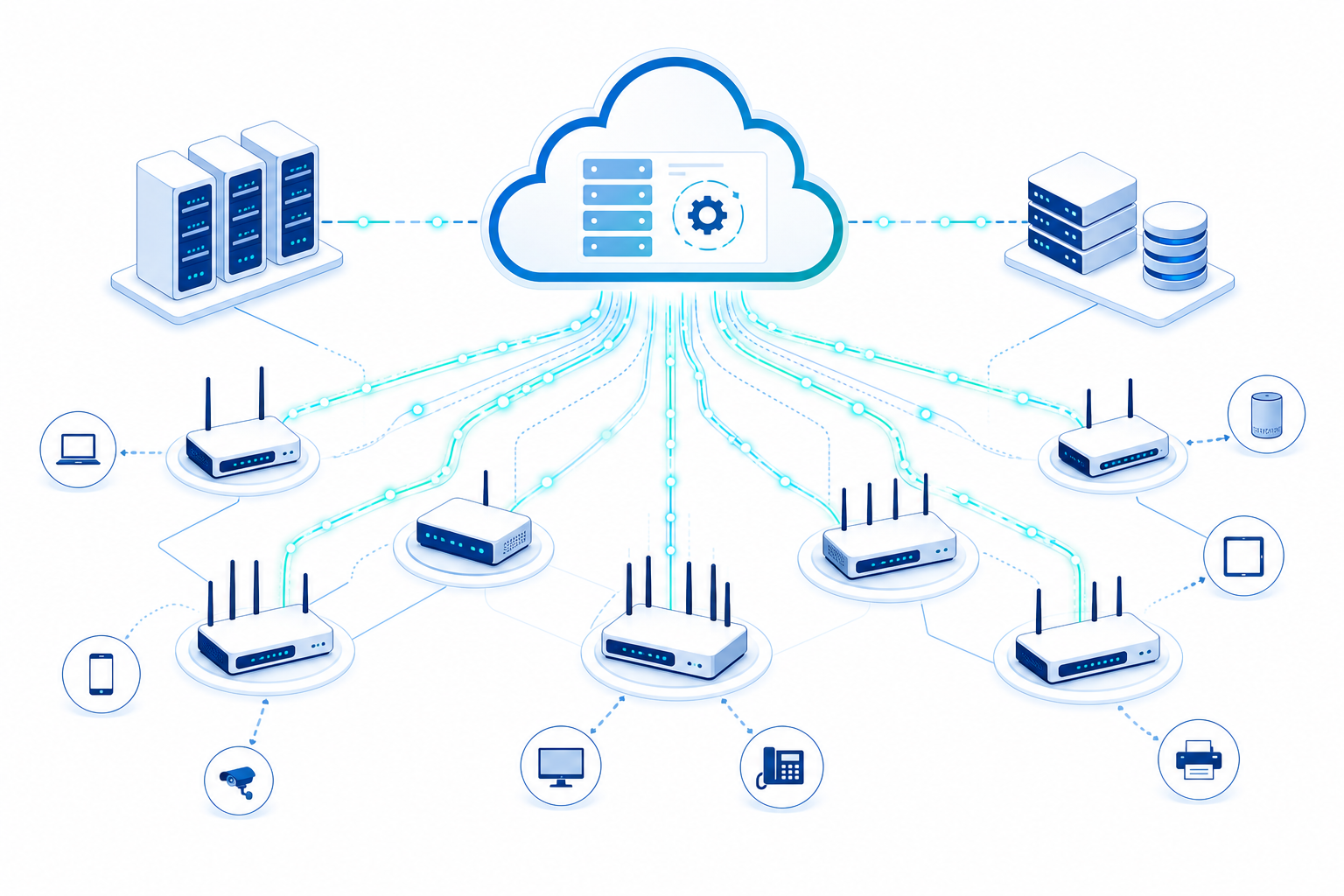
    For ISPs and telecom operators managing thousands of customer premises equipment (CPE) units, the manual configuration of each device represents one of the largest operational cost centers. Zero-touch provisioning (ZTP) — the ability to automatically configure and activate CPE upon first connection without any field technician or end-user intervention — has evolved from a nice-to-have feature to a competitive necessity in 2026. This guide examines the architecture, protocols, and vendor selection criteria for deploying ZTP at scale.

    What Is Zero-Touch Provisioning for CPE?

    Zero-touch provisioning is an automated device onboarding workflow where a CPE unit, upon initial power-up and internet connectivity, automatically discovers its management server, authenticates itself, downloads configuration parameters, and becomes operational without human intervention. The process typically completes within minutes and covers firmware version verification, WAN/LAN interface configuration, Wi-Fi SSID and security setup, VoIP SIP account provisioning, and service-specific VLAN assignments.

    The ZTP Architecture: Core Components

    A production-grade ZTP system for ISP-scale CPE deployments consists of four integrated components:

    1. Auto-Configuration Server (ACS)

    The ACS is the central management platform that communicates with CPE devices. Modern deployments use TR-069 (CWMP) for legacy fleet management and TR-369 (User Services Platform/USP) for new device onboarding. USP offers significant advantages: WebSocket-based always-on connections replacing periodic TR-069 Inform messages, support for MQTT message brokers for IoT-scale deployments, and a more efficient data model based on the Broadband Forum’s Device:2.16 root data model. When selecting an ACS, operators should verify multi-vendor CPE support, horizontal scalability for 100,000+ device fleets, and API-driven integration with existing OSS/BSS systems.

    2. Bootstrapping and Device Identity

    Every ZTP workflow begins with device identity. CPE must present a unique, cryptographically verifiable identity to the ACS before receiving configuration. Common approaches include: X.509 device certificates burned into factory firmware, IMEI-based identification with pre-provisioned ACS URL via DHCP Option 43, and SZTP (RFC 8572) bootstrapping for secure zero-touch onboarding in multi-vendor environments. Manufacturers that pre-load device certificates and ACS URLs into firmware significantly reduce operator integration effort — a key differentiator in CPE supplier selection.

    3. Configuration Template Engine

    Rather than configuring each device individually, ZTP systems use parameterized configuration templates. A single template defines the standard configuration for a device class (e.g., “Residential FWA CPE — Region A”), with variables populated from the subscriber management database during provisioning. Template variables typically include WAN IP assignment mode, PPPoE credentials or DHCP settings, Wi-Fi SSID and WPA3 passphrase, VoIP SIP credentials, and QoS policy references. Operators should require that CPE vendors support the Broadband Forum’s TR-181 Device Data Model to ensure template portability across hardware generations.

    4. Firmware Lifecycle Management

    ZTP extends beyond initial configuration to ongoing firmware management. During provisioning, the ACS should verify the device firmware version against a defined minimum baseline template. If the firmware is outdated, the ZTP workflow pauses configuration, triggers a firmware upgrade, reboots the device, and then resumes provisioning. This ensures every deployed CPE runs a known-good firmware version before entering service — critical for security compliance and feature consistency across the fleet.

    Vendor Selection Criteria for ZTP-Ready CPE

    When evaluating CPE suppliers for ZTP-enabled deployments, ISP procurement teams should assess these capabilities:

    • TR-069/TR-369 Protocol Support: Does the CPE support both CWMP and USP? Is the USP agent conformant with Broadband Forum TP-469 Conformance Test Plan?
    • Factory Certificate Provisioning: Can the manufacturer pre-load device certificates and ACS bootstrap URLs during production?
    • TR-181 Data Model Coverage: What percentage of the TR-181 Device:2 root data model is implemented? Critical objects include Device.WiFi., Device.Ethernet., Device.IP., and Device.QoS.
    • ACS Interoperability Testing: Has the supplier tested interoperability with leading ACS platforms (Axiros, Friendly Technologies, AVSystem, Incognito)?
    • Customization Flexibility: Can the manufacturer customize the default configuration file, firmware splash page, and bootstrap URL per operator requirements?
    • Bulk Provisioning API: Does the supplier provide tools or APIs for bulk device pre-provisioning — uploading IMEI/Serial-to-subscriber mappings before shipment?

    Deployment Best Practices

    Operators implementing ZTP at scale should follow these practices: begin with a staged rollout — a small pilot fleet of 500-1,000 devices to validate the full ZTP workflow before scaling. Define clear provisioning state machines with timeout and retry logic for each step. Monitor provisioning success rates by device model, firmware version, and geographic region to identify patterns in failures. Maintain a fallback manual provisioning path for edge cases — approximately 2-5% of devices will require human intervention even in mature ZTP deployments. Finally, require that CPE vendors provide a dedicated engineering contact for ZTP integration support during the initial deployment phase.

    Frequently Asked Questions

    What is the difference between TR-069 and TR-369 for ZTP?

    TR-069 (CWMP) uses periodic HTTP-based inform messages initiated by the CPE, creating a polling-based communication model. TR-369 (USP) uses persistent WebSocket connections initiated by the CPE agent, allowing the ACS to push configuration changes and firmware updates in real time. USP also supports MQTT as a transport protocol for IoT-scale device fleets and provides a more granular, efficient data model.

    How long does a typical ZTP process take?

    A well-optimized ZTP workflow typically completes within 3-8 minutes from device power-on to operational service, including DHCP acquisition, ACS discovery, configuration download, and service activation. Firmware upgrades during provisioning add 2-5 minutes depending on image size and connection speed.

    Can ZTP work without an ACS?

    Lightweight ZTP can be achieved without a full ACS using DHCP options to deliver a configuration file URL or by pre-loading configuration into device firmware. However, these approaches lack the ongoing management, monitoring, and firmware lifecycle capabilities of an ACS-managed deployment and are suitable only for small-scale or single-purpose deployments.

    Planning a large-scale CPE deployment? Honlly Telecom offers ZTP-ready devices with pre-loaded certificates, ACS interoperability testing, and dedicated integration support. Contact our engineering team →