
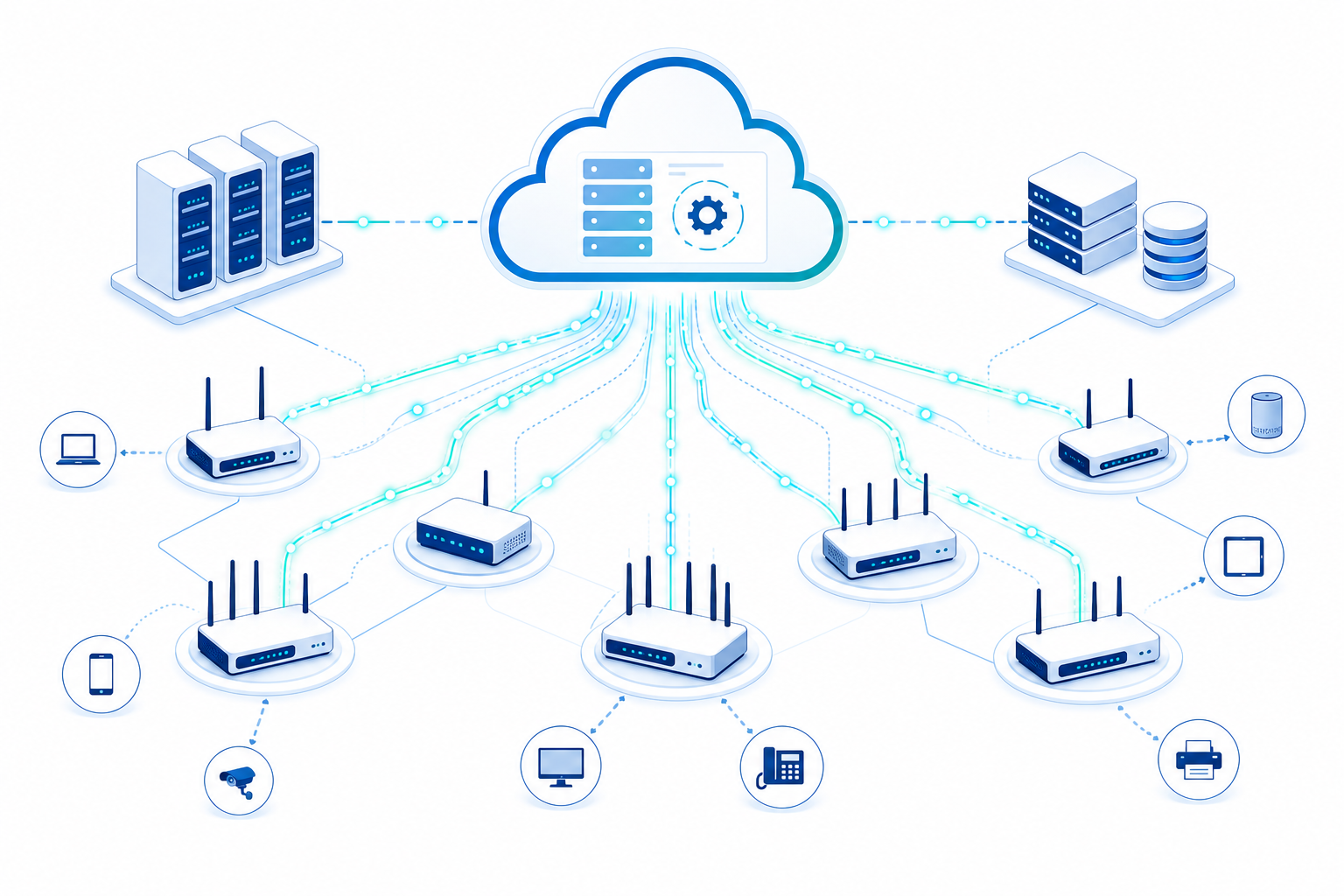
For ISPs and telecom operators managing thousands of customer premises equipment (CPE) units, the manual configuration of each device represents one of the largest operational cost centers. Zero-touch provisioning (ZTP) — the ability to automatically configure and activate CPE upon first connection without any field technician or end-user intervention — has evolved from a nice-to-have feature to a competitive necessity in 2026. This guide examines the architecture, protocols, and vendor selection criteria for deploying ZTP at scale.
What Is Zero-Touch Provisioning for CPE?
Zero-touch provisioning is an automated device onboarding workflow where a CPE unit, upon initial power-up and internet connectivity, automatically discovers its management server, authenticates itself, downloads configuration parameters, and becomes operational without human intervention. The process typically completes within minutes and covers firmware version verification, WAN/LAN interface configuration, Wi-Fi SSID and security setup, VoIP SIP account provisioning, and service-specific VLAN assignments.
The ZTP Architecture: Core Components
A production-grade ZTP system for ISP-scale CPE deployments consists of four integrated components:
1. Auto-Configuration Server (ACS)
The ACS is the central management platform that communicates with CPE devices. Modern deployments use TR-069 (CWMP) for legacy fleet management and TR-369 (User Services Platform/USP) for new device onboarding. USP offers significant advantages: WebSocket-based always-on connections replacing periodic TR-069 Inform messages, support for MQTT message brokers for IoT-scale deployments, and a more efficient data model based on the Broadband Forum’s Device:2.16 root data model. When selecting an ACS, operators should verify multi-vendor CPE support, horizontal scalability for 100,000+ device fleets, and API-driven integration with existing OSS/BSS systems.
2. Bootstrapping and Device Identity
Every ZTP workflow begins with device identity. CPE must present a unique, cryptographically verifiable identity to the ACS before receiving configuration. Common approaches include: X.509 device certificates burned into factory firmware, IMEI-based identification with pre-provisioned ACS URL via DHCP Option 43, and SZTP (RFC 8572) bootstrapping for secure zero-touch onboarding in multi-vendor environments. Manufacturers that pre-load device certificates and ACS URLs into firmware significantly reduce operator integration effort — a key differentiator in CPE supplier selection.
3. Configuration Template Engine
Rather than configuring each device individually, ZTP systems use parameterized configuration templates. A single template defines the standard configuration for a device class (e.g., “Residential FWA CPE — Region A”), with variables populated from the subscriber management database during provisioning. Template variables typically include WAN IP assignment mode, PPPoE credentials or DHCP settings, Wi-Fi SSID and WPA3 passphrase, VoIP SIP credentials, and QoS policy references. Operators should require that CPE vendors support the Broadband Forum’s TR-181 Device Data Model to ensure template portability across hardware generations.
4. Firmware Lifecycle Management
ZTP extends beyond initial configuration to ongoing firmware management. During provisioning, the ACS should verify the device firmware version against a defined minimum baseline template. If the firmware is outdated, the ZTP workflow pauses configuration, triggers a firmware upgrade, reboots the device, and then resumes provisioning. This ensures every deployed CPE runs a known-good firmware version before entering service — critical for security compliance and feature consistency across the fleet.
Vendor Selection Criteria for ZTP-Ready CPE
When evaluating CPE suppliers for ZTP-enabled deployments, ISP procurement teams should assess these capabilities:
- TR-069/TR-369 Protocol Support: Does the CPE support both CWMP and USP? Is the USP agent conformant with Broadband Forum TP-469 Conformance Test Plan?
- Factory Certificate Provisioning: Can the manufacturer pre-load device certificates and ACS bootstrap URLs during production?
- TR-181 Data Model Coverage: What percentage of the TR-181 Device:2 root data model is implemented? Critical objects include Device.WiFi., Device.Ethernet., Device.IP., and Device.QoS.
- ACS Interoperability Testing: Has the supplier tested interoperability with leading ACS platforms (Axiros, Friendly Technologies, AVSystem, Incognito)?
- Customization Flexibility: Can the manufacturer customize the default configuration file, firmware splash page, and bootstrap URL per operator requirements?
- Bulk Provisioning API: Does the supplier provide tools or APIs for bulk device pre-provisioning — uploading IMEI/Serial-to-subscriber mappings before shipment?
Deployment Best Practices
Operators implementing ZTP at scale should follow these practices: begin with a staged rollout — a small pilot fleet of 500-1,000 devices to validate the full ZTP workflow before scaling. Define clear provisioning state machines with timeout and retry logic for each step. Monitor provisioning success rates by device model, firmware version, and geographic region to identify patterns in failures. Maintain a fallback manual provisioning path for edge cases — approximately 2-5% of devices will require human intervention even in mature ZTP deployments. Finally, require that CPE vendors provide a dedicated engineering contact for ZTP integration support during the initial deployment phase.
Frequently Asked Questions
What is the difference between TR-069 and TR-369 for ZTP?
TR-069 (CWMP) uses periodic HTTP-based inform messages initiated by the CPE, creating a polling-based communication model. TR-369 (USP) uses persistent WebSocket connections initiated by the CPE agent, allowing the ACS to push configuration changes and firmware updates in real time. USP also supports MQTT as a transport protocol for IoT-scale device fleets and provides a more granular, efficient data model.
How long does a typical ZTP process take?
A well-optimized ZTP workflow typically completes within 3-8 minutes from device power-on to operational service, including DHCP acquisition, ACS discovery, configuration download, and service activation. Firmware upgrades during provisioning add 2-5 minutes depending on image size and connection speed.
Can ZTP work without an ACS?
Lightweight ZTP can be achieved without a full ACS using DHCP options to deliver a configuration file URL or by pre-loading configuration into device firmware. However, these approaches lack the ongoing management, monitoring, and firmware lifecycle capabilities of an ACS-managed deployment and are suitable only for small-scale or single-purpose deployments.
Planning a large-scale CPE deployment? Honlly Telecom offers ZTP-ready devices with pre-loaded certificates, ACS interoperability testing, and dedicated integration support. Contact our engineering team →