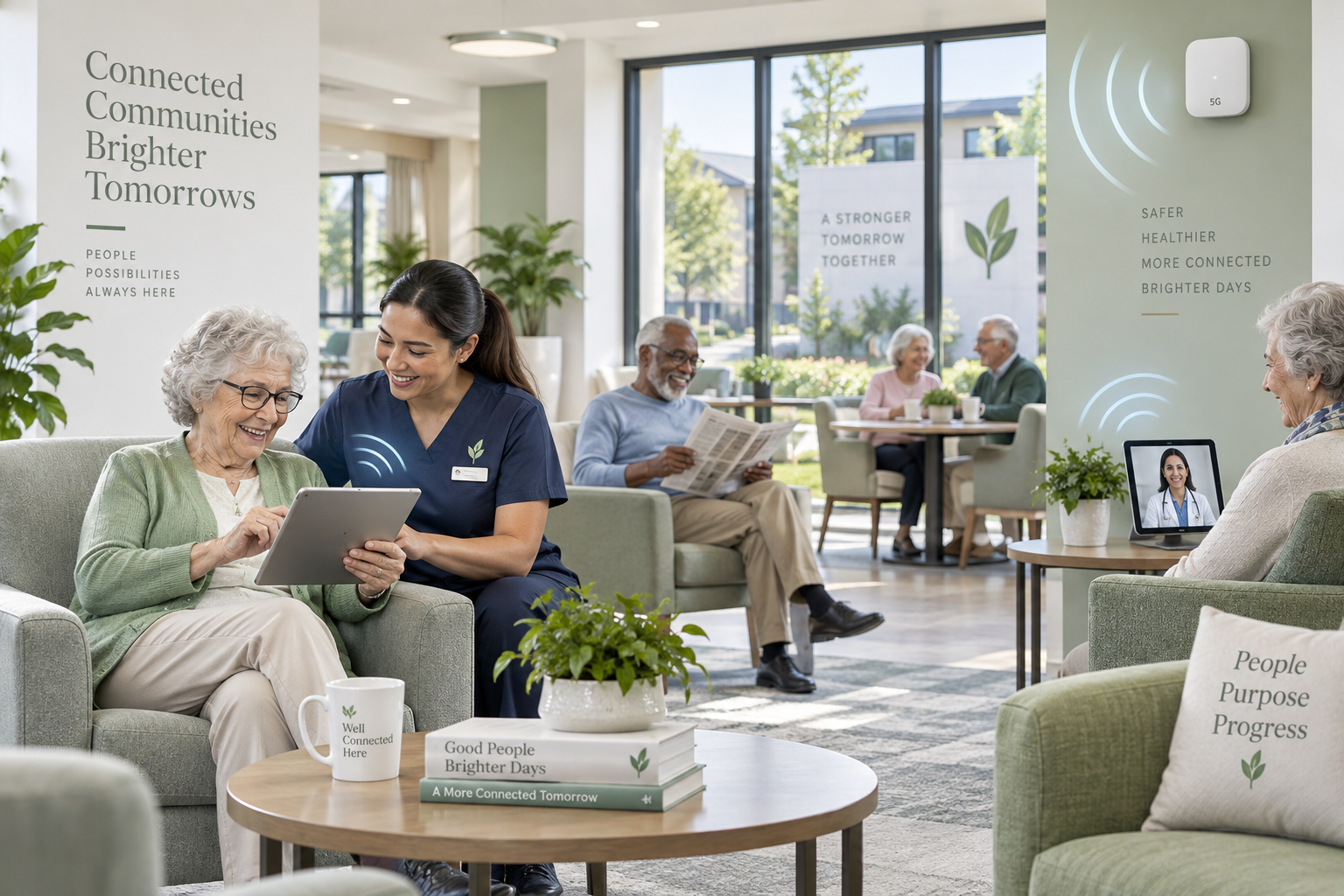
Senior living and assisted living communities are no longer simple residential properties; they are care environments that depend on continuous connectivity for resident safety, clinical workflows, and day-to-day operations. Nurse call systems, electronic health records, medication management, fall-detection sensors, telehealth visits, and family communication all require a network that stays up around the clock. At the same time, many communities operate across multiple buildings, wings, and outdoor spaces where traditional cabling is expensive, disruptive, and slow to extend. In 2026, senior living operators are turning to 5G Fixed Wireless Access (FWA) CPE to bring dependable, secure, high-bandwidth connectivity to resident care and staff operations faster than any wired build-out could deliver.
For operators, integrators, and managed service providers, senior living is a high-growth market for carrier-grade 5G CPE engineered for reliability, security, and rapid, low-impact deployment.
Why senior living operators are turning to 5G FWA
Senior living and assisted living communities face connectivity challenges that are distinctive to the care environment:
- Multi-building campuses: independent living, assisted living, and memory care wings spread across several buildings that must be connected consistently.
- Safety-critical uptime: nurse call, fall detection, and emergency systems cannot tolerate a lost connection.
- No waiting on fiber: extending fiber across occupied buildings, courtyards, and parking areas is slow and disruptive to residents.
- Privacy and compliance: resident health and personal data must be protected and segmented from guest and staff traffic.
What a connected senior living community runs on
A modern community depends on far more than a single internet link. The applications demanding bandwidth, latency, and uptime include:
- Nurse call and emergency response: resident call systems and emergency alerts that must never fail.
- Electronic health records (EHR): clinical documentation and medication management synced continuously.
- Telehealth and video visits: remote consultations between residents, clinicians, and family members.
- Fall detection and environmental sensors: wearable and room sensors that raise alerts in real time.
- CCTV and access control: security cameras and controlled entry protecting residents and staff.
- Resident and guest Wi-Fi: internet for streaming, video calling, and family communication.
Standing up connectivity with minimal disruption
The defining advantage of 5G FWA CPE in senior living is speed of deployment without disturbing residents. Common deployment patterns include:
- Primary site connectivity: a CPE backhauls the community LAN for care, safety, and operations where fiber is absent.
- New and expanded wings: connectivity added quickly as buildings are built out or renovated.
- Failover and resilience: cellular as an automatic secondary path that keeps nurse call and EHR systems live through a fiber outage.
- Outlying buildings: maintenance, housekeeping, and administrative facilities connected without trenching.
Key evaluation criteria for senior living CPE
- Reliability and uptime: carrier-grade hardware built for always-on care and safety systems.
- Security and compliance: hardware VPN and VLAN segmentation to isolate resident, clinical, and guest traffic.
- Centralized management: cloud or ACS control for zero-touch provisioning, monitoring, and updates across every building.
- External antenna support: high-gain antennas to reach cell sites reliably in large, multi-story, or metal-framed buildings.
- Dual-WAN capability: automatic failover to a second carrier or wired link to keep care systems running through outages.
FAQ
Can 5G FWA serve as primary connectivity for a senior living community?
Yes. With a proper site survey, external antennas where needed, and appropriate QoS, 5G FWA CPE can serve as primary connectivity for nurse call, EHR, telehealth, and resident Wi-Fi, and as resilient failover alongside a wired link.
How do communities keep nurse call and safety systems running during an outage?
Dual-WAN configurations that pair the 5G link with fiber or a second carrier, plus automatic failover, keep nurse call, fall detection, and EHR systems live through an outage with minimal disruption.
How is resident health and personal data kept secure over 5G?
Use hardware VPN tunnels, VLAN segmentation, and secure boot to isolate resident, clinical, staff, and guest traffic, keeping sensitive data encrypted and separated. Deployments should align with applicable healthcare privacy and data-protection requirements.
How are multi-building campuses managed consistently with 5G CPE?
A central management platform enables zero-touch provisioning, remote configuration, firmware updates, and health monitoring across all buildings, so operators can roll out and manage CPE at scale without dispatching technicians to every wing.
Get started
Honlly Telecom supplies reliable, secure, carrier-grade 5G FWA CPE and wireless routers engineered for senior living, assisted living, and care communities. Contact our team to discuss connectivity for your communities and care operations.