
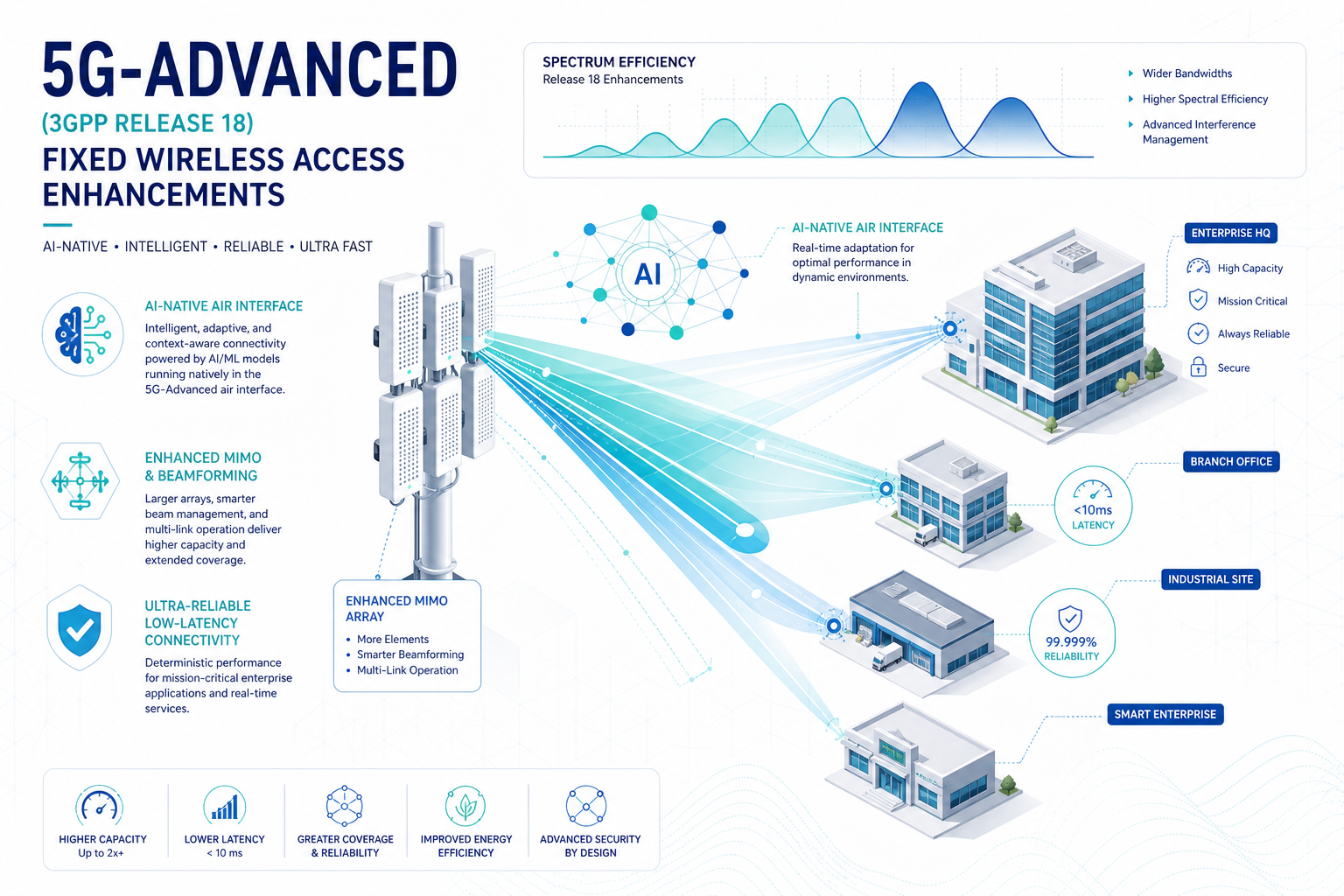
The 5G fixed wireless access (FWA) landscape is entering a transformative phase. With 3GPP Release 18—the first release of 5G-Advanced—now commercially available in chipset platforms throughout 2026, enterprise CPE vendors and telecom operators alike are recalibrating their roadmaps around a suite of enhancements that promise to elevate 5G FWA from a broadband alternative to a genuine fiber replacement. This article examines the key Release 18 features reshaping 5G CPE architecture and what they mean for B2B procurement decisions over the next 12 to 18 months.
The 5G-Advanced Value Proposition for Fixed Wireless
5G-Advanced is not a generational leap but a substantial evolutionary step that refines the NR air interface for real-world deployment scenarios. Unlike the early 5G hype cycle, Release 18 focuses on measurable improvements: spectral efficiency gains of 20–35%, latency reductions to sub-millisecond levels in optimized configurations, and positioning accuracy down to centimeter-grade precision. For FWA operators, these translate directly into higher per-cell capacity, improved edge-of-cell performance, and the ability to offer SLA-backed enterprise services that compete with fiber on technical merit, not just price.
Three architectural pillars underpin the Release 18 FWA story: AI/ML-native air interface optimization, enhanced MIMO evolution, and integrated sensing and communication (ISAC). Each carries distinct implications for CPE hardware design, RF front-end requirements, and software stack complexity.
AI/ML-Native Air Interface: Self-Optimizing CPE
Release 18 formalizes AI/ML as a native component of the NR air interface across three use cases: channel state information (CSI) feedback compression, beam management optimization, and positioning accuracy enhancement. For CPE devices, the most impactful is AI-enhanced beam management.
Traditional beam management relies on predefined codebook-based sweeping that consumes airtime and may converge slowly in dynamic environments. Release 18 introduces two-sided AI/ML models where the gNB and CPE collaboratively predict optimal beam pairs using spatial-temporal channel models trained on deployment-specific propagation data. In field trials conducted by a Tier 1 European operator in Q1 2026, AI-enhanced beam management reduced beam sweep overhead by 40% and improved edge throughput by 28% compared to conventional Release 17 procedures.
What this means for CPE procurement: next-generation enterprise FWA gateways must incorporate AI inference accelerators—either as dedicated NPU blocks within the modem SoC or as companion compute resources—capable of running operator-provisioned or vendor-trained beam prediction models with sub-millisecond latency. Buyers should verify that candidate CPE platforms support the 3GPP-defined AI/ML framework interfaces (specifically the Model Lifecycle Management procedures in TS 38.401 Rel-18) and have sufficient on-device memory for model storage and execution.
Enhanced MIMO: More Layers, More Capacity
Release 18 expands MIMO capabilities significantly for FWA use cases. Key enhancements include support for up to 32 CSI-RS ports for channel measurement (up from 16 in Rel-17), enhanced Type-II codebook with higher-rank extension supporting up to 8-layer transmission on a single UE, and CSI reporting enhancements that leverage the aforementioned AI/ML compression for reduced uplink overhead.
For CPE hardware, 8-layer reception capability demands antenna arrays with at least 8 receive paths—a non-trivial RF design challenge at sub-6GHz frequencies where antenna element spacing requirements constrain industrial design. Leading CPE platforms shipping in H2 2026 are adopting 8Rx configurations with advanced self-interference cancellation to manage the increased RF complexity without sacrificing form factor or thermal performance.
The enterprise procurement implication is straightforward: CPE rated for Release 18 enhanced MIMO will deliver higher sustained throughput at greater range than previous-generation 4Rx devices—particularly important for suburban and rural FWA deployments where signal conditions are marginal. When evaluating specifications, buyers should distinguish between devices that merely support Release 18 bands versus those with full enhanced MIMO capability, as the throughput differential can exceed 40% at cell edge.
Integrated Sensing and Communication (ISAC)
Perhaps the most forward-looking Release 18 feature with FWA implications is ISAC, which enables the 5G waveform to simultaneously perform communication and radar-like sensing functions. While the primary ISAC use cases target automotive and industrial automation, the technology offers intriguing possibilities for FWA CPE self-installation and optimization.
An ISAC-capable CPE can sense its physical environment—detecting obstructions, identifying optimal mounting locations, and even monitoring for physical tampering—using the same RF front-end that handles data communication. Several CPE vendors are exploring ISAC-driven installation wizards that guide end-users to optimal device placement through a smartphone app, potentially reducing truck rolls for operator-managed FWA deployments by 30–40%.
While ISAC-capable CPE remains an emerging category, forward-looking procurement teams should monitor vendor roadmaps for ISAC integration timelines and assess whether self-install optimization capabilities align with their operational cost reduction targets.
NR Positioning Enhancements
Release 18 delivers centimeter-level positioning accuracy through enhancements to NR positioning reference signals (PRS), including wider bandwidth PRS, carrier-phase-based methods, and sidelink-assisted positioning. For enterprise FWA, precise positioning enables geofenced QoS policies, regulatory compliance verification (e.g., confirming CPE location for licensed-band operation), and location-aware network slicing that automatically applies enterprise-specific policies when a managed CPE connects from an authorized site.
CPE devices targeting enterprise verticals—particularly financial services, healthcare, and government—should include NR positioning support as a hardware-level capability, even if the immediate deployment scenario does not require it. The incremental silicon cost is minimal, and the capability future-proofs deployments against evolving regulatory and service differentiation requirements.
Procurement Checklist for 5G-Advanced CPE
As operators and enterprises evaluate CPE for 2026–2027 FWA deployments, the following Release 18 capabilities should factor into RFPs and technical evaluations:
- AI/ML acceleration: On-device NPU or equivalent compute for beam management and CSI compression models. Verify 3GPP Rel-18 AI/ML framework compliance.
- Enhanced MIMO: Minimum 8Rx antenna configuration for sub-6GHz bands. Confirm support for Type-II codebook with high-rank extension and 32-port CSI-RS measurement.
- NR Positioning: Hardware support for wideband PRS and carrier-phase measurement. Assess vendor roadmap for centimeter-accuracy positioning firmware.
- ISAC readiness: Evaluate vendor ISAC roadmap and self-install optimization features. Not critical for current procurement but relevant for TCO projections.
- 3GPP Release compliance: Verify that claimed “5G-Advanced” or “Rel-18” labeling corresponds to actual feature implementation, not just band support or marketing designation.
Market Outlook
Industry analysts project that 5G-Advanced FWA CPE shipments will reach approximately 12 million units globally in 2027, representing roughly 25% of total FWA CPE shipments. Early adopters—particularly operators in spectrum-rich markets such as the United States (CBRS + C-band), Japan (4.5GHz n79), and the Gulf Cooperation Council countries—are expected to drive initial volume, with broader adoption following as chipset costs decline through 2028.
For B2B buyers, the window for strategic 5G-Advanced CPE evaluation is now. Platforms shipping in late 2026 and early 2027 will define the performance baseline for enterprise FWA through the end of the decade, and procurement decisions made without adequate technical scrutiny of Release 18 capabilities risk locking in premature performance ceilings.
This article is part of Honlly Telecom’s ongoing coverage of 5G FWA technology evolution for enterprise and carrier audiences. For technical specifications of Honlly’s 5G-Advanced-ready CPE platforms, contact our solutions engineering team.