
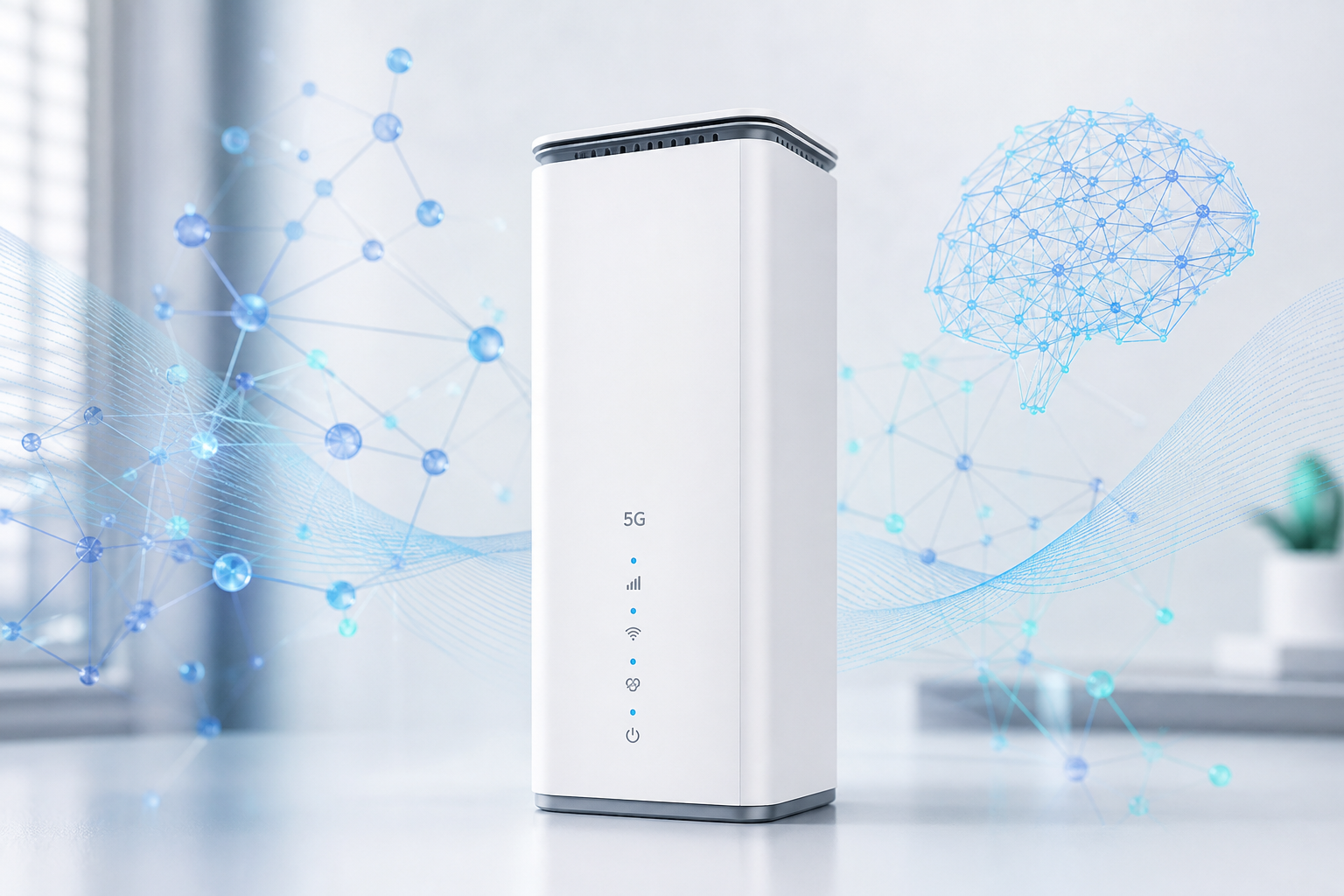
The convergence of artificial intelligence and 5G Fixed Wireless Access is entering a new phase. As enterprise B2B deployments scale globally, AI-driven self-optimizing network (SON) capabilities embedded directly within 5G CPE devices are transforming how operators manage spectrum, mitigate interference, and maintain service-level agreements (SLAs) in real time.
Machine Learning at the CPE Edge
Next-generation 5G CPE platforms are integrating lightweight machine learning inference engines capable of analyzing RF environment data, traffic patterns, and interference sources without cloud dependency. This on-device intelligence enables sub-millisecond decision loops for beam management, carrier selection, and modulation scheme optimization — capabilities traditionally reserved for gNB-side processing.
Qualcomm’s latest Snapdragon X80 and MediaTek’s T830 platforms now expose dedicated neural processing pipelines that CPE manufacturers can leverage for real-time channel estimation and predictive link adaptation. Early field trials demonstrate 18-23% improvement in cell-edge throughput when AI-assisted beamforming is active, compared to conventional codebook-based approaches.
Spectrum Efficiency Gains Through Predictive Analytics
AI-enhanced 5G CPE devices are proving particularly valuable in dense urban enterprise environments where spectrum contention is highest. By continuously learning from historical RF fingerprints and correlating them with time-of-day usage patterns, these systems can proactively switch between frequency bands — n77, n78, n79 — before congestion events materialize.
Operators deploying AI-optimized CPE fleets report a 15% reduction in spectrum wastage and a measurable increase in average sector throughput. For B2B buyers procuring CPE at scale, AI-driven spectrum management translates directly into better QoS consistency across multi-site deployments.
Self-Healing Enterprise FWA Networks
One of the most compelling B2B use cases is autonomous fault recovery. AI-enabled 5G CPE units can detect degrading link quality, identify root causes — whether atmospheric attenuation, adjacent-channel interference, or hardware drift — and execute corrective actions without human intervention. This includes dynamic antenna pattern adjustment, automatic failover to secondary carriers, and on-the-fly TCP optimization parameter tuning.
For enterprises operating mission-critical FWA links at remote sites — retail chains, branch banking, construction field offices — this self-healing capability dramatically reduces truck rolls and mean time to repair (MTTR), delivering tangible OpEx savings.
Vendor Landscape and Procurement Considerations
B2B procurement teams evaluating AI-enhanced 5G CPE should assess whether devices support on-chip NPU/APU acceleration, the maturity of the vendor’s SON software stack, and compatibility with multi-vendor RAN environments. Key questions include whether the AI models are updatable over-the-air, whether inference runs exclusively on-device for latency and privacy, and how the solution integrates with existing operator OSS/BSS frameworks.
Honlly Telecom’s 5G CPE portfolio incorporates adaptive intelligence features across our enterprise-grade product line, designed to support carrier-grade deployments with industry-leading RF performance and AI-assisted network optimization.
Frequently Asked Questions
Q: How does AI improve 5G CPE performance compared to traditional fixed-configuration devices?
A: AI-enabled CPE continuously learns from its RF environment, adapting beam patterns, carrier selection, and modulation in real time. Tests show 18-23% cell-edge throughput gains and 15% spectrum efficiency improvement over static configurations.
Q: Does on-device AI processing increase CPE power consumption significantly?
A: Modern NPU accelerators are designed for power efficiency — the incremental draw is typically under 2W during active inference, well within the thermal budget of enterprise-grade CPE enclosures.
Q: Are AI models on 5G CPE devices field-upgradable?
A: Yes, leading platforms support OTA model updates via TR-369 USP or proprietary device management protocols, ensuring continuous improvement without physical intervention.
Q: Can AI-optimized CPE work in multi-operator or neutral host deployments?
A: Yes, the AI stack operates at the device level independent of operator-specific RAN configurations, making it suitable for multi-IMSI, eSIM, and neutral host scenarios.
Contact Honlly Telecom to discuss AI-enhanced 5G CPE solutions for your enterprise FWA deployment.