
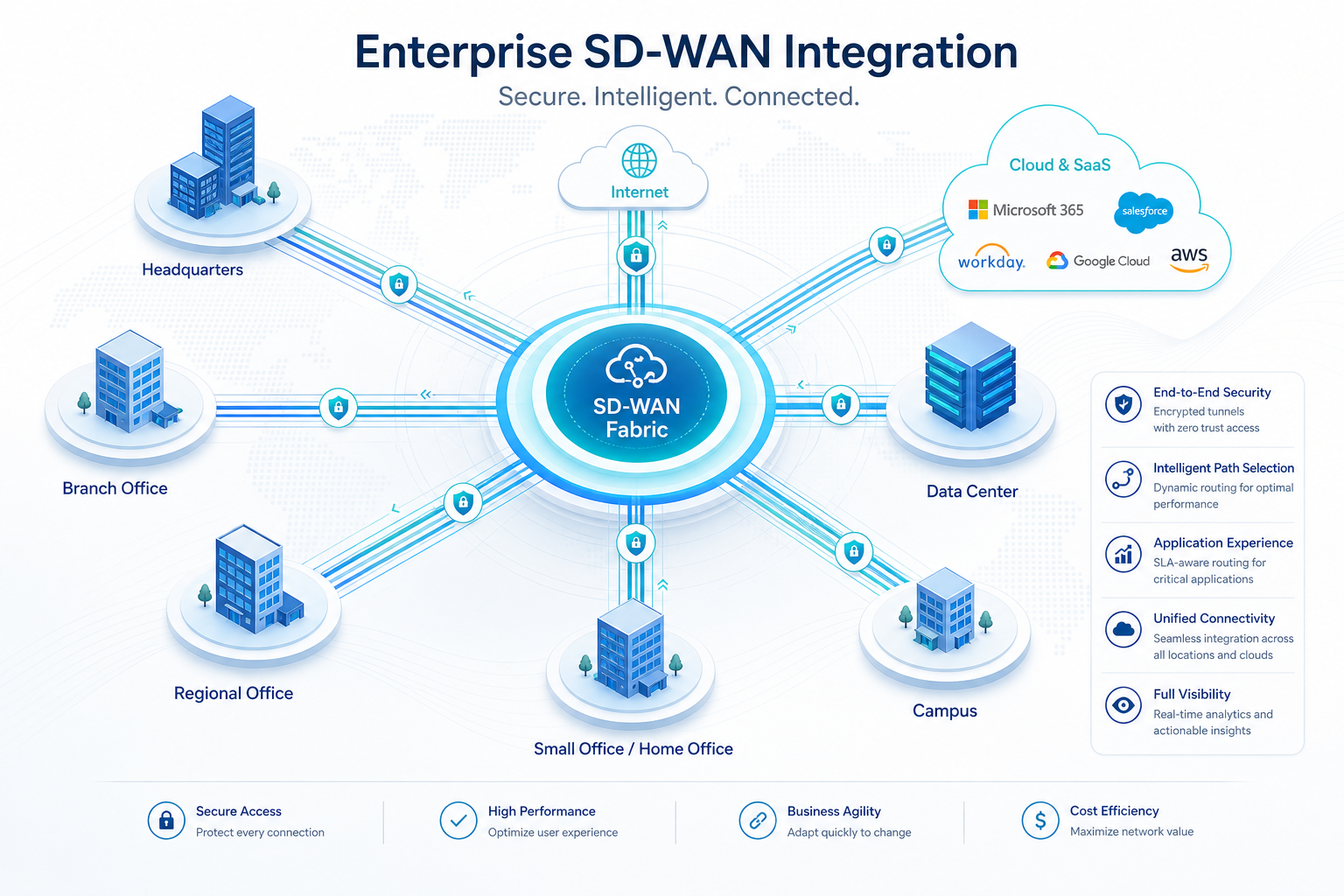
As enterprise branch connectivity strategies evolve beyond MPLS-centric architectures, the convergence of 5G fixed wireless access (FWA) and software-defined wide-area networking (SD-WAN) has emerged as one of the most significant architectural shifts in enterprise networking. 5G CPE devices are no longer simple modem-to-Ethernet bridges—they are becoming intelligent SD-WAN edge nodes that integrate WAN link aggregation, application-aware traffic steering, and hardware-accelerated VPN termination. For enterprise IT teams and managed service providers (MSPs) architecting next-generation branch connectivity, understanding the integration patterns between 5G CPE and SD-WAN is essential.
The 5G CPE as an SD-WAN Edge Platform
Modern enterprise-grade 5G CPE devices have evolved significantly beyond the consumer-grade fixed wireless terminals of the early 5G era. High-end CPE platforms now integrate multi-core ARM or x86 processors, hardware security engines, and sufficient memory to run full SD-WAN software stacks directly on the CPE—eliminating the need for a separate SD-WAN appliance at the branch edge. This consolidation delivers several advantages: reduced hardware footprint and power consumption, simplified deployment (a single device to install and manage), and tighter integration between WAN link telemetry and SD-WAN policy enforcement.
Key hardware capabilities that enable this convergence include: integrated hardware crypto accelerators supporting AES-GCM, SHA-256, and public-key operations at multi-gigabit line rates; dedicated traffic management engines with hierarchical QoS (HQoS) supporting per-application, per-tunnel, and per-interface queuing; and multi-WAN architectures that combine 5G NR, LTE, Ethernet, and Wi-Fi backhaul interfaces within a single CPE platform.
IPSec and WireGuard Performance Considerations
VPN overlay performance is the critical metric for SD-WAN-integrated 5G CPE. Enterprises running latency-sensitive applications (VoIP, video conferencing, real-time trading) and high-throughput workloads (file replication, cloud backup, VDI) require the CPE to sustain near-line-rate encrypted throughput across concurrent tunnels. Two VPN protocols dominate the 5G CPE SD-WAN landscape:
IPSec: The incumbent enterprise VPN standard, IPSec benefits from decades of optimization and widespread hardware offload support. Modern 5G CPE chipsets from Qualcomm (IPQ series networking processors) and MediaTek (Filogic platforms) include dedicated IPSec crypto engines capable of sustaining 2-5 Gbps of AES-256-GCM encrypted throughput. For enterprises with existing IPSec-based SD-WAN deployments (Cisco SD-WAN/Viptela, VMware VeloCloud, Fortinet Secure SD-WAN), selecting a CPE with hardware IPSec offload ensures compatibility while maintaining performance.
WireGuard: The newer, streamlined VPN protocol has gained rapid adoption in SD-WAN due to its minimal codebase, simplified key management, and excellent software performance even without hardware offload. WireGuard’s use of ChaCha20-Poly1305 encryption can achieve 1.5-3 Gbps on mid-range CPE processors without dedicated crypto hardware. Several next-generation SD-WAN platforms—including NetFoundry, ZeroTier, and the open-source FlexiWAN project—have adopted WireGuard as their primary overlay protocol. For greenfield 5G SD-WAN deployments, WireGuard’s operational simplicity and strong security posture make it an increasingly compelling choice.
Hybrid WAN Overlay Architecture
The most advanced 5G CPE SD-WAN deployments implement a hybrid overlay architecture that combines multiple VPN technologies and WAN interfaces into a unified, policy-driven forwarding plane. In this model:
- Underlay abstraction: The CPE treats 5G NR, LTE, Ethernet, and satellite links as abstract WAN transports, each characterized by real-time metrics (bandwidth, latency, jitter, packet loss, signal quality).
- Overlay mesh: IPSec and WireGuard tunnels are established over each viable WAN link to the enterprise SD-WAN hub or cloud gateway, creating a full-mesh or hub-spoke overlay topology.
- Application-aware steering: The SD-WAN policy engine classifies traffic using deep packet inspection (DPI), application signatures, and DNS-based identification, then steers each flow to the optimal overlay tunnel based on application requirements and real-time link quality.
- Intelligent failover: Sub-second link failure detection—leveraging BFD (Bidirectional Forwarding Detection), continuous tunnel health probes, and physical-layer signal monitoring—triggers seamless failover to alternate WAN paths without session interruption.
Deployment Scenarios Driving Adoption in 2026
Several enterprise verticals are driving accelerated adoption of SD-WAN-integrated 5G CPE:
Retail and Quick-Service Restaurants (QSR): Thousands of distributed locations require reliable PCI-compliant connectivity for POS systems, inventory management, and guest Wi-Fi. 5G CPE with integrated SD-WAN provides primary or failover connectivity that deploys in hours rather than the weeks required for wired circuits.
Financial Services Branch Banking: Bank branches demand always-on connectivity with strict SLA guarantees for real-time transaction processing. Dual-5G CPE with SD-WAN enables active-active WAN configurations with encrypted overlay tunnels to redundant data centers, ensuring zero-downtime connectivity for mission-critical banking applications.
Healthcare Clinics and Telemedicine: Remote clinics and pop-up healthcare facilities leverage 5G CPE with SD-WAN for HIPAA-compliant connectivity, with application-aware policies that prioritize telemedicine video traffic over administrative workloads during clinical hours.
Temporary and Pop-Up Sites: Construction sites, event venues, and disaster recovery operations use ruggedized 5G CPE with embedded SD-WAN for rapid-deployment connectivity that can be operational within minutes of power-on.
Procurement Checklist for SD-WAN-Capable 5G CPE
For enterprise IT and MSP procurement teams evaluating 5G CPE for SD-WAN integration, the following checklist provides a structured evaluation framework:
- Hardware IPSec throughput rating at AES-256-GCM with 1400-byte IMIX packets
- WireGuard performance with ChaCha20-Poly1305 at typical IMIX traffic profiles
- Maximum concurrent VPN tunnel count and tunnel establishment rate
- Certification status with target SD-WAN platform (vendor-specific interoperability testing)
- Support for BFD and sub-second failover across 5G, LTE, and Ethernet WAN interfaces
- DPI engine capability and application signature database update mechanism
- Centralized management integration (SD-WAN orchestrator API or TR-369 USP telemetry)
- Hardware root of trust and secure key storage (TPM 2.0 or equivalent)
- Thermal design for sustained multi-gigabit encrypted throughput without throttling
The convergence of 5G FWA and SD-WAN represents a strategic opportunity for enterprises to simplify branch networking architecture, accelerate site deployment, and improve WAN resilience—all while reducing the hardware footprint and operational complexity of traditional multi-box branch edge solutions. As 5G network coverage expands and CPE platforms continue to mature, integrated 5G CPE SD-WAN solutions will become the default branch connectivity architecture for distributed enterprises worldwide.