
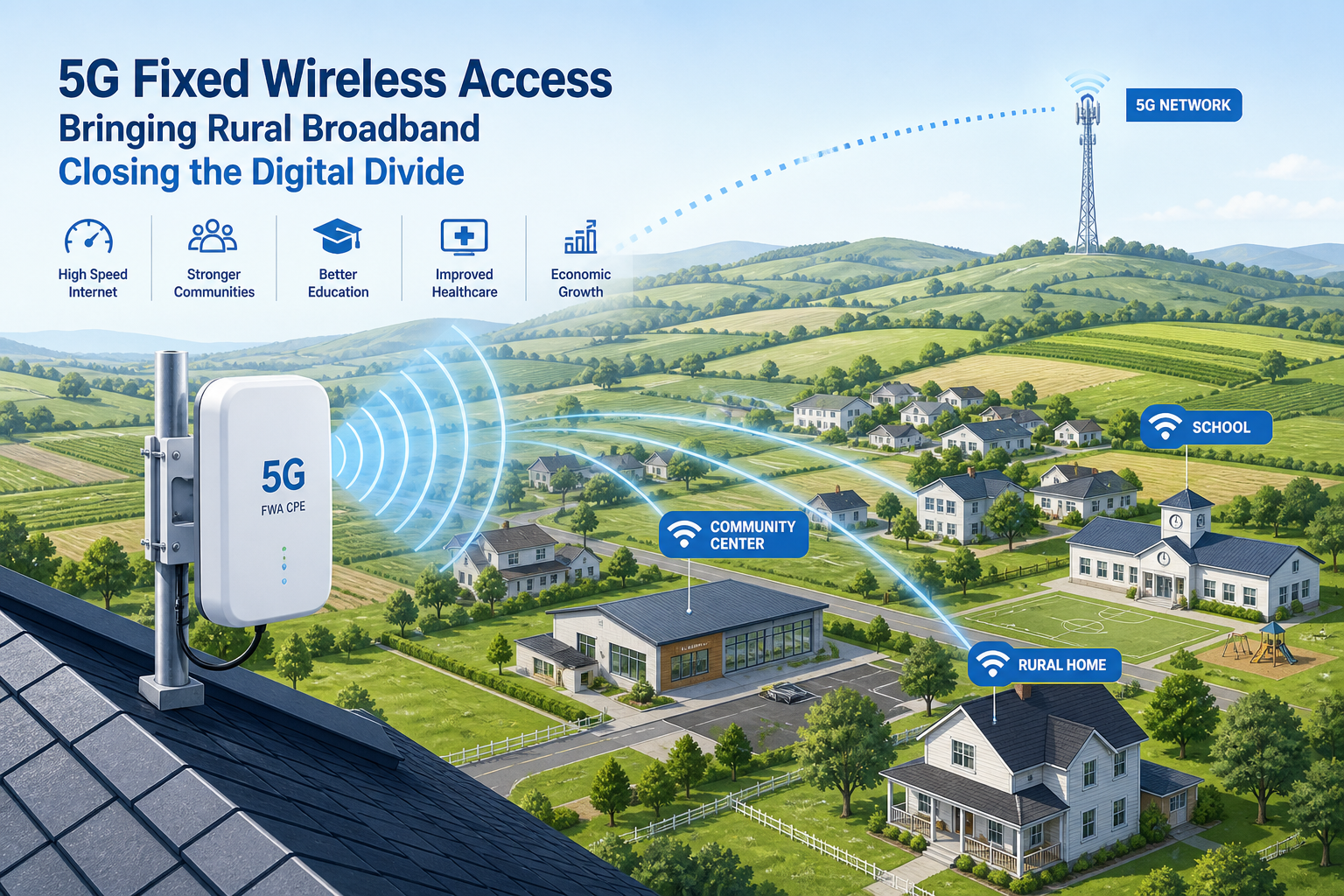
In 2026, the economics of rural broadband have shifted decisively. Where a fiber build-out to a remote village, a farm, or a small industrial cluster once required years of trenching and a fragile business case, 5G fixed wireless access (FWA) now delivers fiber-like speeds at a fraction of the time and cost. As operators and government programs push to close the digital divide, demand for cost-effective, outdoor-rated 5G CPE is rising in step.
The Fiber Gap Is Still the Bottleneck
Despite years of investment, a substantial share of rural and semi-rural premises remain beyond the reach of fiber. Low population density stretches payback periods, while terrain, permitting, and right-of-way disputes add cost and delay. Fixed wireless has become the bridge: it reuses the cellular network that already blankets most of these areas, so an operator can turn on service to a premise in days rather than months, using a rooftop or pole-mounted CPE with a high-gain antenna to close the distance to the nearest tower.
Why 5G Changes the Rural Equation
Earlier generations of fixed wireless were often seen as a stopgap — usable, but not a true substitute for fixed line. 5G changes that. Mid-band spectrum, wider carrier bandwidths, and massive MIMO give a well-engineered outdoor CPE enough throughput to support remote work, video schooling, telemedicine, precision agriculture, and multi-device households simultaneously. Where standalone (SA) 5G and network slicing are available, operators can even reserve capacity for premium or public-service use cases, making fixed wireless a credible primary connection rather than a fallback.
What Rural Deployments Demand From CPE
Rural CPE lives a harder life than its urban counterpart. It sits outdoors in rain, dust, and extreme temperatures, often miles from the cell site and far from a technician. The units that succeed in these programs share a common profile.
- Outdoor-rated, IP-protected housing: weatherproof enclosures and wide operating temperature ranges for year-round rooftop and pole mounting.
- High-gain external antennas: directional or MIMO antenna support to reach distant towers and hold a stable signal in marginal coverage.
- Low total cost of ownership: efficient power draw, simple self-install, and remote management that minimizes truck rolls.
- PoE and flexible mounting: single-cable power and data, with mounting options for walls, poles, and rooftops.
- Robust remote management: zero-touch provisioning and cloud monitoring so operators can support thousands of dispersed units with a lean team.
A Growing Market for Vendors and Distributors
For CPE manufacturers, distributors, and integrators, rural FWA is one of the most durable growth segments in the telecom equipment market. Government broadband-subsidy programs across North America, Europe, and emerging markets continue to direct funding toward fixed wireless as a fast, cost-effective coverage tool, and operators are buying at volume. The buyers reward vendors who can supply carrier-grade hardware at a cost that keeps rural service profitable, ship regionally on demand, and support operators through certification and field deployment. As the fiber gap persists — and as 5G coverage deepens into the countryside — rural fixed wireless is moving from a stopgap to a strategic, long-term broadband platform.
Frequently Asked Questions
Why do operators choose 5G FWA over fiber for rural areas?
Speed of deployment and cost. Fiber requires expensive civil works and years of planning in low-density areas, while 5G FWA reuses existing cellular infrastructure to deliver fiber-like speeds to a premise within days, often at a fraction of the cost.
Can 5G FWA serve as a primary home or business connection in rural areas?
Yes. With mid-band spectrum and a high-gain outdoor CPE, 5G FWA delivers enough throughput for remote work, education, telemedicine, and multi-device households, making it a credible primary connection rather than a fallback.
What hardware features matter most for rural CPE deployments?
Outdoor-rated IP-protected housing, high-gain external antenna support, low power draw, PoE, flexible mounting, and remote zero-touch management are the features that determine reliability and total cost of ownership in dispersed rural deployments.
How can a vendor or distributor succeed in the rural FWA market?
Offer carrier-grade CPE at a cost that keeps rural service profitable, support operators through certification and field rollout, and be able to ship regionally on demand. Government broadband programs increasingly favor fixed wireless, creating sustained volume opportunities.
Looking for carrier-grade 5G FWA CPE for your deployment? Contact Honlly Telecom to discuss OEM/ODM options, sample units, and distributor cooperation for ISP, operator, and enterprise projects.