
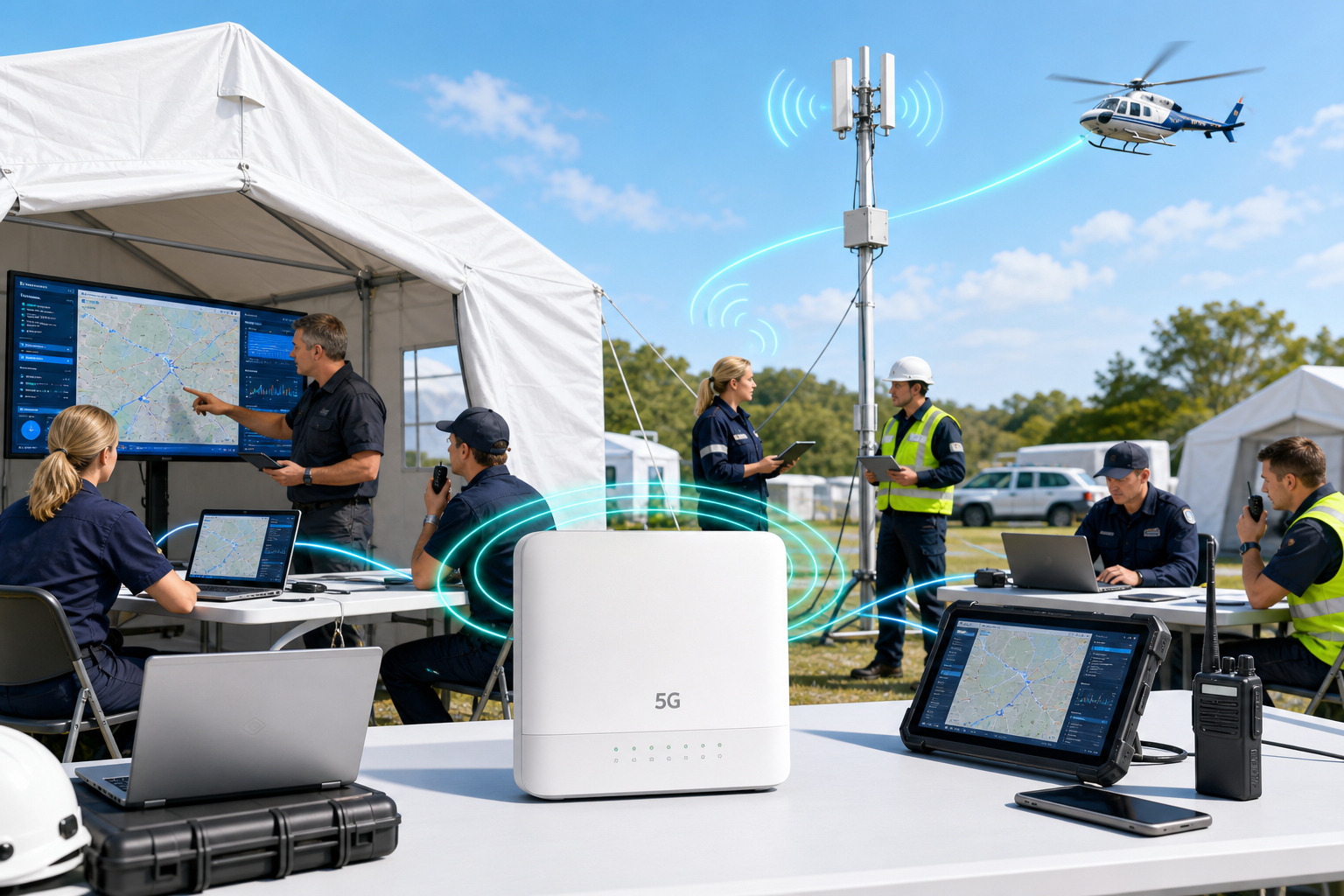
When a hurricane knocks out a region’s fiber, or a wildfire forces an evacuation of a county command center, the first thing emergency managers ask for is connectivity — and the second question is how fast it can be up. In 2026, first-responder agencies, public utilities, and the ISPs that support them are increasingly answering with 5G fixed wireless access (FWA) CPE, which turns a cellular signal into a hardened, multi-device network in the time it takes to raise a mast and plug in a router.
Why Disasters Reward Fixed Wireless
Disaster response is defined by damaged infrastructure and moving timelines. Wired connections — fiber, cable, DSL — are often the first thing to fail, either severed physically or overwhelmed by congestion. Restoring them can take weeks of civil works. Fixed wireless sidesteps both problems: it rides on the cellular network, which operators prioritize for restoration and can back up with portable cell sites, satellite links, and network-in-a-box systems.
A 5G FWA CPE packages that resilience into a single, familiar device. With an external high-gain antenna and a hardened enclosure, it can pull a usable signal from a surviving macro tower several kilometers away, then redistribute it as Ethernet and Wi-Fi to laptops, VoIP phones, telemedicine gear, and command-and-control applications.
Where 5G FWA CPE Is Being Deployed
- Incident command posts: a pop-up headquarters in a parking lot or stadium needs stable voice, video, and data within minutes of arrival.
- Field hospitals and shelters: triage tents and evacuation centers require dependable Wi-Fi and telemetry for patient tracking and family reunification.
- Utility restoration crews: electric, water, and gas crews use FWA CPE to coordinate outage response across a wide geographic area.
- Damage assessment teams: drones, tablets, and mapping tools need backhaul to upload imagery and geotagged reports from the field.
- Public information points: mobile Wi-Fi hotspots in affected neighborhoods keep residents connected when home broadband is down.
What Makes a CPE Suitable for Emergency Use
Not every fixed wireless gateway is cut out for disaster duty. The CPE used by response agencies must survive transport, harsh weather, and rapid redeployment, while delivering dependable throughput and, critically, the ability to be managed remotely by a technician who may be hundreds of kilometers away.
Specifications that matter for emergency deployments
- Rugged, weatherproof enclosure: IP-rated housing and a wide operating temperature range for outdoor masts and temporary tents.
- External antenna support: high-gain directional or MIMO antennas to reach distant or degraded cell sites.
- Dual-WAN and auto-failover: the ability to bond cellular with satellite or a second carrier for uninterrupted command operations.
- Battery and DC power options: support for PoE, vehicle power, and external batteries when grid power is unavailable.
- Zero-touch provisioning: pre-configured profiles so a non-technical responder can deploy a unit without on-site IT.
The Opportunity for Operators and Integrators
For regional operators and systems integrators, emergency connectivity is a compelling, recurring market. Public agencies increasingly procure “rapid-deploy kits” — a ruggedized CPE, antenna, power supply, and carrying case — as standard inventory, and they value vendors who can supply, stage, and support equipment on short notice. Because demand spikes unpredictably, agencies also favor partners who can warehouse reserve units and ship them regionally within hours. As climate-driven weather events grow more frequent, dependable rapid-deploy connectivity is becoming a core public-safety investment rather than a contingency.
Frequently Asked Questions
How fast can 5G FWA CPE restore connectivity after a disaster?
In many cases, minutes to hours. Because it relies on the cellular network rather than physical last-mile infrastructure, a ruggedized CPE with an external antenna can be deployed as soon as a mast is raised and power is available, making it far faster than repairing severed fiber or cable.
Can 5G FWA serve as a primary connection for emergency operations?
Yes. For incident command posts, field hospitals, and shelters that need connectivity immediately, 5G FWA serves as primary connectivity. Many deployments add satellite or a second carrier as automatic failover for maximum resilience.
What is the difference between consumer hotspots and emergency-grade FWA CPE?
Emergency-grade CPE are ruggedized for weather and transport, support high-gain external antennas, offer dual-WAN failover, and can be provisioned and managed remotely at scale. Consumer hotspots are typically less durable and lack enterprise features like VLANs, QoS, and zero-touch provisioning.
How should agencies procure and store rapid-deploy connectivity kits?
Best practice is to standardize on one or two CPE models, keep pre-configured reserve units in regional warehouses, and partner with an operator or integrator who can stage and ship within hours. Zero-touch provisioning lets non-technical staff deploy units without on-site IT support.
Looking for carrier-grade 5G FWA CPE for your deployment? Contact Honlly Telecom to discuss OEM/ODM options, sample units, and distributor cooperation for ISP, operator, and enterprise projects.