
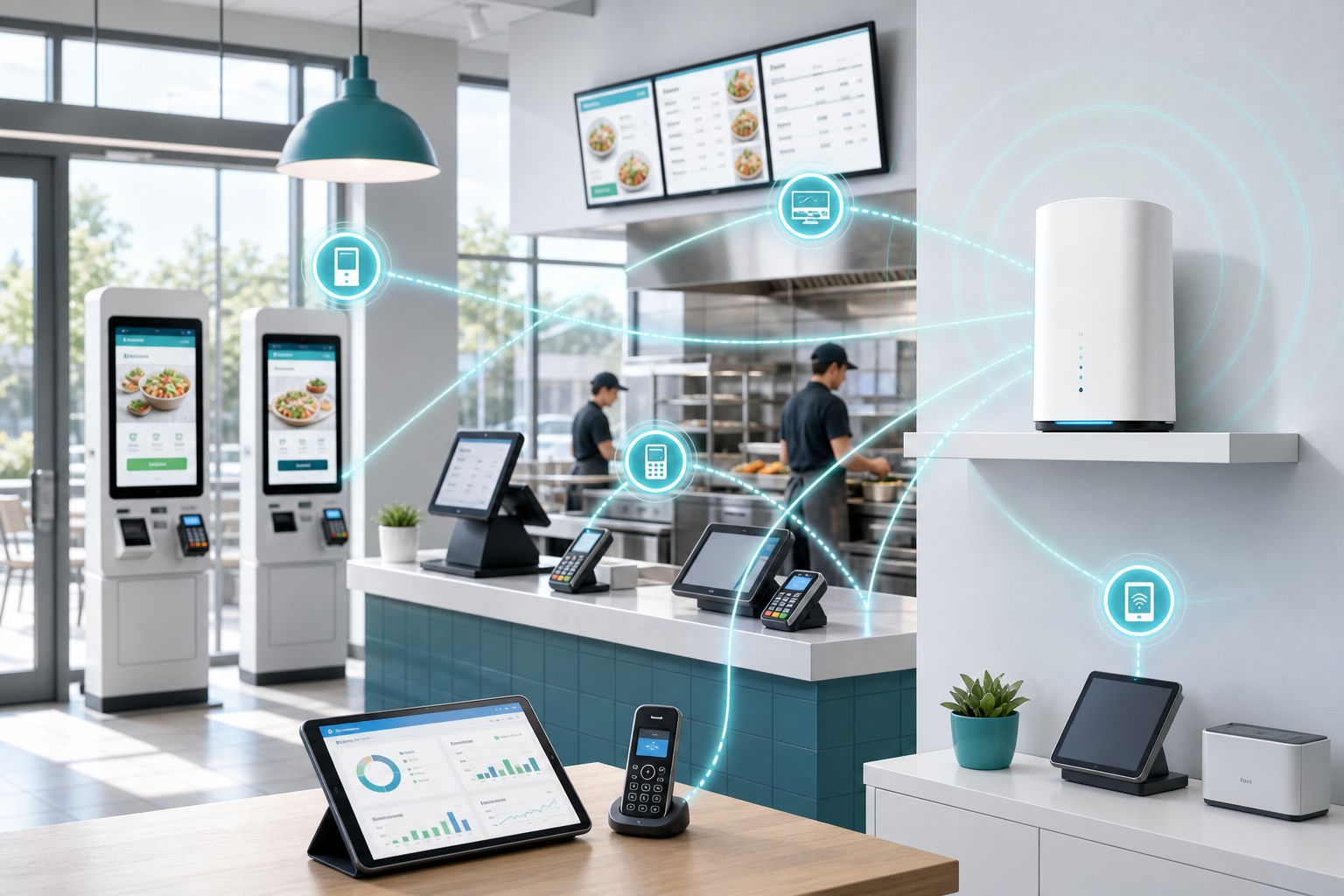
For years, the typical quick-service restaurant (QSR) branch ran on whatever the local exchange could deliver — a DSL line, a coax drop, or a shared building circuit. As ordering has moved to self-service kiosks, mobile apps, cloud POS, and third-party delivery integrations, that legacy backhaul has become the weakest link in the store. A single failed circuit stops payments, freezes kiosks, and stalls kitchen display systems. In 2026, franchise operators and the ISPs that serve them are increasingly standardizing on 5G fixed wireless access (FWA) CPE as the primary or failover connection for store networks.
Why Store Connectivity Is Now Mission-Critical
A modern QSR location is no longer a cash register and a phone line. It runs a converged stack that includes cloud point-of-sale, online ordering aggregation, loyalty and CRM systems, digital menu boards, kitchen display systems, CCTV, and guest Wi-Fi. Every one of those services is transaction-sensitive: an outage of even a few minutes during a lunch rush translates directly into lost revenue and negative reviews. For multi-site franchise groups, the problem is compounded — hundreds or thousands of locations each with different carrier availability and inconsistent install quality.
What 5G FWA CPE Changes for the Store
5G FWA CPE gives franchise operators and managed service providers a single, standardized connectivity platform that can be deployed in hours rather than weeks. Unlike a wired install that depends on civil works and building access, a 5G CPE gateway is placed, powered, and provisioned the same way at every site, whether the location is a high-street storefront, a drive-thru unit, or a mall food-court kiosk.
The practical benefits fall into three areas:
- Rapid deployment: new store openings and pop-up or temporary locations can be online on day one, with no wait for a fixed-line install.
- Resilience and failover: a 5G CPE can serve as primary WAN or as automatic backup to a wired circuit, protecting POS and payments during line faults.
- Centralized management: modern CPE platforms support TR-069/TR-369 remote management, letting a franchise IT team or MSP provision, monitor, and update every location from one dashboard.
What Buyers Should Evaluate
For ISPs, operators, and franchise IT teams evaluating 5G FWA CPE for QSR deployments, the priorities are different from consumer home broadband. Transactional traffic is modest in bandwidth but intolerant of latency spikes and packet loss. Security is non-negotiable: cardholder data traverses the same gateway, so the CPE should support encrypted tunnels, VLAN segmentation, and guest-network isolation. Finally, the hardware must survive the store environment — compact enough for a back office, tolerant of heat near kitchen equipment, and capable of running PoE-powered access points or cameras where cabling is limited.
Key specifications to verify
- WAN failover support: dual-WAN or link backup with fast automatic switchover for POS continuity.
- Throughput class: CAT6/CAT4 or 5G depending on menu board, CCTV, and guest Wi-Fi load.
- VLAN and SSID isolation: separate POS, back-office, and guest traffic on one device.
- Remote management: TR-069/TR-369, SNMP, or a cloud platform for multi-site control.
- Security: IPsec/VPN, firewall, and secure boot to protect payment traffic.
The Franchise Opportunity for Operators
For regional ISPs, wireless operators, and MVNOs, the QSR market is a repeatable, high-retention segment. A single franchise agreement can open dozens or hundreds of locations, and because connectivity underpins payment systems, churn is low once the solution is proven. Offering a managed 5G FWA CPE service — hardware, SIM, and remote management bundled into a per-site fee — turns a one-off hardware sale into recurring revenue.
Frequently Asked Questions
Can 5G FWA CPE handle POS and payment traffic reliably?
Yes. POS and payment transactions are low-bandwidth but latency-sensitive; a properly provisioned 5G FWA CPE with quality-of-service rules and wired or VPN backhaul handles them reliably, and is widely used as backup or primary WAN in retail and hospitality.
Is 5G FWA a good primary connection for restaurants, or only backup?
It can be either. In locations with limited fixed-line availability or for rapid openings, 5G FWA serves as primary. In established stores it is commonly deployed as automatic failover to protect POS and kiosks during wired outages.
How does 5G FWA CPE simplify multi-site restaurant rollouts?
It standardizes the network edge. Every site gets the same hardware, configuration template, and remote management, so an IT team can provision and monitor hundreds of stores centrally without site-by-site variation.
What security should restaurant 5G CPE support?
Look for VLAN segmentation to isolate POS and guest traffic, IPsec/VPN support, a stateful firewall, and secure boot. Cardholder data protection requires segmenting payment systems from guest and back-office networks.
Looking for carrier-grade 5G FWA CPE for your deployment? Contact Honlly Telecom to discuss OEM/ODM options, sample units, and distributor cooperation for ISP, operator, and enterprise projects.