
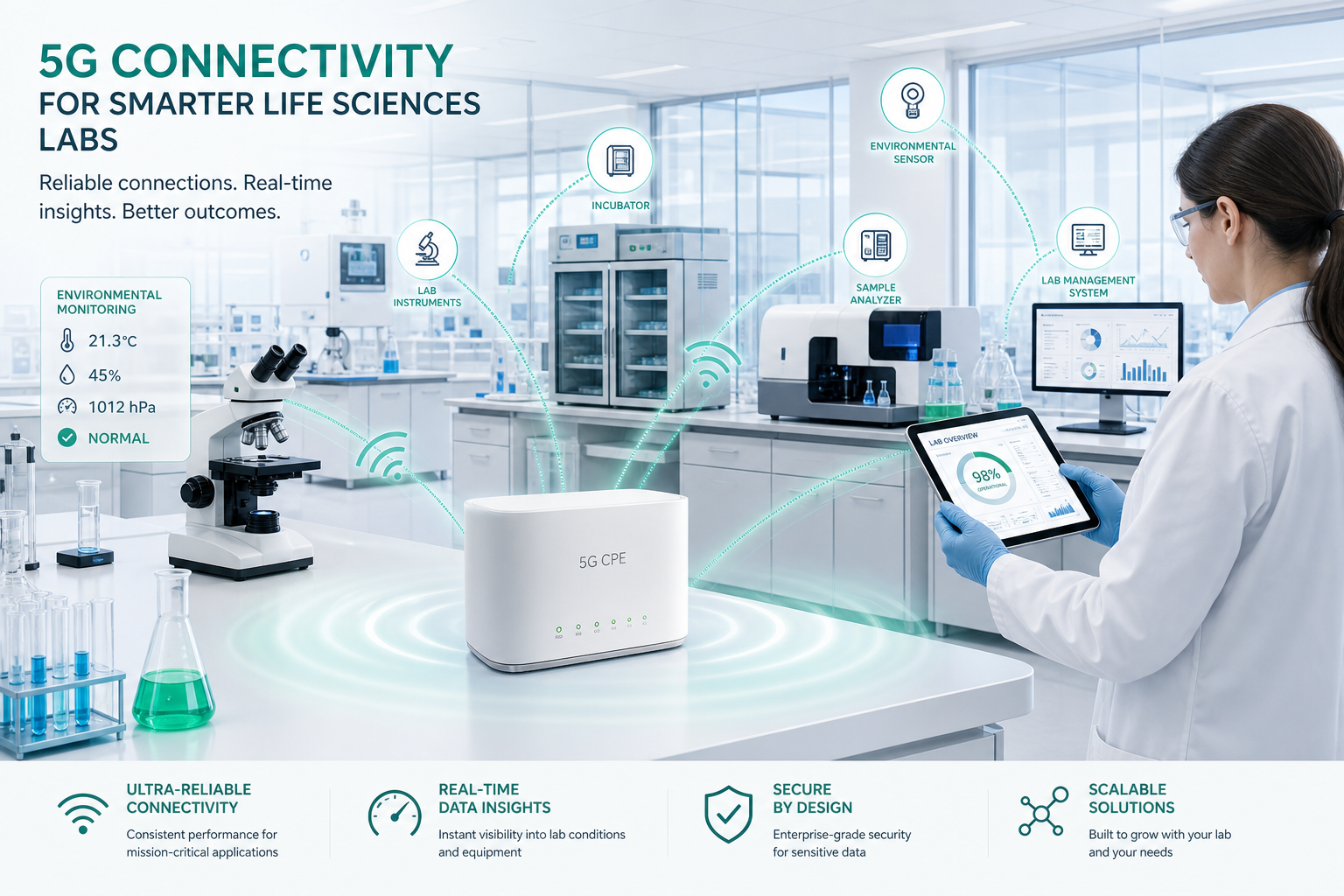
Modern life sciences facilities depend on an invisible but non-negotiable foundation: dependable connectivity. Laboratory instruments stream data to laboratory information management systems (LIMS), cleanrooms run monitored environmental sensors around the clock, researchers collaborate on cloud platforms, and regulated environments require audit trails that never drop. A single connectivity failure can invalidate an experiment, stall a production batch, or trigger a compliance review. For lab managers, biotech firms, and the integrators who serve them, 5G CPE offers a resilient, quickly deployable link that complements — and often protects — the wired infrastructure these facilities rely on.
Why Labs Need Connectivity That Cannot Fail
Laboratory environments are demanding in ways that ordinary office networks never experience. Data integrity is paramount: instrument readings, sample tracking, and environmental monitoring must be captured continuously and accurately. Many facilities also operate in spaces where running new cable is impractical or disruptive — cleanrooms with sealed walls, converted research spaces, and temporary or modular lab units. 5G CPE addresses both problems, providing a high-reliability wide-area link that can be deployed without invasive cabling and used as automatic failover to keep regulated systems online when the primary connection is interrupted.
Where 5G CPE Fits in a Life Sciences Facility
- Instrument data collection: dependable backhaul for analyzers, sequencers, and imaging systems feeding LIMS and cloud platforms.
- Environmental monitoring: continuous connectivity for cleanroom temperature, humidity, and particle sensors.
- Backup and failover WAN: automatic protection for LIMS, ERP, and compliance systems when the primary link fails.
- Modular and temporary labs: rapid connectivity for container labs, field research stations, and expansion projects.
- Collaboration and telepresence: stable links for remote instrument access, video review, and cross-site research teams.
What to Look For in Lab-Grade CPE
The evaluation should begin with the facility’s compliance and data-integrity requirements, then work outward to performance and manageability. A CPE that is dependable but unmanageable, or fast but insecure, is not suitable for a regulated environment.
Reliability and failover requirements
- Multi-WAN with automatic failover: cellular plus wired WAN, with seamless switchover so monitoring and LIMS never lose a sample record.
- Dual-SIM and multi-carrier support: redundancy across operators for maximum uptime in critical facilities.
- External antenna support: dependable signal in shielded rooms, basements, and RF-restricted areas.
Security and compliance requirements
- VPN and encrypted tunnels: IPsec and other VPN support to protect instrument and sample data in transit.
- VLAN segmentation: separation of instrument networks, building systems, and guest access.
- Centralized logging: connectivity and access logs that support audit and compliance requirements.
- Remote management with access control: secure, role-based administration without compromising the network perimeter.
Deployment and management requirements
- Zero-touch provisioning: standardized, repeatable configuration across many lab sites.
- Cloud management and monitoring: continuous visibility into link health and failover status.
- Compact, low-noise hardware: units suited to bench areas and technical rooms without disrupting sensitive environments.
Procurement and Deployment Best Practices
Start by defining the consequence of downtime for each system: a LIMS outage during a regulated batch may be unacceptable, while guest Wi-Fi can tolerate interruption. Use that to decide where 5G CPE serves as primary connectivity, where it acts as automatic failover, and where it simply extends coverage. Standardize on hardware that the IT and facilities teams can both manage, run a pilot in a single lab or cleanroom before scaling, and confirm the vendor’s management platform supports the logging and access controls your compliance framework requires. In life sciences, connectivity is not a convenience — it is part of the data-integrity and quality system, and it should be procured with the same rigor as any other regulated instrument.
Frequently Asked Questions
Is 5G CPE reliable enough for laboratory and cleanroom environments?
Yes. With multi-WAN automatic failover, dual-SIM redundancy, and external antenna support, 5G CPE provides dependable connectivity for instrument data, LIMS, and environmental monitoring — and is often deployed as a resilient backup to wired infrastructure.
Can 5G CPE support regulated and compliant environments?
Yes, when configured with encrypted VPN tunnels, VLAN segmentation, centralized logging, and role-based remote management. These features help facilities meet the data-integrity and audit requirements common in regulated life sciences environments.
How does 5G CPE help modular and temporary laboratories?
Because it needs no invasive cabling, 5G CPE can connect container labs, field research stations, and expansion projects quickly, then be redeployed as needs change — without the cost and disruption of running new cable.
What should a multi-site life sciences organization standardize on?
Standardize on hardware with zero-touch provisioning and centralized cloud management, define the downtime tolerance for each system, and confirm the management platform supports the logging and access controls required by the organization’s compliance framework.
Looking for carrier-grade 5G FWA CPE for your deployment? Contact Honlly Telecom to discuss OEM/ODM options, sample units, and distributor cooperation for ISP, operator, and enterprise projects.