
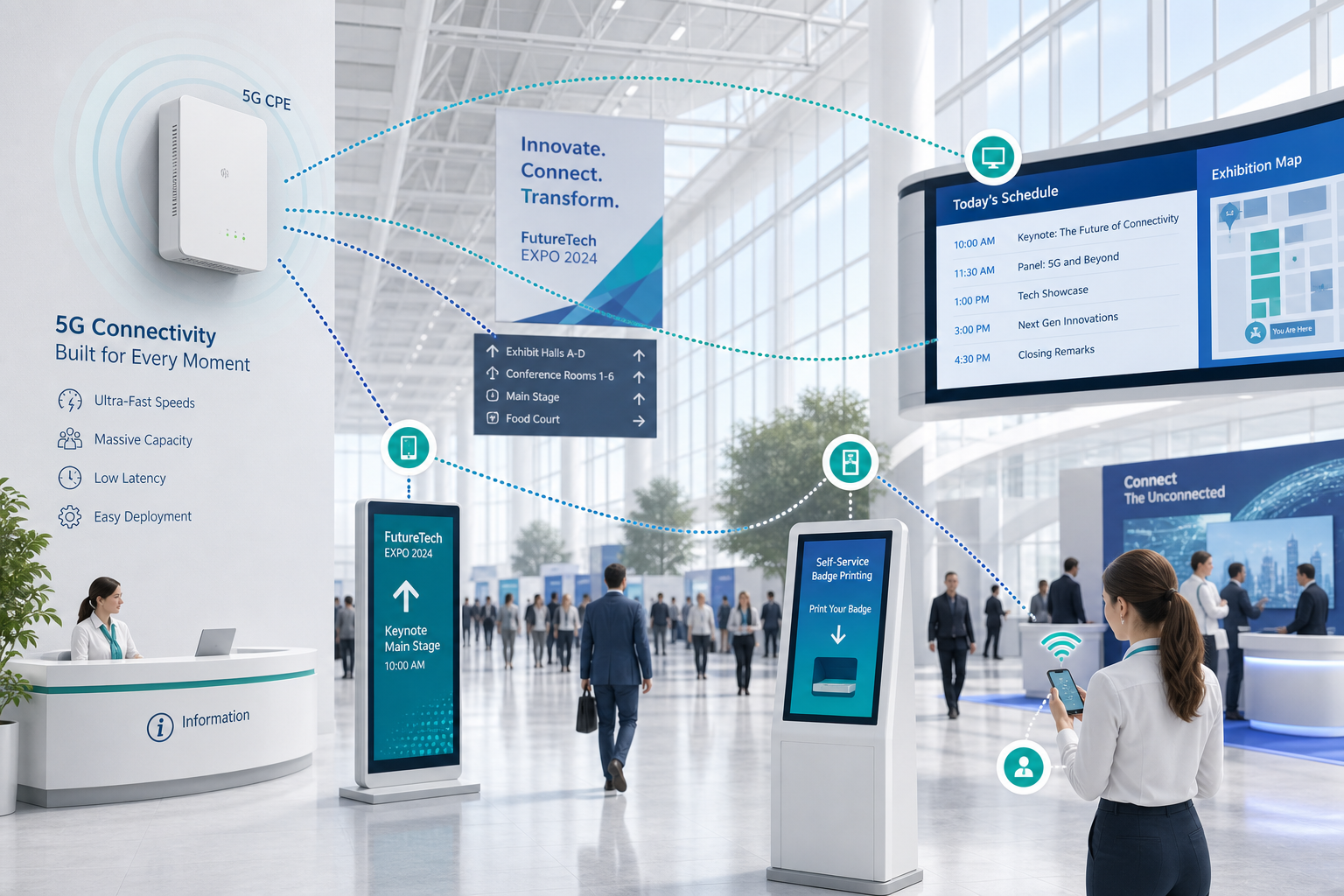
A convention center is a connectivity stress test disguised as a building. For a few days at a time, it must absorb thousands of attendees, hundreds of exhibitors, dense Wi-Fi demand, live streaming, ticketing, wayfinding, and mission-critical event operations — then repeat the cycle days later with a completely different event. Wired capacity alone rarely flexes fast enough. For venue operators and the integrators who serve them, 5G CPE has become the flexible layer that fills the gap, providing rapid, high-capacity fixed wireless wherever and whenever an event needs it.
Why Event Connectivity Is Different
Event traffic is bursty, mobile, and temporary. Registration opens with a surge of simultaneous check-ins; a keynote drives thousands of devices onto the network at once; exhibitors demand isolated, reliable links for demos and payment terminals; and every event teardown leaves the venue needing to reconfigure for the next client. Permanent wired infrastructure is expensive to over-provision and slow to move. 5G CPE complements it by turning cellular capacity into deployable network segments that can be stood up in minutes, relocated between halls, and torn down without civil works.
Where 5G CPE Fits in a Convention Venue
- Event and exhibitor networks: dedicated links for exhibitor booths, demo pods, and sponsor networks isolated from public traffic.
- Ticketing and registration: dependable connectivity for check-in kiosks, badge printing, and access control at entrances.
- Digital signage and wayfinding: backhaul for large-format displays, directory screens, and interactive maps.
- Live streaming and broadcast support: uplink capacity for keynotes, hybrid events, and media feeds.
- Temporary and overflow coverage: quick-deploy capacity for outdoor areas, overflow halls, and pop-up activations.
What to Look For in Venue-Grade CPE
The right CPE for a convention center must handle density and change without compromising security or manageability. Evaluation should focus on how well the device segments traffic, sustains throughput under load, and integrates with a venue’s fast-moving operations.
Capacity and radio requirements
- Multi-gigabit backhaul and Wi-Fi integration: sufficient wired throughput to feed high-density access points and signage.
- Dual-band or multi-carrier support: the ability to aggregate capacity or fail over between operators for event-critical links.
- External antenna support: for venues with signal challenges, steel structures, or basement exhibition halls.
Network and security requirements
- VLAN and SSID segmentation: clean separation between public Wi-Fi, exhibitor networks, and venue operations.
- QoS and traffic shaping: prioritization so ticketing and access control are never crowded out by streaming.
- Captive portal and content filtering: straightforward guest-network compliance and acceptable-use enforcement.
- Firewall and isolation: protection so one compromised exhibitor device cannot reach venue systems.
Deployment and management requirements
- Zero-touch provisioning: pre-staged configurations that make event setup fast and repeatable.
- Centralized cloud management: a single console to monitor and update CPE across multiple halls and venues.
- Rapid redeployment: lightweight, mountable hardware that can move with each event’s floor plan.
- Usage reporting: per-segment analytics to support chargeback and capacity planning for repeat events.
Procurement Best Practices
Venue operators get the best results by treating connectivity as an event-ready service rather than a fixed asset. Standardize on one or two CPE models with zero-touch provisioning so every hall setup follows the same playbook, and build a small reserve of pre-configured units for overflow and last-minute exhibitor requests. Define service levels for ticketing and access control explicitly, and confirm the management platform scales across the estate. Because events are unpredictable and high-stakes, choose hardware and a vendor that can deliver and support on short notice — the cost of a connectivity failure during a keynote or a packed trade-show day far outweighs the price of the equipment.
Frequently Asked Questions
Can 5G CPE handle the density of a large trade show?
Yes, when used to backhaul properly designed access points and segmented networks. 5G CPE supplies the high-capacity wide-area link, while VLAN segmentation and QoS ensure ticketing, exhibitor, and public traffic stay isolated and responsive under load.
How fast can a convention center deploy connectivity for a new event?
With zero-touch provisioning and pre-configured units, event connectivity can be stood up in minutes rather than days, since 5G CPE requires no wired installation and can be moved and reconfigured to match each event’s floor plan.
Should event connectivity be separate from venue operations?
Yes. Best practice is to isolate public Wi-Fi, exhibitor networks, and venue operations on separate VLANs and SSIDs, with QoS protecting ticketing and access control. This keeps a compromised or congested exhibitor network from affecting critical systems.
What should a multi-venue operator standardize on?
Standardize on one or two CPE models with zero-touch provisioning and centralized cloud management, keep pre-configured reserve units for overflow, and define clear service levels for ticketing and access control before rollout.
Looking for carrier-grade 5G FWA CPE for your deployment? Contact Honlly Telecom to discuss OEM/ODM options, sample units, and distributor cooperation for ISP, operator, and enterprise projects.