
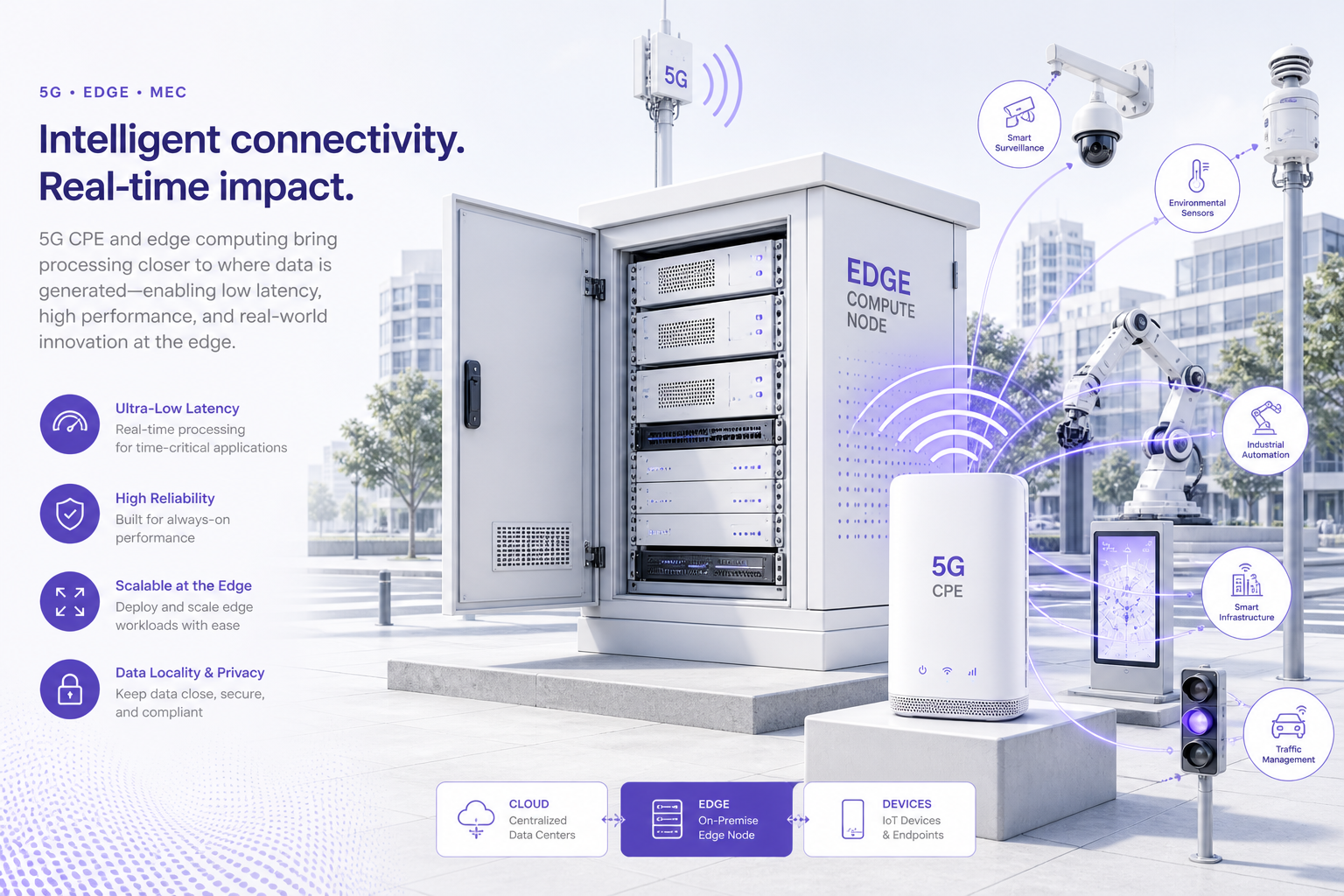
As more applications shift from centralized clouds to the network edge, the small, often unglamorous gateway that sits at the edge has become a critical link in the chain. Multi-access edge computing (MEC) promises to cut latency and backhaul load by running workloads close to users and devices — but that promise only holds if the last-hop connectivity into the edge node is itself fast, stable, and well-managed. For operators, integrators, and enterprises building out edge infrastructure, 5G CPE is emerging as a flexible way to connect edge sites that fiber cannot yet reach.
Where 5G CPE Fits in an Edge Architecture
Edge computing spans a wide range of sites: a street cabinet housing a small server, a cell-tower shelter, a factory control room, a retail back office running local video analytics, or a micro data center serving a neighborhood. In many of these locations, fiber is either absent or months away, yet the workload — real-time inference, video processing, industrial control — cannot tolerate high latency or jitter.
A 5G CPE provides the transport into these edge nodes. When configured correctly, it hands off a clean, low-latency IP path to the edge server or router, letting the edge platform focus on compute rather than connectivity gymnastics. The CPE is not the edge computer itself; it is the reliable on-ramp that makes distributed compute viable.
Latency Is the Defining Requirement
Edge use cases live and die by latency. The table below summarizes typical targets and what they imply for the CPE:
- Real-time industrial control and robotics: single-digit to low-double-digit millisecond budgets demand a short air-interface path, minimal buffering, and priority handling.
- Video analytics and computer vision: more tolerant of throughput than ultra-low latency, but sensitive to jitter that causes frame drops.
- AR/VR and cloud gaming: require consistently low round-trip times and stable packet delivery.
- IoT aggregation and telemetry: latency-tolerant but high-volume, benefiting from efficient uplink scheduling.
Buyers should verify the CPE’s real-world latency and jitter under load — not just its headline throughput — and confirm the device supports the QoS and scheduling features that protect latency-sensitive flows.
Integration Modes: Bridge, Passthrough, and Routing
How the CPE integrates with the edge node matters as much as raw performance. Three modes are common:
- Bridge / IP passthrough: the CPE passes the operator’s IP address through to the edge router or server, which owns NAT, firewall, and routing. This is the cleanest fit when an edge platform or SD-WAN appliance manages the network.
- Router mode with NAT: the CPE performs routing and NAT, suitable when the edge site is simple and the CPE itself can enforce policy.
- Dual-WAN with failover: the CPE combines a wired and cellular WAN, providing resilience for edge nodes that must stay online during fiber faults.
What to Verify in the Data Sheet
- Latency and jitter under load: measured values, not marketing throughput, for the CPE’s target radio class.
- Bridge and IP-passthrough support: essential if an edge router or SD-WAN appliance owns the network layer.
- QoS and traffic shaping: to prioritize latency-sensitive edge workloads over bulk traffic.
- Multi-carrier and multi-SIM: for resilience and to select the lowest-latency path to the edge application.
- Hardening and power: wide temperature range, passive cooling, and PoE support for cabinet and street-level deployments.
- Remote management: TR-069/TR-369 or cloud control to monitor and update distributed edge gateways at scale.
Building a Reliable Edge Transport Layer
Edge computing shifts the performance burden toward the network’s outermost links, and the CPE is the first device an edge workload touches. A disciplined approach — define the latency budget, choose the right integration mode, verify real-world performance, and standardize on a remotely manageable platform — turns the gateway from a commodity into a dependable part of the edge architecture. For operators and integrators building edge offerings, a carrier-grade 5G CPE line is the foundation that makes distributed compute deliver on its promise.
Frequently Asked Questions
Can 5G CPE meet the latency requirements of edge computing?
Yes, for many edge workloads. With a short air-interface path, minimal buffering, and proper QoS, a well-provisioned 5G CPE can deliver the low single-digit to low-double-digit millisecond latency that industrial control, video analytics, and AR/VR applications require.
Should an edge CPE run in bridge or router mode?
It depends on the architecture. When an edge router, firewall, or SD-WAN appliance owns NAT and routing, bridge or IP-passthrough mode is cleanest. Simpler edge sites can use router mode with NAT and local policy.
What is the difference between edge computing and MEC?
Edge computing broadly means running workloads near users or devices. Multi-access edge computing (MEC) is the standardized framework, often operator-hosted, that provides compute and IT services at the network edge — with 5G CPE serving as a common on-ramp into those nodes.
What hardware characteristics matter for an edge-site CPE?
Low latency and jitter under load, bridge/IP-passthrough support, QoS, multi-carrier or multi-SIM redundancy, wide temperature range with passive cooling, PoE support, and TR-069/TR-369 remote management.
Looking for carrier-grade 5G FWA CPE for your deployment? Contact Honlly Telecom to discuss OEM/ODM options, sample units, and distributor cooperation for ISP, operator, and enterprise projects.