
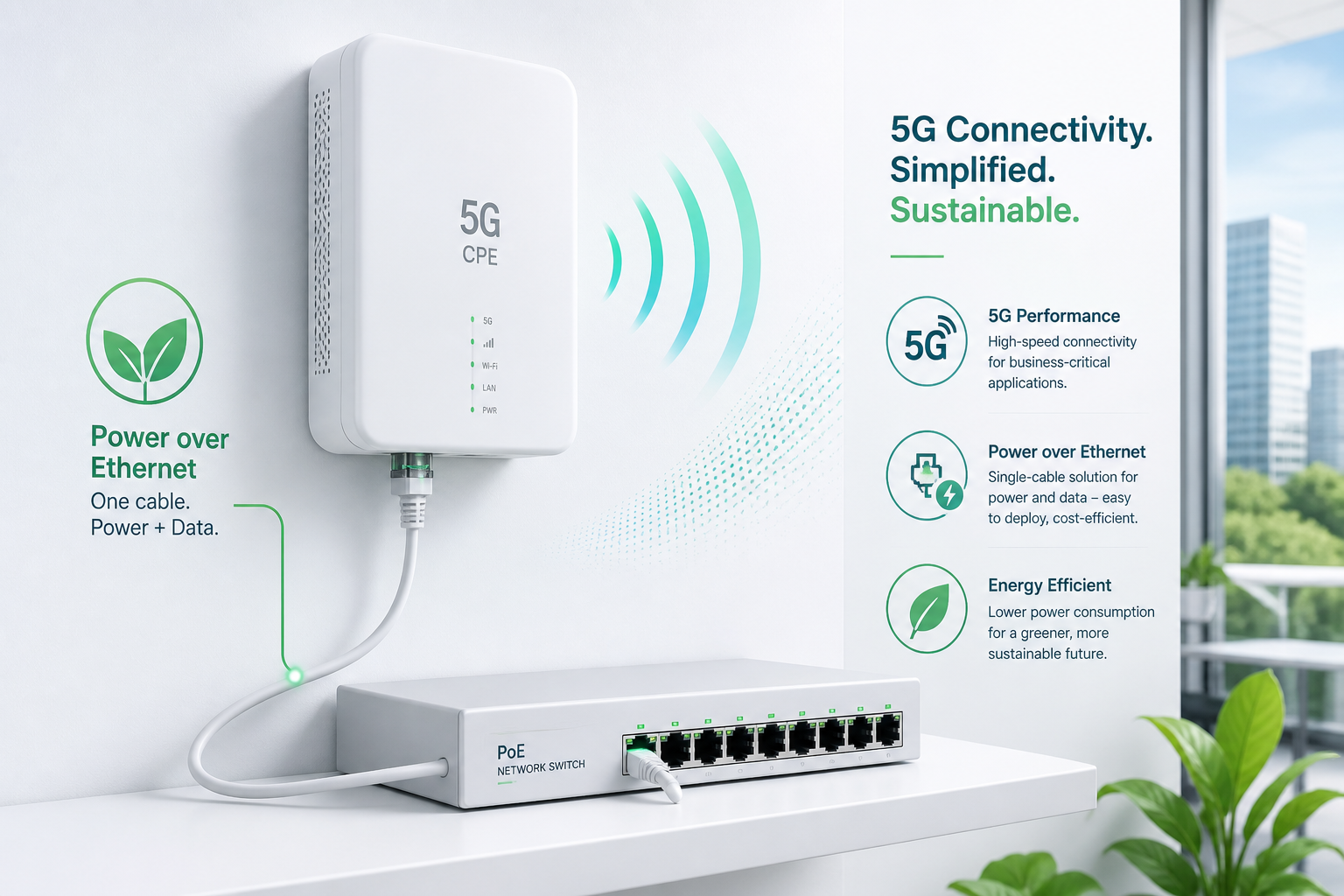
Power is the quiet cost driver in any large CPE estate. A device that draws a few extra watts might seem negligible at one site, but across thousands of branch, kiosk, or outdoor installations, the difference compounds into meaningful electricity spend, higher cooling load, and more frequent battery or UPS sizing. For operators and enterprises standardizing on 5G fixed wireless access, Power over Ethernet (PoE) support and energy efficiency have become first-class procurement criteria, not afterthoughts.
Why PoE Matters for 5G CPE
PoE lets a single Ethernet cable deliver both data and power to the CPE. This is decisive in locations where a nearby AC outlet is unavailable or impractical — outdoor enclosures, ceiling and wall mounts, kiosk cabinets, and rooftop or mast installations. Instead of running mains power to the device, installers run one low-voltage cable from a PoE-capable switch or injector, simplifying cabling, reducing electrical work, and centralizing power management.
PoE Standards and Power Budgets
The two standards that matter for 5G CPE are 802.3at (PoE+) and 802.3bt (PoE++):
- 802.3at (PoE+): up to 30 W at the switch, roughly 25.5 W delivered to the device — adequate for many compact CAT4/CAT6 CPE and mid-range 5G gateways.
- 802.3bt (PoE++): up to 60 W (Type 3) or 90 W (Type 4) at the source, for higher-power 5G CPE with carrier aggregation, Wi-Fi 6/7 radios, or additional powered downstream devices.
Buyers should match the CPE’s real power draw — not just its peak — to the available PoE budget, and confirm whether the device can run on a reduced power state if the switch supplies less than the maximum. An outdoor 5G CPE with heated enclosures or high-gain radios may exceed what PoE+ can deliver, pushing the design toward PoE++ or a local DC supply.
Energy-Efficiency Features to Look For
Beyond raw power draw, the following features meaningfully reduce operating cost and carbon footprint at scale:
- Scheduled radio sleep: dropping idle radios or interfaces during off-hours at locations that do not need 24/7 throughput.
- Idle power states: low-power standby that wakes on traffic, suited to backup-WAN and sensor backhaul roles.
- Efficient power management ICs and thermal design: lower heat means longer component life and less reliance on active cooling.
- Remote power monitoring: TR-069/TR-369 or cloud platforms that report per-device consumption so operators can identify anomalies.
Outdoor and Edge Deployment Considerations
For outdoor or industrial deployments, power and environment are linked. An IP-rated enclosure, wide operating temperature range, and surge protection determine whether the CPE survives the site; the power architecture determines whether it can be installed at all. When PoE is used outdoors, confirm the cable run length, the injector or switch’s PoE class, and that lightning protection is in place. Battery or mini-UPS options — increasingly common on industrial CPE — add ride-through for short outages and are worth specifying for payment or telemetry sites where a power blip must not drop the link.
Building a Green Network Business Case
Energy efficiency is increasingly a formal requirement in operator and enterprise RFPs, driven by sustainability commitments and rising electricity prices. A CPE line with strong idle-power management and PoE centralization can lower per-site energy use by a measurable margin, reduce UPS and cooling sizing, and simplify field service. For procurement teams, the right time to evaluate power is during the datasheet review — not after thousands of units are in the field.
Frequently Asked Questions
Can a 5G CPE run entirely on PoE?
Many compact and mid-range 5G CPE can run on 802.3at PoE+; higher-power models with multiple radios or heated outdoor enclosures may require 802.3bt PoE++ or a local DC supply. Always verify the device’s actual power draw against the available PoE budget.
What is the difference between PoE+ and PoE++ for CPE?
PoE+ (802.3at) delivers up to about 25.5 W to the device; PoE++ (802.3bt) delivers up to 60 W or 90 W. Higher-power 5G CPE and units powering additional downstream devices typically need PoE++.
How does energy-efficient CPE reduce operating cost?
Lower idle power draw, scheduled radio sleep, and efficient thermal design cut per-site electricity use, reduce cooling and UPS sizing, and extend component life — savings that compound across large CPE estates.
Is PoE suitable for outdoor 5G CPE installations?
Yes, and it is often preferred because one cable delivers both power and data to a pole, mast, or enclosure. Confirm cable length, the injector or switch PoE class, and surge protection for outdoor runs.
Looking for carrier-grade 5G FWA CPE for your deployment? Contact Honlly Telecom to discuss OEM/ODM options, sample units, and distributor cooperation for ISP, operator, and enterprise projects.