
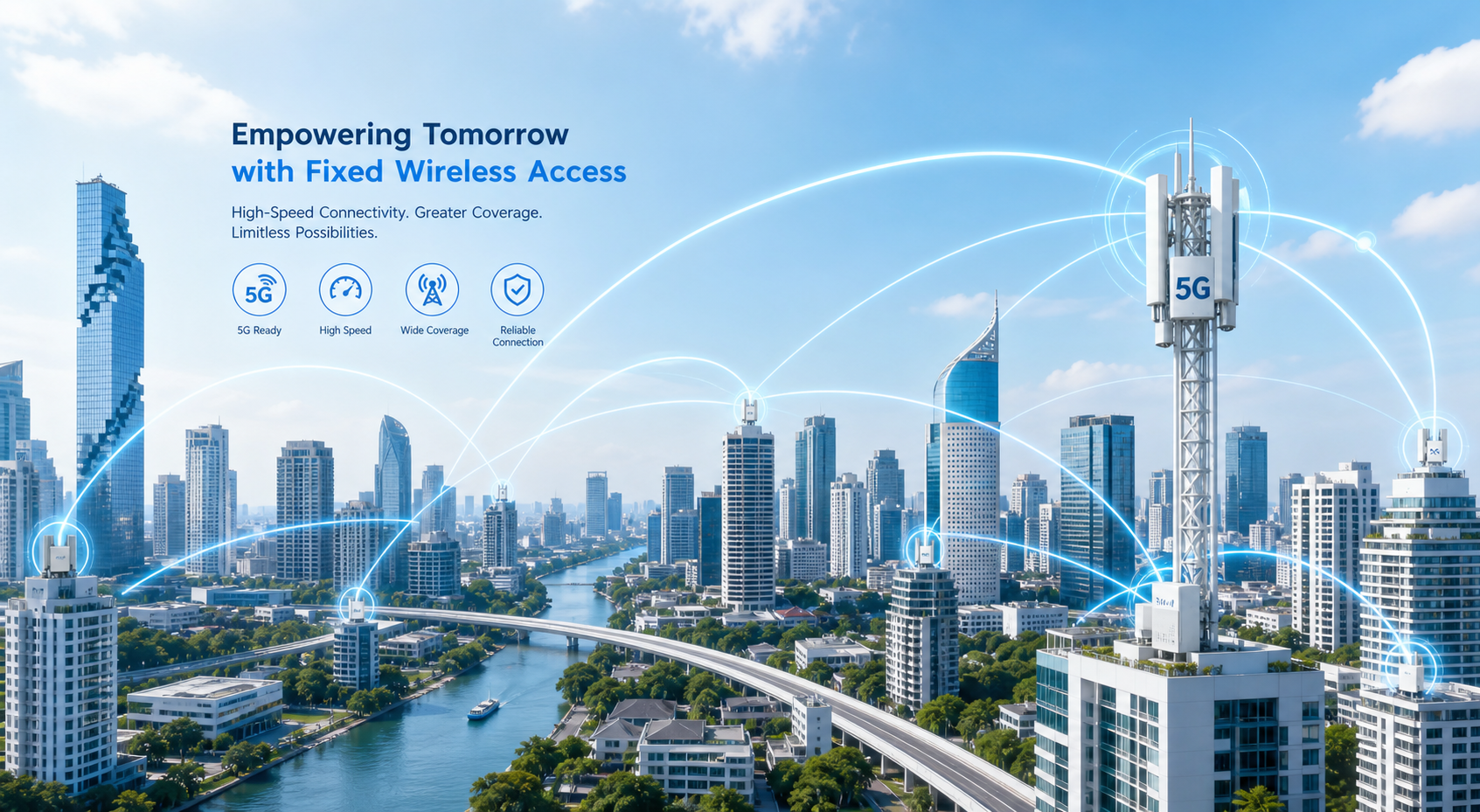
The Southeast Asian telecom landscape is undergoing a significant transformation in 2026, with 5G Fixed Wireless Access (FWA) Customer Premises Equipment (CPE) emerging as the primary vehicle for broadband expansion across Indonesia, Vietnam, the Philippines, and Thailand. As national digital economy agendas mature and operators seek cost-efficient alternatives to fiber trenching, 5G FWA CPE deployments are accelerating at an unprecedented pace in the region’s emerging markets.
The Southeast Asian FWA Opportunity
Southeast Asia presents a uniquely compelling case for 5G FWA. With a combined population exceeding 680 million spread across thousands of islands and diverse topographies, the economics of last-mile fiber deployment have historically constrained broadband penetration outside major urban centers. According to GSMA Intelligence data cited in mid-2026 operator reports, FWA connections in the ASEAN region are projected to grow at a compound annual rate of 38% through 2028, driven by three converging factors: affordable 5G spectrum allocation, declining CPE unit costs, and strong government universal service obligations (USOs).
Indonesia’s Telkomsel has emerged as a regional bellwether, reporting that its 5G FWA subscriber base in tier-2 and tier-3 cities grew 147% year-over-year in H1 2026. The operator attributes this growth to the deployment of sub-6 GHz CPE devices priced below IDR 1.5 million (approximately USD 95), a price point that opens the addressable market beyond enterprise users to small businesses and middle-income households.
Vietnam and the Philippines: Parallel Growth Trajectories
Vietnam’s Ministry of Information and Communications has set an ambitious target of 90% household broadband coverage by 2027, with 5G FWA identified as the primary technology for reaching rural and mountainous provinces where fiber deployment costs exceed USD 800 per household passed. Viettel and VNPT have jointly deployed over 18,000 5G base stations optimized for FWA coverage in 2026, with CPE procurement tenders emphasizing multi-band support across n28 (700 MHz), n41 (2.6 GHz), and n78 (3.5 GHz) to balance coverage range with capacity.
In the Philippines, the government’s Broadband ng Masa (Broadband for the Masses) program has entered its third phase, with Globe Telecom and PLDT-Smart deploying 5G FWA CPE in over 600 municipalities previously served only by legacy 3G or satellite links. The National Telecommunications Commission (NTC) has allocated dedicated FWA spectrum in the 3.3–3.4 GHz band, enabling operators to deploy high-gain outdoor CPE units capable of delivering 100+ Mbps to households up to 12 km from the nearest base station in rural environments with favorable line-of-sight conditions.
Thailand’s Enterprise-First Approach
Thailand is charting a distinctly enterprise-oriented path, with AIS and True Corporation focusing 5G FWA CPE deployments on industrial estates, logistics parks, and SME clusters in Thailand 4.0 economic corridors. The Eastern Economic Corridor (EEC) has seen particularly dense FWA adoption, where manufacturing facilities leverage 5G CPE as primary WAN links for Industry 4.0 applications including real-time production monitoring, automated guided vehicle (AGV) coordination, and computer vision-based quality inspection systems.
Thai enterprise CPE deployments are notably demanding outdoor-rated, industrial-temperature-range devices with IP67 enclosures, PoE++ power delivery, and integrated edge computing capabilities — specifications that are driving innovation among regional CPE vendors and creating a distinct product tier for tropical industrial environments.
CPE Technology Trends Shaping the Regional Market
Several technology trends are defining Southeast Asian 5G FWA CPE requirements in 2026:
Multi-Band Carrier Aggregation: Operators increasingly specify CPE capable of aggregating low-band (n28/n5) and mid-band (n78/n41) carriers simultaneously to maximize both coverage reach and throughput. Three-carrier aggregation (3CC CA) is becoming a standard requirement in operator RFPs across the region.
Outdoor CPE Dominance: Unlike mature markets where indoor CPE predominates, Southeast Asian deployments favor outdoor CPE architectures that overcome building penetration losses common in concrete-and-rebar construction. High-gain directional antennas with 10–12 dBi gain are specified for rural and suburban deployments.
Power Efficiency and Solar Compatibility: With grid reliability varying significantly across the region, CPE vendors are innovating in low-power designs (sub-15W typical consumption) and native DC power input for solar+battery installations — a critical requirement for remote tower-less sites and island deployments.
Multi-Operator SIM and eSIM: Cross-border mobility and operator redundancy requirements are driving adoption of eSIM-capable CPE with dual-SIM failover, particularly relevant in border economic zones and maritime applications across the archipelagic region.
Market Implications for the Global CPE Supply Chain
The Southeast Asian 5G FWA boom is reshaping the global CPE supply chain in measurable ways. Component demand for sub-6 GHz RF front-end modules, outdoor-rated enclosures, and high-gain antenna arrays has increased substantially, with lead times for certain specialized components extending to 14–18 weeks in mid-2026. CPE vendors with established manufacturing partnerships in Vietnam, Thailand, and Malaysia are positioned advantageously, benefiting from both proximity to demand and favorable trade agreements within the ASEAN economic community.
Analysts project that Southeast Asian markets will account for 22–25% of global 5G FWA CPE unit shipments by 2028, up from approximately 12% in 2025, making the region the fastest-growing geographic segment for FWA equipment worldwide. For operators, vendors, and system integrators alike, understanding the unique technical, commercial, and regulatory dynamics of Southeast Asian emerging markets is no longer optional — it is a strategic imperative for capturing growth in the next chapter of global 5G FWA expansion.