
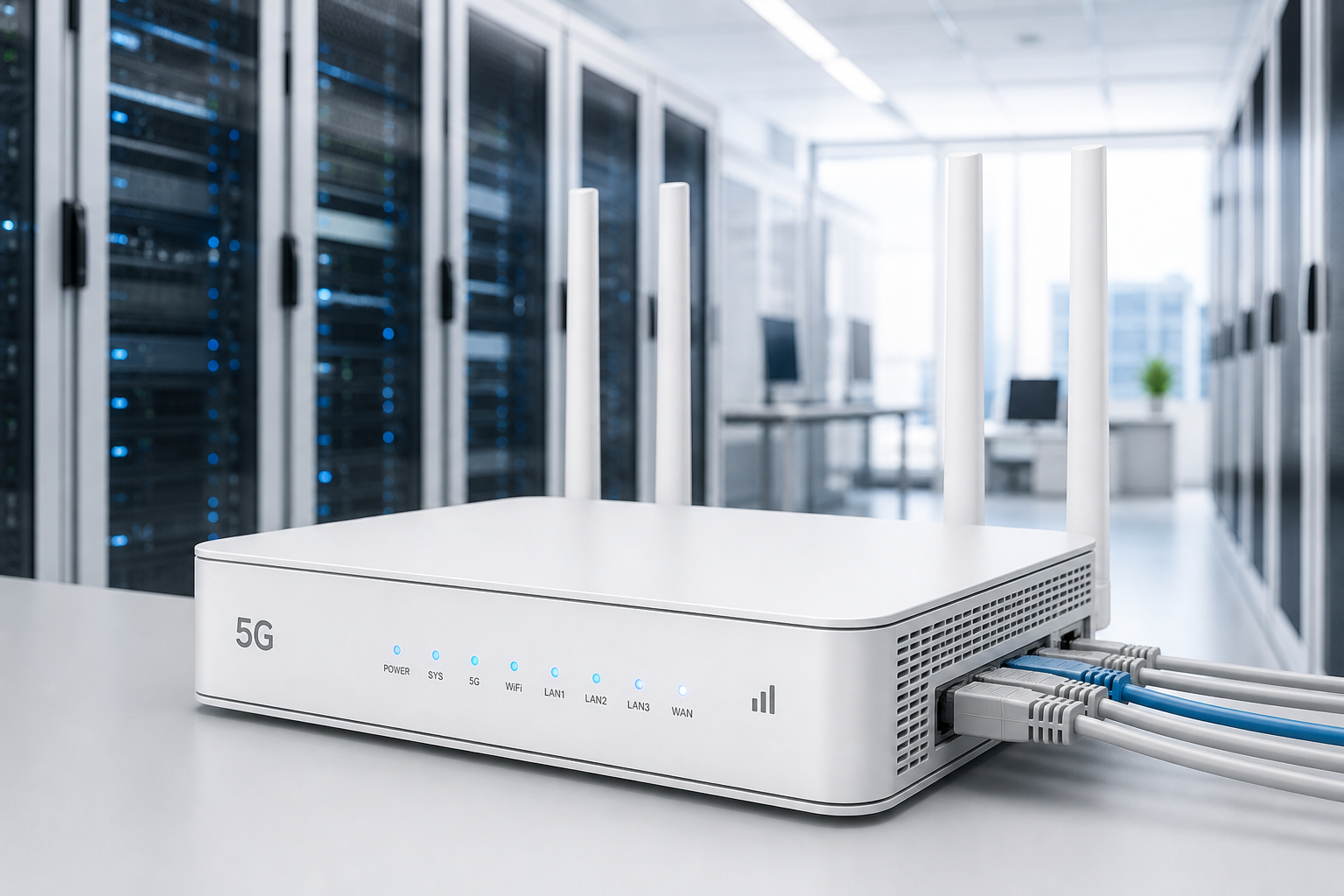
The global B2B telecommunications landscape is witnessing a transformative convergence as 5G Customer Premises Equipment (CPE) and Multi-Access Edge Computing (MEC) increasingly operate as an integrated platform rather than discrete network layers. Throughout the second half of 2026, leading network operators and enterprise solution providers are accelerating the deployment of edge-native 5G CPE gateways capable of hosting containerized workloads at the network edge, fundamentally reshaping how enterprises consume and monetize connectivity services.
The Convergence Imperative: Why CPE and Edge Computing Are Merging
The traditional model of enterprise networking positioned the CPE as a simple WAN termination device — a box that converted cellular signals into Ethernet packets and forwarded them to the corporate LAN. Edge computing, meanwhile, was treated as a separate infrastructure layer residing in carrier facilities, colocation data centers, or on-premises server racks. This architectural separation imposed inherent latency penalties: even with 5G’s improved air interface, applications requiring sub-10ms response times struggled when compute resources sat multiple network hops away from the access point.
The convergence of CPE and MEC addresses this gap directly. Modern 5G CPE gateways are now being designed with embedded compute capabilities — ARM-based multi-core processors, hardware-accelerated AI inference engines, and SSD storage — enabling them to function as micro-edge nodes. This architectural shift means that latency-sensitive enterprise applications such as real-time video analytics, industrial machine vision, autonomous mobile robot (AMR) coordination, and augmented reality (AR) assisted maintenance can execute directly on the CPE device rather than traversing back to a centralized cloud or even a regional edge data center.
Industry analysts project that edge-capable 5G CPE shipments will exceed 12 million units globally by Q4 2026, representing a 47% year-over-year increase. The driving force is clear: enterprises deploying private 5G networks and fixed wireless access (FWA) solutions increasingly demand that connectivity infrastructure doubles as a distributed compute fabric, reducing both latency and backhaul costs while enabling new revenue-generating edge services.
Operator Strategies: From Connectivity Provider to Edge Platform Orchestrator
For telecommunications operators, the CPE-MEC convergence presents a strategic opportunity to move beyond the commoditized connectivity market. Major carriers across Europe, Asia-Pacific, and North America are deploying edge-enabled CPE platforms that support Kubernetes-based container orchestration, allowing third-party ISVs and enterprise developers to deploy applications directly onto customer-premises gateways.
Vodafone’s recently expanded Edge Innovation Programme now incorporates application-hosting CPE devices as part of its distributed MEC architecture, targeting manufacturing quality inspection and retail footfall analytics use cases. Deutsche Telekom’s Campus Edge solution integrates 5G CPE gateways with on-premises edge compute nodes, offering enterprises a unified platform for private 5G connectivity and localized application processing. In the Asia-Pacific region, Singtel’s Paragon edge orchestration platform has added CPE-level application deployment capabilities, enabling enterprises to run AI inference workloads at the network access layer.
This shift is reshaping operator revenue models. Rather than billing solely for bandwidth and SIM subscriptions, carriers are introducing tiered edge service packages that bundle connectivity, compute resources, and pre-integrated enterprise applications. Analysts estimate that edge services can increase average revenue per enterprise account (ARPA) by 35-60% compared to connectivity-only offerings, making the CPE-MEC convergence one of the most significant B2B monetization opportunities in the 5G era.
Key Enabling Technologies: What Makes Edge-Capable CPE Possible
Several technological advancements have converged to make CPE-level edge computing commercially viable in 2026:
Advanced System-on-Chip (SoC) Platforms: Next-generation CPE chipsets from Qualcomm (Snapdragon X75/X80 series), MediaTek (T830 platform), and others now integrate dedicated AI processing units (APUs) and multi-core CPU clusters capable of handling concurrent connectivity and application workloads. These SoCs deliver 8-15 TOPS of AI inference performance while maintaining power envelopes suitable for fanless CPE enclosures.
Lightweight Container Runtimes: The adoption of micro-VM technologies such as AWS Firecracker and lightweight Kubernetes distributions (K3s, MicroK8s) enables secure, isolated application execution on resource-constrained CPE hardware. These runtimes provide strong workload isolation without the overhead of full virtual machines, making multi-tenant edge application hosting practical on gateway devices.
5G LAN-Type Services and URLLC: 3GPP Release 18 enhancements to 5G LAN-type services enable direct Layer 2 connectivity between CPE-hosted applications and on-premises industrial equipment, bypassing complex routing configurations. Combined with Ultra-Reliable Low-Latency Communication (URLLC) capabilities, these features ensure deterministic connectivity for time-sensitive edge applications.
Zero-Touch Edge Orchestration: GSMA-compliant eSIM provisioning combined with cloud-native device management platforms enables operators to remotely deploy, configure, and manage edge applications across thousands of distributed CPE gateways without on-site intervention. This zero-touch operational model is critical for achieving the scale economics required for widespread CPE-MEC adoption.
Enterprise Use Cases Driving Adoption
The business case for CPE-MEC convergence is being validated across multiple industry verticals:
Manufacturing and Industry 4.0: Edge-capable 5G CPE gateways deployed on factory floors execute real-time machine vision inspection algorithms directly at the access point, eliminating the round-trip latency to centralized servers. A major automotive manufacturer in Germany recently deployed edge-CPE units across 14 production facilities, achieving 98.7% defect detection accuracy with under 8ms processing latency — a 40% improvement over cloud-based inspection systems.
Smart Retail and Frictionless Commerce: Retail chains are deploying edge-CPE devices to run computer vision-based shopper analytics, shelf inventory monitoring, and autonomous checkout applications. By processing video feeds locally on the CPE, retailers avoid the bandwidth costs and privacy concerns associated with streaming sensitive footage to external cloud services.
Logistics and Supply Chain: Distribution centers use edge-enabled CPE gateways to coordinate autonomous mobile robots, process RFID tag reads in real time, and optimize warehouse management system (WMS) workflows. The localized compute capability ensures uninterrupted operations even during WAN connectivity disruptions — a critical requirement for 24/7 logistics facilities.
Honlly Telecom’s Edge-Ready CPE Portfolio
As a leading B2B 5G CPE manufacturer, Honlly Telecom is actively developing edge-capable gateway solutions aligned with the CPE-MEC convergence trend. Our engineering teams are integrating advanced SoC platforms with container runtime support, enabling our enterprise customers and operator partners to deploy edge applications alongside high-performance 5G connectivity from a single, unified hardware platform.
Honlly’s edge-ready CPE solutions feature multi-core ARM processors with dedicated AI acceleration, support for standard container orchestration frameworks, and comprehensive remote device management capabilities. These gateways are designed to serve as the foundational node in distributed edge architectures, enabling B2B customers to extract maximum value from their 5G infrastructure investments.
For more information about Honlly Telecom’s 5G CPE solutions and edge computing capabilities, contact our B2B sales team or visit our product catalog.
Conclusion
The convergence of 5G CPE and Multi-Access Edge Computing represents a paradigm shift in enterprise networking architecture. As CPE devices evolve from passive connectivity endpoints into active edge compute nodes, operators gain new B2B monetization pathways, enterprises achieve lower latency and reduced backhaul costs, and the broader 5G ecosystem moves closer to realizing the full promise of distributed intelligence at the network edge. For B2B buyers evaluating 5G CPE investments in 2026 and beyond, edge compute capability should be a core evaluation criterion alongside traditional metrics such as throughput, band support, and ruggedization — the gateway that connects your enterprise today may also power its edge applications tomorrow.