
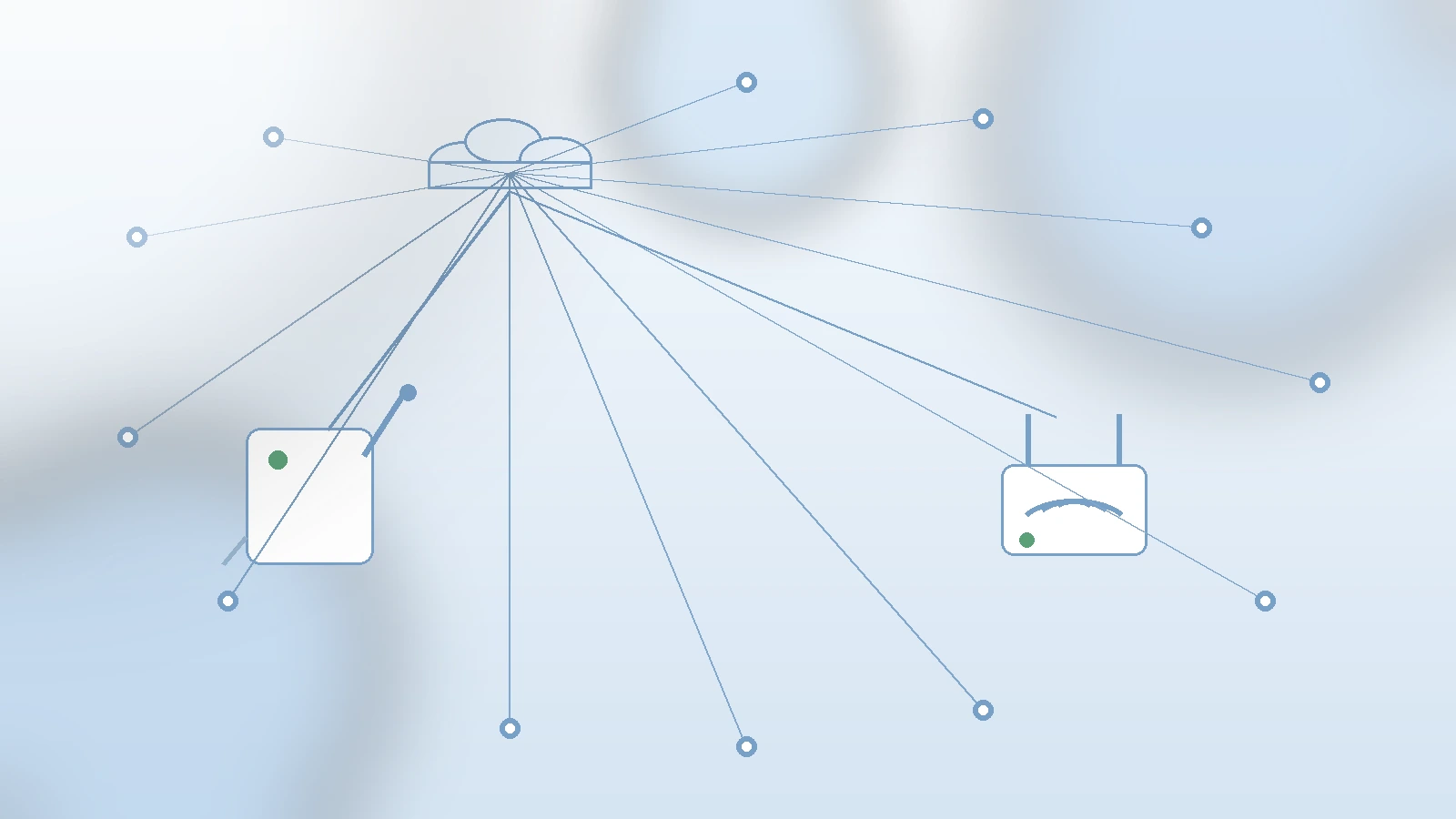
TR-069 has served fixed-broadband operators well for two decades, but a 5G fixed wireless access (FWA) fleet built on split outdoor units (ODU) and indoor units (IDU) is a different animal. Devices now ship with multi-core SoCs, multiple radios, dual SIMs, eSIM profiles, and firmware that changes every few weeks. An aging SOAP/HTTP auto-configuration model that polls on a fixed interval no longer matches how operators want to onboard, secure, and troubleshoot tens of thousands of customer premises units. That is why TR-369 (the Broadband Forum’s User Services Platform, or USP) and zero-touch provisioning (ZTP) are rapidly moving from “nice to have” to procurement requirements in carrier-grade 5G CPE RFPs.
Why TR-069 is running out of road for 5G ODU/IDU fleets
TR-069 (CWMP) was built for a single, always-reachable gateway behind a DSL or fiber line. Its ACS polling model, verbose SOAP envelopes, and connection-triggered sessions worked when devices were static and firmware cadence was slow. 5G CPE breaks several of those assumptions at once:
- NAT and carrier-grade NAT (CGNAT) are the norm. Many FWA subscribers sit behind operator CGNAT with no public IP and no inbound reachability. TR-069 relies on the ACS initiating connections, which becomes fragile and requires persistent connection tricks.
- Two devices, one subscription. The ODU and IDU are physically separate but logically one service. Managing firmware, RF parameters, and diagnostics across the split requires a protocol that can address and proxy to more than one endpoint.
- Telemetry, not just configuration. Operators now want continuous RF metrics — RSRP, RSRQ, SINR, band, MCS, carrier-aggregation state, temperature, power — streamed to analytics, not a single configuration snapshot on a 15-minute poll.
- Security expectations have changed. Modern fleets demand mutual TLS, signed firmware, and fine-grained access control rather than a shared connection credential.
What TR-369 USP actually changes
USP replaces the request/response polling model with an event-driven, message-based architecture. Instead of the ACS reaching in, the device maintains a persistent, authenticated session to one or more controllers over MQTT, STOMP, or WebSockets, with compact CBOR encoding and full TLS security. The practical consequences for a 5G CPE buyer are significant:
- Works through NAT out of the box. The agent originates the connection, so CGNAT and double-NAT deployments stop being a management blocker.
- Multi-controller support. A single device can be managed by the operator’s controller, the vendor’s cloud, and an enterprise tenant simultaneously — useful for managed-service and private-network scenarios.
- Endpoint proxying. The USP agent on the IDU can act as a proxy to reach the ODU, mesh Wi-Fi nodes, or attached IoT sensors through the same secure channel, which matters enormously for split ODU/IDU architectures.
- Bulk data and telemetry. USP defines a bulk-data-collection mechanism for streaming high-frequency metrics to a data lake, enabling proactive RF and thermal analytics instead of reactive truck rolls.
- Unified data model. USP uses the TR-181 Device:2 model, so ODU RF parameters, carrier aggregation, band-locking, and Wi-Fi configuration share a consistent, vendor-neutral vocabulary across suppliers.
Zero-touch provisioning: the onboarding economics that matter
ZTP is the operational payoff. A subscriber unboxes the ODU and IDU, the devices connect to a bootstrap service over a pre-provisioned eSIM or default APN, fetch their configuration and current firmware, and come online without a technician visit. For operators the savings compound quickly: fewer truck rolls, fewer misconfigured units, faster time-to-revenue, and the ability to ship a single SKU that personalizes itself per market, plan, and band plan. In RFPs, ZTP should be specified end to end: bootstrap discovery, secure identity (device certificate or eSIM/IUICC), config application, and firmware verification before the device is released to the subscriber.
FOTA and the ODU/IDU split: treat firmware as a coordinated release
Firmware-over-the-air (FOTA) is not new, but the ODU/IDU split raises a coordination question buyers frequently miss. The two units carry separate firmware images with a version dependency — a new ODU radio driver may require a matching IDU firmware to expose the feature. Specify that the management stack supports grouped or atomic firmware campaigns, staged rollout by percentage, rollback on failure, and signed-image verification on both units. A fleet that can silently revert half a million units on a bad build is worth more than the marginal hardware cost.
Multi-vendor interoperability is the point
One of USP’s design goals is vendor neutrality. For an operator or MVNO running a mixed fleet — a Qualcomm-based ODU from one vendor, a MediaTek-based IDU from another, and a RedCap CPE from a third — a single USP controller with the TR-181 data model avoids maintaining three proprietary management silos. When evaluating suppliers, ask for proof of USP conformance (Broadband Forum certification), the exact TR-181 object coverage, and whether the vendor exposes band-locking, cell-locking, and RF parameters through standard paths rather than custom extensions.
A buyer’s checklist for TR-369 and ZTP in 5G CPE
- USP agent with MQTT/STOMP/WebSocket transport and mutual TLS, NAT-friendly by design.
- TR-181 Device:2 coverage for ODU RF, carrier aggregation, band/cell locking, Wi-Fi, and eSIM/SIM management.
- End-to-end ZTP: bootstrap discovery, device identity (certificate or eSIM), config fetch, and firmware verify.
- Coordinated FOTA for ODU+IDU with staged rollout, atomic grouping, and automatic rollback.
- Bulk-data telemetry for RSRP/RSRQ/SINR, temperature, and power with a defined export path.
- Multi-controller support and ODU/IDU proxying through the indoor agent.
- Vendor conformance evidence: Broadband Forum USP certification and a published TR-181 object map.
The bottom line for 5G CPE procurement
Remote management is no longer an afterthought in the device bill of materials — it is a direct driver of churn, support cost, and deployment velocity. Operators and MVNOs scaling 5G FWA should treat TR-369 USP, zero-touch provisioning, and coordinated FOTA as core specification items, not optional add-ons. The vendors who make these capabilities first-class will be the ones who scale with their operator customers — and the buyers who specify them now will be the ones avoiding the management debt that TR-069-era fleets are now paying off.