
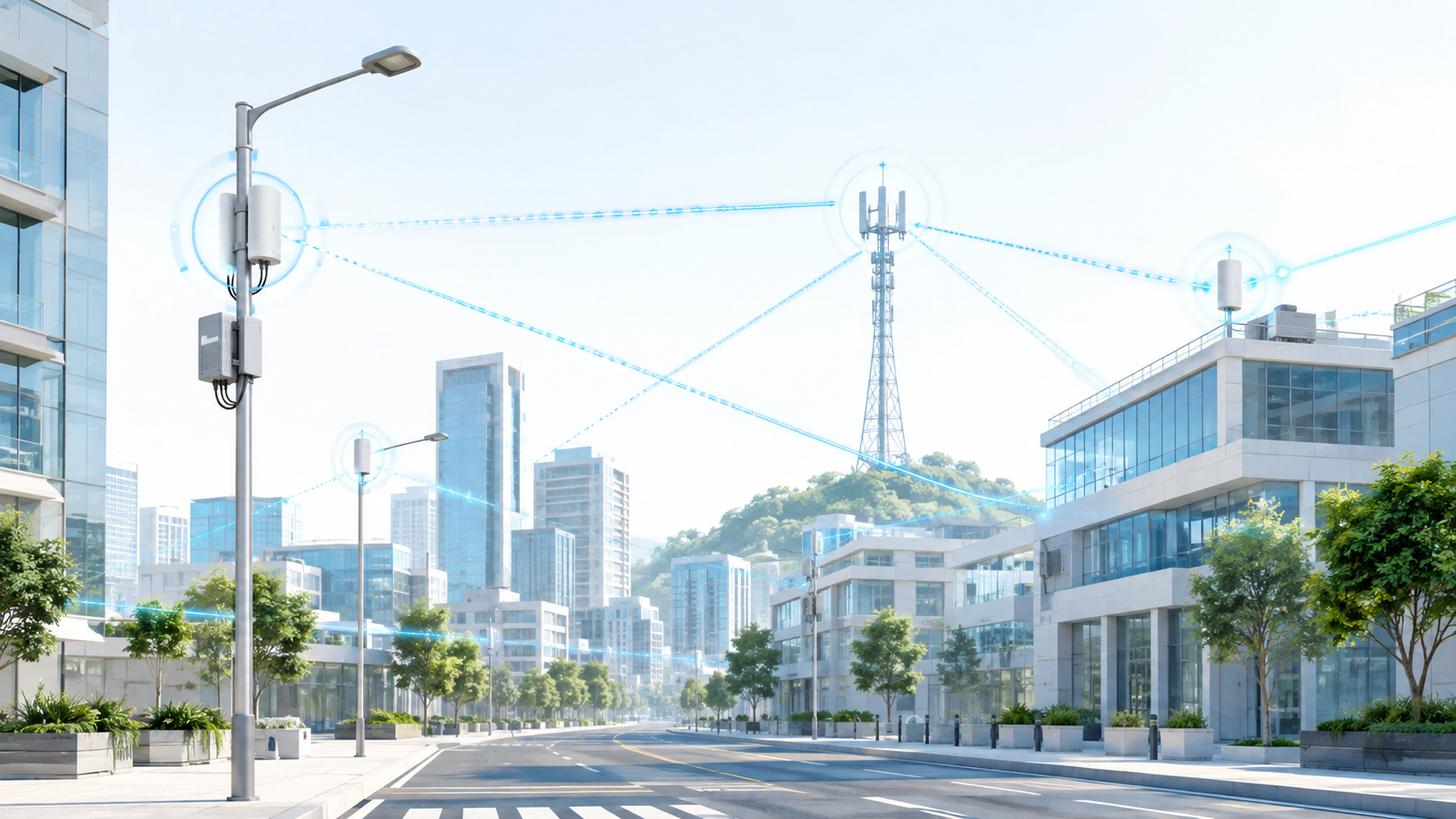
As mobile operators densify their networks, they face a persistent challenge: getting reliable backhaul to small cells. Small cells are deployed on streetlights, utility poles, rooftops, and building facades, often in locations where fiber is unavailable, expensive, or slow to deliver. Each small cell still needs a dependable, secure backhaul connection to the core network. For operators, neutral hosts, and the integrators who serve them, 5G Fixed Wireless Access (FWA) CPE offers a fast, cost-effective, and scalable way to provide small cell backhaul and accelerate network densification in urban and rural areas alike.
This guide covers what buyers should evaluate when selecting a 5G CPE for small cell backhaul and network densification, where capacity, reliability, and easy deployment are the priorities.
The connectivity demands of small cell backhaul
A small cell is only as useful as its backhaul. Each site must deliver:
- Reliable capacity: sufficient throughput to carry user traffic from the small cell back to the core network.
- Low latency: responsive backhaul to meet mobile broadband and enterprise service requirements.
- Secure transport: encrypted tunnels that protect subscriber and signaling traffic in transit.
- Remote management: visibility and control of backhaul status across hundreds or thousands of sites.
- Rapid activation: fast time-to-service so small cells can go live as soon as they are installed.
Why 5G FWA fits small cell backhaul
Small cells are deployed where fiber is hardest to reach. 5G FWA addresses this directly:
- Faster deployment: a small cell can be backhauled and live within days, accelerating densification and revenue.
- Lower cost: fixed wireless avoids the cost and time of fiber builds to poles, facades, and remote sites.
- Scalability: operators can roll out backhaul to hundreds of small cells with zero-touch provisioning and central management.
- Flexibility: CPE can be repositioned as sites move or are re-optimized, without re-cabling.
Designing a secure, resilient backhaul network
The CPE is the backhaul gateway, and availability and security come from how it is integrated. Best practices for small cell deployments include:
- Secure tunnels: hardware VPN and IPsec support to protect subscriber and signaling traffic in transit.
- Dual-WAN failover: a second carrier or wired link with automatic failover so the small cell stays on air through an outage.
- QoS for traffic classes: prioritizing signaling and latency-sensitive traffic over bulk data.
- Central management: cloud or ACS control for firmware, configuration, and health monitoring across all sites.
Deployment and environmental considerations
Small cells live in demanding, exposed locations. Buyers should prioritize hardware built for the conditions:
- Compact, weatherproof enclosure: wide-temperature, IP-rated hardware suited to poles, rooftops, and facades.
- External antenna options: high-gain antennas to reach macro or donor cell sites reliably.
- Reliable power: support for PoE and backup power to keep the small cell on air during outages.
- Mounting flexibility: hardware designed for pole, wall, and enclosure mounting.
What to evaluate in a 5G CPE for small cell backhaul
- Capacity and throughput: sufficient backhaul capacity for the small cell’s user traffic.
- Reliability and uptime: carrier-grade hardware built for always-on backhaul.
- Security features: hardware VPN, IPsec, and secure boot to protect signaling and subscriber data.
- Latency: low-latency performance for mobile broadband and enterprise services.
- Remote management: multi-site visibility and zero-touch provisioning for rapid, consistent rollouts.
FAQ
Is 5G FWA reliable enough for small cell backhaul?
For a proposed small-cell backhaul link, confirm the network interface, synchronization, service and recovery requirements with the network integration team. Test the complete arrangement; the availability of an FWA link alone does not establish backhaul compatibility.
How do operators keep small cells on air during a backhaul outage?
Deploy dual-WAN failover plus local buffering — the small cell retains local service where possible and re-establishes the backhaul link once it returns — so coverage is restored quickly with minimal disruption.
How is signaling and subscriber data kept secure over 5G backhaul?
Use hardware VPN tunnels, IPsec, VLAN segmentation, and secure boot to keep signaling and subscriber traffic encrypted and isolated end-to-end.
Can one CPE backhaul multiple small cells?
Yes, a single 5G CPE can backhaul multiple co-located small cells or a small cluster, feeding a local switch that distributes backhaul to each radio. Capacity planning should account for the combined traffic of all served cells.
Get started
Honlly Telecom supplies secure, carrier-grade 5G FWA CPE and wireless routers engineered for small cell backhaul and network densification. Contact our team to discuss backhaul for your small cell and densification programs.