
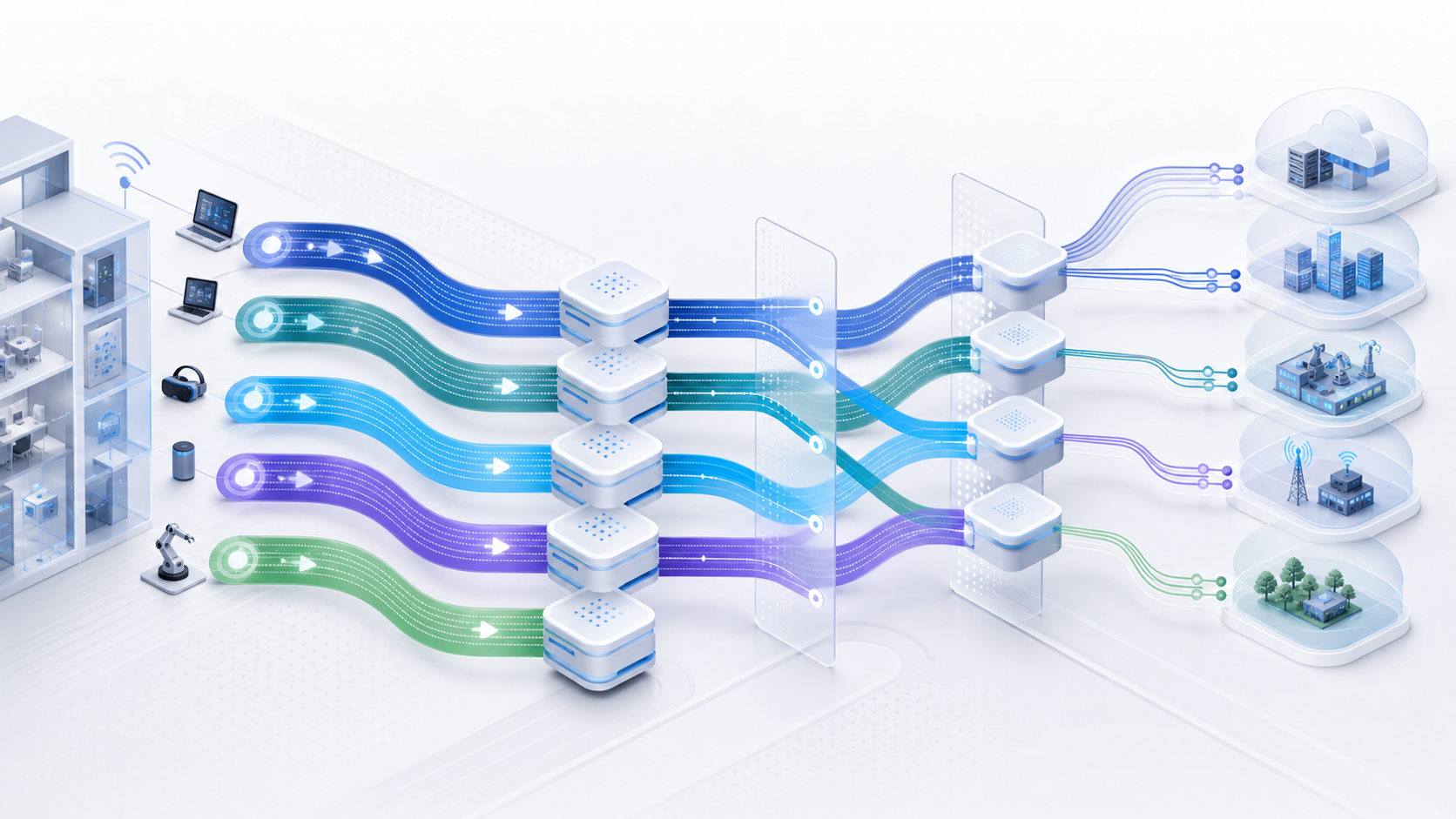
For ISPs, MVNOs, and enterprise network operators deploying 5G Fixed Wireless Access (FWA) at scale, Quality of Service (QoS) architecture is no longer a secondary consideration—it is a fundamental differentiator that determines whether a CPE fleet can deliver carrier-grade service level agreements (SLAs) across diverse traffic profiles. This technical buyer’s guide examines the architectural components, standards frameworks, and procurement criteria that define enterprise-grade 5G CPE QoS capabilities in 2026.
The Enterprise QoS Imperative: Why Best-Effort Is Not Enough
Enterprise 5G FWA deployments carry fundamentally different traffic requirements than consumer broadband. A single enterprise CPE may simultaneously handle real-time UCaaS traffic (Teams, Zoom), cloud ERP transactions, SD-WAN overlay tunnels, IoT telemetry streams, and bulk data backups—each with distinct latency, jitter, throughput, and reliability requirements. Without robust QoS enforcement at the CPE level, the “last meter” of the 5G connection becomes the bottleneck that undermines end-to-end SLA guarantees.
Key enterprise traffic profiles and their QoS requirements:
| Traffic Class | Latency Target | Jitter | Packet Loss | Priority |
|---|---|---|---|---|
| Real-Time Voice/Video | <30ms | <10ms | <0.1% | EF (Expedited Forwarding) |
| Business-Critical Apps | <50ms | <20ms | <0.5% | AF41 (Assured Forwarding) |
| SD-WAN Control Plane | <100ms | N/A | <1% | AF31 |
| IoT Telemetry | <200ms | N/A | <2% | AF21 |
| Bulk Data/Backup | N/A | N/A | <5% | BE (Best Effort) |
5G QoS Architecture Fundamentals: The 5QI Framework
The 3GPP 5G QoS model centers on the 5G QoS Identifier (5QI), a scalar value that maps to standardized QoS characteristics including resource type (GBR, Non-GBR, Delay-Critical GBR), priority level, packet delay budget (PDB), and packet error rate (PER). For CPE procurement, understanding how candidate devices map 5QI values to internal traffic processing pipelines is essential.
Enterprise-relevant 5QI values include:
- 5QI 3 (GBR, PDB 50ms): Real-time gaming, V2X communications, and interactive AR/VR applications requiring guaranteed bit rate with tight latency bounds.
- 5QI 5 (Non-GBR, PDB 100ms): IMS signaling, critical machine-type communications, and enterprise UCaaS session initiation.
- 5QI 6 (Non-GBR, PDB 300ms): TCP-based enterprise applications including HTTP/HTTPS, email, chat, and file transfers with standard buffering tolerance.
- 5QI 7 (Non-GBR, PDB 100ms): Voice, live streaming, and interactive gaming with conversational latency requirements.
- 5QI 82 (Delay-Critical GBR, PDB 10ms): Discrete automation, intelligent transport systems, and industrial control loops requiring ultra-reliable low-latency communication (URLLC).
A production-grade enterprise CPE must support a minimum of 8 concurrent QoS flows with independent 5QI mapping, DSCP marking preservation across the LAN-WAN boundary, and per-flow buffer management with configurable queue depths.
Network Slicing Integration: CPE as the Slice Termination Point
5G network slicing extends QoS architecture from per-flow management to per-slice isolation. A single enterprise CPE may terminate multiple network slices simultaneously—for example, a URLLC slice for industrial control traffic, an eMBB slice for office productivity applications, and an mMTC slice for sensor networks—each with independent security, routing, and QoS policies.
Critical CPE capabilities for network slicing integration include:
- NSSAI Awareness: The CPE must parse and act upon Network Slice Selection Assistance Information (NSSAI) conveyed during PDU session establishment, mapping each S-NSSAI to the appropriate internal processing pipeline.
- Multi-Slice VLAN Mapping: Enterprise deployments typically require per-slice VLAN separation on the LAN side. The CPE must support flexible VLAN-to-slice mapping with 802.1Q tagging, enabling seamless integration with existing enterprise switching and SD-WAN infrastructure.
- Per-Slice DSCP Remarking: When enterprise traffic traverses the 5G core, the CPE should preserve or intelligently remark DSCP markings at the slice boundary to maintain end-to-end QoS consistency.
- Slice-Aware Failover: If a network slice becomes unavailable due to radio conditions or core network events, the CPE should implement graceful degradation policies—routing critical traffic to alternate slices or fallback bearers according to configurable priority rules.
Traffic Prioritization: From 5QI to Silicon
The gap between QoS policy definition and actual packet processing performance is where many CPE implementations fall short. Enterprise buyers should evaluate devices on their hardware-accelerated QoS pipeline capabilities:
- Hardware Queue Architecture: Minimum 8 hardware queues per direction (WAN-to-LAN and LAN-to-WAN) with weighted round-robin (WRR) or deficit round-robin (DRR) scheduling, supporting both strict priority and weighted queuing in a hierarchical configuration.
- Buffer Management: Active Queue Management (AQM) with CoDel or PIE algorithms to minimize bufferbloat under congestion, plus per-queue buffer sizing configurable from 32KB to 2MB to accommodate diverse traffic profiles.
- Flow Classification Engine: Hardware-accelerated packet classification supporting Layer 2–4 matching (MAC, VLAN, IP 5-tuple, DSCP) at line rate for all Ethernet interfaces (1G/2.5G/5G/10G depending on CPE class).
- Hierarchical QoS (HQoS): Support for three-level scheduling hierarchy: per-subscriber shaping at the top level, per-service-class scheduling in the middle, and per-flow queuing at the leaf—enabling service providers to deliver wholesale SLA guarantees to multiple enterprise tenants through a single CPE.
SLA Enforcement and Monitoring
QoS architecture is only as valuable as the monitoring framework that validates it. Enterprise-grade CPE must provide granular telemetry that enables both proactive SLA assurance and forensic troubleshooting:
- Per-Flow KPI Export: The CPE should export per-flow latency, jitter, packet loss, and throughput statistics via IPFIX or NetFlow to centralized monitoring platforms, with configurable reporting intervals down to 10 seconds.
- TWAMP Light Reflector: Integrated Two-Way Active Measurement Protocol (TWAMP) reflector functionality enables end-to-end SLA measurement from centralized probes without deploying additional test endpoints at each customer site.
- Y.1731 Ethernet OAM: For enterprise LAN-side performance monitoring, support for ITU-T Y.1731 Ethernet service OAM including frame loss measurement (LM), frame delay measurement (DM), and synthetic loss measurement (SLM).
- gRPC Streaming Telemetry: Modern CPE platforms should offer gRPC-based streaming telemetry with Protobuf-encoded metrics, enabling integration with cloud-native observability stacks (Prometheus, Grafana, Thanos) and AIOps platforms for predictive SLA analytics.
Procurement Checklist: QoS Evaluation Criteria
When evaluating 5G CPE for enterprise SLA-guaranteed deployments, technical buyers should verify the following capabilities through vendor documentation, independent testing, and reference deployments:
- 5QI Support Matrix: Full documentation of supported 5QI values, including GBR, Non-GBR, and Delay-Critical GBR types, with per-5QI PDB and PER compliance verification.
- Concurrent QoS Flow Capacity: Minimum 8 concurrent QoS flows with independent 5QI mapping; 16+ recommended for multi-tenant or slice-rich deployments.
- Hardware Queue Depth: At least 8 hardware queues per direction with hierarchical scheduling; verify at line rate under 64-byte packet load.
- Bufferbloat Resistance: AQM implementation (CoDel/PIE) with buffer sizing below 500KB per queue under typical RTT conditions; validate with industry-standard bufferbloat tests.
- NSSAI Processing: Confirm S-NSSAI parsing in PDU Session Establishment Accept messages and per-slice VLAN mapping capabilities.
- Telemetry Export: IPFIX/NetFlow v9/v10 with per-flow granularity; gRPC streaming telemetry preferred for cloud-native integration.
- TWAMP Light Support: Reflector functionality with configurable UDP port and DSCP marking for measurement traffic.
- Management API: RESTCONF/NETCONF or gNMI interface for programmatic QoS policy configuration, avoiding vendor-proprietary management lock-in.
- Firmware Update SLA: Vendor commitment to QoS-related firmware updates for the full CPE lifecycle, including new 5QI definitions from 3GPP release updates.
- Independent Certification: O-RAN Alliance or TIP certification covering QoS and slicing interoperability; BBF TR-398 Issue 3 or later for Wi-Fi integrated CPE.
Looking Ahead: AI-Driven QoS Optimization
The next frontier in CPE QoS architecture is AI/ML-driven dynamic policy optimization. Emerging CPE platforms incorporate on-device inference engines that analyze traffic patterns in real time, predict congestion events before they impact SLAs, and autonomously adjust queue weights, buffer allocations, and 5QI-to-DSCP mappings. For enterprise buyers building long-term FWA strategies, selecting CPE with dedicated ML acceleration silicon—even if not yet fully utilized—provides a future-proofing advantage as these capabilities mature through 2027–2028.
To discuss your enterprise 5G CPE QoS requirements or request product specifications for SLA-guaranteed deployment scenarios, contact the Honlly Telecom engineering team for a detailed technical consultation.