
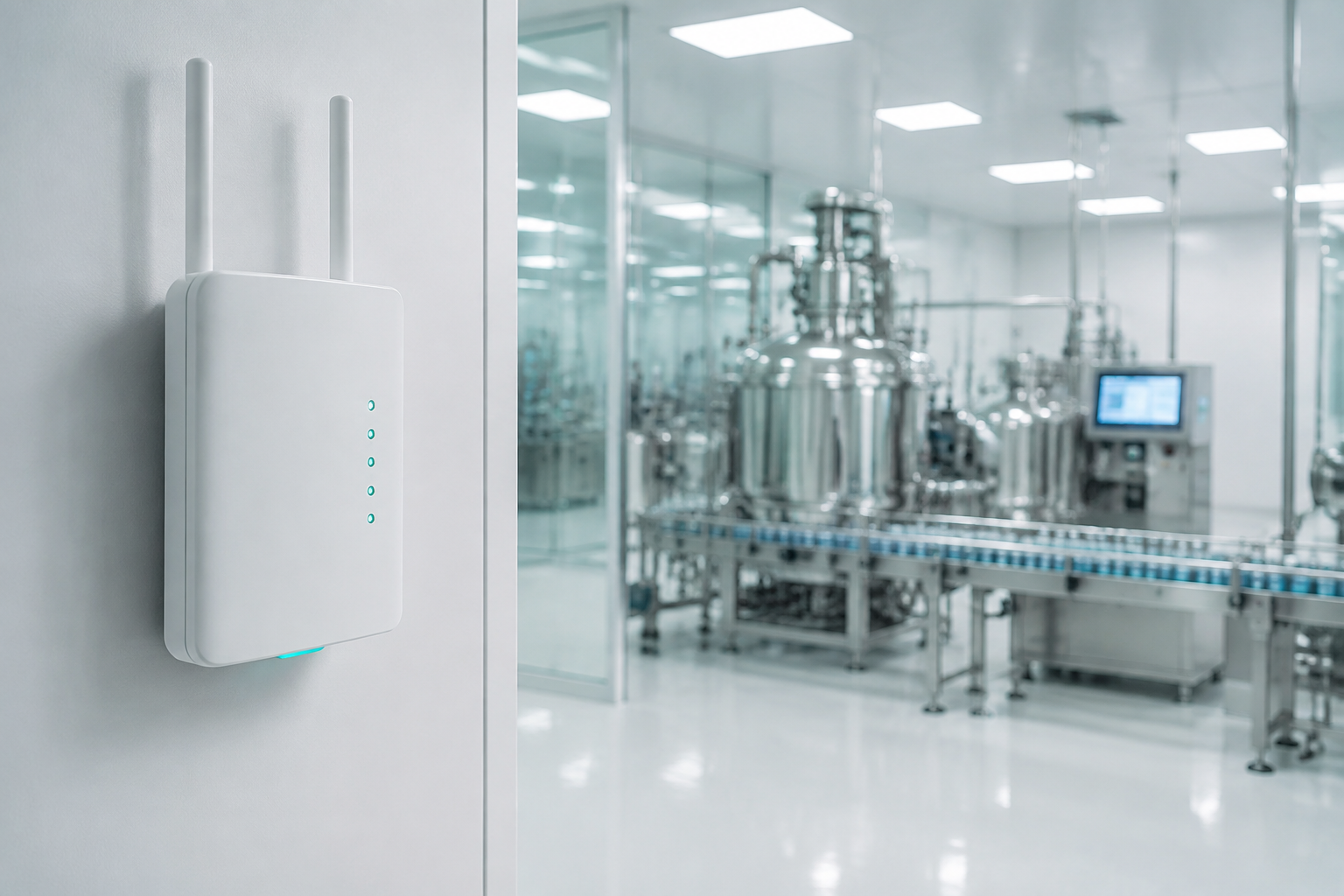
Pharmaceutical and biotech manufacturing operates in one of the most regulated, data-intensive environments in industry. Good Manufacturing Practice (GMP) facilities run on strict batch records, validated systems, environmental monitoring, and traceability that must be complete and tamper-evident. At the same time, many production sites are located on campuses or in locations where wired connectivity is costly to extend or slow to provision. For manufacturers and the systems integrators who support them, 5G FWA CPE offers a secure, compliant, and rapidly deployable way to connect GMP facilities and keep validated systems running.
This guide covers what buyers should evaluate when selecting a 5G CPE for pharmaceutical and biotech manufacturing, where security, compliance, and uptime are the priorities.
The connectivity demands of a GMP facility
A pharmaceutical production site carries a uniquely sensitive blend of traffic. A single facility may run:
- Manufacturing execution (MES): batch control and electronic batch records that must stay online and audit-ready.
- Environmental monitoring: continuous particle, temperature, humidity, and differential-pressure sensors across cleanrooms.
- Laboratory and QC systems: instruments and LIMS that upload results and connect to validated data systems.
- Serialization and track-and-trace: packaging-line systems that encode and verify unit-level identifiers for compliance.
- Enterprise and facility systems: ERP, access control, and building management that depend on reliable connectivity.
Why 5G FWA fits pharmaceutical manufacturing
GMP facilities cannot afford connectivity that is slow to deploy or difficult to validate. 5G FWA addresses this directly:
- Rapid deployment: a new line, satellite building, or modular cleanroom can be online in days, without disrupting validated environments.
- Segmented, controllable connectivity: VLANs and VPNs let manufacturers isolate GMP systems from enterprise and guest traffic.
- Resilience: cellular provides a dependable primary or failover path, protecting batch records and monitoring through outages.
- Flexibility: CPE can be repositioned as production lines are reconfigured, without re-cabling cleanrooms.
Security and compliance considerations
Pharmaceutical networks carry regulated data, so security is a hard requirement. Buyers should prioritize:
- Network segmentation: VLANs to isolate manufacturing, lab, and enterprise traffic from one another.
- Hardware VPN: encrypted tunnels back to corporate or cloud systems for validated data flows.
- Secure boot and firmware signing: to reduce tampering risk on devices in less-controlled areas.
- Centralized policy and logging: consistent security rules and audit trails across every site in the network.
Designing a resilient, compliant manufacturing network
The CPE is the gateway, but reliability and compliance come from how it is integrated. Best practices include:
- Dual-WAN failover: a second carrier or wired link with automatic failover so MES and monitoring continue through an outage.
- QoS for critical systems: prioritizing batch-record, alarm, and monitoring traffic over bulk data and guest Wi-Fi.
- Local buffering: edge devices queue readings and records locally during a link loss, then forward once restored.
- Central management: cloud or ACS control for firmware, configuration, and health monitoring across the estate.
What to evaluate in a 5G CPE for pharmaceutical manufacturing
- Reliability and uptime: carrier-grade hardware built for always-on, audit-ready manufacturing environments.
- Security features: hardware VPN, VLAN, secure boot, and centralized policy to protect regulated data.
- Throughput: sufficient capacity for concurrent MES, lab, monitoring, and track-and-trace traffic.
- Cleanroom suitability: options for external antennas and protected enclosures to avoid disrupting validated spaces.
- Remote management: multi-site visibility and zero-touch provisioning for rapid, consistent rollouts.
FAQ
Is 5G FWA acceptable in a validated GMP environment?
It can be, with careful network design. Manufacturers typically use 5G FWA as a segmented, failover-capable transport layer, isolating validated systems on VPN tunnels and keeping the wired backbone where required. Early engagement with QA and validation teams is essential.
How do manufacturers keep batch records complete during a carrier outage?
Use dual-WAN failover plus local buffering on MES and edge devices, so batch data is queued and forwarded once the link returns — preserving complete, audit-ready records with no gaps.
How is regulated data kept secure over 5G?
Use hardware VPN tunnels, VLAN segmentation, secure boot, and centralized policy and logging to keep manufacturing and lab data encrypted and isolated from enterprise and guest traffic.
Will standard CPE disrupt a cleanroom or validated area?
It can. GMP sites often place the CPE or gateway in a protected cabinet and route antennas into cleanrooms, avoiding hardware changes inside validated spaces. Specifying antenna and enclosure options up front prevents validation impact.
Get started
Honlly Telecom supplies secure, carrier-grade 5G FWA CPE and wireless routers engineered for pharmaceutical and biotech manufacturing. Contact our team to discuss connectivity for your GMP facilities and production network.