
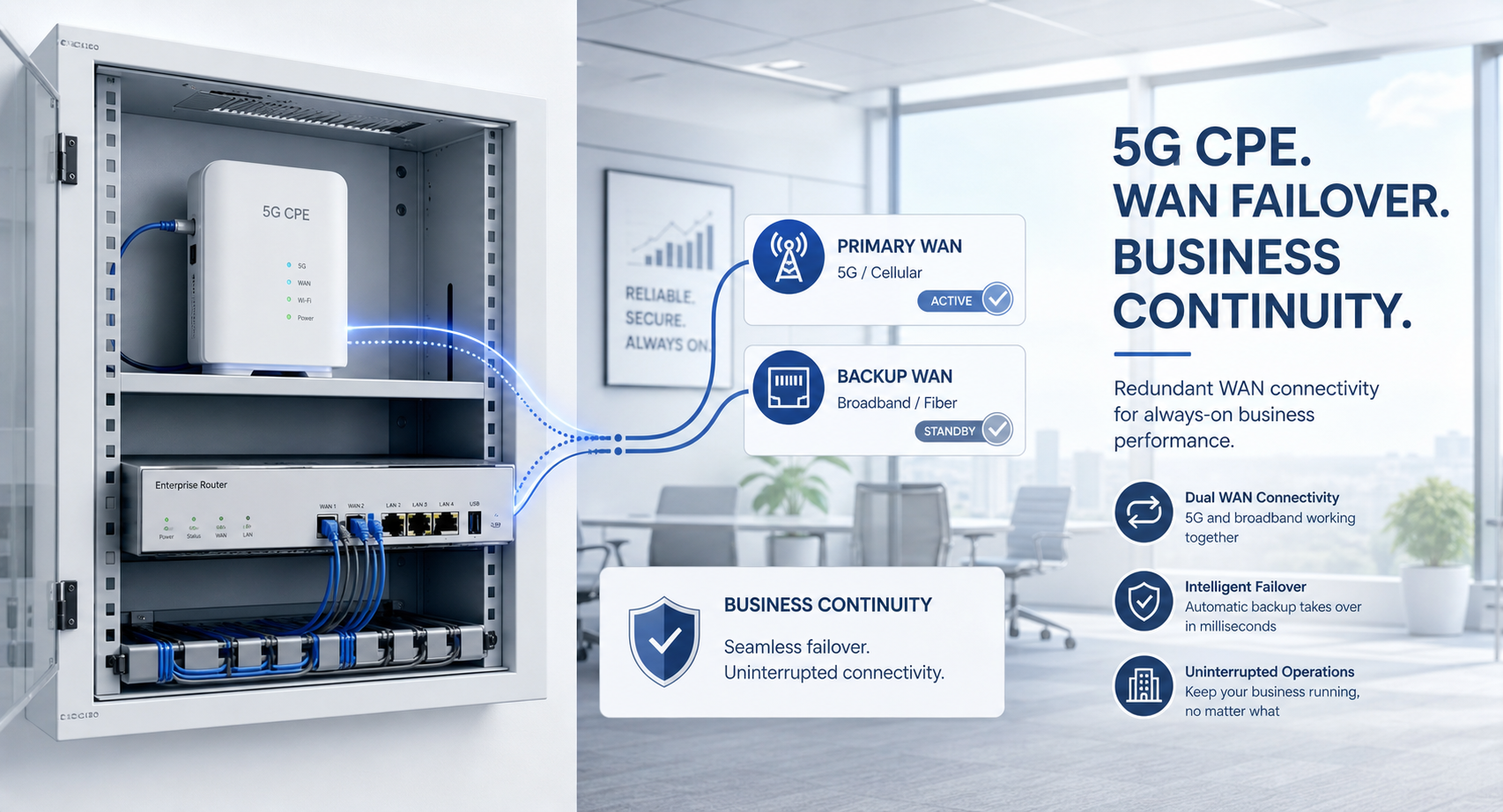
Business continuity planning for branch networks has quietly shifted. Where organizations once treated cellular as an expensive, last-resort fallback, 5G fixed wireless access now offers enough bandwidth and low enough latency to serve as a legitimate primary or co-primary WAN link. For ISPs, managed service providers, and enterprise network teams, the practical question is no longer whether to use 5G CPE for failover but how to specify and deploy it correctly.
What WAN Failover Actually Requires
Failover is more than plugging in a second connection. A production-grade design must answer four questions: how quickly the device detects a failure, how reliably it switches traffic, how it decides to switch back, and how it prevents flapping between two marginal links. The answers determine whether a branch stays online during a fiber cut or suffers a visible outage during the transition.
At the heart of this is link health monitoring. A well-built 5G CPE continuously probes the primary WAN — typically via ICMP, DNS, or HTTP reachability to one or more targets — rather than relying only on the physical link state. This matters because a circuit can stay “up” at layer 1 while routing and transport above it fail. Detection that depends solely on link-down events will miss silent failures and leave the branch degraded.
Failover Triggers and Switchover Timing
Buyers should evaluate the full set of failure triggers a CPE supports:
- Physical link down: the wired WAN port loses carrier — the simplest and fastest case.
- Probe failure: configured reachability probes fail for a defined count or duration.
- Throughput or latency degradation: the link remains up but performance falls below a threshold.
- Manual or scheduled switch: operator-initiated failover for maintenance or testing.
For payment, POS, and other transaction-sensitive branch workloads, sub-second to low-single-digit-second switchover is the realistic target. Some sessions may need to re-establish — a consideration for VPNs and real-time services — so the architecture should prefer stateful failover where the gateway preserves NAT and tunnel state across the switch.
Dual-WAN Architecture Options
There are three common topologies, and the right choice depends on whether the branch already has an enterprise router or firewall:
- Integrated dual-WAN CPE: the 5G CPE itself holds both the wired and cellular WAN and performs failover internally. Simplest for small branches and retail sites.
- CPE as cellular WAN behind a router: the CPE runs in bridge or IP-passthrough mode and hands a public or routed path to an existing SD-WAN or firewall appliance that owns the failover logic.
- 5G as co-primary with SD-WAN: both links carry production traffic with per-application steering; the CPE must expose stable, manageable WAN characteristics to the SD-WAN edge.
What to Verify in the Data Sheet
- Probe configurability: multiple targets, adjustable interval, and failure threshold.
- Switchback behavior: whether recovery to the primary link is automatic, and whether it requires a stable window before failing back to avoid flapping.
- Bridge/IP-passthrough mode: required if an existing router owns NAT and firewall policy.
- Multi-carrier or multi-SIM support: for redundancy against a single network outage, not just a single circuit.
- Remote management: TR-069/TR-369 or cloud control to monitor link health and run failover tests at scale.
Design and Testing Best Practices
Failover is a system behavior, not a spec line. Before rollout, test the full path: unplug the primary, verify application recovery time, confirm VPNs re-establish, then restore and confirm switchback is orderly. Schedule periodic failover drills — many teams discover during a real outage that their failover worked at the network layer but broke a downstream service because of stale routing or DNS. Finally, size the 5G plan for the branch’s actual failover workload, remembering that when a primary fails, backup links absorb traffic from every application at once.
Frequently Asked Questions
What is the difference between failover and load balancing in 5G CPE?
Failover keeps a backup link idle until the primary fails, then moves all traffic to it. Load balancing or co-primary operation uses both links simultaneously, steering applications across them — useful when 5G FWA carries production traffic rather than just standby.
How fast should 5G CPE failover be for branch offices?
For most branch workloads, sub-second to a few seconds is achievable and sufficient. Transaction-sensitive services may briefly re-establish sessions; stateful failover that preserves NAT and tunnel state minimizes disruption.
Should the 5G CPE or the existing router own the failover logic?
It depends on the topology. Small sites often use integrated dual-WAN CPE; sites with an SD-WAN or firewall appliance typically put the CPE in bridge/IP-passthrough mode and let the router or SD-WAN edge manage failover.
Does 5G FWA make sense as primary WAN, or only backup?
Both. Modern 5G FWA delivers throughput and latency suitable for primary use in many branches, and its rapid deployment makes it especially attractive where fixed-line is slow to install or unavailable.
Looking for carrier-grade 5G FWA CPE for your deployment? Contact Honlly Telecom to discuss OEM/ODM options, sample units, and distributor cooperation for ISP, operator, and enterprise projects.