
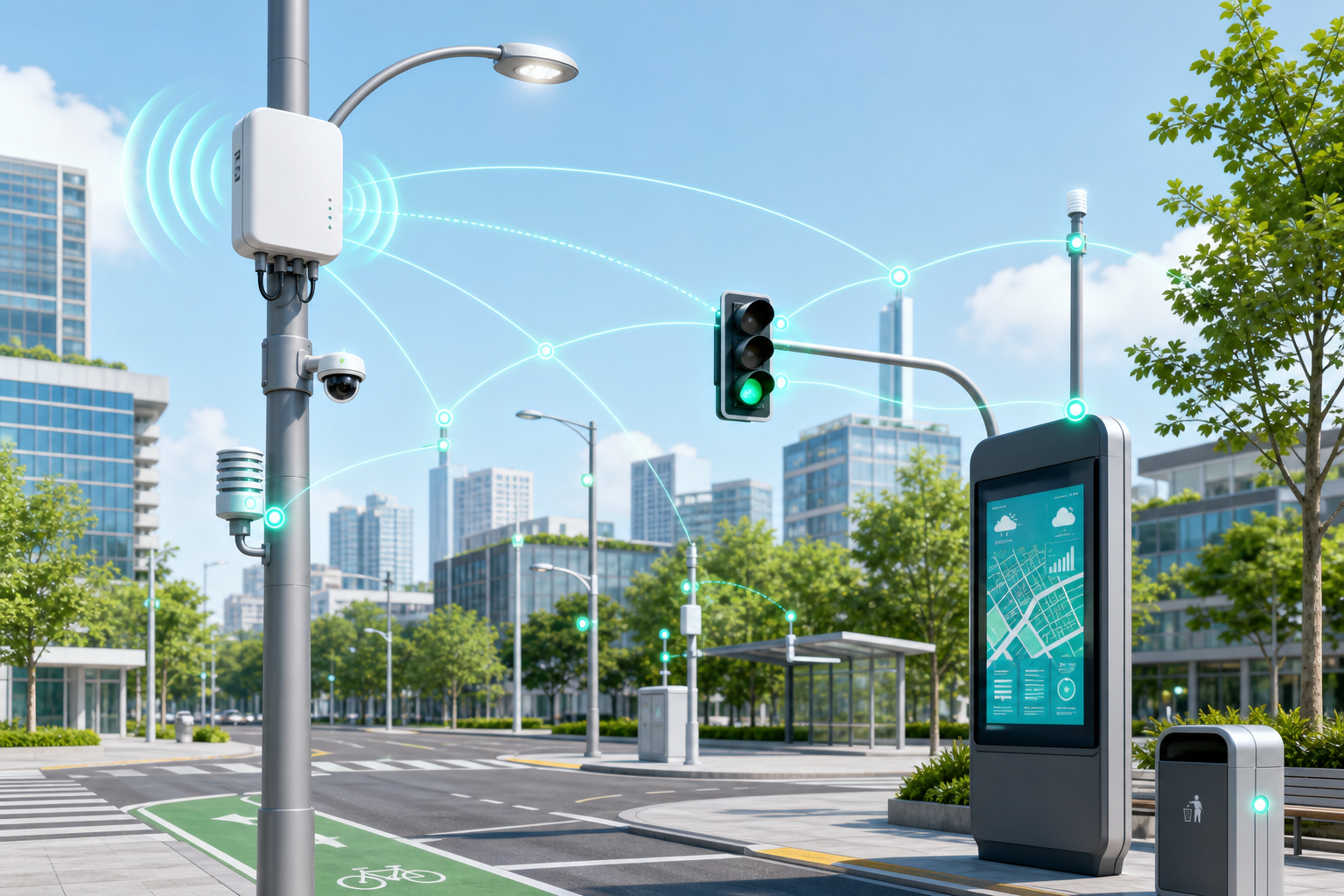
Cities have spent the better part of a decade wiring up a growing portfolio of connected infrastructure: adaptive streetlights, traffic signal controllers, air-quality sensors, public safety cameras, digital kiosks, and smart parking systems. The recurring bottleneck has always been backhaul — how to get reliable connectivity to thousands of small, distributed, often outdoor endpoints without digging up every street. In 2026, municipal network planners and systems integrators are increasingly standardizing on 5G CPE as the practical answer for smart-city connectivity.
Why Municipal Connectivity Is a Backhaul Problem
Most smart-city devices are low-bandwidth individually but collectively demanding, and they sit in locations where fiber is expensive or impractical to reach: atop a streetlight arm, inside a traffic cabinet, or on a pole at the edge of a park. Running fiber to every endpoint is cost-prohibitive, and relying on the city’s core network creates single points of failure and ownership disputes across departments.
5G CPE changes the economics. Because a single cellular gateway can be mounted wherever power is available and provisioned in minutes, it decouples smart-city rollout from civil-works schedules. A city or integrator can deploy sensors and controllers incrementally, site by site, using the same standardized hardware and remote management across the entire estate.
Key Use Cases for 5G CPE in Smart Cities
- Streetlight and cabinet IoT backhaul: aggregating sensors and controllers on a light pole or in a traffic cabinet onto one cellular uplink.
- Adaptive traffic management: connecting signal controllers and detection loops to a central or edge traffic system with low latency.
- Public kiosks and digital signage: providing managed connectivity for interactive wayfinding, transit information, and public announcements.
- Public safety and monitoring: backhauling cameras and environmental sensors where municipal fiber does not reach.
- Public Wi-Fi and event connectivity: temporary or permanent hotspots in parks, plazas, and municipal buildings.
What to Look For in a Municipal-Grade CPE
Outdoor deployment is the defining constraint. A CPE mounted on a pole or in a metal cabinet must survive years of temperature swings, rain, dust, and UV exposure, and it must keep working without constant truck rolls. Buyers should prioritize the following:
Environmental and mounting requirements
- IP-rated, weatherproof enclosure: IP65 or higher for exposed outdoor mounting.
- Wide operating temperature range: suited to the city’s climate extremes, with passive cooling preferred.
- Flexible mounting: pole, wall, and DIN-rail or cabinet options, plus PoE power to avoid running AC mains to the device.
- Surge and lightning protection: essential for pole-top and rooftop installations.
Network and management requirements
- VLAN and traffic segmentation: to isolate different municipal services (traffic, cameras, public Wi-Fi) on one gateway.
- QoS and prioritization: to protect latency-sensitive traffic like adaptive signal control.
- TR-069/TR-369 remote management: for firmware updates, monitoring, and configuration across thousands of devices.
- Multi-carrier or eSIM support: to avoid vendor lock-in and enable failover across networks.
Procurement and Deployment Best Practices
Smart-city projects often stall at procurement because they blend IT, traffic, and public-works budgets. A cleaner path is to run a focused pilot — one district, a defined set of use cases, and a single integrator — then standardize on the CPE that proves reliable in the field. Define service-level expectations up front, especially for safety-related traffic and camera traffic, and confirm the CPE vendor can support the city’s management platform rather than forcing a proprietary console. Finally, plan for scale from day one: the hardware that works for 200 endpoints must also work for 20,000.
Frequently Asked Questions
Why use 5G CPE instead of fiber for smart-city backhaul?
Fiber to every streetlight, cabinet, and kiosk is cost-prohibitive and slow to build. 5G CPE provides reliable connectivity wherever power is available and can be provisioned in minutes, letting cities deploy incrementally without civil-works delays.
Can one 5G CPE support multiple municipal services?
Yes. With VLAN segmentation and QoS, a single gateway can carry separate, isolated networks for traffic control, cameras, public Wi-Fi, and kiosks, prioritizing latency-sensitive services.
What environmental rating should a smart-city CPE have?
For exposed outdoor mounting, look for IP65 or higher, a wide operating temperature range, passive cooling, and surge protection. Pole, wall, and cabinet mounting options plus PoE simplify installation.
How do cities manage thousands of distributed CPE devices?
Through TR-069/TR-369 or a cloud management platform, which enables centralized provisioning, monitoring, firmware updates, and configuration across the entire device estate.
Looking for carrier-grade 5G FWA CPE for your deployment? Contact Honlly Telecom to discuss OEM/ODM options, sample units, and distributor cooperation for ISP, operator, and enterprise projects.