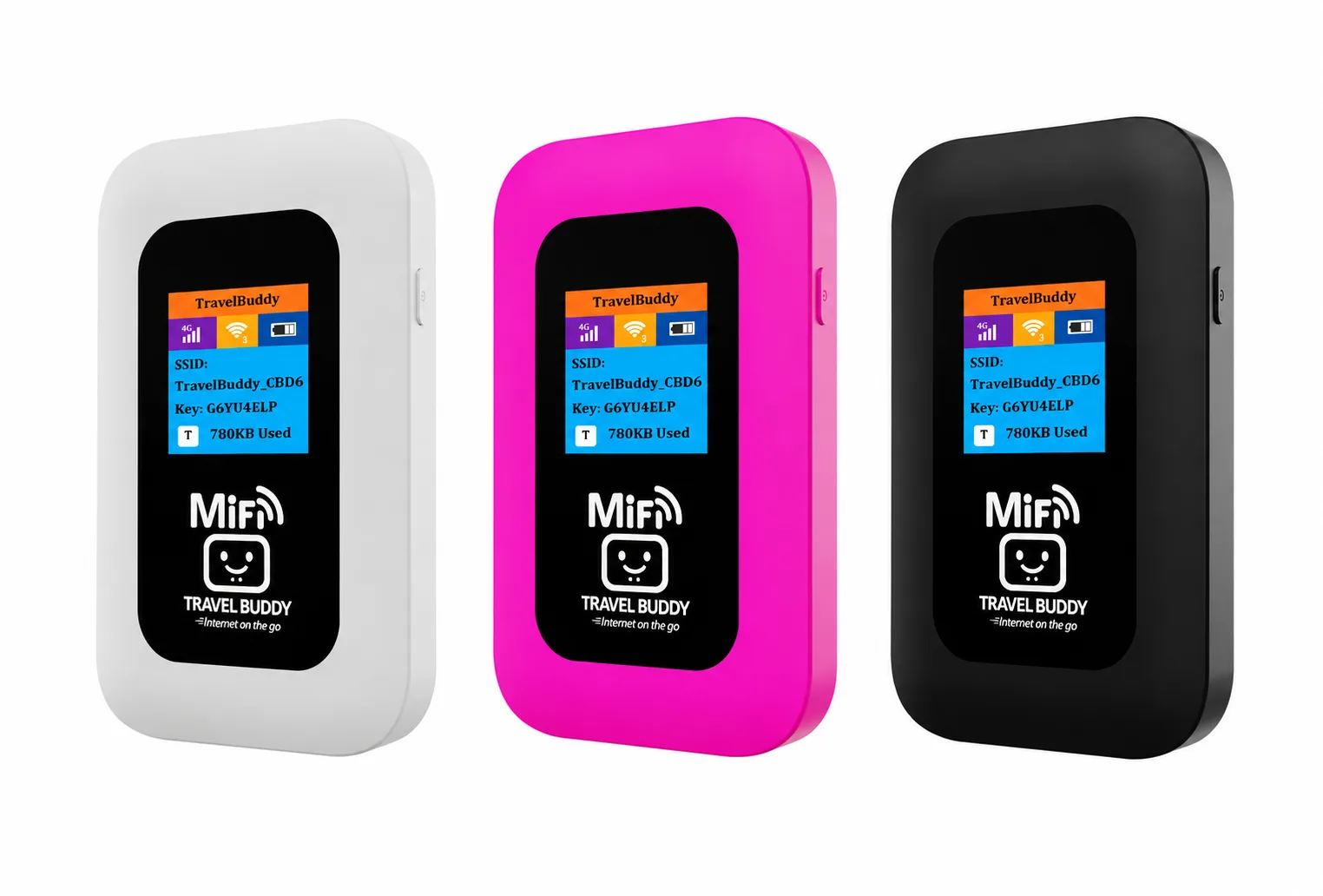
Honlly Telecom has released a new Global Mobile WiFi solution for users and business partners who need simple, portable and private internet access outside fixed broadband environments. The product is designed around a clear idea: people want to stay connected anywhere, any place and any time, without carrying heavy equipment or depending on public WiFi.
The new Global Mobile WiFi is a small and refined portable hotspot device that can be carried in a pocket, backpack, travel bag or business case. For end users, it provides a personal WiFi network for phones, tablets, laptops and other wireless devices. For operators, MVNOs, travel connectivity providers and distributors, it creates a flexible device platform for regional data packages, roaming services, tourism products, short-term rental programs and branded mobile broadband bundles.
The demand for mobile internet has changed quickly in recent years. Travelers use navigation, mobile payment, video calls and messaging as soon as they arrive in a new city. Remote workers often need a backup connection outside the office. Families may want to share one mobile broadband connection during holidays, road trips or temporary stays. Small teams also need a reliable option when fixed-line internet is not available or when installation takes too long. A compact Mobile WiFi device answers these needs in a practical way because it turns a mobile network connection into a local private WiFi hotspot.
Honlly developed the Global Mobile WiFi for these real use cases. The device is lightweight, easy to store and simple to operate. Users can power it on, connect their devices to the WiFi network, and start using mobile internet through the available data service. Compared with using an unknown public hotspot in an airport, hotel, cafe or exhibition hall, a private Mobile WiFi network gives users more control over who connects to the network. This is especially useful for people who handle email, online banking, cloud documents or business communication while traveling.
Portability is one of the most important design points. The Global Mobile WiFi is made for daily movement, not only for desks. It can be used at home, in a car, at a temporary office, in a hotel room, at a trade show booth, on a business trip or during outdoor activities where mobile coverage is available. The product is small enough for travel, but still designed as a dedicated connectivity device rather than a temporary phone hotspot. This helps users avoid draining a smartphone battery while sharing internet with several devices.
The device also supports the kind of multi-device experience that modern users expect. A traveler may connect a phone and tablet. A remote worker may connect a laptop and phone at the same time. A family may share one hotspot across several phones during a trip. A small business team may use it as a temporary internet solution during events, pop-up stores or field work. This shared access model makes Global Mobile WiFi useful for both consumer-facing service packages and B2B distribution projects.
For telecom operators and MVNOs, Honlly sees Global Mobile WiFi as more than a single device. It can become part of a complete service offer. A partner can combine the hardware with prepaid data, pay-as-you-go top-up, local network access, international roaming packages or seasonal travel bundles. Depending on project requirements, Honlly can support OEM and ODM customization, including housing color, logo printing, packaging, firmware interface, default SSID rules, language settings and operator-specific configuration.
The product direction also fits the growing need for flexible wireless broadband. Fixed broadband remains important, but it does not cover every scenario. Students move between dormitories and rented apartments. Business travelers move between airports, hotels and meetings. Field staff may work from vehicles or temporary locations. Retailers may need quick network access for payment terminals. Families may need a simple connection during vacations. Global Mobile WiFi gives these users a portable bridge between the mobile network and their everyday WiFi devices.
Ease of use is another focus. Many users do not want complicated setup steps, long contracts or technical configuration before they can get online. A well-designed Mobile WiFi product should be clear, direct and ready for quick deployment. Honlly’s approach is to make the device simple for end users while keeping enough flexibility for service providers and distributors behind the scenes. This balance matters in overseas markets where buyers may need different frequency bands, certification paths, local packaging, SIM rules and after-sales documentation.
The product is suitable for several target markets. Travel connectivity companies can use it for international visitor packages. MVNOs can use it to sell portable broadband plans without fixed installation. Operators can use it for entry-level mobile broadband programs, short-term users or backup internet service. Distributors can supply it to retail channels, online stores, telecom shops and business buyers. Enterprise customers can use it for temporary offices, field service teams, exhibitions and emergency connectivity.
Honlly’s manufacturing experience in 4G and 5G wireless products gives the company a strong base for Global Mobile WiFi development. The company works with CPE routers, MiFi devices, industrial routers and outdoor wireless broadband equipment for international customers. This background helps Honlly understand what overseas buyers care about: stable supply, practical hardware design, market-ready packaging, firmware flexibility, certification planning, reliable communication and clear product documentation.
With the launch of Global Mobile WiFi, Honlly is responding to a simple but powerful market need. Internet access is no longer tied to one room, one cable or one location. Users expect a connection when they travel, work, study, shop, meet customers or move between cities. A compact Mobile WiFi device gives them a familiar WiFi experience through a portable wireless broadband product.
Honlly will continue to support partners who want to build mobile broadband services for travel, home backup, remote work and operator-branded connectivity projects. The Global Mobile WiFi solution is available for product consultation, sample discussion and OEM/ODM cooperation.
For more information about Global Mobile WiFi devices, custom branding, firmware options, frequency band planning or distributor cooperation, please contact Honlly Telecom.
Frequently Asked Questions
Q1: What does Honlly’s Global Mobile WiFi solution offer for portable connectivity?
Honlly’s Global Mobile WiFi (MiFi) portfolio includes 4G LTE and 5G NR portable hotspots with multi-band support, eSIM capability for international roaming, all-day battery life (3000+ mAh), up to 32 simultaneous device connections, and compact pocket-sized designs for travelers and remote workers.
Q2: Who benefits most from portable mobile WiFi solutions?
Key user groups include: international travelers needing seamless roaming, remote/hybrid workers requiring reliable backup internet, field service teams (utilities, insurance, emergency response), students in accommodation without fixed broadband, and event organizers needing temporary connectivity.
Q3: What connectivity features does Honlly’s portable WiFi support for global use?
Devices support: 15+ 4G bands and 8+ 5G NR bands for global compatibility, eSIM with multi-profile switching for local data plans in 100+ countries, Wi-Fi 6 (AX1800) for local connections, VPN pass-through for corporate security, and USB tethering for zero-configuration laptop connectivity.
When you need internet on the go, two options dominate the conversation: a dedicated MiFi device and your smartphone’s built-in mobile hotspot. On the surface, they appear to do the same job — broadcasting a WiFi signal from a cellular data connection. But beneath that similarity lie significant differences in battery life, connection stability, multi-device performance, security features, and total cost of ownership.
For ISPs, MVNOs, and enterprise buyers evaluating portable connectivity solutions for field teams, remote workers, or consumer offerings, understanding these differences is essential to making the right procurement decision. This guide breaks down the MiFi vs mobile hotspot comparison across eight critical dimensions to help you determine which solution delivers the best value for your specific use case.
1. Understanding the Technology: What Separates a MiFi from a Phone Hotspot
A MiFi device (short for “My WiFi”) is a purpose-built portable router that contains a dedicated cellular modem, a WiFi access point, and its own battery — all in a pocket-sized form factor. It connects to 4G or 5G cellular networks and creates a local WiFi network that laptops, tablets, and other devices can join. Because MiFi hardware is designed for this single purpose, manufacturers optimize every component — from the modem chipset to the antenna layout — for sustained wireless performance.
A mobile hotspot, by contrast, is a software feature built into most modern smartphones. When enabled, the phone uses its cellular modem to connect to the mobile network and shares that connection over WiFi, Bluetooth, or USB tethering. The phone is simultaneously running its operating system, background apps, notifications, and potentially voice calls — all of which compete for processing power, battery, and modem resources.
This fundamental architectural difference — dedicated hardware vs shared resource — cascades into performance gaps that become especially apparent under sustained use or when multiple devices are connected. Purpose-built MiFi devices like the Honlly HL-830M 5G MiFi incorporate optimized antenna designs and thermal management that smartphones simply cannot match given their space constraints.
2. Connection Capacity and Multi-Device Performance
MiFi devices consistently outperform smartphone hotspots in multi-device scenarios. A typical MiFi device supports 10 to 32 simultaneous connections, while most smartphones cap hotspot connections at 5 to 10 devices — and real-world performance often degrades well before reaching those limits.
The reason is twofold. First, MiFi devices use dedicated WiFi chipsets with multiple spatial streams and beamforming capabilities that maintain throughput as more clients connect. Second, MiFi firmware includes traffic-shaping algorithms that prioritize latency-sensitive applications like video calls over background downloads — a feature largely absent from smartphone hotspot implementations.
For business scenarios — such as a field team sharing a single connection for laptops, tablets, and VoIP calls — this difference is decisive. A dedicated MiFi handles the load gracefully; a phone hotspot begins dropping packets and stuttering connections after 3–4 concurrent active users.
Enterprise-grade MiFi devices also support guest network isolation and VLAN tagging, features that separate client traffic for security compliance — capabilities no consumer smartphone hotspot provides. For MVNOs offering managed portable WiFi services to business customers, these enterprise features are table stakes that require purpose-built MiFi hardware.
3. Battery Life: The Deciding Factor for All-Day Connectivity
Battery performance represents the single largest practical difference between MiFi and smartphone hotspots. A dedicated 4G/5G MiFi device typically delivers 8 to 16 hours of continuous use on a single charge. The same phone running a mobile hotspot drains its battery in 2 to 5 hours — and that’s assuming a fully charged device that isn’t running other applications.
Consider a typical field-work scenario: a technician needs internet access from 8 AM to 5 PM at a remote site. With a MiFi device, they carry one pocket-sized unit that lasts the full workday. With a phone hotspot, they need either a power bank (adding bulk and requiring the phone to remain tethered to it) or they must ration connectivity — turning the hotspot on and off throughout the day, disrupting workflow.
The battery math is straightforward. A smartphone’s 4,000–5,000 mAh battery powers a high-resolution display, application processor, GPU, multiple radios (cellular, WiFi, Bluetooth, GPS), and background services. Activating the hotspot function adds continuous high-power cellular transmission — often the single most power-hungry operation a phone performs. A MiFi’s 3,000–5,000 mAh battery, by contrast, powers only the cellular modem, WiFi radio, and a low-power embedded processor — nothing else.
For buyers evaluating portable fleet connectivity, this battery differential translates directly to operational reliability. A field technician whose phone dies at 2 PM because the hotspot drained it has lost both internet access and their primary communication device.
4. Network Performance: Speed, Signal Reception, and Data Optimization
MiFi devices typically achieve 10–25% higher throughput than smartphone hotspots on the same cellular network in the same location. Three engineering factors explain this gap:
Antenna design: MiFi devices dedicate internal volume to optimized antenna arrays — often 2×2 or 4×4 MIMO configurations with antenna elements spaced for maximum diversity gain. Smartphones pack antennas into millimeters of edge space, compromising pattern quality.
Thermal management: Sustained cellular transmission generates significant heat. Smartphones throttle modem power to manage skin temperature (users notice a hot phone). MiFi devices, which users pocket or place on a table, can tolerate higher internal temperatures and maintain peak transmission power longer. A MiFi’s plastic housing also dissipates heat more effectively than a phone’s glass-and-metal sandwich.
Data optimization: Many carrier-branded MiFi devices include data compression and content-optimization features that reduce data consumption by 15–30% for web browsing without visible quality degradation. These optimizations run at the firmware level and are invisible to connected devices.
For ISP and MVNO procurement teams evaluating CPE options for portable broadband services, the throughput advantage of dedicated hardware translates to better customer experience scores and lower churn — especially in areas with marginal signal strength where antenna quality makes the difference between usable and unusable service.
5. MiFi vs Mobile Hotspot: Feature-by-Feature Comparison
Feature
MiFi Device
Smartphone Hotspot
Typical Battery Life (Continuous Use)
8–16 hours
2–5 hours
Max Connected Devices
10–32
5–10
Antenna Configuration
Dedicated 2×2 or 4×4 MIMO
Shared antennas, typically 2×2
Thermal Throttling
Minimal (higher tolerance)
Aggressive (skin temperature limits)
Throughput (Same Network/Site)
Baseline (100%)
75–90% of MiFi performance
Guest Network / VLAN
Supported (enterprise models)
Not available
Data Compression
Firmware-level, 15–30% savings
Not available
SIM Flexibility
Dedicated SIM slot, often dual-SIM
Uses phone SIM (or eSIM)
International Roaming
Multi-band global LTE/5G; eSIM support
Depends on phone model and carrier
VPN Passthrough / Client
Supported
Limited or blocked by carriers
External Antenna Ports
Available on select models
Not available
Device Cost (Unlocked)
$80–$400
$0 (already owned)
Impact on Primary Device Battery
None (independent device)
Drains phone battery rapidly
6. Security and Enterprise-Grade Management Features
For business deployments, security separates MiFi from smartphone hotspots decisively. Enterprise-grade MiFi devices include multiple security layers that consumer smartphones lack:
Hardware-level VPN support: MiFi firmware can route all connected-device traffic through an IPSec or WireGuard VPN tunnel at the device level, ensuring every connected client is protected without requiring per-device VPN configuration. This is critical for industries handling sensitive data — healthcare field workers accessing patient records, financial services teams processing transactions, or government field staff communicating over public networks.
Remote device management: MiFi fleets can be managed through TR-069 or TR-369 (USP) protocols, allowing operators to push firmware updates, change configurations, monitor data usage, and lock compromised devices remotely. The Honlly HL-875H 5G CPE platform supports both TR-069 and TR-369 for comprehensive remote management — a capability shared with Honlly’s MiFi product line. Smartphone hotspots offer no equivalent centralized management.
SIM lock and device authentication: MiFi devices support SIM-lock, IMEI whitelisting, and certificate-based network authentication — controls that prevent unauthorized SIM swapping and ensure only approved devices connect to corporate or operator networks.
Firewall and access control: Built-in SPI firewalls, MAC address filtering, and IP/port-level access controls allow administrators to restrict which services connected clients can access. A field team’s MiFi can be configured to allow only VPN traffic and block all other outbound connections — an impossible configuration on a smartphone hotspot.
7. Cost Analysis: Dedicated MiFi vs Leveraging Existing Phone Plans
The cost comparison between MiFi and mobile hotspot is more nuanced than the upfront price tag suggests. A smartphone hotspot carries zero hardware cost — the user already owns the phone. A MiFi device costs $80–$400 depending on features and cellular generation (4G vs 5G). But the total cost of ownership (TCO) must account for several hidden expenses:
Battery replacement and power banks: Heavy hotspot users who drain their phone twice daily will cycle through battery charge cycles 2–3× faster than normal, potentially requiring battery replacement within 18 months ($50–$100). Many also purchase external power banks ($30–$80) to compensate — eroding the hardware cost advantage.
Data plan economics: Many carriers charge extra for mobile hotspot data or throttle hotspot speeds after a usage cap — even on “unlimited” plans. A MiFi on a dedicated data-only plan typically offers higher or no throttling thresholds at a lower cost per gigabyte. For organizations deploying 20+ field units, moving traffic to dedicated MiFi data plans often reduces overall wireless spend by 20–30%.
Productivity cost: The most significant hidden cost is lost productivity. When a phone battery dies, the worker loses both connectivity and their primary communication tool. When hotspot speed throttles, cloud application performance degrades. When an important call interrupts the hotspot session, all connected devices lose internet. Quantifying these disruptions at even $15–25 per incident makes the MiFi hardware investment recoverable within months for field-dependent teams.
For MVNOs and ISPs evaluating which CPE to bundle with portable broadband plans, dedicated MiFi hardware like the Honlly HL-880U 5G Outdoor CPE (for fixed-mobile convergence scenarios) or Honlly’s portable MiFi line creates a sticky service relationship — subscribers who own a carrier-locked MiFi are far less likely to churn than those using their own phone as a hotspot.
8. Travel, Roaming, and Multi-Network Flexibility
For international travelers and cross-border business operations, MiFi devices offer decisive advantages in network flexibility. Key capabilities include:
Multi-band global support: Purpose-built MiFi devices support a broader range of LTE and 5G bands than most smartphones — typically 15–25 bands across sub-6 GHz and mmWave frequencies. This means a single MiFi can provide connectivity across North America, Europe, Asia, and Africa without band-compatibility gaps. For global enterprises equipping traveling executives or cross-border logistics fleets, one MiFi SKU covers far more territory than any single phone model.
Dual SIM and eSIM support: Many MiFi devices feature dual physical SIM slots plus eSIM capability, allowing users to maintain a home-network SIM alongside a local SIM for the destination country. The device can automatically switch to the lower-cost network based on location or data usage thresholds — a feature that cuts roaming costs by 50–70% for frequent travelers.
Dedicated data management: Using a separate MiFi for travel data means the traveler’s personal phone number, SMS, and messaging apps remain on the home network while data flows through the local SIM — avoiding roaming charges for voice and SMS while maintaining connectivity for WiFi calling apps.
9. Which Solution Fits Your Use Case? Recommendations by Scenario
Choose a MiFi device when:
You need all-day connectivity without battery anxiety (field technicians, event staff, remote workers)
Multiple people share one connection (team meetings, family travel, trade show booths)
Security and centralized management matter (enterprise deployments, healthcare, finance)
International travel is frequent (eSIM + dual SIM flexibility substantially reduces roaming costs)
You’re an ISP or MVNO bundling portable broadband for customer retention
Signal conditions are marginal (dedicated antennas extract more performance from weak signals)
A smartphone hotspot suffices when:
Usage is occasional and short-duration (under 1–2 hours)
Only 1–2 devices need connection
Budget constraints preclude additional hardware
The user always has access to power (office, vehicle with charger)
For most business and frequent-use scenarios, the dedicated MiFi device delivers better reliability, security, and total cost of ownership — making it the preferred choice for operators, enterprises, and power users alike.
Frequently Asked Questions
Can a MiFi device replace home broadband?
For light to moderate users (web browsing, email, streaming on 1–2 devices), a 5G MiFi with a generous data plan can serve as a primary internet connection. However, for households with multiple 4K streams, online gaming, or large file downloads, a fixed 5G CPE like the Honlly HL-830M is better suited — it offers higher-gain antennas, more Ethernet ports, and better sustained throughput than any pocket MiFi.
How many devices can connect to a MiFi vs a phone hotspot simultaneously?
A typical MiFi supports 10–32 simultaneous connections with minimal performance degradation. Smartphone hotspots support 5–10 devices on paper, but real-world performance degrades noticeably beyond 3–4 concurrently active clients due to shared processing and antenna resources.
Does a MiFi device work internationally with different SIM cards?
Yes. Most MiFi devices are carrier-unlocked and support a wide range of LTE/5G bands (15–25 bands typically). Many models include dual SIM slots plus eSIM support, enabling users to insert a local SIM at their destination while retaining their home SIM. Always verify the specific band support for your target countries before purchasing.
Is MiFi internet faster than a phone hotspot on the same network?
Yes. On the same cellular network in the same location, MiFi devices typically deliver 10–25% higher throughput due to optimized antenna design, better thermal management (less throttling), and dedicated modem resources that aren’t shared with phone applications and background processes.
What is the real-world battery life difference between MiFi and mobile hotspot?
A MiFi device delivers 8–16 hours of continuous use on a single charge. A smartphone hotspot typically lasts 2–5 hours before the phone battery is depleted — and that’s if the phone started at 100% charge and isn’t running other apps. The difference is structural: a MiFi battery powers only the modem and WiFi radio; a phone battery powers a display, processor, GPU, multiple radios, and background services simultaneously.