
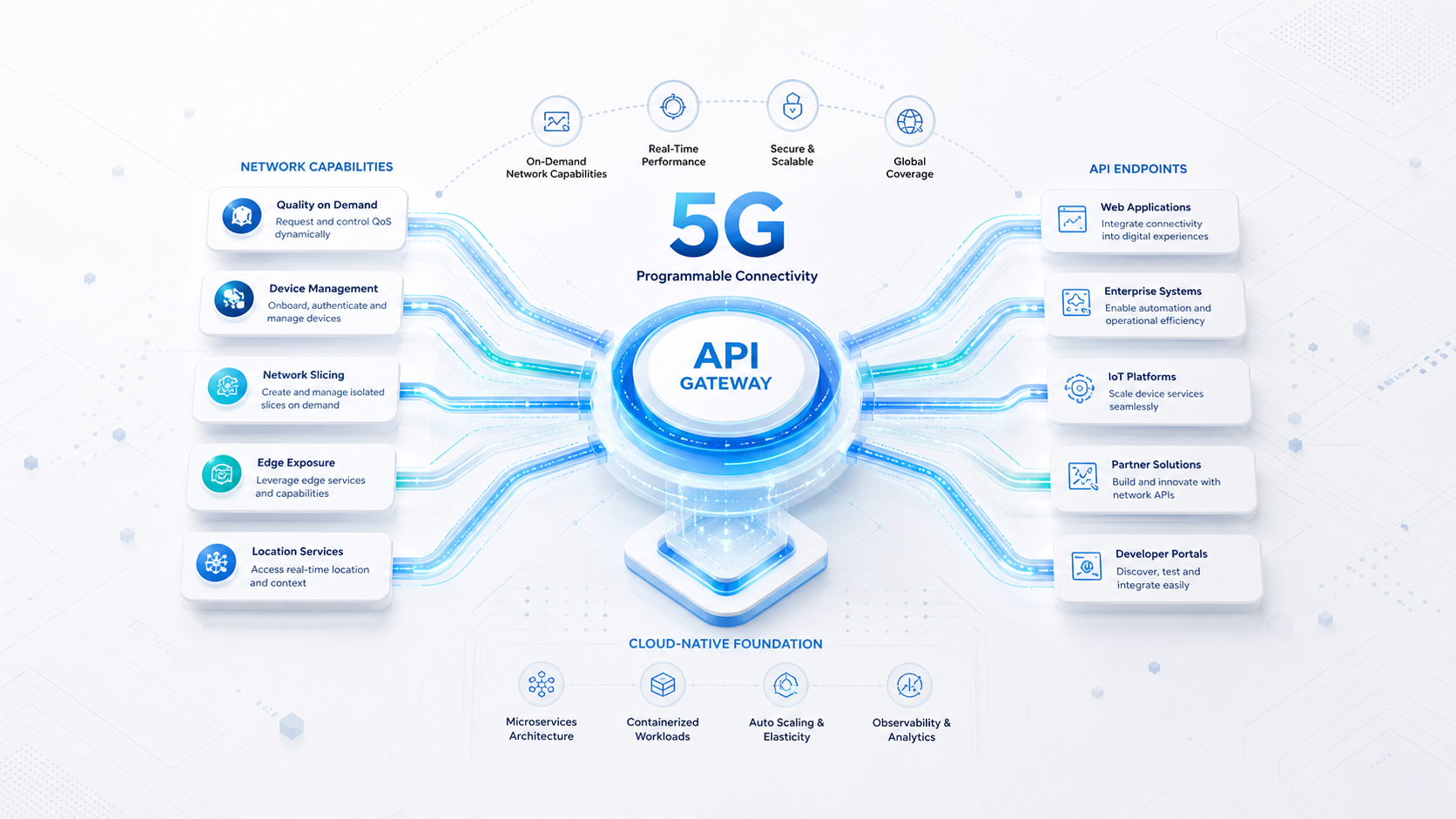
The GSMA CAMARA initiative is reshaping how mobile operators expose network capabilities to third-party applications — and 5G Fixed Wireless Access (FWA) Customer Premises Equipment (CPE) is emerging as a critical endpoint in this programmable connectivity ecosystem. As operators worldwide adopt Open Gateway APIs for network-as-a-service (NaaS) models, CPE vendors must understand how CAMARA-standardized APIs — including Quality-on-Demand (QoD), Device Location, and Device Status — will influence procurement specifications, device firmware architecture, and operator service innovation roadmaps through 2027.
The CAMARA Open Gateway Framework: What CPE Buyers Need to Know
The CAMARA project, incubated under the Linux Foundation in collaboration with GSMA and TM Forum, defines a set of standardized, northbound network APIs that expose 5G core network capabilities to application developers. With over 1,200 API families under development and 67 operator commitments globally as of mid-2026, CAMARA has moved from proof-of-concept to commercial deployment phase across major carrier groups including Vodafone, Deutsche Telekom, AT&T, and China Mobile.
For CPE procurement teams, the significance lies in how these APIs will traverse the operator-to-CPE boundary. Three CAMARA API families directly impact FWA CPE design and deployment: Quality-on-Demand (QoD) — enabling applications to request specific latency and throughput guarantees for a given device session; Device Location Verification — allowing enterprise applications to validate the physical location of a CPE for regulatory compliance and service licensing; and Device Status & Reachability — providing real-time connectivity state, roaming status, and session continuity information for fleet management at scale.
Operator Procurement Shifts: API-Readiness as a CPE Selection Criterion
Industry analysis from Omdia and ABI Research indicates that by Q4 2026, at least 35% of new FWA CPE RFPs from Tier-1 operators will include CAMARA API compatibility requirements. This represents a significant shift from traditional procurement criteria centered on throughput, band support, and price-per-unit. Operators are increasingly evaluating CPE on its ability to participate in an end-to-end programmable network architecture where device capabilities are abstracted, exposed, and consumed through standardized APIs.
Key technical requirements emerging in operator RFPs include: TR-369/USP (User Services Platform) support with CAMARA API proxy integration for QoD session establishment; secure OAuth 2.0 / OpenID Connect authentication between CPE management systems and operator NEF (Network Exposure Function); real-time telemetry export via gNMI/gRPC for consumption by CAMARA Device Status APIs; and YANG-based data modeling alignment with 3GPP TS 28.532 for consistent device capability exposure across multi-vendor CPE fleets.
QoD API: The Killer Application for Enterprise FWA
The CAMARA Quality-on-Demand API is widely regarded as the most commercially impactful for FWA CPE. It allows enterprise applications — via the operator NEF or SCEF — to dynamically request bandwidth and latency profiles for specific CPE sessions. For a manufacturing plant using 5G FWA as primary WAN, this means the ERP system can programmatically request a guaranteed 50 Mbps with less than 20 ms latency during critical production windows, with the CPE policy enforcement engine executing the QoS change in real time.
CPE vendors that implement native QoD API support — including session-level QoS Flow mapping to 5QI values, dynamic DSCP remarking, and application-aware traffic steering with DPI — will differentiate their products in the enterprise segment. Ericsson and Nokia have already demonstrated end-to-end QoD use cases at MWC 2026, pairing their 5G core NEF implementations with third-party CPE devices. The ecosystem is maturing rapidly, and CPE vendors without QoD API readiness risk exclusion from Tier-1 enterprise FWA tenders in 2027.
Device Location API: Regulatory Compliance and Service Licensing
The CAMARA Device Location Verification API addresses a critical pain point for operators deploying FWA in regulated markets. Many national telecom regulators require operators to verify that fixed-wireless CPE remains within its licensed service area — particularly for spectrum bands with geographic licensing constraints. The Device Location API, integrated with the CPE GNSS module or network-based positioning, provides automated compliance verification at scale.
For CPE buyers serving markets with strict regulatory frameworks — including India (PM-WANI and BharatNet licensing), Brazil (Anatel FWA spectrum authorization), and the European Union (geographic spectrum usage rights under national regulatory authorities) — Device Location API support is transitioning from optional feature to mandatory requirement. CPE with integrated multi-constellation GNSS (GPS + BeiDou + Galileo + GLONASS) and CAMARA Device Location API compliance will command premium positioning in these procurement cycles.
Device Status API: Fleet Management at Carrier Scale
The CAMARA Device Status & Reachability API standardizes how operators and enterprise customers query the real-time state of CPE fleets — including connectivity status, roaming condition, session continuity indicators, and reachability for incoming communications. For MVNOs and wholesale operators managing tens of thousands of CPE units across multiple host networks, this standardized API replaces fragmented, vendor-specific device management protocols with a unified status query interface.
The operational impact is substantial: operators can integrate CAMARA Device Status into their existing OSS/BSS stacks, automate SLA monitoring, trigger proactive support tickets based on real-time device reachability, and feed device status data into AIOps platforms for predictive maintenance. CPE chipsets from Qualcomm (X75/X80), MediaTek (T800/T830), and UNISOC (V510/V516) already support the necessary modem telemetry interfaces, and CPE vendors integrating these chipsets should ensure their firmware exposes the required status endpoints in CAMARA-compatible formats.
Honlly Telecom Position: API-Native CPE Architecture
Honlly Telecom has been tracking the CAMARA standardization roadmap since 2025 and is actively incorporating API-native architecture principles into its 5G CPE product line. The company next-generation FWA platform — built on Qualcomm X75/X80 and MediaTek T830 chipsets — includes native TR-369/USP support with planned CAMARA QoD API proxy integration, multi-constellation GNSS for Device Location compliance, and gNMI-based real-time telemetry export aligned with Device Status API requirements.
For operators and MVNOs evaluating CPE vendors for 2026-2027 FWA deployments, API-readiness should be a top-tier evaluation criterion alongside RF performance and cost efficiency. As CAMARA adoption accelerates across the GSMA operator community — projected to reach 100+ commercial operator deployments by end-2026 — CPE that cannot participate in the programmable network ecosystem will become a procurement liability. Honlly Telecom is committed to delivering API-native 5G CPE that enables operator service innovation, regulatory compliance, and operational efficiency at scale.
For more information on Honlly Telecom 5G FWA CPE portfolio and CAMARA API readiness, contact our B2B solutions team or visit our product page.