
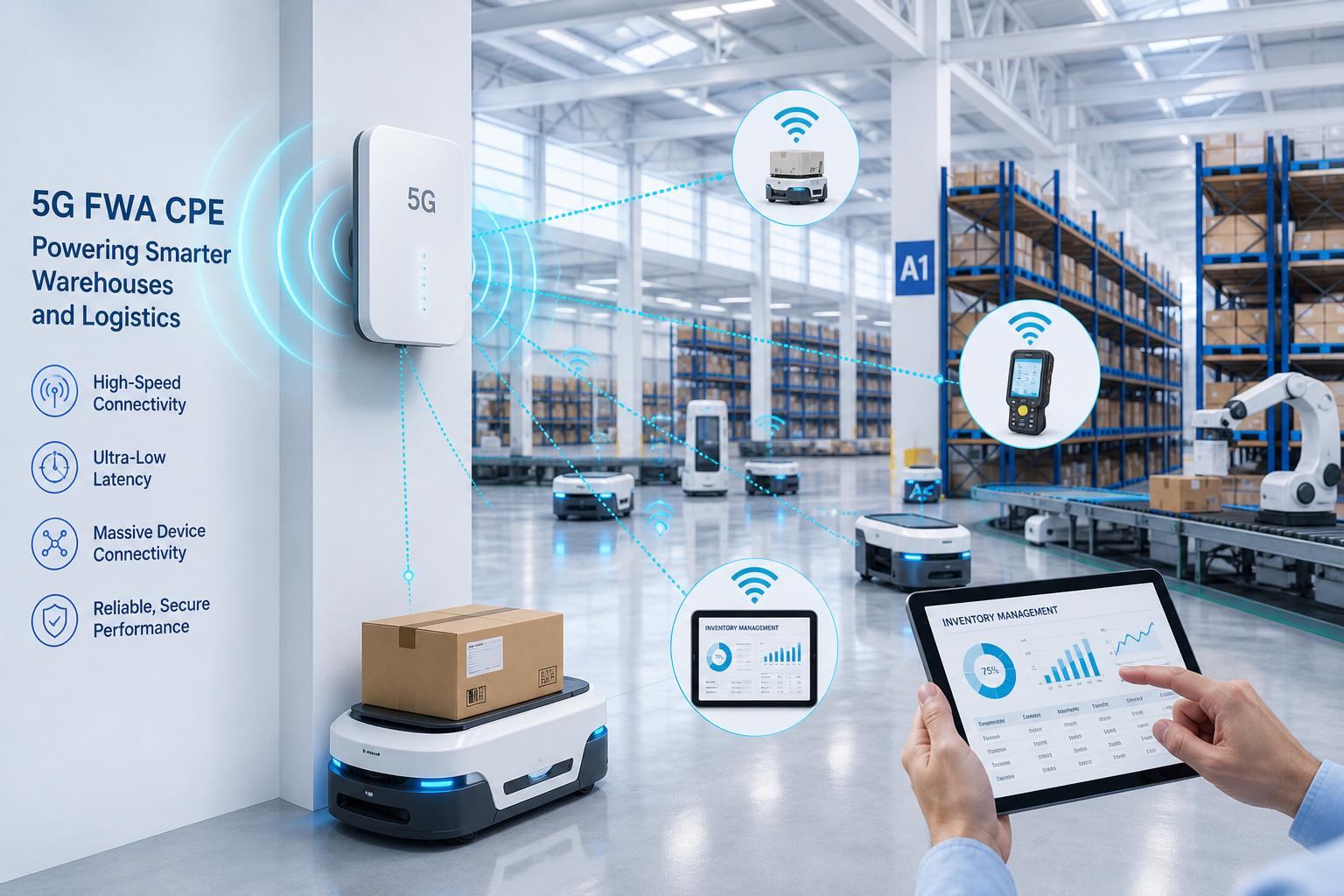
Distribution centers have quietly become some of the most connectivity-hungry industrial sites in the supply chain. Where a warehouse once needed a few wired access points and a handful of barcode scanners, today’s facilities run fleets of automated guided vehicles (AGVs) and autonomous mobile robots (AMRs), dense networks of IoT sensors, wearable scanners, and cloud-connected warehouse management systems (WMS) that track every pallet in near real time. In 2026, logistics operators and the ISPs that serve them are turning to 5G fixed wireless access (FWA) CPE to deliver the reliable, low-latency connectivity these environments demand.
Why Warehouse Connectivity Is Changing
The shift toward automation has changed the traffic profile of the modern warehouse. AGVs and AMRs are mobile, roaming constantly across large floor areas, and they cannot tolerate dropouts: a robot that loses its link mid-route risks a collision, a lost pallet, or a stalled workflow. Simultaneously, voice-directed picking, handheld scanners, and vision-based quality inspection generate a steady stream of small, latency-sensitive packets that must reach the WMS without queueing delays.
Traditional designs built on fixed Ethernet to static stations and consumer-grade Wi-Fi across the floor struggle to keep up. Wired drops are expensive to extend as racking layouts change, and Wi-Fi coverage in tall steel racking can be patchy, especially for roaming robots that must hand off cleanly between access points. A 5G FWA CPE gives operators a private, high-performance backhaul path that can be repositioned as the facility reconfigures.
What 5G FWA CPE Brings to the Distribution Center
A 5G FWA CPE acts as a resilient cellular gateway that connects warehouse systems to the operator’s network, the corporate WAN, or a private 5G core. The practical advantages fall into three areas:
- Rapid, flexible deployment: a CPE can be online in hours and moved between zones, sites, or temporary seasonal facilities without waiting for fiber construction.
- Reliable roaming backhaul: cellular-grade handover and QoS keep AGVs, AMRs, and scanners connected as they move, reducing the dropouts that stall automated workflows.
- WAN diversity and failover: a 5G CPE can serve as primary backhaul for a remote or seasonal warehouse, or as automatic failover to protect a wired WAN from single-point failures.
What Buyers Should Evaluate
For logistics operators and managed service providers, the evaluation criteria differ from a standard office broadband gateway. Industrial warehouses are electromagnetically noisy, dusty, and often temperature-extreme; the CPE must be built to survive the environment and to serve latency-sensitive automation traffic.
Key specifications to verify
- Low-latency performance: consistent sub-50 ms (ideally lower) paths for AGV control and real-time WMS transactions.
- Industrial hardening: wide operating temperature range, metal enclosure, and resistance to dust and vibration.
- Multi-WAN and failover: cellular plus wired WAN with automatic switchover for uninterrupted automation.
- QoS and traffic prioritization: the ability to prioritize robot-control and WMS traffic over bulk data.
- Remote management: TR-069/TR-369 or a cloud platform to monitor and update devices across many sites.
The Opportunity for Operators and Integrators
For regional ISPs, wireless operators, and systems integrators, the smart-logistics segment is a repeatable, high-value market. Each distribution center may require multiple CPE units for primary backhaul, failover, and zone coverage, and once the platform is proven, operators can bundle hardware, SIM, and managed services into a per-site recurring model. As e-commerce growth and labor constraints push more facilities toward automation, the demand for dependable fixed wireless at the warehouse edge will only grow.
Frequently Asked Questions
Can 5G FWA CPE support AGVs and autonomous mobile robots reliably?
Yes. AGVs and AMRs need stable, low-latency connectivity with clean roaming. A properly provisioned 5G FWA CPE provides cellular-grade handover and QoS that keep mobile robots connected across a warehouse floor, avoiding the dropouts common with patchy Wi-Fi.
Is 5G FWA a good primary connection for a distribution center?
It can be. For remote, seasonal, or rapidly opened facilities where fiber is slow to install, 5G FWA serves as primary backhaul. In established sites it is often deployed as automatic failover to protect warehouse automation from wired WAN outages.
What makes an industrial 5G CPE different from a consumer gateway?
Industrial CPE are built for harsh environments with wide temperature ranges, dust and vibration resistance, and metal enclosures, and they typically offer advanced features like multi-WAN failover, QoS, VLAN segmentation, and TR-069/TR-369 remote management.
How does 5G FWA CPE simplify multi-site logistics rollouts?
It standardizes the connectivity edge. Every warehouse gets the same hardware and configuration template, and an IT or operations team can provision, monitor, and update dozens of facilities centrally — including temporary or seasonal sites.
Looking for carrier-grade 5G FWA CPE for your deployment? Contact Honlly Telecom to discuss OEM/ODM options, sample units, and distributor cooperation for ISP, operator, and enterprise projects.