
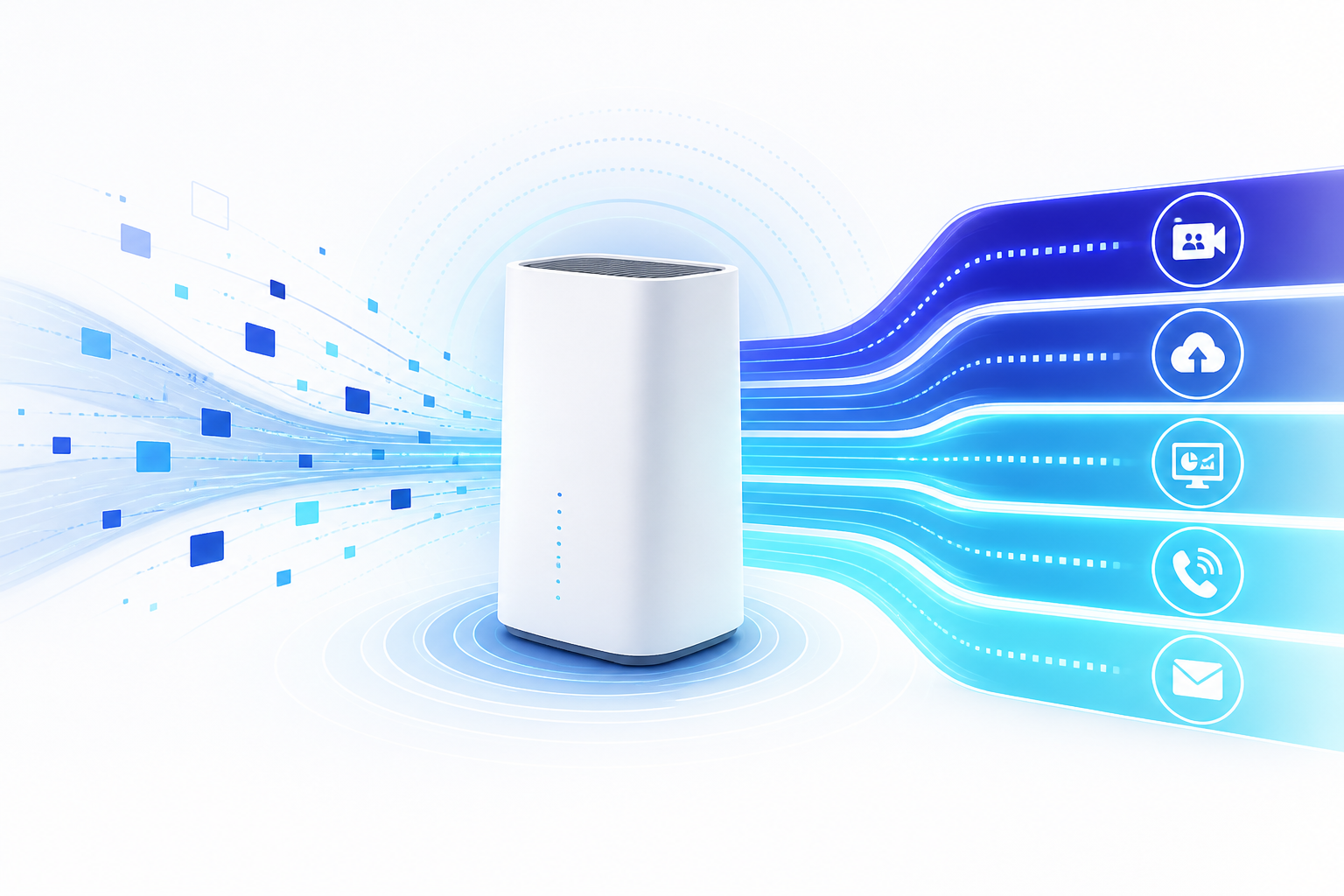
Bandwidth is not the same as performance. A fixed wireless link that delivers 300 Mbps can still feel sluggish if a large file transfer is allowed to crowd out a VoIP call or a cloud ERP transaction. Quality of service (QoS) and traffic shaping are what turn raw throughput into predictable, responsive connectivity — and they are among the most important, and most misunderstood, features to evaluate in a 5G CPE.
Why QoS Matters More on Fixed Wireless
Cellular links are shared and variable. Signal conditions, tower load, and spectrum congestion can all change throughput from one moment to the next, and the uplink is often far more limited than the downlink. When bandwidth is constrained, traffic competes for scarce resources, and without prioritization the result is jittery voice, frozen video conferences, and slow line-of-business applications.
QoS and traffic shaping address this by classifying packets, assigning them to queues with defined priorities, and — when necessary — limiting lower-priority traffic so it cannot saturate the link. On a 5G CPE, this turns a best-effort internet connection into a predictable business-grade link.
The Core Mechanisms
- Classification: identifying traffic by application, port, protocol, IP address, or DSCP marking so the CPE knows what it is handling.
- Prioritization and queuing: giving voice and real-time traffic strict priority over bulk transfers, while ensuring every class gets a fair share.
- Traffic shaping and rate limiting: capping non-critical traffic (such as software downloads or guest streaming) so it cannot consume the whole link.
- DSCP marking and VLANs: preserving or rewriting QoS marks so prioritization survives the path to the wider network.
What to Evaluate in a 5G CPE
Not all QoS implementations are equal. Some devices expose only a handful of fixed priorities; others offer granular, per-application control. Buyers should match the feature set to the traffic they actually run.
Classification and policy capabilities
- Application-aware classification: the ability to recognize voice, video, and business applications automatically, not just by port number.
- Layer 3/4 and DSCP matching: rules based on IP, port, protocol, and DSCP/802.1p markings for integration with an existing QoS design.
- Per-user and per-VLAN policies: separate policies for guest Wi-Fi, IoT, and business VLANs on the same gateway.
Queuing and shaping features
- Priority queuing and weighted fairness: strict priority for real-time traffic with fair allocation for the rest.
- Uplink and downlink shaping: controls on both directions, since the uplink is often the true bottleneck on fixed wireless.
- Per-application rate limits: caps on bulk traffic like backups and downloads to protect interactive sessions.
- Buffer and queue management: appropriate queue depths to avoid latency spikes under congestion.
Designing a QoS Policy That Works
The most common mistake is over-classifying. A policy with dozens of tiers is hard to maintain and easy to misconfigure. A cleaner approach is three to five broad classes — real-time voice and video, business-critical applications, default, and bulk — with strict priority on the first, guaranteed minimums on the second, and shaping on the last. Test the policy under load, not just in a lab, and revisit it when applications change. Remember that QoS only helps if the CPE and the upstream network agree: where possible, align DSCP markings with the operator’s network so prioritization is honored end to end rather than only at the gateway.
Frequently Asked Questions
Does QoS increase my total bandwidth?
No. QoS does not create bandwidth; it manages how existing bandwidth is shared so that latency-sensitive traffic is not crowded out by bulk transfers. The result is more predictable performance, not more raw throughput.
Which traffic should get the highest priority?
Real-time traffic such as VoIP and video conferencing should typically receive strict priority, followed by business-critical applications like ERP and payment systems. Bulk traffic such as software downloads and backups should be shaped or rate-limited.
Can I apply different QoS policies to guest Wi-Fi and business traffic?
Yes. A capable 5G CPE supports per-VLAN and per-SSID policies, letting you keep guest traffic isolated and rate-limited while business traffic on separate VLANs receives prioritization.
How do I know my QoS policy is working?
Test under real load with voice and video calls active while bulk transfers run, and monitor latency, jitter, and packet loss before and after enabling QoS. A working policy should keep real-time traffic smooth even when the link is busy.
Looking for carrier-grade 5G FWA CPE for your deployment? Contact Honlly Telecom to discuss OEM/ODM options, sample units, and distributor cooperation for ISP, operator, and enterprise projects.