
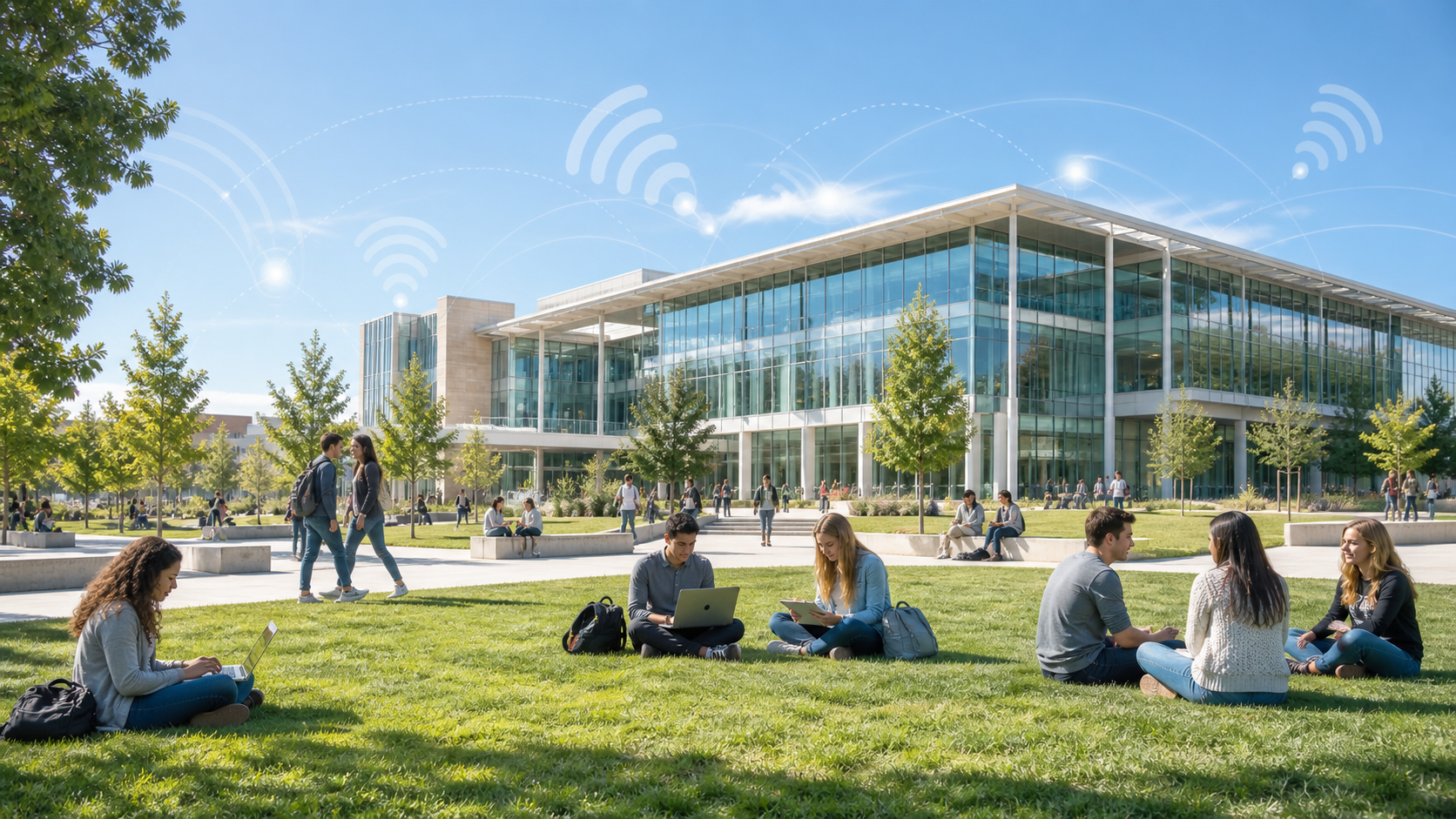
Education networks are being stretched in two directions at once. Campuses are wiring more buildings, devices, and services than ever before, while hybrid and remote learning keeps connectivity demand high far beyond the classroom. For many schools, colleges, and universities — especially those in areas where fiber is slow to arrive or costly to extend — 5G Fixed Wireless Access (FWA) CPE has become the fastest, most flexible way to deliver reliable broadband across an entire campus and its surrounding community.
For telecom operators, integrators, and education technology providers, the education sector is a growing and repeatable market for carrier-grade 5G CPE, where rapid deployment and predictable performance matter more than one-off installations.
Why schools and universities are turning to 5G FWA
Educational institutions face a unique mix of connectivity pressures that wired networks alone struggle to solve:
- Distributed campuses: many institutions span multiple buildings, annexes, temporary classrooms, and off-site facilities that fall outside the core fiber footprint.
- Budget pressure: the cost of trenching fiber to every building can be prohibitive, especially for smaller and rural districts.
- Seasonal demand spikes: enrollment, testing windows, and events drive sudden surges in network load.
- Digital equity goals: schools increasingly serve as community connectivity hubs, extending service to students and families beyond the campus boundary.
What a connected campus actually runs on
A modern campus network supports far more than a few computer labs. The applications demanding bandwidth and uptime include:
- Learning-management systems: cloud-hosted coursework, video lectures, and assessments that must be available to every student.
- Connected classrooms: interactive displays, cameras, and collaboration tools that rely on low-latency, high-capacity links.
- Administrative systems: student records, scheduling, finance, and security systems that require constant availability.
- Campus safety: surveillance, access control, and emergency notification that cannot tolerate downtime.
- Remote and hybrid learning: video conferencing and digital resources delivered to students learning from home or satellite sites.
Standing up campus connectivity in days, not semesters
The defining advantage of 5G FWA CPE in education is time-to-service. A building or temporary classroom can be online within days, without waiting for a fiber build-out. Common deployment patterns include:
- Building-to-building backhaul: a CPE on each building feeds a local switch and Wi-Fi access points, extending the campus LAN wirelessly.
- Temporary and portable classrooms: instant connectivity for relocatable units, event spaces, and field facilities.
- Community Wi-Fi and digital equity: a campus-edge CPE that serves nearby students and families who lack home broadband.
- Failover for the core network: cellular provides a resilient secondary path when the primary campus link degrades.
Key evaluation criteria for education CPE
- Capacity and multi-user throughput: enough sustained bandwidth for dozens of simultaneous video sessions and cloud applications.
- Reliability and uptime: carrier-grade hardware with redundant power and failover options for always-on campus services.
- External antenna support: directional antennas to reach distant cell sites, often critical for rural and sprawling campuses.
- Centralized management: cloud or ACS control so IT teams can monitor and update CPE across many buildings from one console.
- Security and segmentation: VLAN support and VPN to separate student, staff, and administrative traffic.
FAQ
Can 5G FWA support a full campus network?
Yes. With proper site surveys and external antennas, 5G FWA CPE can serve as primary backhaul for individual buildings or temporary classrooms, and as a resilient failover for the core campus link.
How do schools extend connectivity to students without home broadband?
By placing campus-edge CPE units that broadcast managed Wi-Fi to nearby areas, schools can serve as community connectivity hubs and close the homework gap for students and families.
Is 5G FWA cost-effective for smaller districts?
Frequently, yes. Deploying 5G FWA avoids the high upfront cost of trenching fiber to every building, and the same CPE can be recovered and redeployed as needs change.
What keeps campus safety systems online during an outage?
Dual-WAN configurations that pair the 5G link with a second carrier or wired fallback, plus battery backup, keep surveillance, access control, and emergency systems operational.
Get started
Honlly Telecom supplies carrier-grade 5G FWA CPE and wireless routers engineered for fast, resilient education and campus connectivity. Contact our team to discuss connectivity for your schools, colleges, and university deployments.