
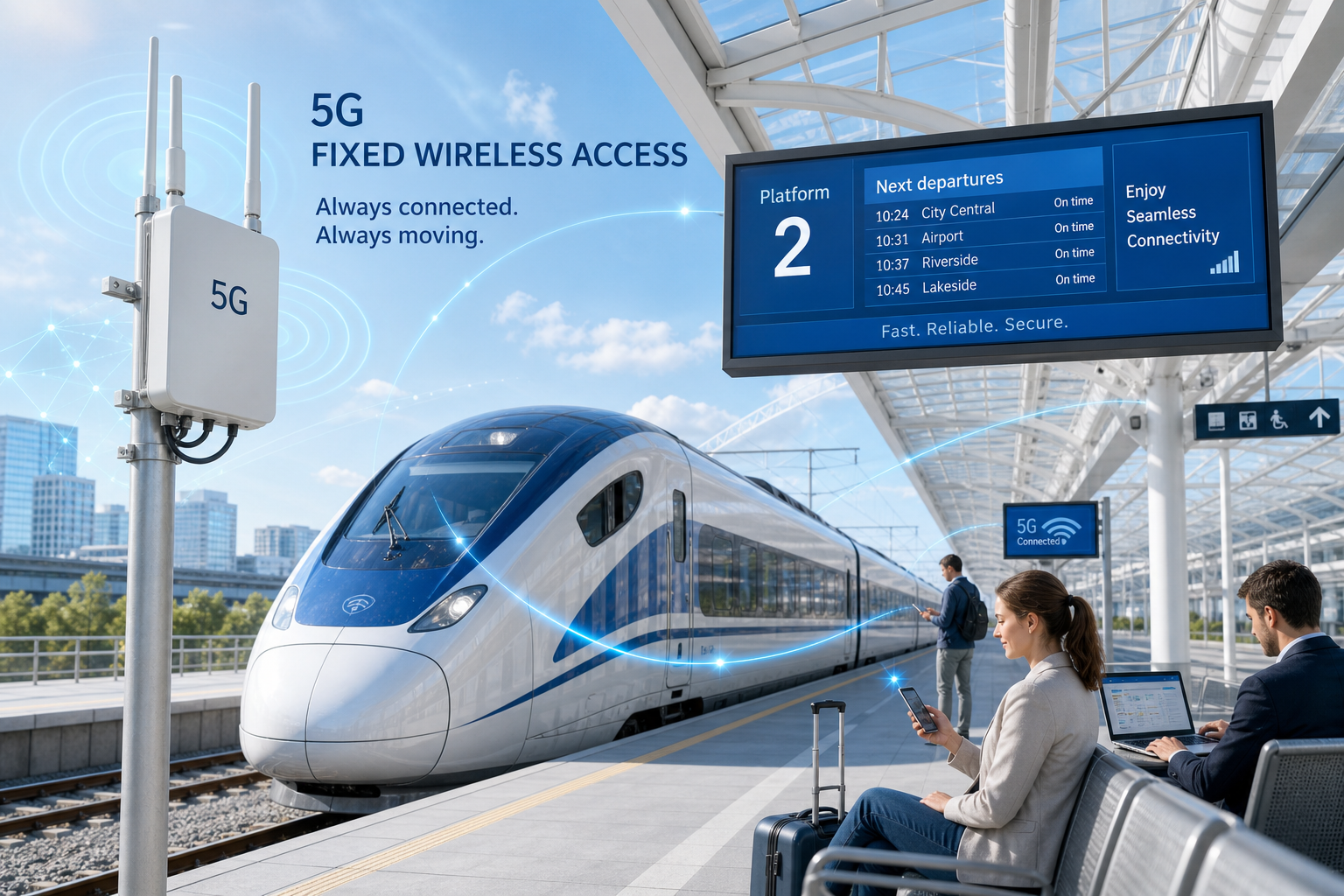
Railways were among the first industries to be transformed by wireless communications — from trackside signaling to voice dispatch — yet many networks still rely on narrowband radios and fragmented legacy systems. In 2026, rail and transit operators are turning to 5G fixed wireless access (FWA) CPE as a unifying connectivity layer that supports trackside backhaul, onboard passenger Wi-Fi, and connected train telemetry on a single managed platform.
Why Railways Are Moving to 5G FWA CPE
The rail environment poses connectivity challenges that few other industries face. Trains move at high speed across long, thin corridors that cross urban, suburban, and rural terrain, with frequent tunnels, cuttings, and electromagnetic interference from traction power. CPE devices must also withstand vibration, temperature extremes, and continuous operation.
5G FWA CPE addresses these challenges by delivering carrier-grade throughput and low latency along a fixed route, while supporting the ruggedized, outdoor form factors that trackside and onboard deployments require. For operators, the result is a single technology that can serve signaling-adjacent data, security video, passenger services, and maintenance telemetry.
Trackside Backhaul and Lineside Infrastructure
Along the track, a growing number of sensors and devices need backhaul: points and signals monitors, level-crossing cameras, hot-box and wheel-condition detectors, and weather stations. Many of these are located where fiber is impractical to trench, making cellular backhaul the most economical option.
Trackside 5G CPE with outdoor-rated enclosures and high-gain external antennas lets operators place a connection point exactly where it is needed, backhauling camera and sensor data to a central operations center. Dual-SIM failover across carriers reduces the risk of a coverage gap on a critical lineside asset.
Onboard Passenger Wi-Fi and Connectivity
Passenger expectations have risen sharply. Commuters and long-distance travelers alike expect reliable Wi-Fi for work, streaming, and messaging throughout a journey. Onboard connectivity requires a mobile gateway that aggregates one or more cellular links and distributes them over onboard Wi-Fi — while handing off cleanly between cells as the train moves.
Modern onboard CPE solutions support multi-carrier aggregation, seamless roaming, and traffic shaping that prioritizes operational systems over passenger entertainment. Because the device travels with the vehicle, it must also tolerate vibration, wide temperature swings, and the electrical noise of a rail carriage, while drawing from the vehicle’s power system.
Connected Train Telemetry and Predictive Maintenance
Beyond passenger services, operators are instrumenting rolling stock with sensors for doors, brakes, HVAC, and wheel bearings. This telemetry supports condition-based and predictive maintenance, reducing failures and improving fleet availability. The data must be offloaded reliably — often while the train is in motion and sometimes in tunnels.
CPE devices that buffer data during coverage gaps and upload when the connection returns ensure that telemetry is not lost. Secure VPN tunnels protect operational data in transit, and centralized remote management lets operators update firmware and configuration across an entire fleet without depot visits.
What This Means for Rail Procurement Teams
For rail operators, the move to 5G FWA CPE is as much about consolidation as about performance. A single class of ruggedized, remotely managed device can replace multiple legacy systems, simplifying procurement, sparing, and maintenance. Procurement teams should evaluate devices against the full journey — from trackside poles to moving carriages — with emphasis on environmental ratings, multi-carrier support, and centralized management rather than raw speed alone.
As railways digitize operations and raise passenger-service standards, connectivity is becoming a strategic asset. Operators that standardize on flexible, carrier-grade 5G CPE will be better positioned to roll out new services — from real-time passenger information to full onboard media — without repeatedly rebuilding their network edge.
FAQ
What is 5G FWA CPE used for in railways?
It provides cellular connectivity for trackside backhaul, onboard passenger Wi-Fi, connected train telemetry, lineside cameras, and maintenance systems over a single managed platform.
Why use cellular backhaul instead of fiber along the track?
Fiber is expensive or impractical to trench across long, remote, or densely built rail corridors. 5G FWA CPE offers economical, fast-to-deploy backhaul for lineside sensors and cameras.
Can onboard CPE maintain connectivity while a train is moving?
Yes. Onboard mobile gateways aggregate one or more cellular links and hand off between cells as the train moves, with buffering during tunnels and coverage gaps.
What should rail buyers look for in 5G CPE?
Prioritize ruggedized, outdoor-rated enclosures, wide temperature range, multi-carrier and dual-SIM support, secure VPN, remote management, and vibration tolerance for onboard use.
Partner with Honlly for Carrier-Grade 5G CPE
Honlly Telecom designs and manufactures industrial and carrier-grade 4G/5G wireless routers, outdoor CPE, and MiFi devices for ISPs, operators, MVNOs, system integrators, and enterprise buyers worldwide. We support OEM/ODM programs, custom firmware, and regional band certification to match your deployment requirements. Contact our team to discuss your next fixed wireless project.