
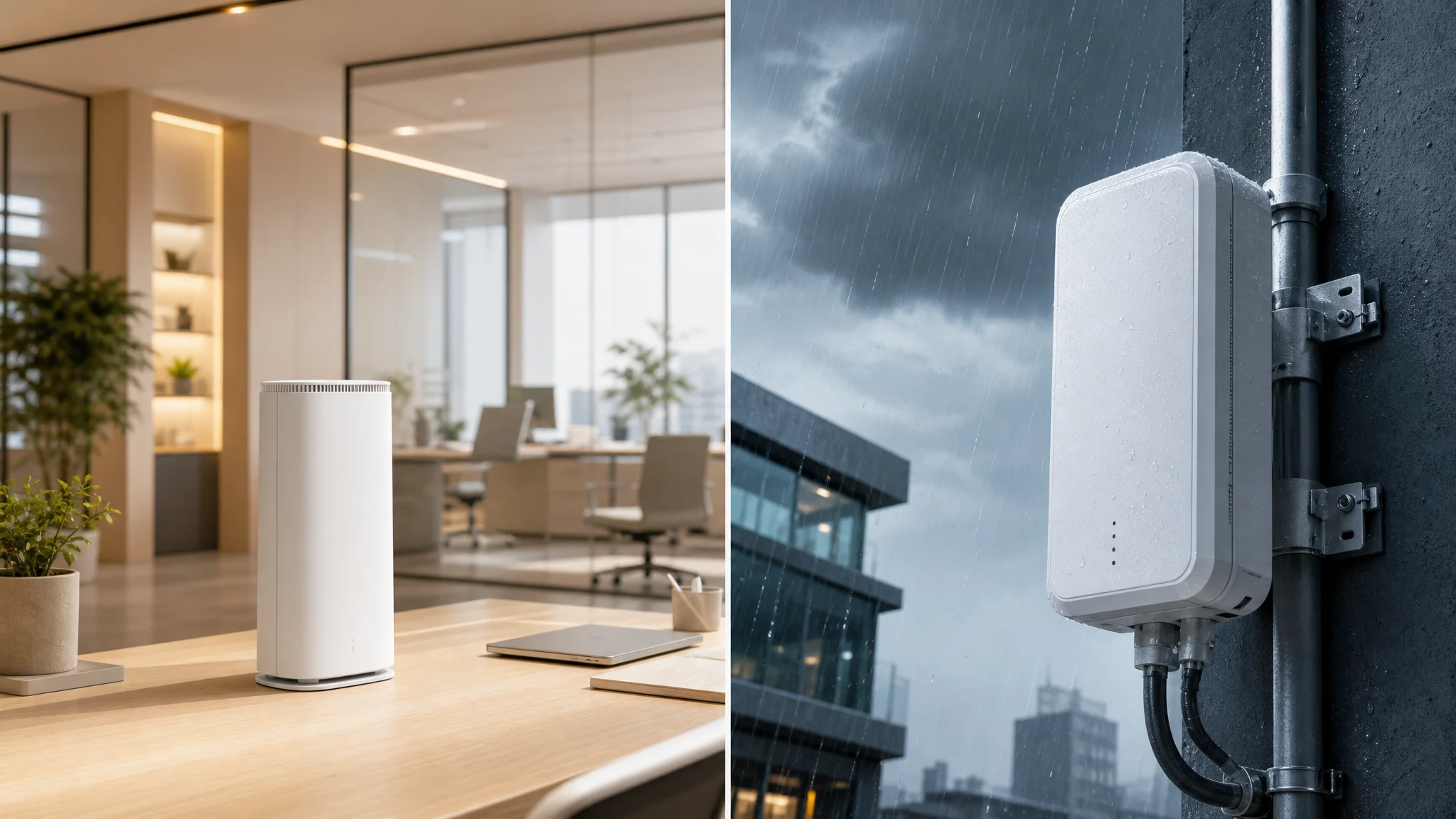
Every ISP or telecom operator launching 5G Fixed Wireless Access faces the same early architectural question: should we deploy outdoor CPE, indoor CPE, or a mix of both? The answer is never universal — it depends on spectrum band, cell density, building construction materials, target subscriber density, and the operators installation cost model. This guide provides a detailed technical comparison to inform a data-driven deployment strategy.
The Fundamental Trade-Off
At the architectural level, the outdoor-vs-indoor CPE decision is a trade-off between RF performance and deployment simplicity:
- Outdoor CPE: Maximizes signal reception by placing the antenna outside the building envelope, eliminating penetration loss through walls, low-E glass, and reinforced concrete. The trade-off: professional installation is nearly always required, adding $150–$400 per site in labor and mounting hardware.
- Indoor CPE: Minimizes deployment friction — the subscriber can self-install in minutes by placing the unit near a window. The trade-off: signal loss from building penetration, suboptimal antenna placement, and interference from indoor RF noise sources (Wi-Fi, Bluetooth, microwave ovens).
The operators achieving the best FWA economics do not choose one or the other — they develop a tiered deployment matrix based on RF planning data.
Signal Performance: Quantifying the Gap
Building Penetration Loss
The RF penalty for indoor placement is significant and highly variable. Measured at 3.5 GHz (n78), typical building penetration losses are:
- Wood-frame construction with standard glass: 8–12 dB
- Brick or concrete block with standard glass: 15–22 dB
- Low-E coated glass (common in modern buildings): 25–35 dB
- Reinforced concrete with metal-framed windows: 30–40+ dB
A 20 dB penetration loss effectively reduces the usable cell radius by 40–60%, depending on the propagation model. For an operator deploying on 3.5 GHz with inter-site distances of 800–1200 meters, this is the difference between serving 80% of homes in a cell versus 40%.
Antenna Gain Comparison
Modern outdoor CPE units achieve 10–14 dBi of directional gain through phased-array or high-gain panel antenna designs. Indoor CPE units, constrained by form factor and the need for omnidirectional coverage, typically deliver 3–5 dBi per antenna element in a 4×4 MIMO configuration. The net advantage — combining penetration loss avoidance and higher antenna gain — can exceed 20–30 dB in challenging deployment scenarios. That margin frequently determines whether a subscriber receives 100 Mbps or 10 Mbps.
Installation and Operational Considerations
Outdoor CPE Installation
Outdoor CPE requires a trained technician visit for mounting, cable routing, grounding (essential for lightning protection), and alignment toward the serving gNodeB. The process typically takes 60–90 minutes per site. Key installation requirements:
- Mounting: Wall bracket or pole mount at 3–6 meters above ground. Must be structurally secure and compliant with local building codes.
- Cabling: Outdoor-rated Cat6A or Cat7 Ethernet cable for PoE power and data backhaul to the indoor router/switch. Cable runs of up to 100 meters are possible with 802.3bt (Type 4, 60W) PoE injectors.
- Grounding: Per IEC 62305 and local electrical codes. The outdoor unit, Ethernet surge protector, and PoE injector must all be properly bonded to the buildings earth ground.
- Alignment: Using the CPEs onboard signal strength indicator (LED or mobile app RSSI readout), the technician aligns the directional antenna to maximize SINR, not just RSSI. This 5–10 minute step has an outsized impact on long-term throughput stability.
Indoor CPE Installation
Indoor CPE is designed for subscriber self-installation. The unit is placed near a window facing the general direction of the cell site, plugged into mains power, and connected to the home network via Ethernet or Wi-Fi. Setup typically takes under 10 minutes. However, self-install success rates vary significantly: operators report 15–25% of indoor self-installs require a technician follow-up due to poor placement, leading to borderline signal quality and higher churn risk.
Weatherproofing and Environmental Durability
Outdoor CPE must withstand years of exposure to sun, rain, snow, dust, and temperature extremes. The minimum acceptable ingress protection rating for outdoor CPE is IP67 (dust-tight and protected against temporary immersion). Many carrier-grade units go further with IP68. Key environmental specifications to verify:
- Operating temperature: –40°C to +60°C (outdoor), 0°C to +45°C (indoor)
- UV resistance: Enclosure material should be UV-stabilized (UL 746C f1 rating for outdoor use)
- Wind loading: Specified survival wind speed (typically 200+ km/h for pole-mounted units)
- Salt fog / corrosion: Per IEC 60068-2-52 for coastal deployments
Indoor CPE has significantly relaxed environmental requirements, which contributes to its lower unit cost. However, operators should still verify that indoor units meet relevant safety standards (IEC 62368-1) and do not exceed acceptable surface temperatures under sustained load.
Power over Ethernet (PoE) Architecture
Outdoor CPE is almost exclusively PoE-powered, eliminating the need for mains power at the mounting location. The current standard is IEEE 802.3bt (PoE++, Type 4) delivering up to 60W at the PSE (Power Sourcing Equipment), with 51W available at the PD (Powered Device) after cable losses. This is sufficient for outdoor CPE with active beamforming arrays, onboard GPS/GNSS, and a companion 2.5GbE switch.
For operators, the PoE architecture creates an additional deployment consideration: the indoor PoE injector or PoE switch becomes a single point of failure for the entire CPE link. Operators should budget for PoE injector replacements at a rate of 1–2% annually, and consider managed PoE switches with SNMP monitoring for remote power-cycle capability.
Spectrum Band Considerations
The outdoor-vs-indoor decision is heavily influenced by the spectrum band used for FWA:
- Sub-1 GHz (n5, n8, n28): Excellent propagation and building penetration. Indoor CPE performs well in most environments. Outdoor CPE may be unnecessary except in the most challenging locations.
- Mid-band 3.5 GHz (n77, n78): The most common FWA band globally. Building penetration loss is meaningful — outdoor CPE should be planned for 40–60% of subscribers, varying by building stock.
- mmWave (n257, n258, n260, n261): Near-zero building penetration. Outdoor CPE with line-of-sight to the gNodeB is effectively mandatory. Indoor mmWave CPE is only viable with specialized window-mounted units incorporating external antenna passthrough.
- C-band / 4.7 GHz (n79): Similar penetration characteristics to 3.5 GHz but with slightly higher loss. Outdoor CPE penetration in the deployment mix should be 5–10% higher than for 3.5 GHz deployments.
Total Cost of Ownership Comparison
Comparing CPE unit prices in isolation is a common procurement mistake. A realistic 36-month TCO comparison for a mid-scale deployment (5,000 subscribers) looks approximately like this:
| Cost Component | Outdoor CPE | Indoor CPE |
|---|---|---|
| CPE unit cost (volume pricing) | $180–$320 | $90–$180 |
| Installation labor + hardware | $150–$400 | $0 (self-install) |
| Annual failure rate | 1.5–3% | 3–6% |
| Truck roll cost per incident | $80–$150 | $80–$150 |
| Subscriber churn risk (annual) | 8–12% | 15–25% |
| Estimated 36-month TCO/sub | $450–$700 | $380–$620 |
Counterintuitively, the higher upfront cost of outdoor CPE is often justified by lower churn and fewer support calls. Operators that deploy outdoor CPE in medium-to-weak signal areas while using indoor CPE in strong-signal zones consistently report better unit economics than those using a single CPE type across the entire footprint.
Recommendations: Building a Tiered Deployment Strategy
Based on field data from multiple operator deployments, we recommend the following tiered approach:
- Strong-signal zones (RSRP > –95 dBm): Indoor CPE with self-install. 30–50% of subscriber base typically falls here in urban/suburban deployments on mid-band spectrum.
- Moderate-signal zones (RSRP –95 to –110 dBm): Outdoor CPE with professional install. 35–50% of subscriber base. This is where outdoor CPE delivers the strongest ROI: converting marginal-signal locations into reliable service addresses.
- Weak-signal zones (RSRP –110 to –120 dBm): High-gain outdoor CPE with precise alignment, possibly supplemented by external high-gain antennas. 10–15% of subscriber base. These locations should be carefully vetted during the site survey to avoid chronic support issues.
- No-service zones (RSRP < –120 dBm): Do not deploy. Prioritize these areas for future small-cell or infill site expansion.
The exact thresholds should be tuned based on your specific spectrum, gNodeB configuration, and target throughput SLA. The principle, however, is universal: match the CPE type to the RF environment, not the other way around.
Frequently Asked Questions
What is the main advantage of outdoor 5G CPE over indoor CPE?
Outdoor CPE avoids building penetration loss (8–40 dB depending on construction materials) and uses high-gain directional antennas (10–14 dBi vs 3–5 dBi for indoor units). The combined signal advantage can exceed 20–30 dB in challenging locations, which is often the difference between reliable service and no service.
Can subscribers self-install outdoor 5G CPE?
While technically possible for some wall-mounted units, professional installation is strongly recommended for outdoor CPE. Proper mounting, grounding (essential for lightning protection), cable routing, and antenna alignment require training and specialized tools. Operators that allow self-install of outdoor CPE typically see higher failure rates and support costs.
What PoE standard is required for outdoor 5G CPE?
Most current outdoor 5G CPE requires IEEE 802.3bt (PoE++, Type 4) delivering 60W at the power source. This provides sufficient power for the modem, active antenna array, onboard processing, and a companion Ethernet switch. Verify the specific power budget with your CPE supplier before committing to PoE infrastructure.
Does outdoor CPE work in extreme weather conditions?
Carrier-grade outdoor CPE with IP67 or IP68 rating is designed for –40°C to +60°C operating temperature, 200+ km/h wind survival, and salt-fog resistance for coastal deployments. Always verify the environmental specifications against your target deployment geography.
Which is more cost-effective: outdoor or indoor CPE?
The answer depends on the RF environment. Indoor CPE has a lower upfront unit cost but higher churn risk and more support calls in marginal-signal areas. Outdoor CPE costs more upfront but delivers lower churn and better throughput stability. Most operators achieve the best economics with a tiered strategy: indoor CPE in strong-signal zones, outdoor CPE in moderate and weak-signal zones.
Planning a 5G FWA deployment and need expert guidance on CPE selection? Honlly Telecom provides both indoor and outdoor 5G CPE solutions with OEM/ODM customization for operators worldwide. Contact our engineering team for a consultation →
Compare Honlly indoor and outdoor 5G options
- HL-850UE 5G indoor router: indoor desktop connectivity with WiFi 6 AX1800.
- HL-6300R 5G outdoor CPE kit: an outdoor receiving unit paired with an indoor WiFi 6 router.
Review the linked model specifications and discuss the required network configuration before selection. These examples do not establish operator approval, mmWave support or guaranteed site performance.