
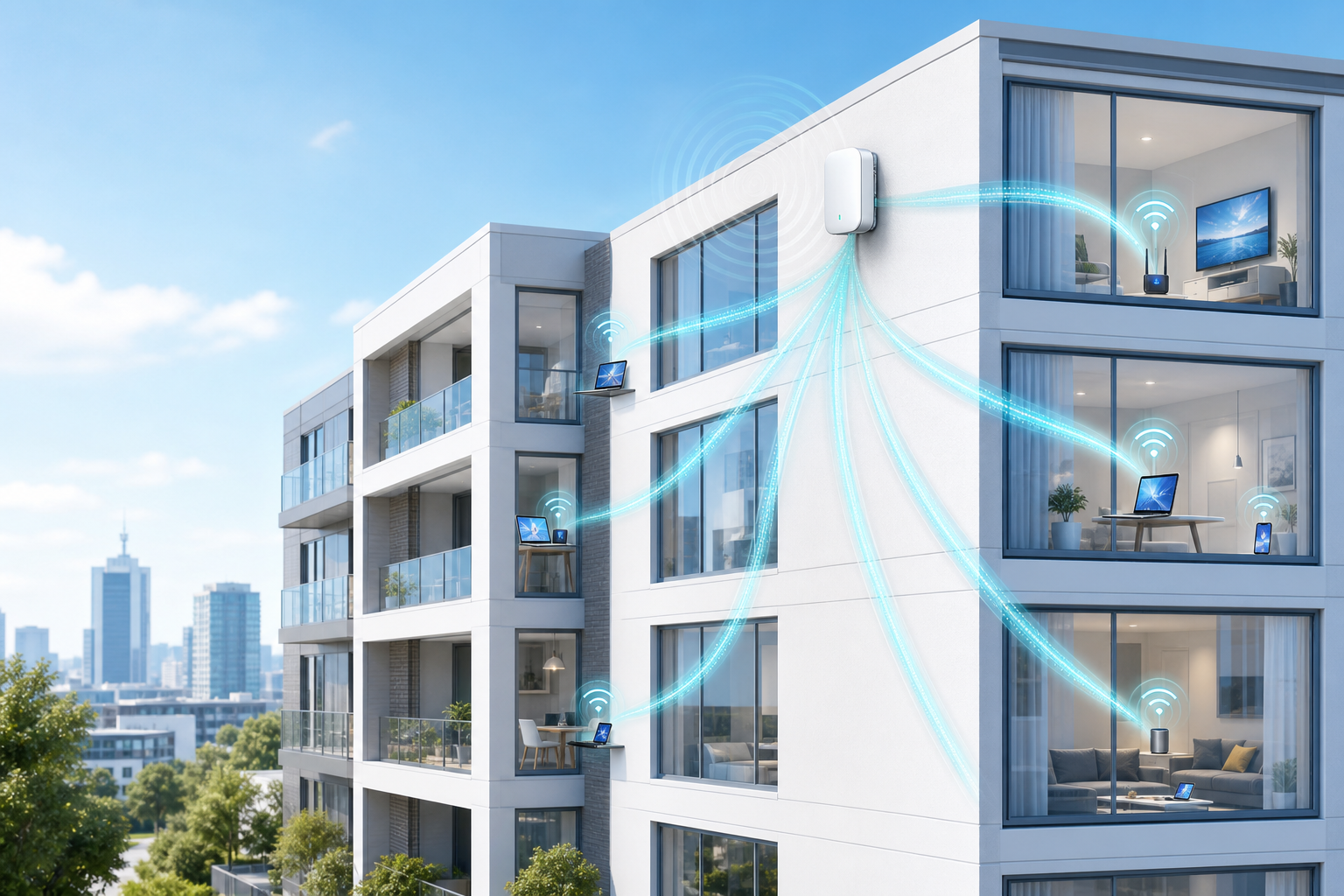
Across urban and suburban markets, multi-dwelling unit (MDU) owners and operators — from mid-rise apartment buildings and condominium associations to student housing and senior living communities — are adopting 5G Fixed Wireless Access (FWA) as a faster, more flexible path to tenant broadband. Rather than waiting on fiber builds, building owners are installing 5G FWA CPE at the point of entry and distributing service across existing in-building wiring or managed Wi-Fi.
For operators and property technology (PropTech) integrators, the appeal is straightforward: a single 5G CPE can deliver gigabit-class throughput in days, not months, while doubling as the connectivity backbone for smart building services such as access control, video intercom, energy monitoring, and common-area Wi-Fi.
Why MDUs are turning to fixed wireless
The traditional economics of wiring an MDU are unforgiving. Fiber overbuild requires wayleave agreements, riser space, drilling, and coordination with multiple stakeholders — often stretching timelines beyond a year. 5G FWA collapses that timeline by connecting a building to the nearest macro cell or small cell with no street-level trenching.
Three market forces are accelerating adoption in 2026:
- Tenant expectations: renters now screen buildings for fast, reliable internet before signing a lease, making broadband a retention and rent-premium lever.
- Operator capacity: mid-band and C-band spectrum rollouts have given operators the excess capacity needed to serve dense residential clusters profitably.
- Shorter ROI: a roof- or window-mounted CPE begins generating revenue almost immediately, versus multi-year fiber payback models.
Instant tenant broadband without the fiber wait
Modern 5G FWA CPE for MDUs typically supports carrier aggregation across multiple bands, gigabit Ethernet uplinks, and integrated dual-band Wi-Fi 6 or Wi-Fi 7. Building owners can deploy a managed model where the CPE feeds a property-wide network, then provide each unit with a VLAN-isolated connection for security and billing separation.
Key deployment patterns include:
- Point-of-entry (POE) CPE serving an entire building and feeding in-building switches or access points.
- Per-unit CPE for smaller buildings or retrofit scenarios where each dwelling gets its own device.
- Hybrid failover combining 5G FWA with a legacy DSL or cable link for business-continuity redundancy.
Smart building services riding the same CPE
The same 5G CPE that delivers tenant internet can backhaul a building’s operational technology. Integrators are using the fixed wireless uplink to connect IP cameras, smart access readers, elevator telemetry, energy sub-metering, and water-leak sensors without running a second circuit.
This convergence cuts the total cost of ownership for property owners, who no longer need separate connectivity contracts for tenant-facing and operations-facing systems. Features such as VLAN segmentation, QoS prioritization, and remote management (TR-069/TR-369) let a single device serve both networks securely.
What property owners and operators should look for
Not every CPE is suited to MDU duty. Buyers should evaluate devices against the demands of dense, always-on residential environments:
- Throughput headroom: aggregate bandwidth that can sustain dozens of concurrent HD streams and video calls during peak evening hours.
- Antenna performance: external or directional antenna support for buildings with weak signal or challenging positioning.
- Management at scale: cloud or ACS platforms that let operators provision, monitor, and troubleshoot hundreds of devices remotely.
- Security: hardware VPN, firewall, and segmented VLANs to isolate tenants and protect building systems.
- Environmental tolerance: wide temperature ranges for rooftop or riser-closet installations.
FAQ
Can one 5G CPE serve an entire apartment building?
Yes. A point-of-entry CPE with a gigabit Ethernet uplink can feed a property-wide switch and Wi-Fi network, serving many units. For larger buildings, multiple CPEs or a carrier-aggregated unit with higher throughput may be required.
How fast can 5G FWA broadband be deployed in an MDU?
In most cases, service can be live within days of site survey and installation, since no trenching or wayleave is required. Actual speed depends on signal quality, spectrum, and distance to the serving cell.
Is 5G FWA reliable enough for tenant broadband?
With proper site planning, external antennas, and a failover path, 5G FWA can meet typical residential service-level agreements. Operators increasingly offer dedicated business-grade plans with committed information rates for MDUs.
Can the same CPE support smart building IoT devices?
Yes. VLAN segmentation and QoS allow one CPE to backhaul both tenant traffic and operational technology such as cameras, access control, and energy meters on isolated networks.
Get started
Honlly Telecom supplies industrial-grade 5G FWA CPE and wireless routers engineered for MDU and multi-tenant deployments. Contact our team to discuss your building’s connectivity requirements and request a sample unit.