
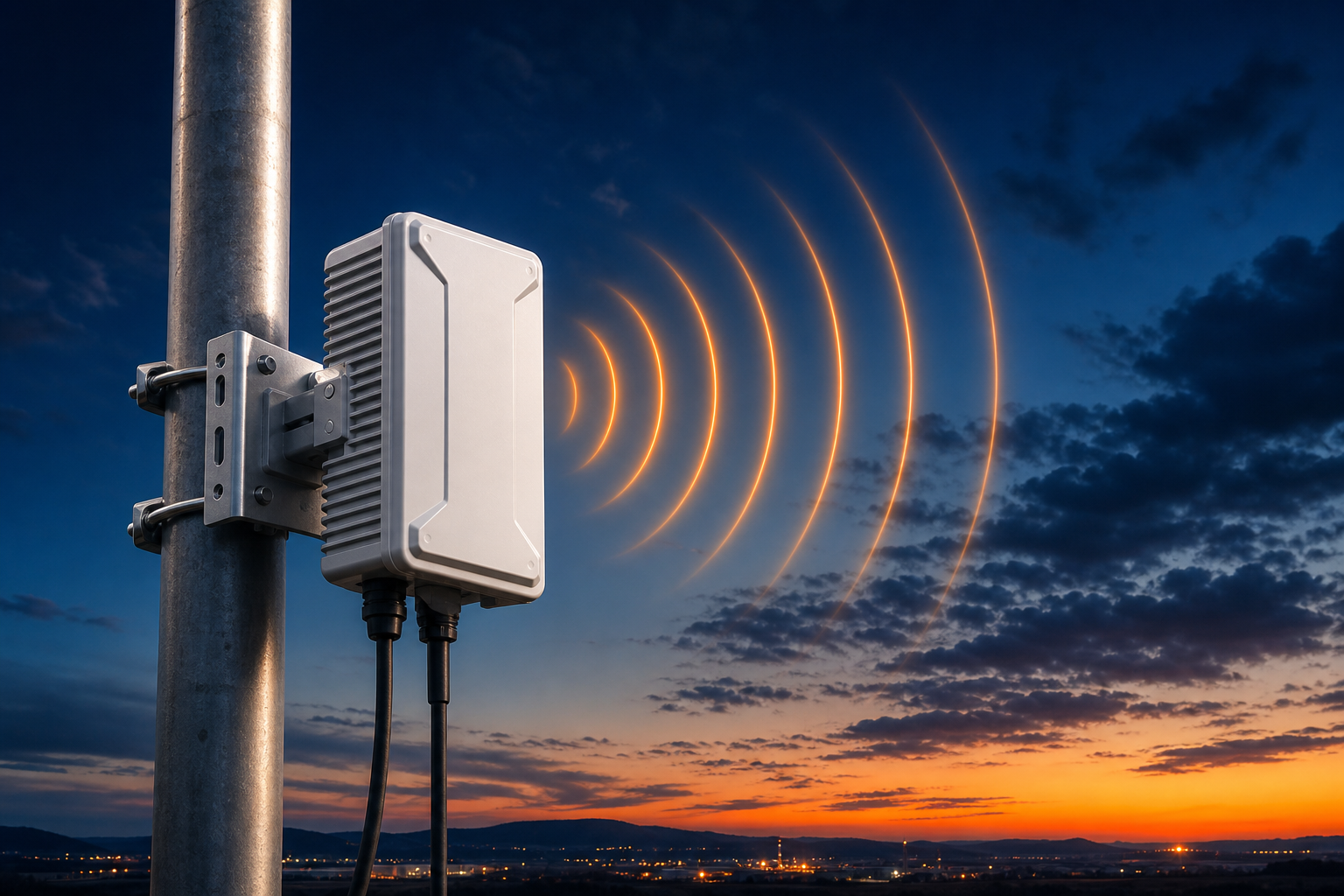
Antenna performance is the single most overlooked differentiator in 5G CPE procurement. While chipset specifications and software feature lists dominate RFQ responses, the physical antenna array—its element count, geometry, gain, polarization, and beamforming capability—determines whether a CPE delivers gigabit throughput at the cell edge or fails to maintain a stable connection two kilometers closer to the tower. This technical deep-dive examines the antenna technologies that separate carrier-grade 5G CPE from consumer-grade devices, providing telecom buyers with a structured framework for antenna specification evaluation.
Antenna Fundamentals: What Matters for 5G CPE
The move from 4G to 5G NR fundamentally changes antenna requirements. Where 4G LTE typically operates with 2×2 MIMO on a single frequency band below 3 GHz, 5G NR CPE must simultaneously support 4×4 MIMO across multiple Sub-6 GHz bands (n77, n78, n79, n41, n1, n3, n7, n28) and, for mmWave models, additional antenna arrays operating at 24-47 GHz. This multi-band, multi-antenna complexity makes antenna design one of the hardest engineering problems in CPE development.
Four antenna parameters directly determine real-world CPE throughput:
- Antenna gain (dBi): The concentration of radiated power in a specific direction. Higher gain improves signal-to-noise ratio (SNR) at the receiver but narrows the beamwidth, which can reduce robustness in multi-path environments. Indoor CPE typically targets 3-5 dBi per element; outdoor CPE units commonly achieve 8-12 dBi per element with directional antenna arrays.
- Antenna efficiency (%): The ratio of radiated power to input power. Poor efficiency—common in compact, cost-optimized CPE designs—directly translates to reduced throughput. Carrier-grade CPE should achieve antenna efficiency above 65% across all operating bands; efficiency below 50% indicates a design compromised for cost or aesthetics over RF performance.
- Isolation between elements (dB): The degree to which signals on one antenna element interfere with adjacent elements. Isolation below -10 dB causes significant MIMO performance degradation because the spatial streams become correlated. Quality CPE designs achieve -15 dB or better isolation between adjacent elements across all operating bands.
- Correlation coefficient: A mathematical measure of how independently antenna elements receive signals. Values below 0.3 (and ideally below 0.1) are required for effective MIMO spatial multiplexing. High correlation effectively reduces a 4×4 MIMO system to 2×2 or worse performance.
MIMO Configurations: 2×2 vs 4×4 and Beyond
MIMO (Multiple Input Multiple Output) technology is the foundation of modern cellular throughput. Each “layer” of MIMO adds an independent data stream between the base station and the CPE, multiplying throughput under favorable RF conditions. However, the practical benefits of higher MIMO orders depend heavily on deployment environment and antenna design quality.
| MIMO Configuration | Max Layers | Typical Use Case | Throughput Gain vs SISO |
|---|---|---|---|
| 2×2 MIMO | 2 | Entry-level FWA, 4G MiFi, portable hotspots | 1.7-1.9× (ideal) / 1.3-1.5× (urban) |
| 4×4 MIMO | 4 | Carrier-grade indoor CPE, outdoor FWA CPE | 2.5-3.5× (ideal) / 1.8-2.4× (urban) |
| 4×4 MIMO + CA | 4 per carrier | High-performance 5G FWA with multi-band CA | 5-8× (multi-band aggregation) |
The practical throughput multiplier of 4×4 MIMO over 2×2 in urban and suburban environments typically ranges from 1.4× to 1.8×—substantially less than the theoretical 2× improvement—due to spatial correlation between antenna elements in compact CPE enclosures. This gap between theory and reality makes antenna array design quality the dominant factor in MIMO performance, far more so than the modem chipset itself.
Beamforming: From Theory to CPE Implementation
Beamforming concentrates transmitted or received energy toward a specific direction rather than radiating omnidirectionally, improving SNR at the target receiver. In 5G NR, beamforming operates at both the base station (gNB) and CPE (UE) levels, with the CPE’s role becoming increasingly important as operators deploy higher frequency bands with greater path loss.
Types of Beamforming in 5G CPE
- Analog beamforming: Phase shifters adjust the phase of each antenna element’s signal before combining, creating a single beam. Simple, low-power, but supports only one beam direction at a time. Common in consumer-grade CPE with 4-8 antenna elements.
- Digital beamforming: Each antenna element has its own RF chain and ADC/DAC, enabling simultaneous multiple beams in different directions. This is the architecture used by carrier-grade outdoor CPE with 8-16 elements, supporting concurrent beam management with multiple gNB sectors.
- Hybrid beamforming: Combines analog sub-arrays with digital processing, balancing performance and power consumption. This architecture is becoming the mainstream approach for mid-to-high-tier 5G CPE, enabling 2-4 simultaneous beams without the power and cost of full digital beamforming.
For fixed wireless access deployments, beamforming performance directly impacts cell-edge throughput. Field measurements from a North American tier-1 operator’s 5G FWA deployment showed that CPE with hybrid beamforming (8-element array, 2 simultaneous beams) achieved 2.3× higher throughput at the cell edge compared to CPE with basic analog beamforming (4-element array), despite using the same Qualcomm X65 modem in both devices.
Antenna Selection Framework for CPE Procurement
When evaluating CPE antenna specifications in procurement RFPs, telecom buyers should require vendors to provide the following data for each CPE model under consideration:
- Per-band antenna gain and efficiency measurements from an accredited test laboratory (CTIA or equivalent), covering all bands the CPE supports. Vendor self-reported data without independent verification should be treated as indicative only.
- Envelope Correlation Coefficient (ECC) between each pair of antenna elements across all operating bands, measured in the intended deployment orientation (desktop, wall-mounted, or pole-mounted for outdoor units).
- Total Isotropic Sensitivity (TIS) and Total Radiated Power (TRP) measurements in both free-space and phantom-head configurations (for MiFi devices) or representative mounting scenarios (for fixed CPE).
- Beamforming gain patterns showing the 3D radiation pattern for each supported beam configuration, enabling operators to model coverage for specific deployment geometries.
- Field test data comparing throughput vs. RSRP (Reference Signal Received Power) curves for the CPE against reference antennas, collected from at least three distinct deployment environments (urban, suburban, rural).
Indoor vs Outdoor CPE Antenna Design Trade-offs
Indoor CPE antenna design must balance RF performance against industrial design constraints—size, appearance, and placement flexibility. Indoor units typically use PCB-embedded or stamped metal antennas with 3-5 dBi gain, accepting that building penetration loss (typically 10-20 dB depending on construction materials) will reduce link budget compared to outdoor installations.
Outdoor CPE, freed from aesthetic constraints and indoor placement limitations, can employ larger antenna arrays with higher gain (8-12 dBi), better isolation between elements, and weather-sealed radomes. The 10-20 dB link budget advantage of outdoor placement—combined with higher antenna gain—typically translates to 2-4× higher throughput at equivalent distances from the cell site, making outdoor CPE the preferred architecture for rural FWA and enterprise-grade deployments where performance and reliability take priority over installation simplicity.
A growing category of “window-mounted” or “semi-outdoor” CPE splits the difference, placing the antenna unit outside a window with a thin coaxial cable passing through the window seal to the indoor modem unit. This architecture captures most of the outdoor link budget advantage while simplifying installation—no drilling required—and is gaining traction in European multi-dwelling unit (MDU) FWA deployments.
Future Trends: AI-Driven Antenna Optimization
The next frontier in CPE antenna technology is AI-driven real-time optimization. Qualcomm’s latest modem platforms incorporate machine learning inference engines that continuously analyze channel state information and adjust antenna impedance matching, beam selection, and MIMO rank adaptation based on instantaneous RF conditions. Early field data suggests 15-25% throughput improvement in challenging multi-path environments compared to static antenna configurations. For telecom buyers, CPE platforms with AI-driven antenna management represent a meaningful differentiator in network edge performance, particularly in dense urban deployments where multi-path interference dominates link quality.
Frequently Asked Questions
Why does 4×4 MIMO not deliver 2× the throughput of 2×2 MIMO in real-world deployments?
The theoretical 2× throughput gain assumes perfectly uncorrelated antenna elements receiving independent spatial streams. In practice, the compact form factor of CPE devices creates spatial correlation between antenna elements—measured by the Envelope Correlation Coefficient (ECC)—which reduces MIMO multiplexing efficiency. Urban multi-path environments, while providing rich scattering for MIMO, also introduce interference that partially negates spatial multiplexing gains. Real-world 4×4 MIMO throughput improvement over 2×2 typically ranges from 1.4× to 1.8× in urban/suburban deployments, making antenna array design quality the critical performance factor.
How much link budget improvement does an outdoor CPE antenna provide compared to indoor placement?
Outdoor CPE antenna placement provides a 10-20 dB link budget advantage over indoor placement due to elimination of building penetration loss, combined with the ability to use higher-gain directional antenna arrays (8-12 dBi vs 3-5 dBi for indoor units). This translates to 2-4× higher throughput at equivalent distances from the cell site. For rural FWA deployments where cell sites may be 5-15 km distant, outdoor CPE with high-gain directional antennas is essential for achieving commercially viable service levels.
What antenna performance data should telecom buyers request from CPE vendors during procurement?
Buyers should request five categories of independently verified antenna data: (1) per-band gain and efficiency from a CTIA-accredited lab, (2) Envelope Correlation Coefficient (ECC) between all antenna element pairs, (3) Total Isotropic Sensitivity (TIS) and Total Radiated Power (TRP) in relevant deployment configurations, (4) 3D beamforming radiation patterns for all supported beam configurations, and (5) field-measured throughput vs. RSRP curves from at least three deployment environments (urban, suburban, rural). Vendor self-reported data without independent verification should be treated as indicative only.
Procuring carrier-grade 5G CPE with optimized antenna performance for your network deployment? Honlly Telecom designs and manufactures 4×4 MIMO 5G CPE with independently verified antenna performance across all global Sub-6 GHz and mmWave bands, supporting hybrid beamforming for maximum cell-edge throughput. Request antenna performance test data from our engineering team →