
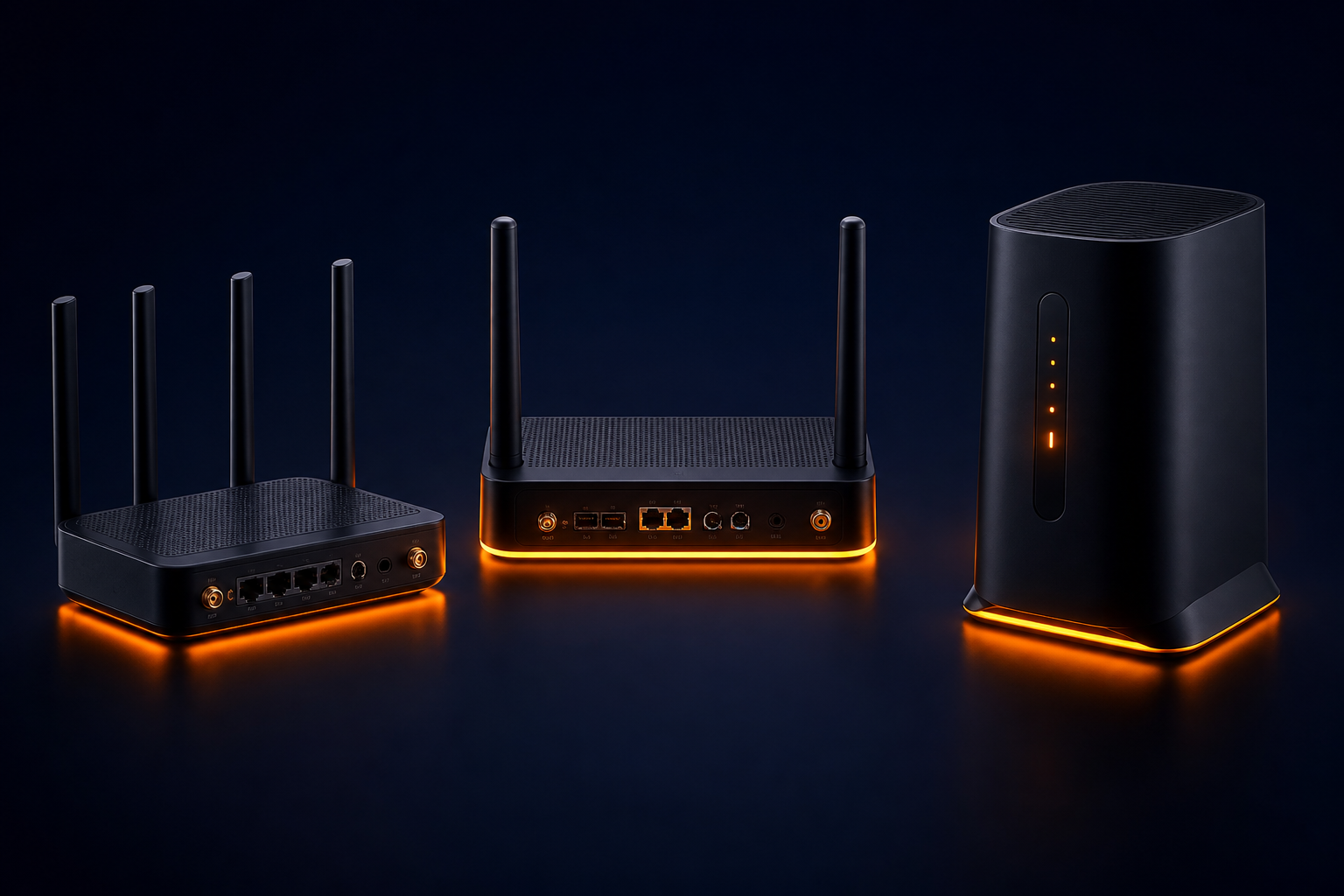
Enterprise IoT is not a single connectivity problem — it is a portfolio of connectivity problems, each with distinct requirements for throughput, latency, power consumption, coverage range, device density, and cost sensitivity. A smart meter in a basement, an HD surveillance camera on a highway gantry, an agricultural soil sensor in a rural field, and a factory AGV navigating a shop floor all require connectivity — but the optimal radio technology and CPE architecture for each differs fundamentally.
This guide provides a structured comparison of the four dominant IoT connectivity technologies — 4G LTE (Cat-1 through Cat-18), 5G NR (eMBB and RedCap), NB-IoT, and LoRaWAN — across the dimensions that matter most to system integrators and enterprise buyers selecting IoT gateways, routers, and endpoint CPE.
Technology Overview
4G LTE (Cat-1 to Cat-18)
LTE remains the workhorse of cellular IoT. The ecosystem spans ultra-low-power Cat-1bis (10 Mbps downlink, suitable for basic telemetry and POS terminals) through Cat-4 (150 Mbps, the standard for most enterprise IoT gateways) to Cat-18 (1.2 Gbps, used for video backhaul and high-bandwidth industrial applications). LTE’s advantage lies in its global coverage footprint — 3GPP reports over 800 commercial LTE networks worldwide — and a mature device ecosystem with aggressive per-unit pricing. For enterprise IoT gateways aggregating multiple sensor streams or requiring reliable VPN tunnel support, Cat-4 and Cat-6 LTE modules remain the pragmatic default choice in 2026.
5G NR (eMBB and RedCap)
5G NR enters enterprise IoT through two distinct paths. Enhanced Mobile Broadband (eMBB) CPE serves bandwidth-intensive applications: multi-camera video analytics, real-time digital twin synchronisation, and AR-assisted field maintenance requiring 100+ Mbps sustained throughput and sub-20ms latency. 5G RedCap (NR-Light), standardised in 3GPP Release 17, addresses the mid-tier IoT segment between eMBB and LPWA — delivering 150 Mbps downlink and 50 Mbps uplink at significantly lower modem cost and power consumption than full 5G eMBB. RedCap CPE is gaining traction for industrial IoT gateways, connected healthcare devices, and smart city infrastructure where LTE Cat-4 is becoming capacity-constrained in dense deployments.
NB-IoT (LTE Cat-NB1/NB2)
NB-IoT is the 3GPP LPWA standard designed for ultra-low-power, low-data-rate applications. With 200 kbps peak downlink, 20+ dB coverage extension beyond conventional LTE (enabling deep indoor and basement penetration), and a target module cost below $5, NB-IoT is optimised for smart meters, environmental sensors, parking sensors, and asset trackers that transmit kilobytes per day. NB-IoT CPE typically takes the form of data concentrators or aggregation gateways that collect data from multiple NB-IoT endpoints and backhaul it over LTE or wired WAN.
LoRaWAN
LoRaWAN operates in unlicensed sub-GHz spectrum (868 MHz in Europe, 915 MHz in North America), offering multi-kilometre range in rural environments and excellent building penetration at the cost of very low data rates (0.3–50 kbps) and duty-cycle limitations. As an unlicensed technology, LoRaWAN eliminates spectrum access costs but introduces reliability trade-offs in interference-heavy urban environments. LoRaWAN gateways serve as the bridge between endpoint devices and cloud application servers, typically backhauling over Ethernet, LTE, or Wi-Fi.
Comparative Analysis: Eight Dimensions
| Dimension | 4G LTE (Cat-4/6) | 5G NR (eMBB) | 5G RedCap | NB-IoT | LoRaWAN |
|---|---|---|---|---|---|
| Peak Throughput | 150–300 Mbps | 1–4 Gbps | 150 Mbps | 200 kbps | 0.3–50 kbps |
| Latency (RTT) | 15–30 ms | 5–15 ms | 10–20 ms | 1.5–10 s | 100 ms–2 s |
| Power Profile | 1–3 W (gateway) | 5–15 W (CPE) | 0.5–2 W | <0.1 W (endpoint) | <0.1 W (endpoint) |
| Range (Urban) | 1–3 km | 0.5–2 km (mid-band) | 1–3 km | 5–10 km | 2–5 km |
| Spectrum | Licensed (operator) | Licensed (operator) | Licensed (operator) | Licensed (operator) | Unlicensed (ISM) |
| Device Cost | $25–80 (module) | $80–200 (module) | $15–40 (module) | $3–8 (module) | $2–6 (module) |
| Device Density | ~2,000/km² | ~1,000,000/km² | ~100,000/km² | ~50,000/cell | ~10,000/gateway |
| Mobility | Excellent (seamless HO) | Excellent (seamless HO) | Good (limited HO) | Limited (cell reselection) | None (stationary) |
Application-to-Technology Mapping
Selecting the right connectivity technology starts with a clear understanding of the application profile:
Video Surveillance and Analytics
Recommended: 4G LTE Cat-6/12 or 5G NR CPE. Multi-camera deployments generating 5–50 Mbps sustained uplink require the capacity and reliability of licensed-spectrum cellular. LTE Cat-6 (300 Mbps) handles 4–8 HD camera streams cost-effectively; 5G NR CPE is warranted for 4K multi-camera analytics, especially where AI inference runs at the edge and low latency is critical for real-time alerting.
Smart Metering and Utility Infrastructure
Recommended: NB-IoT endpoints with LTE Cat-4 concentrator gateways. Smart electricity, water, and gas meters transmit small payloads (50–500 bytes) at intervals of 15 minutes to 24 hours. NB-IoT’s deep penetration, 10+ year battery life, and sub-$5 module cost are purpose-built for this profile. An LTE Cat-4 gateway serving as a neighbourhood data concentrator provides the WAN backhaul.
Industrial Automation and AGV/AMR
Recommended: 5G NR CPE (eMBB or URLLC-capable). Autonomous guided vehicles require sub-20ms command latency, seamless mobility across coverage zones, and real-time video uplink for safety functions. Wi-Fi handoff latency in multi-AP factory environments frequently exceeds 100ms — unacceptable for fast-moving AGVs. 5G NR CPE with URLLC support provides deterministic latency and seamless mobility that Wi-Fi cannot match.
Agriculture and Environmental Monitoring
Recommended: LoRaWAN for wide-area sensor networks; LTE Cat-1bis for gateway backhaul. Soil moisture sensors, weather stations, and livestock trackers spread across hundreds of hectares benefit from LoRaWAN’s multi-kilometre range and battery-operated endpoint economics. A solar-powered LoRaWAN gateway with LTE Cat-1bis backhaul provides the bridge to cloud analytics platforms.
Smart City and Public Infrastructure
Recommended: Hybrid 4G/5G gateways with NB-IoT and LoRaWAN concentrator capability. Smart city deployments — parking sensors, waste bin fill-level monitors, streetlight controllers, air quality sensors — mix ultra-low-power endpoints with medium-bandwidth video applications (traffic cameras, ANPR). A multi-radio CPE gateway supporting NB-IoT/LoRaWAN concentration plus LTE/5G WAN backhaul provides a unified connectivity architecture.
Total Cost of Ownership Comparison
Beyond per-unit hardware cost, enterprise IoT buyers must evaluate TCO over a typical 5–7 year deployment lifecycle:
- Cellular (LTE/5G/NB-IoT): Higher hardware unit cost, ongoing operator data plan fees ($1–15/month per device depending on data consumption), but zero gateway infrastructure cost (coverage provided by mobile operator). Best for geographically dispersed deployments without existing private network infrastructure.
- LoRaWAN: Lowest endpoint hardware cost, zero spectrum license fees, but requires customer-deployed gateway infrastructure ($200–800 per gateway covering 2–15 km radius). Best for dense sensor deployments within a defined geographic area where gateway deployment is feasible and interference is manageable.
Procurement Recommendations
- Start with the application profile, not the technology. Define throughput, latency, mobility, power, and density requirements before evaluating technology options.
- Plan for hybrid architectures. Most enterprise IoT deployments above 500 endpoints require at least two connectivity technologies. Select CPE gateways that support multiple radio types and protocol bridging.
- Evaluate 5G RedCap for mid-tier IoT refresh cycles. If your LTE Cat-4 gateways are approaching end-of-life in 2027–2028, RedCap offers a cost-effective migration path with 5G core network benefits (network slicing, enhanced security) at comparable module cost.
- Don’t overlook spectrum access. LoRaWAN’s unlicensed spectrum advantage can become a liability in interference-saturated urban or industrial environments. For mission-critical IoT, licensed-spectrum cellular technologies provide guaranteed quality of service that unlicensed alternatives cannot.
- Negotiate IoT-specific data plans. Major operators now offer IoT-optimised tariffs with shared data pools across thousands of devices and pricing as low as $0.50/month for NB-IoT connections. Standard M2M or smartphone data plans are significantly more expensive.
Frequently Asked Questions
Which IoT connectivity technology has the lowest total cost of ownership?
For deployments above 1,000 endpoints in a defined geographic area, LoRaWAN typically offers the lowest TCO due to zero spectrum fees and ultra-low endpoint module cost ($2–6), though it requires gateway infrastructure investment. For geographically dispersed deployments or mobile applications, NB-IoT on existing operator networks eliminates gateway CAPEX and delivers comparable endpoint economics at $3–8 per module plus low-cost IoT data plans.
Is 5G NR overkill for most IoT applications?
For many IoT applications — smart meters, environmental sensors, asset trackers — full 5G NR eMBB is indeed excessive. However, 5G RedCap (NR-Light) specifically addresses the mid-tier segment where LTE Cat-4 is appropriate today but will become capacity-constrained in dense environments. RedCap bridges the gap between LPWA and eMBB at attractive unit economics.
Can I mix multiple IoT technologies in a single CPE gateway?
Yes. Multi-radio IoT gateways combining LTE/5G WAN backhaul with NB-IoT and/or LoRaWAN concentrator functionality are increasingly available from specialist CPE manufacturers. These gateways serve as protocol bridges, aggregating data from diverse endpoint types and backhauling over a single cellular connection to the cloud platform.
What role does eSIM/eUICC play in IoT CPE deployments?
eSIM (eUICC) is particularly valuable for IoT deployments because it enables remote operator profile switching without physical SIM replacement — critical for devices deployed in inaccessible locations, multi-country logistics tracking, and operator redundancy for mission-critical applications. Most cellular IoT modules shipping in 2026 include integrated eSIM capability.
Does Honlly Telecom offer IoT gateway and CPE solutions?
Yes. Honlly Telecom manufactures a comprehensive range of IoT connectivity hardware including 4G LTE Cat-4/Cat-6 industrial gateways, 5G NR CPE for high-bandwidth IoT applications, multi-radio concentrator gateways with NB-IoT and LoRaWAN support, and custom IoT CPE solutions tailored to enterprise and system integrator requirements.
Planning an enterprise IoT connectivity deployment?
Contact Honlly Telecom to discuss your IoT gateway requirements, technology selection, and custom CPE development.
Discuss Your IoT Project →