
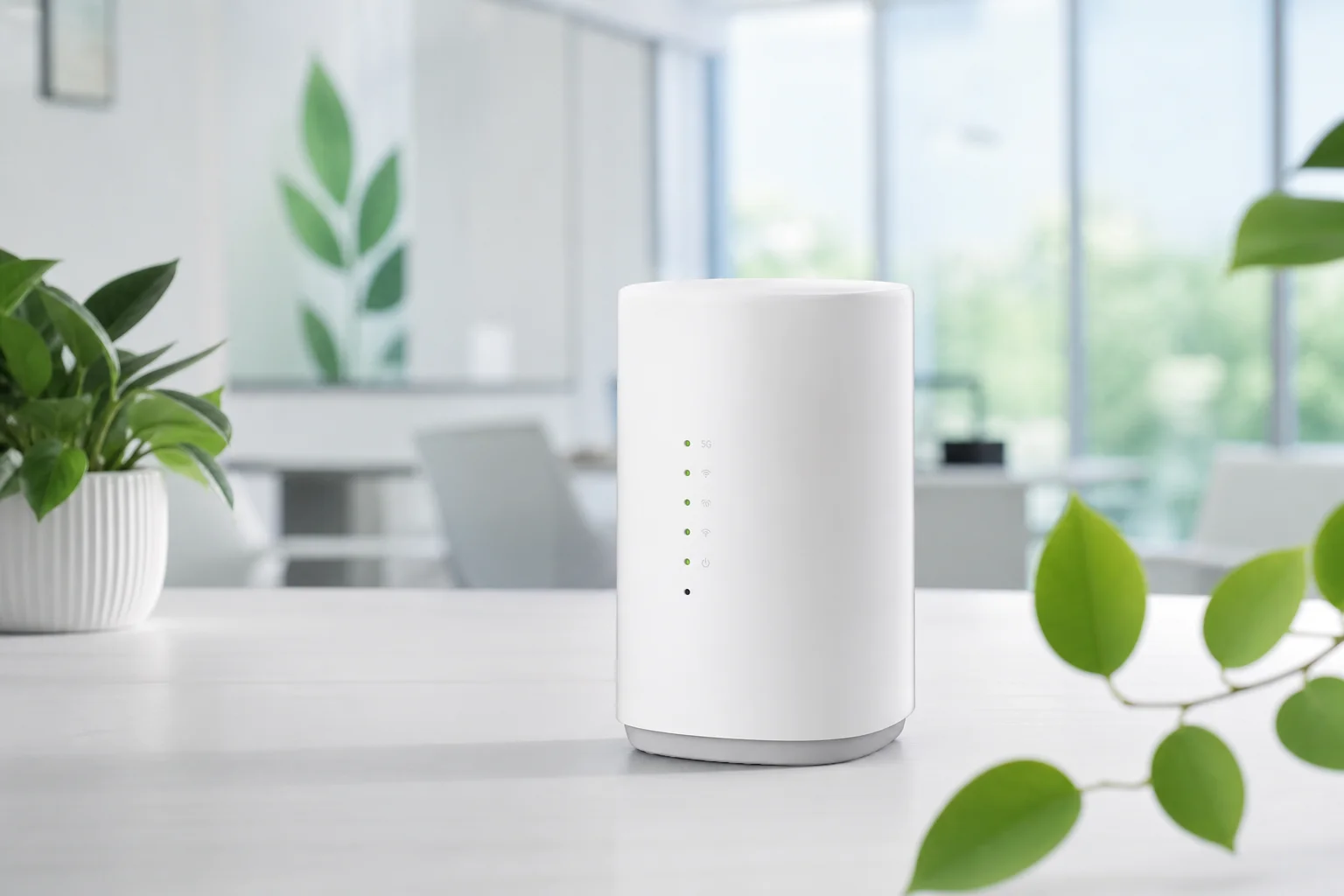
As global telecom operators scale their 5G Fixed Wireless Access (FWA) deployments, a new procurement criterion is rapidly moving from “nice-to-have” to mandatory: energy efficiency. With rising electricity costs, tightening environmental regulations, and corporate ESG commitments, the power consumption of customer premises equipment (CPE) has become a critical factor in operator RFPs worldwide.
The European Union’s updated Ecodesign Directive, effective from mid-2026, now sets maximum standby power limits for broadband equipment at 3 watts, with further reductions to 2 watts planned by 2028. Similar regulations are advancing in Japan, South Korea, and California. For CPE manufacturers, compliance is no longer optional — it is a market access requirement.
The Business Case for Green CPE
Operators deploying hundreds of thousands of CPE units face substantial cumulative energy costs. A 2-watt reduction per device across a 500,000-unit deployment saves approximately 8,760 MWh annually — translating to over $1.3 million in electricity savings at average industrial rates. For large-scale FWA rollouts in markets like India, Indonesia, and Nigeria, where operators are connecting millions of new subscribers, these savings directly impact EBITDA margins.
Beyond cost, green CPE aligns with operator ESG goals. Vodafone, Deutsche Telekom, and Telefónica have all committed to net-zero emissions targets that encompass their supply chains. CPE devices, which account for a significant share of operator Scope 3 emissions, are under increasing scrutiny from sustainability teams.
Chipset Innovation Driving Power Efficiency
The latest 5G chipset platforms are delivering dramatic improvements in power efficiency. Qualcomm’s X80 and X105 modems, built on 4nm process technology, achieve up to 40% lower power consumption compared to previous-generation 5G modems under typical FWA workloads. MediaTek’s T900 series similarly leverages advanced power gating and adaptive voltage scaling to minimize idle and active power draw.
Key technologies enabling greener CPE include:
- Advanced sleep modes: Deep sleep states that reduce power to under 1 watt during periods of low network activity while maintaining instant wake capability
- Dynamic power scaling: Real-time adjustment of CPU frequency, antenna chains, and RF front-end power based on traffic load
- Integrated SoC designs: Combining modem, application processor, and Wi-Fi into single-chip solutions to eliminate inter-chip communication overhead
- Wi-Fi 7 Target Wake Time (TWT): Scheduled communication windows that allow client devices to remain in low-power states longer
Regulatory Landscape and Certification
The EU Energy Label for broadband equipment, introduced in 2026, assigns A-to-G ratings based on power consumption, throughput efficiency (watts per Gbps), and recyclability. Operators in EU member states are increasingly specifying minimum B-rating or higher in their procurement documents.
In Asia-Pacific, Japan’s Top Runner Program sets progressively stricter efficiency benchmarks, while South Korea’s KEA energy efficiency labeling now covers 5G CPE devices. India’s Bureau of Energy Efficiency is consulting on mandatory standards for telecom equipment expected by 2027.
For CPE manufacturers targeting multiple markets, designing once for the strictest standard — typically the EU Ecodesign Directive — and certifying across jurisdictions is emerging as the most cost-effective compliance strategy.
What Operators Should Require in RFPs
Procurement teams evaluating 5G CPE in 2026 should include clear energy-efficiency requirements in RFPs:
- Standby power: Maximum 2.5W in idle state with Wi-Fi active
- Active efficiency: Minimum 0.5 Gbps per watt under typical traffic load
- Energy certifications: EU Energy Label B or higher, Energy Star, or equivalent
- Power supply efficiency: Level VI efficiency rating for external power adapters
- Eco-design features: Recyclable packaging, modular design for repair, minimum 3-year lifecycle
- Reporting capability: TR-369 USP telemetry for per-device power consumption monitoring
Honlly’s Green CPE Portfolio
At Honlly Telecom, we have invested significantly in power-optimized CPE designs across our 4G and 5G product lines. Our engineering team prioritizes energy efficiency at every stage — from component selection and PCB layout to firmware power management algorithms.
Our latest 5G CPE devices achieve sub-3W standby and deliver best-in-class Gbps-per-watt efficiency, exceeding EU Ecodesign 2026 requirements. We provide comprehensive energy certification documentation and support operator ESG reporting with TR-369 power telemetry integration.
For operators and distributors preparing for the green procurement transition, Honlly offers consulting, sample evaluation, and customized energy-efficiency optimization services. Contact our team to discuss your green CPE requirements.
Published: August 2, 2026