
For a telecom operator, ISP, or MVNO launching — or scaling — a 5G Fixed Wireless Access service, the CPE device is not a commodity. It is the primary touchpoint with the subscriber, the single largest hardware cost per connection, and the component most likely to generate support calls if it underperforms. A poor CPE decision can erase the margin on an otherwise well-engineered FWA deployment.
Yet many procurement teams rely on a narrow set of criteria — price per unit, peak throughput on a spec sheet, and perhaps a reference customer or two. This article presents a structured 15-point framework for evaluating 5G CPE suppliers, covering the full lifecycle: silicon selection, software maturity, manufacturing quality, and long-term partnership viability.
Part 1: Silicon & RF Performance (Points 1–4)
1. Chipset Platform Generation
Begin with the modem-RF platform. As of mid-2026, the baseline should be Qualcomm Snapdragon X75/X80 or MediaTek T830. These platforms support 5G-Advanced features including AI-enhanced beamforming, multi-carrier aggregation (up to 4CA on sub-6 GHz), and improved power efficiency. Suppliers still offering X65/X70-based designs are shipping hardware that is two generations behind — the performance gap in real-world deployments is measurable and growing.
Evaluation action: Request the exact modem model and firmware revision. Verify it against the chipset vendors current product roadmap. Ask whether the supplier has committed volumes with the chipset vendor — this affects both pricing and long-term availability.
2. Carrier Aggregation Combinations
A 5G CPE spec sheet may list “3CA” or “4CA” support, but the specific band combinations matter enormously. An operator deploying on n78 (3.5 GHz) with n28 (700 MHz) for uplink coverage needs the CPE to support that exact combination, not a theoretical maximum. Request the suppliers certified CA combination table — preferably with GCF/PTCRB validation — and cross-reference it against your planned spectrum holdings.
3. Antenna Architecture and Gain
The antenna system — not the modem — often limits real-world CPE performance. Evaluate:
- Indoor units: 4×4 MIMO with at least 3–4 dBi per element across operating bands. Look for polarization diversity, not just spatial diversity.
- Outdoor units: Directional or phased-array design delivering 10–14 dBi gain across the primary band. Ask for 3D radiation pattern plots, not just single-number gain figures.
- Self-install vs. professional install: If targeting the consumer self-install market, the antenna must be forgiving of suboptimal placement. Request chamber test data showing performance at ±30° misalignment from boresight.
4. 5G-Advanced Readiness
CPE deployed in 2026 will likely remain in the field for 3–5 years. During that time, operator networks will activate 3GPP Release 18 features including AI/ML-based CSI compression, multi-TRP coordination, and enhanced positioning. Confirm whether the suppliers CPE can support these features via field-upgradable firmware, or whether they require a hardware swap. Suppliers that have demonstrated OTA firmware upgrades in production networks should score higher.
Part 2: Software, Management & Interoperability (Points 5–8)
5. TR-369 USP Support
The Broadband Forums User Services Platform (USP, TR-369) is the successor to TR-069 and is now the expected device management protocol for greenfield FWA deployments. A CPE without a mature USP agent creates operational friction: manual provisioning, reactive troubleshooting, and inability to push configuration changes or firmware updates at scale.
Evaluation action: Ask for the suppliers USP Agent conformance test results (TP-469). Request a live demo of remote provisioning, parameter get/set, firmware upgrade, and factory reset via USP. Confirm support for the Device:2 data model with WiFi. and Cellular. objects fully populated.
6. Zero-Touch Provisioning (ZTP)
Can the CPE be dispatched directly from the manufacturer to the end subscriber without intermediate staging? ZTP requires the device to bootstrap securely, contact the operators ACS (Auto Configuration Server), and download its configuration automatically. Evaluate the suppliers ZTP flow end to end, including secure credential injection at the factory (SCEP/EST-based certificate enrollment, not hardcoded passwords).
7. Interoperability Testing History
A CPE that works perfectly in the lab can fail mysteriously on a live network due to subtle RAN implementation differences between Ericsson, Nokia, Samsung, and Huawei gNodeBs. The supplier should provide IOT (Interoperability Testing) reports from at least two major RAN vendors, ideally including results from your specific network equipment vendor.
8. IPv6 and Dual-Stack Readiness
Many enterprise and government RFPs now require full IPv6 support. The CPE must handle IPv6-only WAN (464XLAT/CLAT), dual-stack, and IPv4aaS transparently. Confirm DHCPv6-PD (Prefix Delegation) for downstream LAN, SLAAC, and DNS64/NAT64 support.
Part 3: Hardware Quality & Manufacturing (Points 9–12)
9. Thermal Design Validation
5G CPE, especially outdoor units in direct sunlight, must dissipate 15–25W of thermal load without throttling. Request the suppliers thermal chamber test report showing sustained throughput at 55°C and 65°C ambient. Look for evidence of heatsink design, airflow modeling (CFD simulation), and component derating analysis. A CPE that throttles at high temperature will generate disproportionate support calls in warm-climate deployments.
10. Manufacturing Capacity and Quality Certifications
Visit the factory if possible; if not, request documentation. Key certifications: ISO 9001 (quality management), ISO 14001 (environmental management), and ideally IATF 16949 if the supplier also serves automotive — this indicates a high maturity level in manufacturing process control. Ask about monthly production capacity, typical lead times, and surge capacity (can they double output within 60 days?).
11. Regulatory Compliance Portfolio
CPE must carry regional certifications: FCC (US), CE (EU), UKCA (UK), ANATEL (Brazil), IC (Canada), RCM (Australia), and others depending on target markets. A supplier that already holds certifications for your target regions can save 8–16 weeks and significant cost versus pursuing new certifications. Request a compliance matrix showing exactly which SKUs hold which certifications.
12. Supply Chain Transparency
Post-2023, supply chain resilience is a board-level concern. The CPE supplier should disclose their bill of materials (BOM) risk assessment: which components are single-source, which have qualified second sources, and what alternative components are pre-validated. Suppliers with deep relationships with Qualcomm and MediaTek, and with strategic buffer stock agreements, should be preferred.
Part 4: Commercial & Partnership (Points 13–15)
13. Total Cost of Ownership, Not Unit Price
A low unit price can be deceptive. Calculate TCO over a 36-month lifecycle including: CPE unit cost, shipping and logistics, installation labor (outdoor CPE installs cost 3–5× more than indoor), predicted failure rate × replacement cost, firmware maintenance fees, and technical support burden. A CPE with a 1% lower annual failure rate can save hundreds of thousands of dollars at scale, even at a higher unit price.
14. OEM/ODM Flexibility
Does the supplier offer white-label and custom branding options? Can they customize the industrial design, packaging, firmware UI, and default configuration for your operator brand? For larger deployments, operator-specific firmware builds with custom TR-069/USP data model extensions, branded WebUI, and pre-loaded APN settings reduce deployment friction significantly.
15. Long-Term Roadmap Alignment
The best CPE supplier relationship is a partnership, not a transaction. Evaluate whether the supplier has a published product roadmap covering the next 24–36 months. Does it align with your network evolution plans — for example, do they have a Wi-Fi 8 CPE on the roadmap, or a 3GPP Release 19-capable device planned? A supplier investing in continuous R&D is more likely to remain a viable partner through the deployment lifecycle.
Scorecard Approach
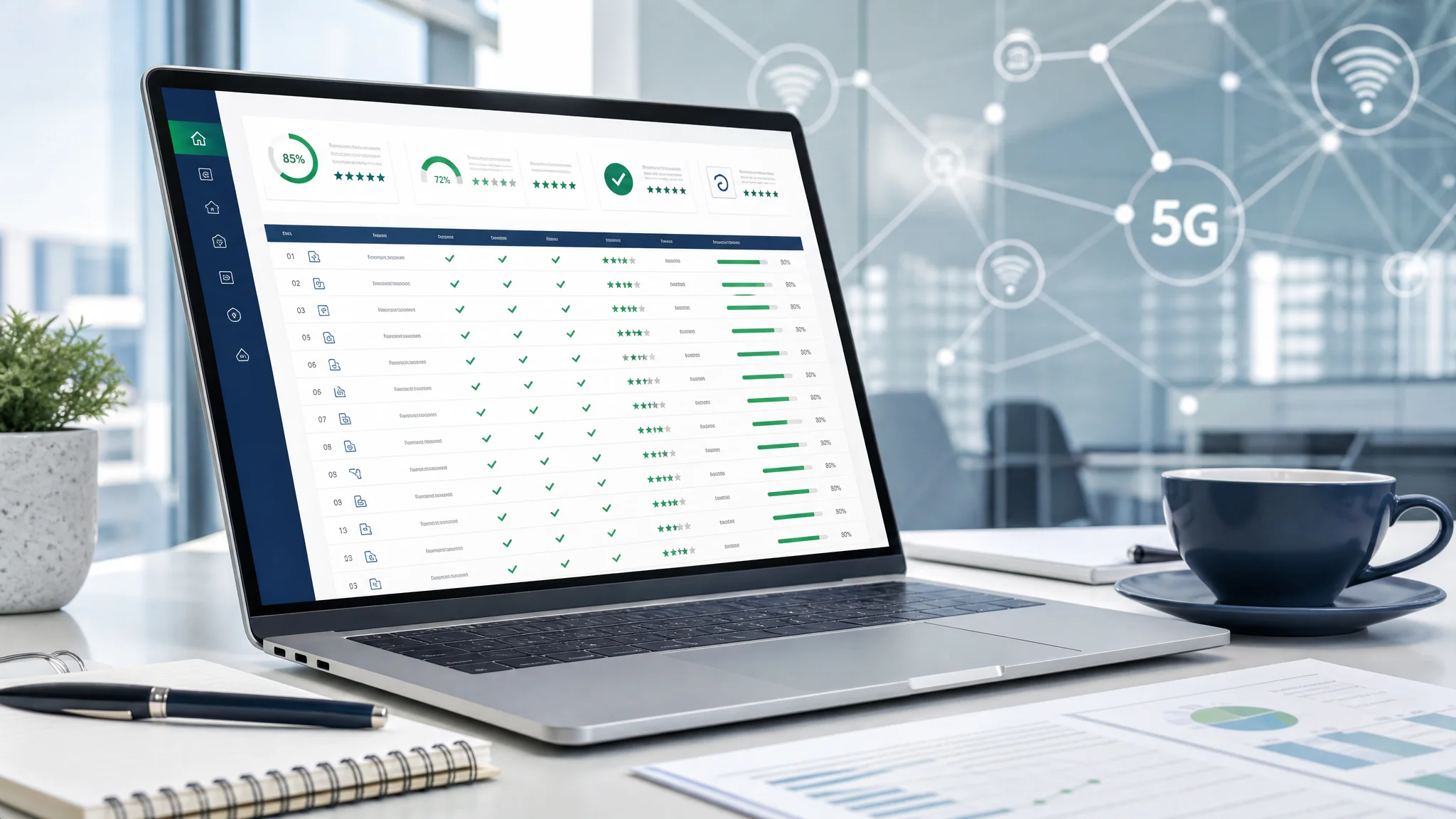
We recommend scoring each of the 15 points on a 0–3 scale (0 = unacceptable, 1 = below average, 2 = meets requirements, 3 = exceeds requirements), then weighting according to your specific deployment priorities. A minimum threshold of 30 out of 45 (weighted) is a reasonable starting filter before proceeding to lab testing and field trials.
The operators that invest disciplined evaluation effort upfront consistently report lower churn, fewer support calls, and better subscriber NPS than those that select CPE primarily on price. In a market moving toward 100 million FWA connections, CPE quality is not a cost center — it is a competitive moat.
Frequently Asked Questions
Which chipset should a 5G CPE use in 2026?
For new FWA deployments, Qualcomm Snapdragon X75/X80 and MediaTek T830 are the recommended baseline platforms. These support 5G-Advanced features including AI-enhanced beamforming, 4CA carrier aggregation, and improved power efficiency. Avoid X65/X70-based designs for new rollouts.
What is TR-369 USP and why is it critical for 5G CPE?
TR-369 (User Services Platform) is the Broadband Forums modern device management protocol, replacing the aging TR-069. It enables operators to remotely provision, monitor, troubleshoot, and upgrade CPE at scale with a secure, efficient architecture. For FWA deployments spanning thousands or tens of thousands of units, a mature USP agent is operationally essential.
How much does 5G CPE cost for operators?
Indoor 5G CPE typically ranges from $80–$200 per unit in operator volumes (1,000+ units), while outdoor CPE ranges from $150–$350 depending on antenna complexity and enclosure requirements. However, total cost of ownership — including installation, support, failure replacement, and firmware maintenance — should be the primary metric, not unit price alone.
What certifications should a 5G CPE have for global deployment?
Essential certifications include FCC (US), CE (EU), UKCA (UK), IC (Canada), ANATEL (Brazil), and RCM (Australia/NZ). Additional certifications may be required for specific markets — suppliers with a broad existing certification portfolio can reduce time-to-market by 8–16 weeks.
Should operators choose outdoor or indoor CPE for FWA?
Most successful FWA deployments use a mix: outdoor CPE with high-gain directional antennas in cell-edge and weak-signal locations, indoor CPE with omnidirectional antennas in strong-signal urban and suburban areas. The decision should be based on RF planning data, not a one-size-fits-all approach.
Evaluating 5G CPE suppliers for your next network deployment? Honlly Telecom offers carrier-grade 5G CPE, OEM/ODM manufacturing, and customized solutions for ISPs and operators worldwide. Speak with our solutions team →