
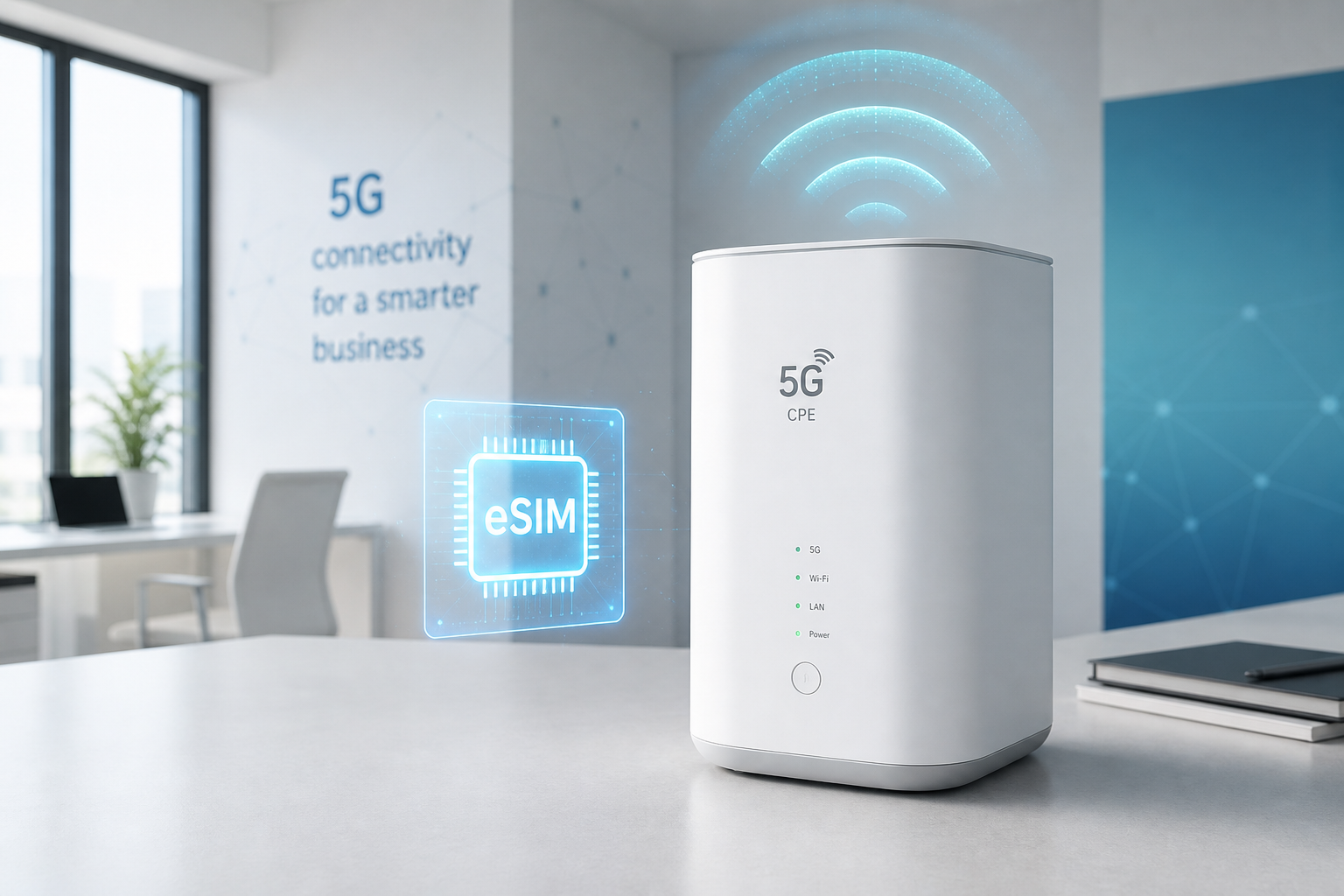
The global enterprise Fixed Wireless Access (FWA) market is projected to surpass $18 billion by 2027, with multinational deployments becoming the norm rather than the exception. Yet beneath the surface of this growth lies a persistent operational challenge that has plagued B2B CPE rollouts for years: physical SIM card management across borders, carriers, and regulatory domains.
Enter eSIM (embedded SIM) and iSIM (integrated SIM) technology. These two related but distinct standards are fundamentally reshaping how enterprises procure, deploy, and manage 5G CPE at global scale — eliminating a logistics bottleneck that has long been accepted as an unavoidable cost of doing business.
The Physical SIM Problem at Enterprise Scale
For B2B deployments spanning multiple countries, traditional physical SIM cards introduce a cascade of operational inefficiencies. A typical multinational retailer deploying 5G CPE across 500 locations in 12 countries must contend with at least 12 different carrier SIM variants, each with its own procurement cycle, shipping logistics, regional regulatory compliance, and activation workflow.
The numbers are sobering. Industry estimates suggest that physical SIM logistics — procurement, secure warehousing, international shipping, on-site insertion, and decommissioning — can add $15–$35 per device to the total cost of ownership. For a 10,000-unit enterprise deployment, that translates to $150,000–$350,000 in pure logistics overhead before a single byte of data flows through the network.
Beyond cost, physical SIMs introduce security vulnerabilities. A SIM card that is shipped separately from the CPE can be intercepted, cloned, or tampered with during transit. In regulated industries — finance, healthcare, critical infrastructure — this represents an unacceptable attack surface.
eSIM: Software-Defined Carrier Selection
The GSMA-standardized eSIM (eUICC) architecture decouples the SIM profile from the physical form factor. Instead of inserting a physical card, the CPE contains a soldered eUICC chip that can be remotely provisioned with operator profiles via the GSMA’s Remote SIM Provisioning (RSP) infrastructure.
For B2B deployments, this creates a fundamentally different operational model. A single 5G CPE SKU can be manufactured, warehoused, and shipped to any country without pre-assigning a carrier. The operator profile is downloaded over-the-air upon first boot — or even switched mid-lifecycle if the enterprise changes carriers or adds multi-carrier failover.
Key technical capabilities enabled by eSIM in 5G CPE include:
- Multi-Profile Storage: Modern eUICC chips can store multiple operator profiles simultaneously, enabling carrier-agnostic deployments where the CPE can switch between providers based on signal quality, cost, or policy.
- Zero-Touch Provisioning: Combined with TR-369 USP or proprietary ACS platforms, eSIM enables true zero-touch onboarding where CPE devices self-configure upon power-up without any on-site technician involvement.
- Remote Carrier Switching: Enterprises can remotely migrate an entire fleet from one carrier to another — for example, when renegotiating contracts or when a new operator builds out coverage in a target region — without physically touching any device.
- Regulatory Compliance Automation: eSIM profiles can be pre-vetted for compliance with local telecom regulations (IMEI registration requirements, lawful intercept obligations), reducing customs delays and regulatory friction at border crossings.
iSIM: The Next Integration Frontier
While eSIM is now mainstream — GSMA reports over 400 operator eSIM launches globally as of mid-2026 — iSIM (integrated SIM) represents the next evolutionary step. The iSIM architecture embeds the SIM functionality directly into the CPE’s system-on-chip (SoC), eliminating the need for a separate eUICC component entirely.
Qualcomm’s Snapdragon X75 and X80 modem-RF platforms, as well as MediaTek’s T800 series, now include native iSIM support with GSMA SAS-UP certification. For CPE manufacturers, this integration delivers several advantages:
- Bill of Materials Reduction: Eliminating the discrete eUICC chip reduces component count, PCB real estate requirements, and supply chain complexity — particularly meaningful for compact CPE form factors like 5G mobile hotspots and outdoor FWA units.
- Power Efficiency: iSIM implementations in advanced SoC nodes (4nm and below) consume approximately 40–60% less power than discrete eUICC solutions, contributing to longer battery life in portable CPE and reduced thermal load in fixed installations.
- Enhanced Security Posture: iSIM leverages the SoC’s existing hardware root of trust and secure enclave, creating a more tightly integrated security architecture that is harder to physically attack than a discrete chip on the PCB.
- Simplified Certification: With iSIM functionality pre-certified as part of the modem platform, CPE manufacturers can reduce the carrier certification cycle by 4–8 weeks per operator.
Real-World B2B Deployment Models
Several deployment patterns are emerging as eSIM/iSIM-capable 5G CPE reaches commercial maturity:
Multinational Retail SD-WAN: A global retailer deploys identical 5G CPE hardware across 30 countries. Each unit boots, detects its location via network-based geolocation, and downloads the appropriate local carrier profile via RSP. The CPE then establishes an SD-WAN tunnel to the nearest cloud on-ramp, providing uniform policy enforcement regardless of the underlying carrier.
Cross-Border Fleet Telematics: Logistics companies operating across the EU, ASEAN, or USMCA trade zones use iSIM-equipped 5G CPE in vehicles that automatically switch carrier profiles at border crossings. The CPE maintains session continuity using make-before-break profile switching, avoiding the data session drops that plague physical SIM-based solutions.
Global IoT Backhaul: Agricultural technology providers deploying sensor networks across multiple continents use eSIM-enabled outdoor 5G CPE as aggregation gateways. A single hardware SKU serves deployments in Brazil, Kenya, India, and Australia — each downloading the appropriate regional carrier profile during installation by local technicians with no SIM logistics overhead.
Enterprise Procurement Impact
The shift to eSIM/iSIM is reshaping B2B CPE procurement in three fundamental ways:
1. SKU Rationalization: Instead of maintaining region-specific CPE variants with different SIM configurations, enterprises can standardize on a single global SKU. This reduces procurement complexity, enables volume pricing, and simplifies sparing strategies.
2. Just-in-Time Carrier Selection: Carrier decisions can be deferred until the moment of deployment — or even changed afterward. This shifts bargaining power toward the enterprise, enabling competitive carrier selection based on real-time pricing and performance data.
3. Reduced Deployment Timelines: Physical SIM procurement and shipping adds 2–6 weeks to typical enterprise deployment timelines. eSIM eliminates this entirely, enabling same-week deployment from local inventory.
Challenges and Considerations
Despite the clear advantages, several challenges must be addressed for successful eSIM/iSIM CPE deployments:
- RSP Infrastructure Maturity: While GSMA RSP standards are well-defined, not all carriers have fully deployed the required SM-DP+ (Subscription Manager Data Preparation) infrastructure. Enterprises should verify RSP readiness with target carriers before committing to eSIM-only deployments.
- Regulatory Fragmentation: Some countries maintain restrictions on permanent roaming or remote SIM provisioning. India, for example, required amendments to its M2M guidelines before permitting eSIM for IoT devices. Enterprises must navigate this regulatory patchwork on a country-by-country basis.
- Profile Lifecycle Management: At scale, managing thousands of eSIM profiles — including provisioning, suspension, reactivation, and deletion — requires robust integration between the enterprise’s device management platform and carrier SM-DP+ systems.
- eSIM/iSIM Transition Strategy: For enterprises with existing fleets of physical SIM-based CPE, a phased migration approach is recommended. New deployments adopt eSIM/iSIM; existing devices are migrated during natural refresh cycles rather than through costly retrofits.
Outlook: 2026–2028
The trajectory is clear. GSMA Intelligence projects that by 2028, over 70% of new 5G CPE shipped for enterprise FWA will incorporate eSIM or iSIM technology. The convergence of GSMA SGP.32 (IoT eSIM standard) with 3GPP Release 18 enhancements for non-terrestrial network integration will further expand the addressable use cases.
For B2B buyers and systems integrators, the message is straightforward: eSIM and iSIM are no longer emerging technologies — they are current-generation procurement requirements. Organizations that incorporate embedded SIM capabilities into their 5G CPE RFPs today will realize compounding operational savings over the 3–5 year lifecycle of their deployed fleets.
The era of shipping plastic SIM cards across borders for enterprise network deployments is rapidly drawing to a close. For the B2B 5G CPE market, that is unequivocally good news.