
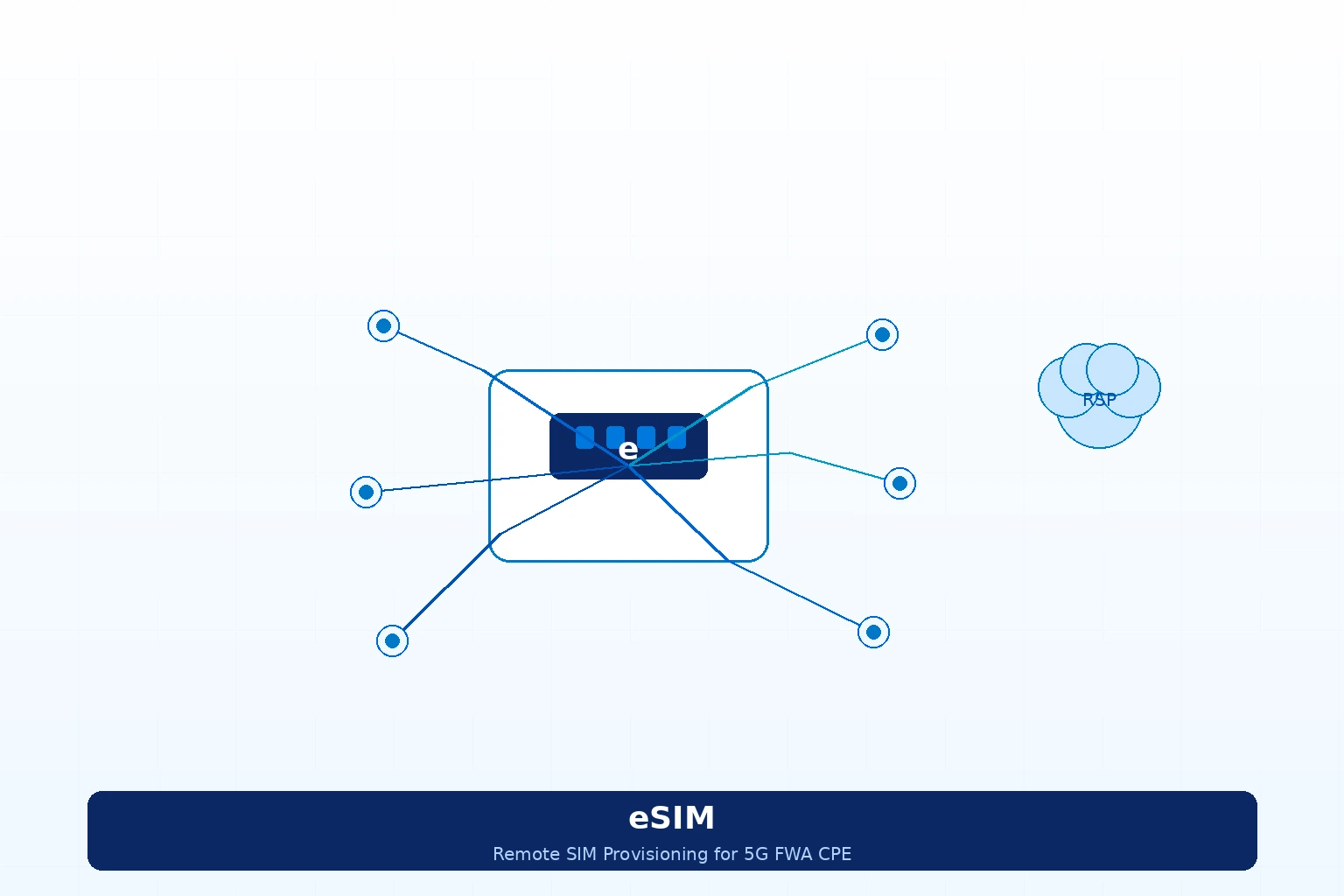
The GSMA estimates that by 2027, over 4 billion eSIM-capable devices will be in circulation globally. While smartphones have dominated early eSIM adoption, the fixed wireless access (FWA) CPE segment is emerging as one of the most compelling use cases for embedded SIM technology. For operators and MVNOs deploying 5G FWA at scale, eSIM integration transforms device logistics, reduces churn, and enables new service models that physical SIM cards cannot support.
Why eSIM Matters for 5G FWA CPE
Traditional physical SIM deployment in FWA CPE creates multiple operational friction points:
- Logistics overhead: Physical SIM cards must be manufactured, inventoried, shipped, inserted, and activated — a process that adds days or weeks to subscriber onboarding.
- SIM swap complexity: When a subscriber changes operators or plans, a physical SIM replacement requires either a truck roll or customer self-service, introducing service disruption and cost.
- Single-IMSI limitation: A physical SIM typically carries one profile, locking the CPE to a single operator unless multi-IMSI applets are pre-provisioned — which adds cost and complexity.
- Device return and refurbishment: Recovered CPE units often have outdated or operator-locked SIMs, complicating refurbishment and redeployment workflows.
eSIM (embedded UICC, or eUICC) addresses all of these challenges through remote SIM provisioning (RSP), enabling operators to download, activate, switch, and delete SIM profiles over the air — without any physical intervention on the CPE.
GSMA eSIM Architecture for Consumer and M2M Devices
The GSMA defines two primary eSIM architectures, each relevant to different FWA CPE deployment scenarios:
Consumer Architecture (GSMA SGP.22)
The SGP.22 (RSP Technical Specification v3.x) consumer architecture is increasingly the preferred model for FWA CPE because it empowers the end-user — or in B2B contexts, the enterprise IT administrator — to manage profiles. Key components include:
- LPA (Local Profile Assistant): A software component running on the CPE that manages profile download, enabling, disabling, and deletion. The LPA interfaces with the SM-DP+ (Subscription Manager Data Preparation) server via HTTPS.
- SM-DP+: The operator-side server that securely packages and delivers profiles to the eUICC.
- SM-DS (Discovery Server): Optional push-notification infrastructure that alerts the LPA when a new profile is available for download.
- eUICC (embedded UICC): The hardware secure element (typically a MFF2 or WLCSP soldered chip) that stores multiple operator profiles.
In a typical FWA deployment flow: the operator provisions a profile on the SM-DP+, sends an activation code (or SM-DS event) to the CPE, the LPA downloads and installs the profile, and the eUICC switches to the new profile — all within seconds and without physical interaction.
M2M Architecture (GSMA SGP.02)
The older SGP.02 M2M architecture uses a push model where the operator’s SM-SR (Subscription Manager Secure Routing) server directly controls profile operations on the eUICC. While less flexible than SGP.22, SGP.02 remains relevant for managed-service FWA deployments where the operator wants complete control over profile lifecycle without any LPA dependency on the CPE.
eSIM Hardware Integration in 5G FWA CPE
Integrating eSIM into a 5G CPE design involves several hardware and firmware considerations:
eUICC Form Factors
- MFF2 (QFN-8): The most common eUICC package for CPE, measuring 5x6mm. Widely available from Infineon, STMicroelectronics, and Thales, with GSMA SAS-UP certification. Compatible with standard SMD assembly processes.
- WLCSP (Wafer-Level Chip-Scale Package): Smaller footprint (approximately 2.5×2.5mm), suitable for compact CPE such as MiFi hotspots. Higher integration complexity but better thermal characteristics.
- iSIM (Integrated SIM): The next evolution where eUICC functionality is integrated directly into the modem SoC die (e.g., Qualcomm’s Snapdragon X80 with integrated iSIM support on select SKUs). iSIM eliminates the discrete eUICC component entirely, reducing BOM cost and board area.
Profile Storage and Multi-IMSI
Modern eUICCs for 5G CPE typically support 2-5 simultaneously stored profiles, with one active at a time. For operators offering multi-country or multi-network FWA services, this enables:
- Home + Roaming profiles: A primary profile for the home network and a secondary profile for partner-network roaming, with automatic switching based on PLMN availability.
- Failover profiles: A backup profile from a different MNO that activates automatically if the primary network experiences an outage, enabling carrier-grade FWA resilience.
- Test-to-production migration: Pre-loaded test profiles that can be remotely replaced with production profiles after device installation and network verification.
RSP Integration Architecture for Carrier-Grade CPE
At the CPE firmware level, eSIM integration requires:
- LPA implementation: An SGP.22-compliant LPA daemon that handles profile download (ES9+, ES11 interfaces), profile management (ES10x interfaces), and SM-DS event listening. For Linux-based CPE (OpenWrt, RDK-B, prplOS), LPAd open-source implementations are viable starting points but require security hardening for carrier deployment.
- Modem-eUICC interface: The ISO 7816 interface between the modem baseband processor and the eUICC, with support for the increased APDU throughput required by 5G NR authentication procedures.
- TR-069 / TR-369 remote management integration: Operators managing large CPE fleets need to trigger profile operations through their existing device management platforms. This requires extending the TR-069/TR-369 data model with eSIM-specific parameters and RPCs for profile download, activation, and status reporting.
- Secure boot and TEE integration: The LPA and eUICC communication path must be protected against tampering. A Trusted Execution Environment (TEE) is strongly recommended for storing LPA credentials and protecting the eUICC-ISD-R communication channel.
Operator Benefits: Operational and Commercial
Reduced subscriber acquisition cost: Zero-touch provisioning eliminates physical SIM logistics. CPE can be drop-shipped directly from the manufacturer (or distributor) to the end user, with profile download triggered on first power-on — reducing time-to-service from days to minutes.
Churn reduction via multi-profile stickiness: A CPE with multiple eSIM profiles creates a switching-cost barrier. Even if a subscriber considers changing their primary operator, the convenience of managing all profiles on one device — and the perceived complexity of re-provisioning — reduces churn rates.
New wholesale and MVNO models: eSIM enables dynamic wholesale: an infrastructure operator can pre-integrate profiles from multiple retail MVNO partners, allowing enterprise customers to select (and switch between) service providers through a self-service portal — without any CPE hardware change.
Refurbishment and circular economy: When a CPE is returned, the operator can remotely delete all profiles and provision a new one for the next subscriber in minutes, dramatically reducing device turnaround time and enabling CPE-as-a-Service rental models.
Current Challenges and Mitigations
Despite its advantages, eSIM deployment in 5G FWA CPE faces several real-world challenges:
- SM-DP+ interoperability: Not all SM-DP+ implementations handle FWA CPE profile downloads identically. Operators should validate profile download success rates across their SM-DP+ vendor and target CPE models during lab testing, not after field deployment.
- Regulatory variance: Some markets (e.g., India, certain Middle Eastern countries) have regulatory restrictions on remote SIM provisioning or eSIM profile switching that differ from GSMA norms. Local legal review is essential before launching eSIM-based FWA services.
- LPA maturity on embedded Linux: LPAd implementations for OpenWrt and similar CPE operating systems are less mature than their Android counterparts. Operators should budget for LPA integration and testing effort when evaluating eSIM-capable CPE.
- Legacy OSS/BSS integration: Existing operational support systems designed for physical SIM lifecycle management may require adaptation to handle eSIM profile inventory, activation codes, and state transitions.
Recommendations for Operators
For operators planning 5G FWA CPE deployments in 2026-2027:
- Specify eSIM readiness in procurement RFPs: Require SGP.22 consumer architecture compliance as a minimum, with iSIM readiness as a forward-looking preference. Include LPA integration with TR-369 USP as a firmware requirement.
- Select an SM-DP+ provider early: Entrust, Thales, G+D, Idemia, and Workz all offer SM-DP+ platforms. Early engagement ensures profile packaging compatibility with your chosen CPE vendor’s LPA implementation.
- Run multi-vendor interoperability testing: Test profile download, activation, switching, and deletion across all CPE models, SM-DP+ platforms, and network configurations in your deployment plan.
- Plan for iSIM migration: If your CPE roadmap extends into 2027-2028, engage with modem vendors (Qualcomm, MediaTek) on iSIM-integrated SoC availability to further reduce BOM and simplify supply chain.
As eSIM and iSIM technology mature, the business case for operators to transition from physical SIM to embedded SIM in 5G FWA CPE becomes increasingly compelling. Early adopters who build eSIM RSP infrastructure today will be positioned to capture the operational and commercial advantages that remote provisioning delivers at scale.
Honlly Telecom offers 5G FWA CPE with eSIM-ready hardware platforms. Contact our engineering team to discuss eSIM integration requirements for your deployment.