Category: 未分类

  • Open RAN Deployments Create New CPE Interoperability Requirements: What Telecom Buyers Need to Know in 2026

    Open RAN Deployments Create New CPE Interoperability Requirements: What Telecom Buyers Need to Know in 2026

    Open RAN Momentum Creates New CPE Interoperability Demands

    The global Open RAN market is projected to surpass $15 billion by 2027, driven by operator demand for multi-vendor radio access networks that break vendor lock-in. As this architectural shift accelerates, a critical question emerges for telecom buyers: how do CPE devices maintain seamless interoperability across heterogeneous Open RAN deployments?

    The Multi-Vendor Challenge for CPE

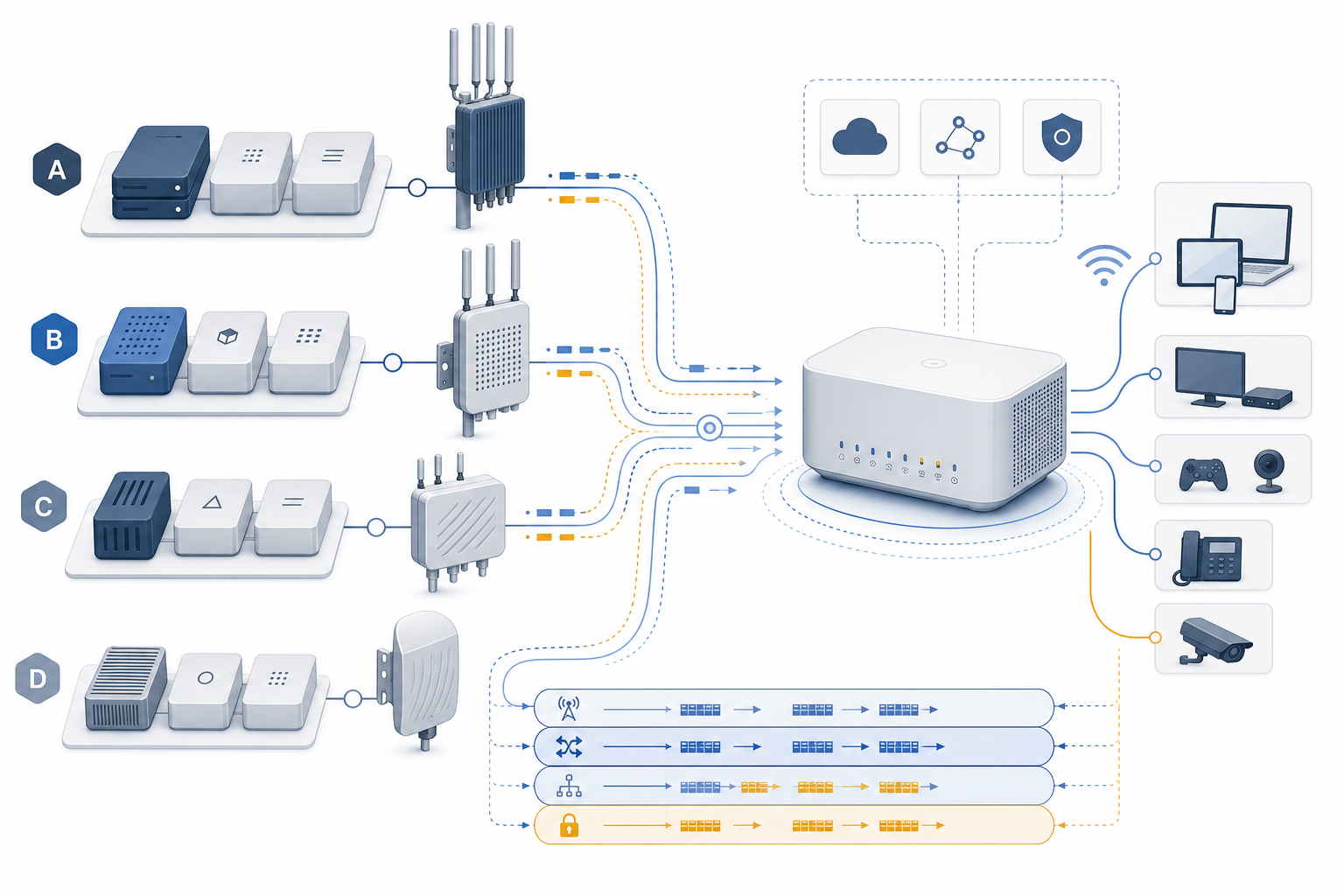
    Traditional RAN deployments pair a single vendor’s baseband unit (BBU), radio unit (RU), and core network — ensuring end-to-end compatibility testing. Open RAN disaggregates these components, allowing operators to mix RU from Vendor A with DU/CU from Vendor B and core from Vendor C. While this creates procurement flexibility, it introduces interoperability testing complexity at the CPE edge.

    For CPE devices, the challenge is clear: the device must reliably attach, authenticate, and maintain sessions across multi-vendor network configurations without requiring per-deployment firmware customization.

    Key Interoperability Requirements for Open RAN-Ready CPE

    1. O-RAN Alliance Compliance

    CPE devices targeting Open RAN deployments should support O-RAN Alliance fronthaul specifications (Split 7.2x) and demonstrate successful interoperability at O-RAN Global PlugFests. Third-party validation through organizations like TIP (Telecom Infra Project) provides additional assurance for operators.

    2. 3GPP Release 17/18 Feature Alignment

    Open RAN networks increasingly deploy Release 17 and 18 features — including NR-U (NR in unlicensed spectrum), multi-TRP (multiple transmission reception points), and enhanced carrier aggregation across non-co-located cells. CPE devices must support these features at both the modem and antenna system level to maintain peak performance in disaggregated architectures.

    3. Flexible Beam Management

    In Open RAN deployments, beamforming configurations may differ between vendors’ radio units even within the same network. CPE devices need robust beam acquisition and tracking algorithms that adapt to varying beam patterns, SSB periodicities, and CSI-RS configurations from different RU vendors.

    Industry Response: Certification Programs and Testbeds

    The industry is responding with dedicated testing frameworks. The O-RAN Alliance’s Open Testing and Integration Centers (OTIC) now include CPE interoperability test cases. Similarly, major operators including Vodafone, Deutsche Telekom, and Rakuten Mobile have published CPE acceptance criteria for their Open RAN networks, creating de facto industry standards for multi-vendor performance validation.

    What This Means for Telecom Buyers

    For ISPs, operators, and system integrators procuring CPE in 2026, Open RAN readiness should be a formal evaluation criterion in vendor RFPs. Key questions to ask CPE suppliers include:

    • Has the CPE been tested at an OTIC lab or O-RAN Global PlugFest?
    • Does the device support 3GPP Release 17 multi-TRP and enhanced CA across non-co-located cells?
    • What beam management fallback strategies are implemented for mixed-vendor RU environments?
    • Is a field-upgradeable firmware architecture in place to address future O-RAN specification updates?

    Conclusion

    Open RAN is transforming how mobile networks are built — and CPE procurement strategies must evolve accordingly. The operators that succeed in this new paradigm will be those who partner with CPE manufacturers that have invested in Open RAN interoperability testing, multi-vendor validation, and flexible firmware architectures designed for disaggregated network environments.

    Contact Honlly Telecom to discuss Open RAN-ready 4G/5G CPE solutions for your network — with O-RAN Alliance compliant designs and proven multi-vendor interoperability.
  • Thermal Design for Outdoor 5G CPE: Engineering IP67-Rated Enclosures for Extreme Climate Deployments

    Thermal Design for Outdoor 5G CPE: Engineering IP67-Rated Enclosures for Extreme Climate Deployments

    Introduction: Why Outdoor CPE Thermal Design Matters

    Outdoor 5G CPE devices face some of the harshest operating conditions in telecom infrastructure. Mounted on rooftops, poles, and building exteriors, these devices must maintain reliable performance across temperature extremes from -40°C desert nights to +55°C direct sunlight — all while dissipating heat from power-hungry 5G chipsets. Effective thermal management is not optional — it is the difference between a 5-year field life and a 6-month failure rate.

    This engineering guide examines the thermal design principles, materials, and testing protocols that ensure outdoor 5G CPE achieves IP67-rated protection while maintaining safe operating temperatures for internal components.

    Understanding the Thermal Challenge in 5G Outdoor CPE

    5G NR CPE devices generate significantly more heat than their 4G predecessors. The combination of multi-gigabit throughput, carrier aggregation across multiple bands, and beamforming antenna arrays pushes power consumption to 15–30W — comparable to a small laptop. In a sealed IP67 enclosure with no active fan, this heat has nowhere to go except through passive conduction and radiation.

    Key Heat Sources in Outdoor 5G CPE

    • 5G modem/baseband processor: 4–8W for sub-6 GHz; up to 12W for mmWave-capable chipsets
    • RF front-end and power amplifiers: 3–6W depending on TX power and number of antenna chains
    • WiFi 6/7 subsystem: 2–4W for dual-band concurrent operation
    • Ethernet PHY and PoE PD controller: 1–2W
    • Total thermal budget: 12–25W for typical outdoor 5G CPE

    IP67 Enclosure Requirements and Thermal Trade-offs

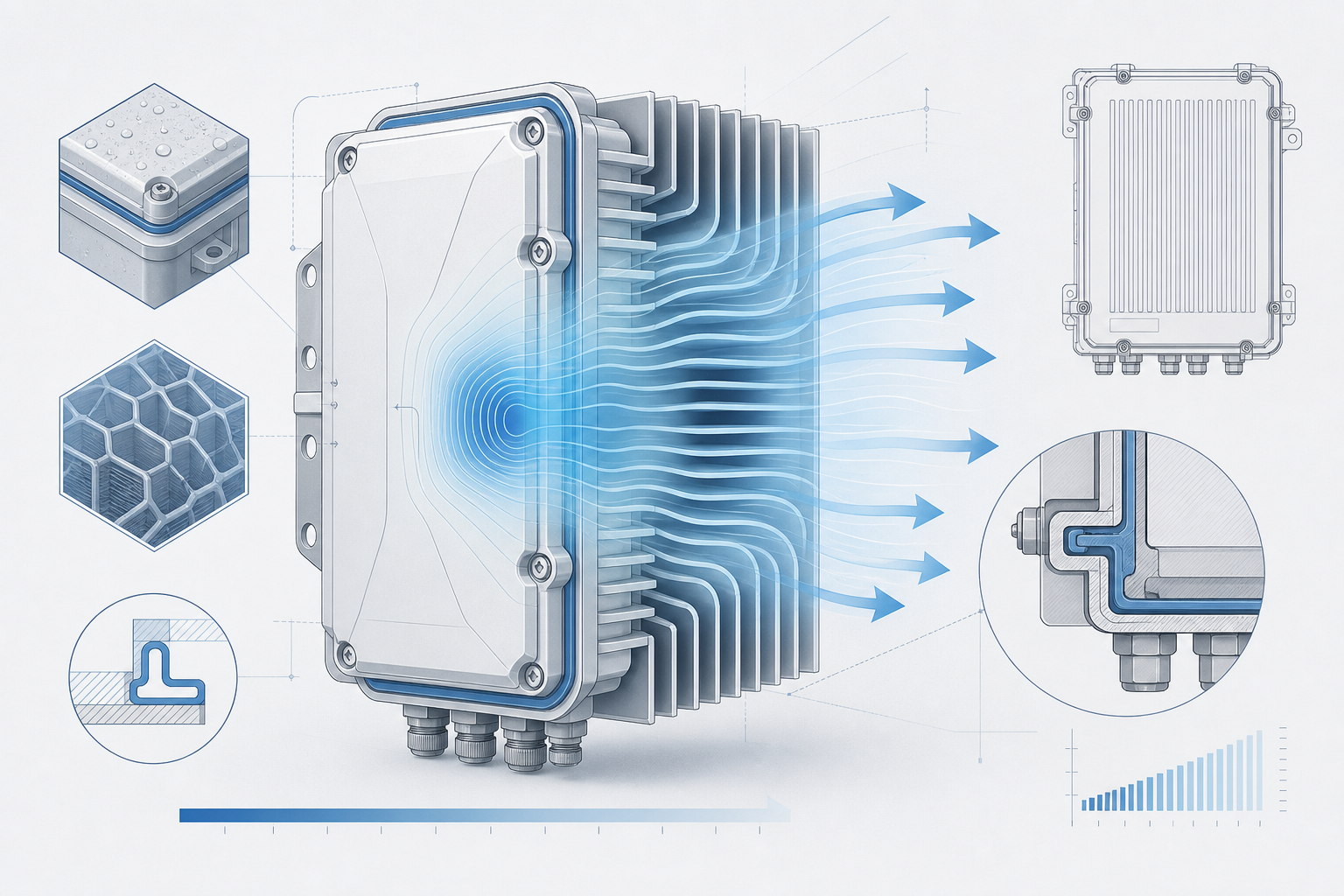
    IP67 certification requires complete protection against dust ingress (6) and immersion in 1 meter of water for 30 minutes (7). This means the enclosure must be hermetically sealed — no ventilation holes, no fans, no air exchange with the outside environment. Every watt of heat generated must be transferred through the enclosure walls via conduction.

    The fundamental trade-off: better sealing = worse natural cooling. Solving this requires careful material selection and enclosure geometry optimization.

    Passive Cooling Design Strategies

    1. Conductive Heat Path Optimization

    Direct thermal contact between high-power components and the enclosure body is the most efficient passive cooling method. Thermal interface materials (TIM) — typically silicone-based gap fillers with 3–6 W/mK conductivity — bridge the air gap between chip surfaces and the aluminum heatsink or enclosure wall. For 5G CPE, a 0.5–1.0 mm gap filler compressed to 30% provides optimal thermal transfer without stressing solder joints.

    2. Aluminum Die-Cast Enclosure with Integrated Fins

    Die-cast aluminum (ADC12 or A380 alloy) is the material of choice for outdoor CPE enclosures. Its thermal conductivity (96–130 W/mK) is 100× higher than plastic alternatives. External cooling fins increase surface area by 300–500%, dramatically improving convective heat transfer to ambient air. Modern designs use computational fluid dynamics (CFD) simulation to optimize fin spacing, height, and orientation for maximum natural convection at the target wind speeds for the deployment region.

    3. Phase-Change Materials for Peak Load Buffering

    For deployments in regions with extreme daily temperature swings, paraffin-based phase-change materials (PCMs) embedded in the enclosure wall can absorb heat during peak afternoon operation and release it during cooler evening hours. This thermal buffering smooths temperature peaks by 8–15°C, extending component lifespan without adding active cooling complexity.

    Testing and Validation: Beyond the Datasheet

    Real-world thermal validation goes far beyond component datasheet specifications. Reputable CPE manufacturers conduct:

    • Thermal chamber cycling: -40°C to +85°C, 500+ cycles, monitoring LTE/5G throughput stability
    • Solar load testing: 1,120 W/m² simulated solar radiation at 55°C ambient, 8-hour duration
    • Condensation testing: Rapid temperature transitions (85°C to -40°C in 15 seconds) to verify no internal moisture accumulation
    • Accelerated life testing: Continuous operation at 85°C component junction temperature for 1,000+ hours

    FAQ

    Q: Can outdoor CPE use active cooling (fans)?
    A: Not in IP67-rated enclosures. Active cooling requires air intake/exhaust, which breaks the dust and water seal. All cooling must be passive. Some industrial designs use sealed liquid cooling loops, but these add cost and complexity rarely justified for CPE.

    Q: How does solar radiation affect thermal performance?
    A: Direct sunlight adds 500–1,120 W/m² of radiative heat load to the enclosure surface. Light-colored (white or light gray) enclosures with high solar reflectance (>0.85) reduce solar absorption by 40–60% compared to dark-colored units.

    Q: What is the typical operating temperature range for outdoor 5G CPE?
    A: Industrial-grade designs achieve -40°C to +60°C ambient operation with full RF performance. Extended-temperature variants push to +70°C with graceful performance throttling above 55°C.

    Conclusion

    Thermal design is the silent differentiator between outdoor 5G CPE that survives a decade in the field and units that fail within the first summer. When evaluating CPE suppliers, buyers should request full thermal validation reports — not just spec sheets — and prioritize manufacturers with in-house environmental testing laboratories and proven field-deployment track records in target climate zones.

    Contact Honlly Telecom to discuss outdoor 5G CPE with validated IP67 thermal designs for your deployment region — backed by ISO 9001 manufacturing and full environmental test reports.

  • Untitled post 2945

    Introduction: The eSIM Revolution in Telecom CPE

    For telecom operators, ISPs, and MVNOs managing multi-country CPE deployments, the traditional plastic SIM card has long been a logistical bottleneck. Each device must be paired with a region-specific SIM, creating fragmented inventory, complex warehouse management, and delayed rollouts. eSIM (embedded SIM) technology with Remote SIM Provisioning (RSP) is changing this equation fundamentally. This article explores how eSIM integration in 4G and 5G CPE devices simplifies global operator deployment, reduces supply chain complexity, and enables new business models for telecom equipment buyers.

    What is eSIM RSP and Why It Matters for CPE

    Unlike traditional SIM cards that are physically inserted and locked to a single operator profile, eSIM RSP (GSMA SGP.22) allows operators to remotely download, activate, and switch carrier profiles over the air. For CPE devices — fixed wireless access routers, MiFi hotspots, and industrial gateways — this means:
    • Single SKU global inventory: One device model ships worldwide, with operator profiles provisioned at destination
    • Over-the-air operator switching: End users or enterprise IT can change carriers without physical SIM swaps
    • Reduced logistics costs: Eliminate per-country SIM kitting, warehousing, and regional packaging variants
    • Faster time-to-market: Deploy CPE in new markets in days, not months

    eSIM Architecture in CPE: Technical Considerations

    Integrating eSIM into CPE devices requires careful engineering across several layers:

    1. eUICC Hardware Integration

    The embedded Universal Integrated Circuit Card (eUICC) must meet GSMA SGP.02 compliance. For 5G CPE, the eUICC should support the M2M (Machine-to-Machine) profile with robust remote management capabilities. Industrial-grade eUICCs rated for -40°C to +105°C are recommended for outdoor CPE deployments.

    2. Local Profile Assistant (LPA) Implementation

    The LPA is the software component that communicates between the eUICC and the operator’s Subscription Manager Data Preparation (SM-DP+) server. For CPE devices running OpenWrt or Linux-based firmware, LPAs can be implemented as daemons that manage profile downloads, activation, and deletion automatically — without user interaction.

    3. Multi-Profile and Multi-IMSI Support

    Advanced eSIM implementations support multiple operator profiles stored simultaneously, enabling CPE devices to switch between carriers based on signal quality, cost, or contractual arrangements. Combined with multi-IMSI capabilities, a single CPE can serve subscribers across multiple MNOs and MVNOs.

    Supply Chain Transformation: From Regional to Global

    The introduction of eSIM fundamentally restructures the CPE supply chain: Before eSIM: OEM → regional SIM kitting → country-specific packaging → regional warehouse → operator → end user. Each region requires separate inventory, increasing working capital and lead times. After eSIM: OEM → global warehouse → ship anywhere → operator provisions via RSP → end user. One universal SKU covers all markets, reducing inventory by up to 70% and cutting deployment time from months to days.

    Operator Benefits: Why ISPs and MVNOs Should Prioritize eSIM CPE

    For telecom operators, eSIM-enabled CPE delivers measurable operational advantages:
    • Reduced churn: Lock-in effect through eSIM profile management; subscribers stay within operator ecosystem
    • Dynamic carrier partnerships: MVNOs can negotiate and switch wholesale agreements without touching physical devices
    • Enterprise private network deployments: Factory-floor CPE can be reconfigured remotely as network topologies change
    • Compliance and security: GSMA-certified eSIM provisioning provides end-to-end encryption and anti-cloning protection

    5G and Beyond: eSIM as a Competitive Differentiator

    As 5G Standalone networks proliferate and network slicing becomes commercialized, eSIM-capable CPE becomes a strategic asset. Operators can offer differentiated slice-based services — ultra-reliable low-latency for manufacturing, enhanced mobile broadband for offices, massive IoT for smart cities — all provisioned to eSIM CPE over the air.

    FAQ

    Q: Is eSIM more expensive than traditional SIM for CPE? A: The eUICC hardware cost is marginally higher (approximately $0.80-$1.50 per unit), but this is offset by eliminating physical SIM cards, regional kitting, and complex inventory management. Total cost of ownership typically decreases by 15–25% at scale. Q: Can eSIM CPE work with operators that don’t support RSP? A: Yes — eSIM CPE can fall back to traditional SIM operation via a physical SIM slot alongside the eSIM. This hybrid approach provides maximum compatibility during the transition period. Q: What certifications are required for eSIM CPE? A: GSMA SAS-UP certification for eUICC manufacturing, plus regional regulatory approvals (CE, FCC). Reputable OEM/ODM partners handle the full certification lifecycle.

    Conclusion

    eSIM RSP integration represents the next frontier in CPE supply chain optimization. For operators and ISPs deploying fixed wireless access at scale, the combination of global SKU simplification, over-the-air provisioning, and multi-profile flexibility makes eSIM-capable CPE a strategic procurement priority in 2026 and beyond. Contact Honlly Telecom to discuss eSIM-enabled 4G/5G CPE for your next deployment — with flexible OEM/ODM customization, GSMA-compliant integration, and global logistics support.