Category: Industry News

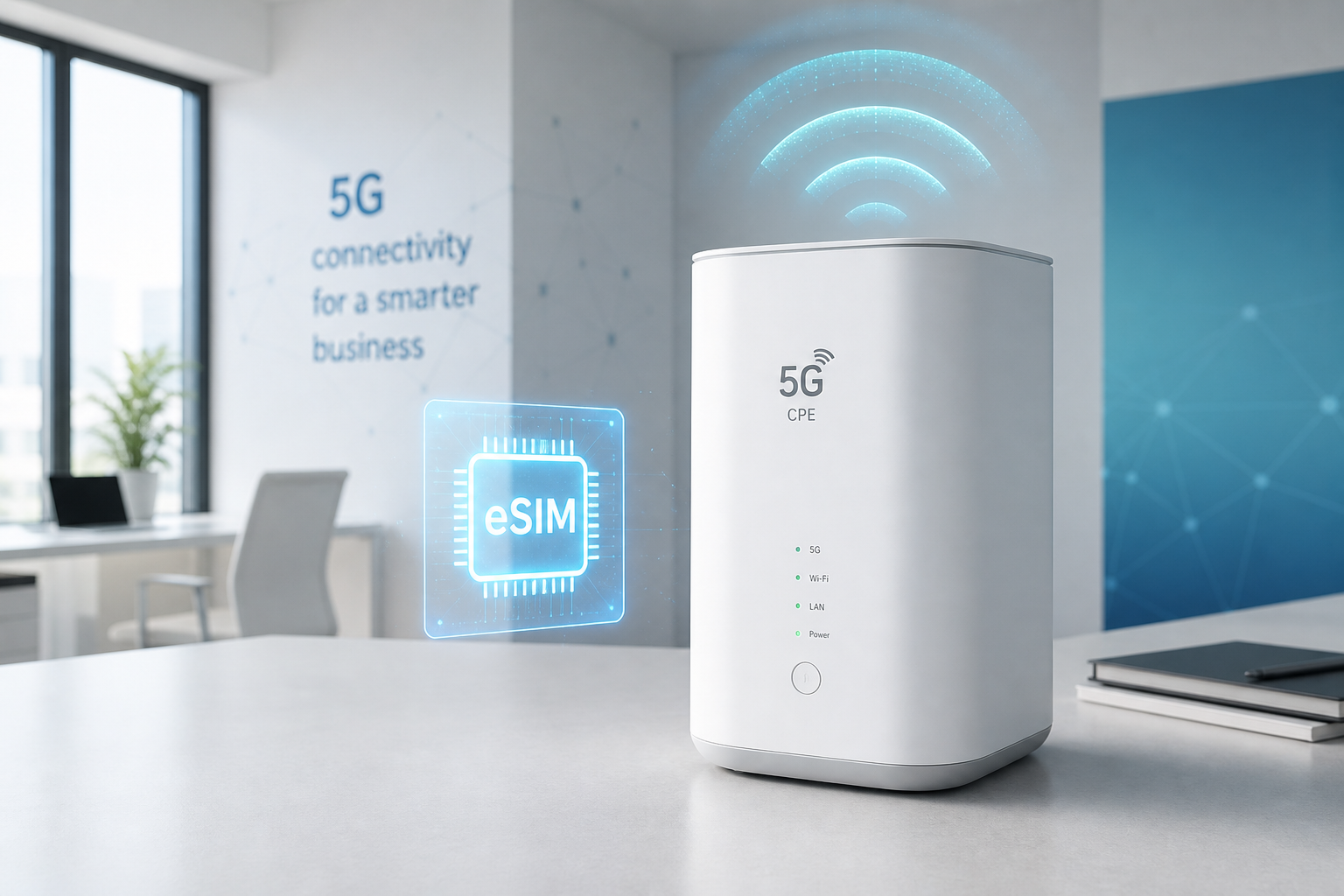
  • eSIM and iSIM Integration in 5G CPE Streamlines Global B2B FWA Deployments as Embedded SIM Technology Eliminates Physical SIM Logistics for Enterprise Customers in 2026

    eSIM and iSIM Integration in 5G CPE Streamlines Global B2B FWA Deployments as Embedded SIM Technology Eliminates Physical SIM Logistics for Enterprise Customers in 2026

    The global enterprise Fixed Wireless Access (FWA) market is projected to surpass $18 billion by 2027, with multinational deployments becoming the norm rather than the exception. Yet beneath the surface of this growth lies a persistent operational challenge that has plagued B2B CPE rollouts for years: physical SIM card management across borders, carriers, and regulatory domains.

    Enter eSIM (embedded SIM) and iSIM (integrated SIM) technology. These two related but distinct standards are fundamentally reshaping how enterprises procure, deploy, and manage 5G CPE at global scale — eliminating a logistics bottleneck that has long been accepted as an unavoidable cost of doing business.

    The Physical SIM Problem at Enterprise Scale

    For B2B deployments spanning multiple countries, traditional physical SIM cards introduce a cascade of operational inefficiencies. A typical multinational retailer deploying 5G CPE across 500 locations in 12 countries must contend with at least 12 different carrier SIM variants, each with its own procurement cycle, shipping logistics, regional regulatory compliance, and activation workflow.

    The numbers are sobering. Industry estimates suggest that physical SIM logistics — procurement, secure warehousing, international shipping, on-site insertion, and decommissioning — can add $15–$35 per device to the total cost of ownership. For a 10,000-unit enterprise deployment, that translates to $150,000–$350,000 in pure logistics overhead before a single byte of data flows through the network.

    Beyond cost, physical SIMs introduce security vulnerabilities. A SIM card that is shipped separately from the CPE can be intercepted, cloned, or tampered with during transit. In regulated industries — finance, healthcare, critical infrastructure — this represents an unacceptable attack surface.

    eSIM: Software-Defined Carrier Selection

    The GSMA-standardized eSIM (eUICC) architecture decouples the SIM profile from the physical form factor. Instead of inserting a physical card, the CPE contains a soldered eUICC chip that can be remotely provisioned with operator profiles via the GSMA’s Remote SIM Provisioning (RSP) infrastructure.

    For B2B deployments, this creates a fundamentally different operational model. A single 5G CPE SKU can be manufactured, warehoused, and shipped to any country without pre-assigning a carrier. The operator profile is downloaded over-the-air upon first boot — or even switched mid-lifecycle if the enterprise changes carriers or adds multi-carrier failover.

    Key technical capabilities enabled by eSIM in 5G CPE include:

    • Multi-Profile Storage: Modern eUICC chips can store multiple operator profiles simultaneously, enabling carrier-agnostic deployments where the CPE can switch between providers based on signal quality, cost, or policy.
    • Zero-Touch Provisioning: Combined with TR-369 USP or proprietary ACS platforms, eSIM enables true zero-touch onboarding where CPE devices self-configure upon power-up without any on-site technician involvement.
    • Remote Carrier Switching: Enterprises can remotely migrate an entire fleet from one carrier to another — for example, when renegotiating contracts or when a new operator builds out coverage in a target region — without physically touching any device.
    • Regulatory Compliance Automation: eSIM profiles can be pre-vetted for compliance with local telecom regulations (IMEI registration requirements, lawful intercept obligations), reducing customs delays and regulatory friction at border crossings.

    iSIM: The Next Integration Frontier

    While eSIM is now mainstream — GSMA reports over 400 operator eSIM launches globally as of mid-2026 — iSIM (integrated SIM) represents the next evolutionary step. The iSIM architecture embeds the SIM functionality directly into the CPE’s system-on-chip (SoC), eliminating the need for a separate eUICC component entirely.

    Qualcomm’s Snapdragon X75 and X80 modem-RF platforms, as well as MediaTek’s T800 series, now include native iSIM support with GSMA SAS-UP certification. For CPE manufacturers, this integration delivers several advantages:

    • Bill of Materials Reduction: Eliminating the discrete eUICC chip reduces component count, PCB real estate requirements, and supply chain complexity — particularly meaningful for compact CPE form factors like 5G mobile hotspots and outdoor FWA units.
    • Power Efficiency: iSIM implementations in advanced SoC nodes (4nm and below) consume approximately 40–60% less power than discrete eUICC solutions, contributing to longer battery life in portable CPE and reduced thermal load in fixed installations.
    • Enhanced Security Posture: iSIM leverages the SoC’s existing hardware root of trust and secure enclave, creating a more tightly integrated security architecture that is harder to physically attack than a discrete chip on the PCB.
    • Simplified Certification: With iSIM functionality pre-certified as part of the modem platform, CPE manufacturers can reduce the carrier certification cycle by 4–8 weeks per operator.

    Real-World B2B Deployment Models

    Several deployment patterns are emerging as eSIM/iSIM-capable 5G CPE reaches commercial maturity:

    Multinational Retail SD-WAN: A global retailer deploys identical 5G CPE hardware across 30 countries. Each unit boots, detects its location via network-based geolocation, and downloads the appropriate local carrier profile via RSP. The CPE then establishes an SD-WAN tunnel to the nearest cloud on-ramp, providing uniform policy enforcement regardless of the underlying carrier.

    Cross-Border Fleet Telematics: Logistics companies operating across the EU, ASEAN, or USMCA trade zones use iSIM-equipped 5G CPE in vehicles that automatically switch carrier profiles at border crossings. The CPE maintains session continuity using make-before-break profile switching, avoiding the data session drops that plague physical SIM-based solutions.

    Global IoT Backhaul: Agricultural technology providers deploying sensor networks across multiple continents use eSIM-enabled outdoor 5G CPE as aggregation gateways. A single hardware SKU serves deployments in Brazil, Kenya, India, and Australia — each downloading the appropriate regional carrier profile during installation by local technicians with no SIM logistics overhead.

    Enterprise Procurement Impact

    The shift to eSIM/iSIM is reshaping B2B CPE procurement in three fundamental ways:

    1. SKU Rationalization: Instead of maintaining region-specific CPE variants with different SIM configurations, enterprises can standardize on a single global SKU. This reduces procurement complexity, enables volume pricing, and simplifies sparing strategies.

    2. Just-in-Time Carrier Selection: Carrier decisions can be deferred until the moment of deployment — or even changed afterward. This shifts bargaining power toward the enterprise, enabling competitive carrier selection based on real-time pricing and performance data.

    3. Reduced Deployment Timelines: Physical SIM procurement and shipping adds 2–6 weeks to typical enterprise deployment timelines. eSIM eliminates this entirely, enabling same-week deployment from local inventory.

    Challenges and Considerations

    Despite the clear advantages, several challenges must be addressed for successful eSIM/iSIM CPE deployments:

    • RSP Infrastructure Maturity: While GSMA RSP standards are well-defined, not all carriers have fully deployed the required SM-DP+ (Subscription Manager Data Preparation) infrastructure. Enterprises should verify RSP readiness with target carriers before committing to eSIM-only deployments.
    • Regulatory Fragmentation: Some countries maintain restrictions on permanent roaming or remote SIM provisioning. India, for example, required amendments to its M2M guidelines before permitting eSIM for IoT devices. Enterprises must navigate this regulatory patchwork on a country-by-country basis.
    • Profile Lifecycle Management: At scale, managing thousands of eSIM profiles — including provisioning, suspension, reactivation, and deletion — requires robust integration between the enterprise’s device management platform and carrier SM-DP+ systems.
    • eSIM/iSIM Transition Strategy: For enterprises with existing fleets of physical SIM-based CPE, a phased migration approach is recommended. New deployments adopt eSIM/iSIM; existing devices are migrated during natural refresh cycles rather than through costly retrofits.

    Outlook: 2026–2028

    The trajectory is clear. GSMA Intelligence projects that by 2028, over 70% of new 5G CPE shipped for enterprise FWA will incorporate eSIM or iSIM technology. The convergence of GSMA SGP.32 (IoT eSIM standard) with 3GPP Release 18 enhancements for non-terrestrial network integration will further expand the addressable use cases.

    For B2B buyers and systems integrators, the message is straightforward: eSIM and iSIM are no longer emerging technologies — they are current-generation procurement requirements. Organizations that incorporate embedded SIM capabilities into their 5G CPE RFPs today will realize compounding operational savings over the 3–5 year lifecycle of their deployed fleets.

    The era of shipping plastic SIM cards across borders for enterprise network deployments is rapidly drawing to a close. For the B2B 5G CPE market, that is unequivocally good news.


  • Global 5G Private Network CPE Market Surges Past USD 2.1 Billion as Enterprise Deployments Scale from Pilot to Production in H1 2026

    Global 5G Private Network CPE Market Surges Past USD 2.1 Billion as Enterprise Deployments Scale from Pilot to Production in H1 2026

    The global market for 5G private network customer premises equipment (CPE) is entering a decisive growth phase in mid-2026, driven by accelerating enterprise adoption of dedicated cellular infrastructure across manufacturing, logistics, energy, and campus environments. Industry analysts now project the private 5G CPE segment to exceed USD 4.2 billion by 2028, with compound annual growth rates surpassing 35% as organizations move beyond proof-of-concept trials toward full-scale production deployments.

    Enterprise Private 5G: From Pilot to Production

    The transition from laboratory trials to operational private 5G networks marks a fundamental shift in enterprise connectivity strategy. Throughout Q2 2026, major system integrators including Siemens, Accenture, and NTT DATA reported a threefold increase in private 5G deployment contracts compared to the same period in 2025. Manufacturing leads adoption with 38% of all new deployments, followed by logistics and warehousing at 24%, energy and utilities at 18%, and campus environments including universities and corporate headquarters at 12%.

    This acceleration is underpinned by several converging factors. Spectrum liberalization in key markets—including the 3.7–3.8 GHz band in Germany, the n77 band expansion in Japan, and shared-access frameworks in the United States—has lowered barriers to entry for enterprises seeking dedicated spectrum. Simultaneously, the maturation of 3GPP Release 17 and early Release 18 features has delivered enterprise-grade capabilities including network slicing, ultra-reliable low-latency communication (URLLC) enhancements, and simplified device onboarding through 5G-specific authentication frameworks.

    CPE Requirements for Private Networks: A New Procurement Paradigm

    Private 5G networks impose fundamentally different requirements on CPE compared to public network deployments. Enterprise procurement teams are increasingly evaluating devices against a multi-dimensional matrix that extends well beyond throughput specifications. Key criteria now include:

    • Spectrum flexibility: Support for n48 (CBRS), n77, n78, and n79 bands, with seamless operation across shared, licensed, and unlicensed spectrum frameworks. CPE must handle dynamic spectrum allocation and frequency coordination with existing industrial wireless systems including Wi-Fi 6E/7 and legacy private LTE.
    • Industrial protocol integration: Native support for PROFINET, EtherCAT, Modbus TCP, and OPC UA time-sensitive networking (TSN) profiles. The CPE must function as a protocol-aware edge node rather than a transparent bridge, with deterministic latency guarantees below 1 millisecond for motion control applications.
    • Ruggedization and environmental hardening: IP65 minimum ingress protection, extended temperature range from -40°C to +75°C, and compliance with IEC 60068 for shock and vibration. For hazardous environments, ATEX/IECEx Zone 2 certification is becoming a standard requirement in chemical and oil and gas verticals.
    • Security architecture: Hardware root of trust with TPM 2.0, secure boot chains, IEEE 802.1X/EAP-TLS authentication, and integrated zero-trust network access (ZTNA) client capabilities. The CPE must support enterprise SIM (eSIM) provisioning with GSMA SGP.32 compliance for IoT-optimized remote management.

    Regional Deployment Trends and Operator Dynamics

    Europe continues to lead private 5G CPE adoption, with Germany alone accounting for 28% of global deployments. The German government’s “Campusnetz” program, which has allocated over 200 local spectrum licenses, has created a fertile ecosystem for CPE vendors. Major industrial conglomerates including Siemens, Bosch, and Volkswagen now operate production-scale private 5G networks with hundreds of connected CPE endpoints per facility.

    In Asia-Pacific, Japan and South Korea are driving demand through smart factory initiatives. Japan’s Ministry of Economy, Trade and Industry reported 156 operational private 5G installations as of June 2026, with CPE shipments growing at 47% year-over-year. Chinese manufacturers are deploying private 5G CPE at unprecedented scale, with Foxconn’s Shenzhen campus alone connecting over 5,000 industrial endpoints through a dedicated n79 network.

    North America’s growth is fueled by CBRS deployments and the emergence of neutral-host private 5G models. AWS Private 5G, Microsoft Azure Private 5G Core, and Nokia DAC now represent the three dominant platform approaches, each with distinct CPE certification and interoperability requirements that vendors must navigate.

    Implications for B2B CPE Procurement

    For B2B buyers and system integrators, the private 5G CPE landscape demands rigorous technical evaluation beyond datasheet specifications. Integration with existing industrial OT networks, compliance with regional spectrum regulations, and alignment with chosen private 5G core platforms are critical decision factors. CPE that offers multi-platform interoperability—supporting both 3GPP-compliant and enterprise-core implementations—provides significant deployment flexibility and reduces vendor lock-in risk.

    As private 5G matures from early-adopter enthusiasm to mainstream enterprise infrastructure, the CPE that succeeds will be those engineered for the harsh realities of industrial environments, not repurposed consumer-grade hardware. Procurement teams should prioritize vendors with proven industrial track records, comprehensive certification portfolios, and roadmaps aligned with 3GPP Release 18 and beyond.

  • Global 4G/5G CPE Shipments Reach Record 480 Million Units in 2026 as FWA Becomes Primary Broadband in Emerging Markets

    Global 4G/5G CPE Shipments Reach Record 480 Million Units in 2026 as FWA Becomes Primary Broadband in Emerging Markets

    The global 4G and 5G Customer Premises Equipment (CPE) market is on track to ship approximately 480 million units in 2026, according to data compiled from multiple industry analysts, marking a 12 percent year-over-year increase and a new record for the sector. The growth is being driven primarily by fixed wireless access (FWA) deployments in emerging markets, where operators are scaling broadband infrastructure to serve previously unconnected populations.

    The 480-million-unit figure spans all CPE categories — including 4G and 5G FWA routers, mobile hotspots (MiFi), indoor routers, outdoor CPE units, and industrial gateways — and reflects the accelerating role of wireless technology as a primary broadband access method rather than a backup or secondary connection.

    5G CPE Share Hits 38 Percent as 4G Maintains Volume Leadership

    5G CPE now accounts for 38 percent of total unit shipments, up from 26 percent in 2025 and 14 percent in 2024. The rapid share gain reflects the combination of expanding 5G network coverage, falling 5G chipset costs, and operator strategies that increasingly position 5G FWA as a direct competitor to fixed-line broadband.

    Despite the 5G growth, 4G LTE CPE continues to dominate unit volumes at approximately 62 percent of shipments. In Sub-Saharan Africa, Southeast Asia, and parts of Latin America, CAT4 and CAT6 LTE CPE remain the primary devices for new broadband subscriber acquisition, owing to their lower cost and the continued expansion of 4G network coverage in these regions.

    “The market is bifurcating,” noted a senior analyst at a leading telecom research firm. “Developed markets and premium urban deployments are moving rapidly to 5G FWA. But for operators serving rural and peri-urban populations in Africa, South Asia, and Latin America, 4G CPE at the $30–50 price point is the volume driver — and will remain so through at least 2028.”

    Regional Breakdown: Africa and Southeast Asia Lead Growth

    Region 2026 CPE Shipments (Est.) YoY Growth 5G Share Key Driver
    Asia-Pacific (incl. China) 195 million +9% 42% 5G FWA expansion, China Mobile CPE procurement
    Africa & Middle East 82 million +22% 12% 4G network rollout, rural broadband programs
    Europe 68 million +7% 48% 5G FWA as DSL replacement, rural connectivity
    Latin America 55 million +18% 15% 4G FWA expansion, government broadband initiatives
    North America 48 million +6% 65% 5G Home Internet (T-Mobile, Verizon), mmWave CPE
    Others 32 million +10% 20% Mixed 4G/5G deployments

    Africa and the Middle East stand out with 22 percent year-over-year growth, driven by large-scale 4G network expansion programs and the first wave of 5G FWA trials in markets including Nigeria, Kenya, and South Africa. Latin America shows 18 percent growth, supported by government-subsidized broadband programs in Brazil, Mexico, and Colombia.

    North America, while showing the lowest unit growth rate at 6 percent, leads in 5G adoption with 65 percent of CPE shipments now 5G-enabled. T-Mobile and Verizon together account for the majority of 5G FWA CPE deployments in the region, with both carriers reporting FWA as their fastest-growing broadband segment.

    Outdoor CPE Demand Surges as Operators Target Rural Coverage

    One of the most significant shifts in the 2026 CPE market is the growing share of outdoor CPE units. Outdoor CPE — typically IP65 or IP67-rated devices mounted externally for better signal reception — now accounts for approximately 28 percent of total FWA CPE shipments, up from 19 percent in 2024.

    The shift is being driven by operator experience: in rural and peri-urban deployments, indoor CPE often delivers marginal signal quality that leads to higher churn and increased support costs. Outdoor CPE with higher-gain antennas consistently delivers 30–50 percent better throughput at the subscriber premises, making the incremental hardware and installation cost worthwhile over the device lifecycle.

    “Operators who deployed indoor-only CPE for rural FWA in 2023–2024 are now actively replacing those devices with outdoor units,” said a procurement director at a major African operator group. “The lesson is clear: if you are deploying FWA outside dense urban areas, budget for outdoor CPE from day one.”

    CPE Manufacturing Hub: Asia-Pacific Now Produces 67 Percent of Global CPE

    The CPE manufacturing landscape has consolidated further in 2026, with Asia-Pacific now producing an estimated 67 percent of global CPE units, up from 62 percent in 2024. China remains the dominant manufacturing base, with the Fujian province — home to Honlly Telecom and other CPE manufacturers — emerging as one of the world’s largest CPE production clusters.

    The concentration of CPE manufacturing in Asia-Pacific has created both opportunities and risks for global operators. On the opportunity side, economies of scale continue to drive down per-unit costs. A CAT6 outdoor CPE that cost $75–90 in 2023 is now available at $45–60 in volume, enabling operators to deploy at larger scale. On the risk side, supply chain concentration has prompted some operators to qualify secondary manufacturing sources in Vietnam, India, and Eastern Europe for supply chain resilience.

    WiFi 7 Integration in CPE Accelerates

    WiFi 7 (802.11be) integration in premium CPE has accelerated faster than expected in 2026. Approximately 18 percent of 5G FWA CPE shipped in H1 2026 includes WiFi 7, up from 4 percent in 2025. The rapid adoption is being driven by chipset availability from Qualcomm, MediaTek, and Broadcom, and by operator demand for future-proof indoor coverage as multi-gigabit 5G FWA plans become more common.

    WiFi 7’s Multi-Link Operation (MLO) capability — which allows simultaneous use of 2.4 GHz, 5 GHz, and 6 GHz bands — is particularly valuable for FWA CPE, where the indoor WiFi network often becomes the bottleneck as 5G WAN throughput increases beyond 500 Mbps. By aggregating multiple bands, WiFi 7 CPE can deliver indoor throughput that more closely matches the 5G WAN connection.

    Outlook: CPE Market to Exceed 550 Million Units by 2028

    Looking ahead, industry analysts project the global CPE market to exceed 550 million annual unit shipments by 2028, driven by continued FWA expansion in emerging markets, 5G RedCap adoption in mid-tier segments, and the eventual sunset of 2G and 3G networks that will require device upgrades across millions of subscribers.

    Key trends to watch through 2028 include: the commercialization of 5G RedCap CPE for cost-sensitive markets, the integration of AI-based network optimization into CPE firmware, the expansion of eSIM-capable CPE for flexible operator provisioning, and the growing role of CPE in private 5G network deployments for enterprise and industrial applications.

    For operators, ISPs, and distributors, the message from the 2026 data is clear: the CPE market is growing, diversifying, and becoming more technologically sophisticated. Those who build flexible, multi-tier CPE procurement strategies now will be best positioned to capture the next wave of broadband subscriber growth across emerging markets.

    Industry Implications

    • For Operators: Review CPE procurement strategies to ensure adequate outdoor CPE allocation for rural FWA deployments. Evaluate 5G RedCap CPE as a cost-bridge between LTE and full 5G for mid-tier markets.
    • For Distributors: The multi-region growth pattern favors distributors who can manage logistics, certification, and after-sales support across diverse markets. Invest in regional hub capabilities.
    • For CPE Manufacturers: Manufacturing scale and regional certification coverage are becoming key differentiators. Customers increasingly prefer vendors who can supply across their full technology spectrum — from CAT4 LTE to 5G with WiFi 7 — rather than managing multiple single-technology suppliers.

    Source: Industry analysis compiled from GSA 4G-5G FWA Forum, Counterpoint Research, Omdia, and operator procurement data, May 2026.

    Frequently Asked Questions

    Q1: What drove global 4G/5G CPE shipments to 480 million units in 2026?

    Massive FWA expansion across emerging markets, 5G network buildouts in India and Africa, replacement cycles for aging 4G CPE, enterprise private network deployments, and the surge in remote work and hybrid connectivity needs combined to drive record volumes.

    Q2: Which regions are the fastest-growing markets for 4G/5G CPE?

    Southeast Asia, Africa, and South Asia lead growth with 25–40% YoY CPE shipment increases. Mature markets (North America, Western Europe) show steady 10–15% growth driven by 5G FWA and Wi-Fi 7 upgrade cycles. Latin America and the Middle East are also emerging as significant markets.

    Q3: What does the 480M unit milestone mean for CPE manufacturers like Honlly Telecom?

    The record volume signals sustained long-term demand and validates Honlly’s capacity expansion strategy. As a leading Asian OEM/ODM manufacturer, Honlly is well-positioned to capture market share through competitive pricing, diverse product portfolio (4G Cat4 to 5G-Advanced), and strong operator relationships across 50+ countries.