As 5G Standalone (SA) core networks reach commercial maturity across Europe, North America, and parts of Asia-Pacific, telecom operators are shifting their focus from infrastructure deployment to service monetization. One of the most promising revenue engines emerging from 5G SA is network slicing and at the edge of every slice sits a customer premises equipment (CPE) device that must keep pace with the new capabilities.
The global market for 5G SA network slicing is projected to exceed USD 8 billion by 2028, according to industry analysts at ABI Research, with enterprise slices for fixed wireless access (FWA), private networks, and industrial IoT leading adoption. For CPE manufacturers and the operators who deploy them, this represents both a technical challenge and a significant commercial opportunity.
What Network Slicing Means for the CPE Layer
Network slicing allows an operator to partition a single physical 5G infrastructure into multiple virtual networks, each optimized for a specific service type: ultra-reliable low-latency communications (URLLC) for industrial automation, enhanced mobile broadband (eMBB) for high-throughput FWA, and massive machine-type communications (mMTC) for IoT sensor networks. In a 5G SA architecture, these slices are end-to-end constructs spanning the radio access network (RAN), transport, and core.
For the CPE device, this introduces new requirements. A 5G SA-capable CPE must support multiple concurrent PDU sessions, each potentially associated with a different network slice identified by Single Network Slice Selection Assistance Information (S-NSSAI). The 3GPP Release 17 specifications define UE Route Selection Policy (URSP) rules that allow the device to route application traffic to the appropriate PDU session based on traffic descriptors. This means a single CPE could simultaneously handle a high-bandwidth video conferencing slice for an enterprise customer while maintaining a low-latency slice for industrial control systems, all through the same physical radio.
Operator Momentum: Who is Launching Slice-Based Services
Deutsche Telekom launched commercial 5G SA network slicing for enterprise customers in Germany in late 2025, offering dedicated slices with guaranteed throughput and latency SLAs. Vodafone UK followed in early 2026 with a Network Slice as a Service API that lets enterprise customers provision slices on demand through a self-service portal. In North America, T-Mobile US has been piloting slice-based FWA services targeting small and medium businesses, while AT&T 5G SA core now supports slice-aware QoS differentiation across its nationwide footprint.
In the Asia-Pacific region, Singtel 5G SA network has been delivering slice-based services for port automation and smart manufacturing since mid-2025. China Mobile has deployed over 800,000 5G SA base stations and is actively monetizing network slicing for vertical industries including mining, healthcare, and transportation. These deployments share a common thread: they all require CPE devices capable of slice identification, session management, and traffic steering at the network edge.
CPE Architecture for the Slice-Aware Era
Traditional CPE devices designed for 5G Non-Standalone (NSA) networks typically support a single PDU session anchored to an LTE Evolved Packet Core. Moving to slice-aware operation requires CPE silicon that supports the 5G SA protocol stack natively, including NAS-layer S-NSSAI handling, URSP rule enforcement, and multiple concurrent PDU session management. Qualcomm Snapdragon X75 and X80 modem-RF platforms, along with MediaTek T800 series, now include these capabilities as standard features in their 2025-2026 product lines.
Beyond the modem, CPE software architecture matters. A production-grade slice-aware CPE must implement:
URSP rule engine: Maps application traffic flows to specific PDU sessions based on IP descriptors, domain descriptors, or DNN/APN descriptors
Multi-slice QoS enforcement: Maintains per-slice 5QI (5G QoS Identifier) parameters for latency, packet loss, and guaranteed bit rate
Slice failure recovery: Graceful fallback when a requested slice is unavailable in a particular tracking area, with automatic re-establishment upon mobility
Management plane integration: TR-369 USP (User Services Platform) or TR-069 support for remote slice configuration, performance monitoring, and firmware updates
Enterprise Use Cases Driving CPE Demand
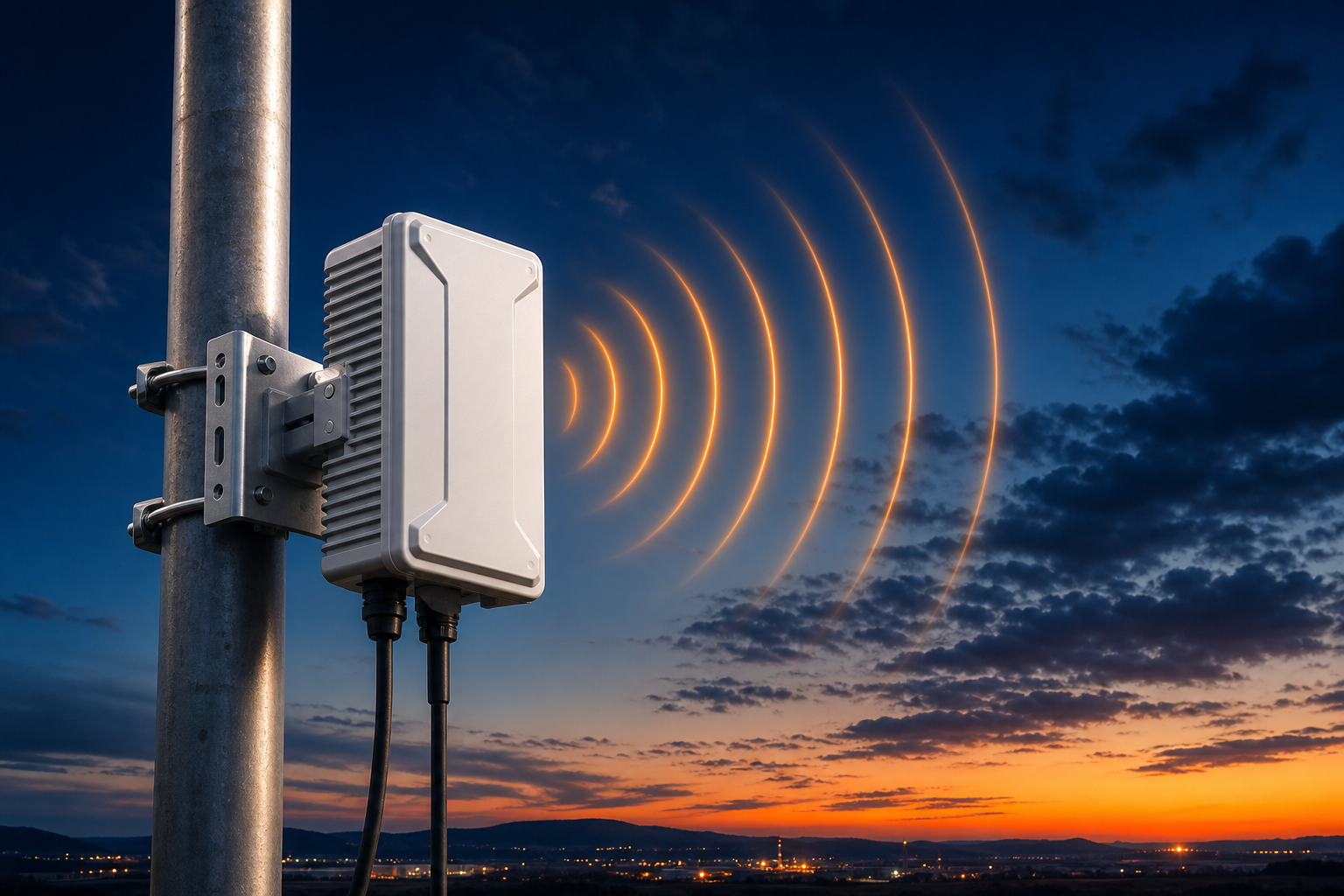
1. Fixed Wireless Access with SLA Guarantees. Enterprises replacing MPLS or leased-line connections with 5G FWA demand service-level agreements on throughput and availability. Network slicing enables operators to deliver a dedicated FWA slice with guaranteed resources, and the CPE at the customer site becomes the SLA enforcement point. Honlly Telecom HL-880U outdoor 5G CPE, for instance, supports carrier aggregation across sub-6 GHz bands with IP67-rated enclosures suitable for rooftop and tower-mounted deployments in SLA-backed FWA services.
2. Industrial Private Networks. Manufacturing facilities, ports, and logistics hubs require deterministic low-latency connectivity for automated guided vehicles (AGVs), robotic control systems, and real-time video analytics. Slice-aware CPE devices operating in the n77/n78/n79 bands can deliver sub-10ms latency while coexisting with public network traffic on the same infrastructure.
3. Multi-Tenant Enterprise Buildings. Office complexes and co-working spaces increasingly demand per-tenant network isolation. A single slice-aware CPE can serve multiple virtual networks, each with its own security policy, bandwidth allocation, and routing domain, reducing hardware footprint and simplifying deployment for managed service providers.
Market Outlook: What Buyers Should Watch
For ISPs, system integrators, and enterprise procurement teams evaluating 5G CPE in 2026, the key question is no longer whether a device supports 5G but rather whether it supports the 5G SA features the network will deploy over the next 36 months. A CPE that cannot handle multiple PDU sessions, URSP rules, or slice-aware QoS will become a bottleneck as operators roll out slice-based services commercially.
Industry forecasts from Omdia suggest that slice-capable CPE shipments will grow at a 42% CAGR between 2026 and 2030, driven primarily by enterprise FWA and industrial private network deployments. For operators and enterprises making procurement decisions today, selecting CPE with a clear 5G SA and network slicing roadmap is essential to future-proofing network investments.
Frequently Asked Questions
Q: What is the difference between 5G NSA and 5G SA in terms of network slicing? A: 5G NSA relies on an LTE core network (EPC) which does not support end-to-end network slicing. True network slicing with guaranteed SLAs requires a 5G SA core (5GC). CPE devices must support the 5G SA protocol stack, including S-NSSAI handling and multiple PDU sessions, to participate in sliced services.
Q: Can existing 5G CPE devices support network slicing through a firmware upgrade? A: In most cases, no. Supporting network slicing requires modem hardware that implements the 5G SA NAS layer and supports multiple concurrent PDU sessions. While some recent CPE devices with Snapdragon X65/X70 or newer chipsets may be upgradeable, earlier 5G NSA-only hardware cannot add slicing support through firmware updates alone.
Q: How does network slicing affect CPE procurement costs? A: Slice-capable CPE devices typically carry a 15 to 30 percent premium over equivalent 5G NSA-only hardware, reflecting the more advanced modem silicon and additional software development. However, this premium should be weighed against the ability to support multiple revenue-generating services from a single device and avoid hardware replacement when operators launch commercial slicing services.
Looking for 5G SA-ready CPE solutions for your network? Honlly Telecom offers a comprehensive portfolio of carrier-grade 5G CPE devices with support for network slicing, multi-PDU session management, and TR-369 remote management. Contact our solutions team to discuss your deployment requirements.
The enterprise wireless connectivity landscape is at an inflection point. For the first time, system integrators have two genuinely viable, high-performance options for mission-critical private wireless networks: Private 5G (3GPP Non-Public Network, or NPN) and Wi-Fi 7 (IEEE 802.11be). Each technology brings distinct strengths to the table—and understanding where each fits is essential for making defensible recommendations to enterprise clients.
This comparison examines the two technologies across the dimensions that matter most in enterprise procurement decisions: spectrum access, performance characteristics, security architecture, deployment complexity, ecosystem maturity, and total cost of ownership.
Spectrum Fundamentals: Licensed, Shared, and Unlicensed
The most fundamental difference between Private 5G and Wi-Fi 7 is spectrum governance:
Private 5G can operate in three spectrum models:
Dedicated licensed spectrum (e.g., 3.7–3.8 GHz in Germany’s Campusnetz, n77/n78 bands globally). Provides guaranteed interference protection and predictable performance—the gold standard for industrial applications.
Shared spectrum (e.g., CBRS 3.55–3.70 GHz in the United States, n48 band). The three-tier SAS (Spectrum Access System) model enables enterprises to access spectrum without auction costs, though with some coordination overhead.
Network slicing on a public MNO’s RAN (PNI-NPN). The enterprise gets a logically isolated slice of a public 5G network—lower upfront cost but less control than a standalone private network.
Wi-Fi 7 operates exclusively in unlicensed spectrum: 2.4 GHz, 5 GHz, and the new 6 GHz band (5.925–7.125 GHz). The 6 GHz band—opened by regulators in the US (FCC), EU (CEPT), and many other jurisdictions—provides up to 1,200 MHz of additional spectrum for Wi-Fi 7. However, unlicensed spectrum carries no interference guarantees; performance degrades as neighboring networks, Bluetooth devices, and radar systems compete for the same channels.
Performance: Throughput, Latency, and Determinism
Performance Metric
Private 5G (3GPP Rel 17/18)
Wi-Fi 7 (802.11be)
Peak theoretical throughput
~10 Gbps downlink (4×4 MIMO, 100 MHz BW)
~46 Gbps (320 MHz, 16×16 MIMO, 4096-QAM)
Typical real-world throughput (single client)
1–3 Gbps downlink
2–5 Gbps
Air interface latency (one-way)
1–4 ms (URLLC with mini-slot scheduling)
<5 ms (with MLO and restricted TWT)
Latency determinism
Guaranteed bounded latency via scheduled OFDMA + preemption
Statistical—improved by MLO and QoS, but no hard guarantee
Mobility handover
<10 ms make-before-break; seamless across gNBs
50–200 ms BSS transition; AP-to-AP with brief interruption
Client density per AP/gNB
1,000+ devices per gNB (massive MTC support)
100–256 clients per AP (practical limit)
The headline throughput numbers favor Wi-Fi 7, but the deeper story is about consistency and determinism. Private 5G’s scheduled OFDMA with preemption guarantees that a URLLC transmission gets airtime exactly when needed—critical for industrial control loops, AGV navigation, and remote machinery operation. Wi-Fi 7’s Multi-Link Operation (MLO) and Restricted Target Wake Time (rTWT) significantly improve latency consistency compared to Wi-Fi 6/6E, but the technology remains fundamentally contention-based.
Security Architecture
Both technologies offer enterprise-grade security, but their models differ:
Private 5G security inherits the full 3GPP security framework: SIM/eSIM-based mutual authentication (5G-AKA or EAP-AKA’), ciphering and integrity protection at the PDCP layer, secure key hierarchy with forward secrecy, and physically isolated network infrastructure. The SIM-based credential model means every device has a hardware-rooted identity that cannot be spoofed through software alone—a meaningful advantage in regulated industries.
Wi-Fi 7 security builds on WPA3-Enterprise with 256-bit GCMP-256 encryption, Protected Management Frames (PMF), and Simultaneous Authentication of Equals (SAE) for personal mode. For enterprise deployments, WPA3-Enterprise + 802.1X + RADIUS provides robust authentication. However, MAC address randomization (now default on iOS, Android, and Windows) complicates device identification and policy enforcement in large-scale Wi-Fi deployments.
Verdict: Private 5G provides stronger, more tamper-resistant device identity via SIM-based authentication. For use cases requiring device-level guaranteed identity—pharmaceutical manufacturing, defense contractors, financial trading floors—this is a tangible advantage. For standard office/branch connectivity, WPA3-Enterprise is fully adequate.
Deployment Complexity and Ecosystem Maturity
Wi-Fi 7 benefits from decades of enterprise Wi-Fi deployment experience. The ecosystem is mature: APs from Aruba, Cisco, Juniper Mist, and Ruckus; controllers and cloud management platforms with well-understood deployment models; and a global base of certified Wi-Fi engineers. Most enterprise IT teams can plan, deploy, and operate a Wi-Fi 7 network with existing in-house skills.
Private 5G requires specialized RF planning, a 5G core (which can be deployed on-premises as a compact server appliance or consumed as-a-service), and SIM/eSIM lifecycle management. While the ecosystem is maturing rapidly—with turnkey solutions from Nokia DAC, Ericsson Private 5G, Athonet, and Celona—the talent pool of enterprise 5G engineers remains limited. System integrators play a crucial bridging role here, combining cellular expertise with enterprise IT integration capabilities.
Total Cost of Ownership: A Practical Framework
TCO comparisons between Private 5G and Wi-Fi 7 must account for the specific deployment scenario. A generic per-square-meter comparison is misleading. Instead, system integrators should evaluate across four dimensions:
1. Coverage area and density. Private 5G’s superior propagation characteristics (especially in sub-6 GHz bands) mean fewer radio units per square meter compared to Wi-Fi 7 APs. For a 50,000 m² warehouse, Private 5G might require 8–12 radio units vs. 25–40 Wi-Fi 7 APs—significantly reducing cabling, mounting, and switch port costs.
2. Device ecosystem cost. Wi-Fi 7 client devices (laptops, phones, tablets) are commodity-priced. Private 5G client devices—industrial CPE, 5G modules for AGVs, and ruggedized handsets—carry a premium of $200–$800 per device compared to Wi-Fi equivalents. This premium narrows as 5G module volumes scale but remains a meaningful consideration for large device fleets.
3. Spectrum access cost. Wi-Fi 7 uses free unlicensed spectrum. Private 5G spectrum costs vary widely: CBRS SAS fees in the US are nominal ($2–$4 per CBSD annually); dedicated licensed spectrum in Germany can cost €1,000–€5,000 per year depending on the allocation. In markets where enterprises can access shared spectrum at low cost, the spectrum cost advantage of Wi-Fi diminishes.
4. Operational overhead. Wi-Fi networks require ongoing channel planning, interference management, and firmware updates—operational tasks that most IT teams already handle. Private 5G networks have lower ongoing RF management burden (scheduled spectrum eliminates co-channel interference concerns) but introduce SIM lifecycle management as a new operational function.
Wi-Fi 7 primary + Private 5G overlay for research/security
Hybrid model leverages strengths of both
Mining / remote industrial site
Private 5G
Coverage range, mobility, device density
The Converged Future: 5G + Wi-Fi 7 as Complementary Layers
The most forward-looking enterprise deployments are not choosing between Private 5G and Wi-Fi 7—they are deploying both as complementary connectivity layers within a unified management framework. In this model:
Wi-Fi 7 serves as the high-throughput, low-cost access layer for standard enterprise clients (laptops, phones, guest devices).
Private 5G serves as the deterministic, high-reliability layer for mission-critical applications (AGVs, industrial control, security cameras, IoT sensor backhaul).
A common policy framework—often based on 3GPP’s ATSSS (Access Traffic Steering, Switching, and Splitting) or enterprise SD-WAN—steers traffic to the appropriate access layer based on application requirements.
For system integrators, the competitive advantage lies in being able to architect both technologies, not just one. The enterprises winning in digital transformation are those that treat wireless connectivity as a multi-layer strategy rather than a single-technology decision.
Frequently Asked Questions
Is Private 5N more expensive than Wi-Fi 7 for a typical enterprise deployment?
Yes, generally. For a typical 5,000 m² office deployment, Private 5G hardware and licensing costs are typically 2–3× higher than an equivalent Wi-Fi 7 deployment. However, for large-area industrial deployments (50,000+ m²), the cost gap narrows significantly because Private 5G requires fewer radio units per square meter. TCO should be calculated per use case, not per square meter.
Can Private 5G and Wi-Fi 7 coexist in the same physical space?
Yes. Private 5G and Wi-Fi 7 operate in different spectrum bands with different air interface protocols—they do not interfere with each other at the RF level. Coexistence is purely an operational consideration: both networks need power, backhaul, and management. Many enterprise campuses already operate cellular DAS (Distributed Antenna Systems) alongside Wi-Fi without issues.
Does Wi-Fi 7 support seamless roaming like Private 5G?
No. Wi-Fi 7 improves roaming with features like Multi-Link Operation (MLO) and enhanced BSS transition, but roaming remains a client-initiated decision with a brief interruption (typically 50–200 ms). Private 5G uses network-controlled make-before-break handover with sub-10 ms interruption times, which is essential for applications like autonomous vehicle navigation and real-time video analytics.
What spectrum options are available for Private 5G in my country?
Spectrum availability varies by regulator. The US offers CBRS (3.55–3.70 GHz) for shared access. Germany has dedicated 3.7–3.8 GHz for industrial private networks (Campusnetz). Japan allocated 4.6–4.8 GHz and 28.2–29.1 GHz. The UK offers shared access to 3.8–4.2 GHz and 24.25–26.5 GHz. Many other countries are developing similar frameworks. Contact your national regulator or a specialized system integrator for current availability.
What CPE hardware is required for Private 5G client devices?
Private 5G client devices require a 5G module or CPE that supports the specific band (n48 for CBRS, n77/n78 for mid-band, etc.) and is certified for the target private network. Many industrial 5G CPE routers, USB dongles, and embedded modules are now available from manufacturers including Honlly Telecom, supporting the major private 5G frequency bands with SIM/eSIM-based authentication and TR-369 USP management.
Design Your Enterprise Wireless Architecture
Honlly Telecom supplies Private 5G-compatible CPE, industrial routers, and modules that support CBRS (n48), n77/n78, and global 5G bands with SIM/eSIM authentication. Whether you are deploying a standalone Private 5G network or a hybrid 5G + Wi-Fi 7 architecture, our engineering team can help you select and configure the right CPE for your deployment. Contact us to discuss your Private 5G CPE requirements and request technical documentation.
Frequently Asked Questions
Q1: What is the difference between private 5G (NPN) and Wi-Fi 7 for enterprises?
Private 5G (NPN) offers licensed-spectrum reliability, wider coverage, and deterministic latency—ideal for Industry 4.0, logistics, and large campuses. Wi-Fi 7 delivers ultra-high throughput (up to 46 Gbps) with MLO and 320 MHz channels, making it a strong choice for high-density office environments and indoor wireless.
Q2: Which technology offers better security—private 5G or Wi-Fi 7?
Private 5G benefits from 3GPP-defined SIM authentication, end-to-end encryption, and isolated network slicing. Wi-Fi 7 supports WPA3-Enterprise and enhanced encryption but remains vulnerable to RF interference and co-channel contention. For mission-critical environments, private 5G provides stronger security guarantees.
Q3: Can private 5G and Wi-Fi 7 coexist in the same enterprise deployment?
Yes. Many enterprises deploy private 5G for wide-area coverage and critical OT systems, while using Wi-Fi 7 for high-speed indoor data. Converged core architectures (5G-WiFi interworking) allow seamless roaming and unified policy management.
Q4: What are the cost implications of deploying private 5G vs Wi-Fi 7?
Private 5G requires spectrum licensing/acquisition, dedicated RAN, and a 5G core—making initial CAPEX higher but TCO competitive for large sites. Wi-Fi 7 leverages unlicensed spectrum and existing Ethernet backhaul, keeping deployment costs lower but requiring denser AP placement.
Q5: When should system integrators recommend private 5G over Wi-Fi 7?
Choose private 5G when mobility (handover at vehicle speed), ultra-reliable low-latency communication (URLLC), outdoor/wide-area coverage, or strict SLA enforcement is required. Choose Wi-Fi 7 for high-throughput indoor data, existing enterprise LAN infrastructure, and budget-constrained deployments.
For telecom operators managing thousands—or hundreds of thousands—of customer premises equipment (CPE) devices, the device management protocol is not a technical footnote. It determines provisioning speed, diagnostic capability, firmware update reliability, and ultimately, operational cost per subscriber. The Broadband Forum’s TR-369 User Services Platform (USP) is the designated successor to the aging TR-069 (CWMP) protocol, and its adoption is accelerating across carrier-grade CPE deployments worldwide.
This guide provides a practical overview of TR-369 USP: what it does, why it matters, how to plan a migration from TR-069, and what procurement teams should verify when sourcing USP-compatible CPE.
What Is TR-369 USP and Why Is It Replacing TR-069?
TR-069 (CPE WAN Management Protocol, or CWMP) has been the workhorse of broadband CPE management since 2004. It enabled auto-configuration servers (ACS) to provision, monitor, and update CPE remotely. However, TR-069 was designed in an era of DSL modems and simple NAT routers. It struggles with modern deployment realities: multi-WAN CPE, mesh Wi-Fi systems, IoT gateways, containerized applications on CPE, and the low-latency telemetry that operators now expect.
TR-369 USP, first published in 2018 and now at version 1.3 (2023), addresses these limitations with a fundamentally modern architecture:
REST/WebSocket-based messaging instead of SOAP/HTTP. This reduces overhead, supports real-time push notifications, and integrates naturally with cloud-native operator OSS/BSS stacks.
Multi-controller support. A single CPE can be managed simultaneously by multiple controllers—for example, the operator’s ACS for provisioning, a separate analytics platform for telemetry, and an end-user mobile app for Wi-Fi optimization.
Data model based on TR-181. USP reuses and extends the mature TR-181 Device Data Model (also used by TR-069), so operators can map existing parameter paths. But USP adds new objects for Wi-Fi 6/7, 5G NR, IoT sensors, and virtualized network functions.
End-to-end security with TLS 1.3 and mutual certificate authentication. USP mandates encrypted transport and device-to-controller certificates, eliminating the plaintext HTTP provisioning vectors that vexed TR-069 deployments.
Bulk data collection with USP’s “Trusted Broker” and “Subscription” mechanisms. Operators can define periodic telemetry subscriptions—for signal strength, throughput, and Wi-Fi channel utilization—without polling each device individually.
USP Architecture: Controllers, Agents, and the Message Transfer Protocol
USP defines a clean separation between three components:
1. USP Agent — embedded in the CPE firmware. Exposes the device’s data model (TR-181 objects) and executes commands from controllers.
2. USP Controller — the operator-side management system (ACS replacement). Sends commands, creates subscriptions, and processes notifications.
3. MTP (Message Transfer Protocol) — the transport layer. The primary binding is WebSocket with TLS 1.3, but USP also supports MQTT and CoAP bindings for constrained IoT devices—a flexibility TR-069 never offered.
This architecture enables a critical operational improvement: always-on connectivity. In TR-069, the ACS could only reach the CPE when the device initiated a session (typically via periodic inform messages). In USP, the WebSocket connection is persistent, allowing the controller to push commands instantly—vital for time-sensitive operations like firmware security patches or QoE remediation.
Checklist: What Operators Should Verify When Procuring USP-Compatible CPE
Not all CPE marketed as “USP-compatible” delivers the full operational benefit. Procurement teams should validate the following before committing to large-volume orders:
Verification Item
Why It Matters
How to Test
USP Agent version (≥1.2)
Version 1.2+ supports bulk data, trusted broker, and firmware management improvements
Request GetInstances on Device.LocalAgent.Controller.
WebSocket MTP with TLS 1.3
Mandatory for persistent connectivity; older MQTT-only implementations limit real-time control
Attempt WebSocket connection from controller to agent endpoint; verify TLS cert chain
TR-181 data model coverage (Device.WiFi., Device.Cellular., Device.Bridging.)
Full coverage enables Wi-Fi optimization, cellular signal monitoring, and VLAN configuration
Run GetSupportedDM to enumerate exposed objects; compare against TR-181 spec
Register two controllers with different credentials; verify both can query
Firmware update with USP (DUStateChangeNotif)
USP-native firmware management is more reliable than TR-069 download methods
Push a test firmware image via USP; verify download, validation, and install notification
Subscription/Notify mechanism
Push-based telemetry eliminates polling overhead; critical for QoE monitoring at scale
Create a subscription for Device.Cellular.SignalStrength; verify periodic value-changed notifications
TR-069 to TR-369 Migration: A Phased Approach
Most operators cannot flip a switch and replace TR-069 overnight. A practical migration follows three phases:
Phase 1 — Dual-stack deployment (months 1–6). Deploy new CPE with both TR-069 and USP agents running. The existing ACS continues to manage day-to-day operations, while the USP controller is validated against a subset of devices for provisioning, telemetry, and firmware management. This is the lowest-risk entry point.
Phase 2 — Controller cutover (months 6–12). Once the USP controller has been validated against all critical workflows, begin routing new device activations exclusively through USP. Existing devices remain on TR-069 or dual-stack until natural hardware refresh occurs.
Phase 3 — TR-069 deprecation (months 12–24). As the installed base refreshes, the TR-069 ACS can be scaled down and eventually decommissioned. USP-native capabilities—bulk telemetry, multi-controller support, application lifecycle management—become the operational baseline.
Why USP Matters for the CPE Supply Chain
For distributors and system integrators, TR-369 compliance is becoming a hard requirement in operator RFPs—particularly in Europe, where Deutsche Telekom, BT Group, and Orange have all published USP roadmap requirements for CPE vendors. In North America, the Broadband Forum’s BBF.369 certification program is driving similar momentum. CPE models that lack USP support will face increasing procurement barriers in carrier tenders from 2026 onward.
When evaluating OEM/ODM partners, verify that the manufacturer has completed USP Agent implementation with a Broadband Forum-recognized test tool (such as the USP Agent Conformance Test or CDRouter USP), and that their roadmap includes support for upcoming USP 1.4 features, including enhanced IoT proxy capabilities and application container management.
Frequently Asked Questions
What is the difference between TR-069 and TR-369 USP?
TR-069 (CWMP) uses SOAP/HTTP for periodic device polling through an ACS. TR-369 USP uses REST/WebSocket for persistent, real-time bidirectional communication. USP supports multi-controller management, bulk data subscriptions, and modern encryption (TLS 1.3), while TR-069 is limited to a single ACS controller with periodic inform-based communication. USP also extends the TR-181 data model to cover Wi-Fi 6/7, 5G NR, and IoT functions that TR-069 cannot represent.
Does USP work with existing TR-069 ACS platforms?
No. USP requires a dedicated USP Controller, not a TR-069 ACS. However, many modern device management platforms (including those from Axiros, Friendly Technologies, and Incognito) now offer dual-protocol support, managing both TR-069 and USP devices from a single administrative interface. This dual-protocol capability is essential for operators managing a mixed installed base during migration.
Is USP mandatory for 5G FWA CPE?
USP is not a 3GPP requirement for 5G, but it is increasingly specified in operator procurement RFPs for 5G FWA CPE, particularly in Europe and parts of Asia-Pacific. The protocol’s ability to handle multi-WAN scenarios (cellular + fixed backup) and real-time signal quality telemetry makes it well-suited for 5G FWA management. Some operators accept TR-069 for initial deployments but require a USP roadmap within 12–18 months.
How does USP handle firmware upgrades at scale?
USP uses the DUStateChangeNotif (Download Update State Change Notification) mechanism for firmware management. The controller can push firmware images to device groups, monitor download progress in real time via WebSocket notifications, verify image integrity before installation, and schedule installations during maintenance windows. This is more reliable than TR-069’s download methods, which often relied on the device periodically polling for available updates.
Can USP manage non-Broadband CPE like industrial routers and IoT gateways?
Yes. USP’s flexible data model and MTP options (WebSocket, MQTT, CoAP) make it suitable for industrial routers, IoT gateways, and even constrained sensor devices. The protocol’s subscription mechanism is particularly valuable for industrial use cases where periodic sensor readings or equipment status updates need to flow to a central management platform without constant polling.
Plan Your TR-369 USP CPE Deployment
Honlly Telecom’s carrier-grade 4G/5G CPE and industrial routers support TR-369 USP alongside TR-069 for seamless migration. Our engineering team can provide USP Agent conformance test reports, data model coverage documentation, and integration support for your operator management platform. Contact us to discuss your USP CPE requirements and request a test sample.
The embedded SIM (eSIM) market is entering a phase of rapid commercial deployment, and its trajectory has direct implications for telecom equipment buyers. According to GSMA Intelligence, global eSIM connections are forecast to reach 7.6 billion by 2030, up from approximately 1.2 billion in 2024. While smartphones drove early adoption, the growth engine is shifting toward IoT devices, fixed wireless access (FWA) CPE, and industrial routers—the very product categories that define the B2B telecom equipment supply chain.
What Is Driving eSIM Adoption in CPE and IoT?
Three structural factors are converging to accelerate eSIM integration in non-handset devices:
1. GSMA SGP.32 for IoT. The GSMA’s SGP.32 specification, finalized in 2023 and now entering commercial implementations, defines a lightweight eSIM provisioning architecture purpose-built for constrained IoT devices. Unlike the consumer-focused SGP.22 standard that relies on QR-code-driven SM-DP+ servers, SGP.32 introduces the IoT Profile Assistant (IPA) and eSIM IoT Remote Manager (eIM), enabling fully remote, zero-touch profile switching across networks. This removes the single largest barrier to eSIM adoption in fixed CPE: the need for physical intervention when changing carriers.
2. Operator demand for zero-touch provisioning. Tier-1 operators including Vodafone, Deutsche Telekom, and AT&T are scaling FWA deployments that require rapid, remote subscriber onboarding. Embedding an eSIM at the manufacturing stage allows operators to ship CPE directly to end users and activate service over the air, cutting logistics costs by an estimated 15–20% per subscriber according to industry analyst estimates.
3. Regulatory mandates in key markets. India’s TRAI and Brazil’s Anatel have both introduced frameworks recognizing eSIM as a compliant connectivity module for CPE-type devices. The EU’s proposed eIDAS 2.0 regulation further normalizes eSIM as a trusted identity carrier, reducing legal friction for cross-border device distribution.
Implications for CPE Manufacturers and OEM/ODM Buyers
For OEM and ODM buyers sourcing 4G/5G CPE and MiFi devices, the eSIM shift introduces several practical considerations:
Hardware readiness. Integrating eSIM (eUICC) requires an embedded secure element—typically a discrete GSMA-certified chip such as ST4SIM or Thales Cinterion, or a system-on-chip (SoC) solution from Qualcomm or MediaTek with integrated iSIM capability. Buyers should verify that selected CPE models support at minimum GSMA SGP.02 (M2M) for current deployments, with a clear roadmap to SGP.32 (IoT) compatibility.
Carrier certification timelines. eSIM-capable CPE must still pass individual operator certification for network attachment. While the eSIM standardizes the credential carrier, it does not bypass the need for GCF/PTCRB certification or operator-specific IOT testing. Lead times of 8–14 weeks remain typical.
Inventory flexibility. One underappreciated advantage of eSIM-based CPE is SKU consolidation. A single eSIM-equipped 5G FWA CPE model can be pre-provisioned or remotely provisioned for multiple operators across different markets. This reduces the inventory fragmentation that plagues traditional SIM-locked device distribution—a meaningful cost lever for distributors serving multi-operator accounts.
eSIM vs. Traditional SIM in CPE: A Practical Comparison
Factor
Traditional SIM
eSIM (eUICC)
Physical handling
Requires insertion/replacement
Soldered at factory; no field handling
Carrier switching
Physical SIM swap needed
Remote profile download (OTA)
Multi-profile support
Single profile per card
Multiple operator profiles stored
Device tamper resistance
SIM slot accessible externally
Embedded—higher physical security
Unit cost delta
Baseline
+$1.50–$3.00 BOM (declining)
What ISPs, MVNOs, and Distributors Should Evaluate Now
Telecom buyers who are procuring CPE for multi-year deployments should incorporate eSIM readiness into their RFP criteria. Key evaluation points include:
Does the CPE support eUICC with remote SIM provisioning (RSP) per GSMA SGP.02 or SGP.32?
Has the manufacturer completed interoperability testing with your target MNO’s SM-DP+ or eIM platform?
Does the device firmware support local profile assistant (LPA) functions for consumer-facing activation flows?
What is the manufacturer’s roadmap for iSIM (integrated SIM) support, which embeds the eUICC function directly into the modem SoC?
The market is moving decisively toward software-defined connectivity. CPE devices that ship with eSIM as a standard feature—rather than a premium option—will define the next procurement cycle for forward-looking operators and distributors.
Frequently Asked Questions
What is the difference between eSIM and iSIM in CPE devices?
eSIM (eUICC) is a discrete hardware secure element soldered onto the device PCB, compliant with GSMA specifications. iSIM (integrated SIM) integrates the eUICC function directly into the device’s system-on-chip (SoC), eliminating the need for a separate chip. iSIM offers further BOM cost reduction and smaller footprint but is at an earlier stage of carrier certification maturity.
Can eSIM-equipped CPE work with operators that do not yet support eSIM?
Yes. Most eSIM-capable CPE also includes a physical SIM slot for fallback. During the transition period, operators that do not support RSP can still provision service using a traditional SIM card inserted into the device’s physical slot. The eSIM provides future-readiness without sacrificing current compatibility.
How does GSMA SGP.32 change the IoT eSIM landscape?
SGP.32 introduces a dedicated IoT provisioning architecture that eliminates the need for an end-user-facing local profile assistant (LPA). Instead, an IoT Profile Assistant (IPA) embedded in the device communicates with an eSIM IoT Remote Manager (eIM) managed by the operator. This enables fully automated, zero-touch profile management suitable for fixed CPE, industrial routers, and large-scale IoT fleets.
Is eSIM more secure than a physical SIM card?
From a physical security standpoint, yes. An eSIM is soldered to the device PCB and cannot be removed or tampered with without disassembling the device. From a logical security standpoint, eSIM provisioning uses the same mutual authentication and encryption mechanisms as traditional SIM—the security model is equivalent, with additional protections against physical theft of credentials.
What is the typical lead time for eSIM CPE procurement?
eSIM-capable CPE procurement lead times are generally 8–14 weeks for standard models, comparable to traditional SIM-based CPE. The main variable is operator-specific IOT testing and SM-DP+/eIM platform integration, which can add 4–6 weeks for the first deployment with a given operator. Subsequent deployments with the same operator typically proceed faster.
Get Expert Guidance on eSIM-Capable CPE
Honlly Telecom offers a comprehensive portfolio of 4G/5G CPE, MiFi, and industrial routers with eSIM (eUICC) capability. Our engineering team can guide you through eSIM integration requirements, carrier certification, and SKU planning for your target markets. Contact our team today to discuss your eSIM CPE requirements.
Frequently Asked Questions — eSIM in CPE Devices
What is eSIM and how does it differ from traditional SIM cards?
eSIM (embedded SIM) is a soldered chip that allows remote SIM provisioning (RSP) without physical card swapping. Unlike traditional SIMs, eSIM supports multiple carrier profiles stored simultaneously, enables over-the-air carrier switching, and eliminates physical SIM slot requirements — enabling smaller, more durable device designs ideal for outdoor CPE and industrial routers.
Why is eSIM adoption accelerating in CPE and IoT devices in 2026?
Three factors drive 2026 eSIM acceleration: (1) GSMA SGP.32 IoT eSIM standard finalized for mass deployment, (2) major carriers launching eSIM-only data plans for FWA and IoT, and (3) CPE manufacturers adopting eSIM to reduce logistics costs and enable remote carrier provisioning for global deployments without regional SIM variants.
Does Honlly Telecom offer eSIM-compatible CPE and MiFi devices?
Yes. Honlly Telecom offers eSIM-compatible 4G/5G CPE and MiFi devices including the HL-430A and HL-540A with eSIM + physical SIM dual support. Our devices support GSMA RSP compliance for remote carrier profile downloads and management, giving operators and MVNOs maximum deployment flexibility.
What does GSMA SGP.32 mean for IoT and CPE procurement?
GSMA SGP.32 is the IoT eSIM specification that enables bulk, automated eSIM profile management without per-device user consent. For CPE procurement, this means operators can deploy thousands of devices with a single eSIM profile, remotely switch carriers post-deployment, and eliminate physical SIM logistics costs — a game-changer for large-scale FWA and IoT rollouts.
How does eSIM benefit operators and MVNOs deploying CPE at scale?
eSIM benefits operators through: reduced SIM logistics and warehousing costs, instant remote provisioning at device activation, carrier profile switching without truck rolls, reduced device returns due to SIM compatibility issues, and simpler multi-market deployments with region-specific carrier profiles managed through a single eSIM platform.
The global fixed wireless access (FWA) market is entering a period of accelerated deployment, with mobile network operators (MNOs) across North America, Europe, the Middle East, and Asia-Pacific ramping up 5G CPE procurement to support broadband expansion strategies. Industry data from the GSA confirms that over 560 operators in 180+ countries have now launched commercial 5G networks, with FWA identified as a primary 5G use case by more than 40% of them.
FWA as the Operator Broadband Growth Engine
For MNOs, 5G FWA solves a fundamental business problem: how to monetize 5G spectrum investments beyond mobile data plans. By deploying 5G CPE in subscriber homes and businesses, operators can sell fixed broadband services without the capital expenditure of fiber trenching or cable infrastructure. This model is particularly compelling in three deployment scenarios:
Rural and underserved areas: Where fiber build-out costs exceed $5,000 per household passed, 5G FWA delivers 100–500 Mbps at a fraction of the deployment cost.
Multi-dwelling units (MDUs): Apartment buildings where internal wiring limits traditional broadband options. A single 5G CPE can serve as the building’s internet gateway.
Temporary and event connectivity: Construction sites, outdoor events, and emergency response scenarios where fixed-line infrastructure is impractical.
CPE Procurement Trends Shaping 2026
Several shifts in operator procurement behavior are reshaping the 5G CPE supply chain:
Shift to Multi-Sourcing
After supply chain disruptions in 2021–2023, operators are moving away from single-vendor CPE procurement. Major operators now qualify 2–3 CPE suppliers per product category (indoor CPE, outdoor CPE, MiFi), creating opportunities for second-tier and regional OEM manufacturers to win operator business.
Rise of Open CPE Platforms
Operators are increasingly specifying open CPE platforms based on standardized chipsets (Qualcomm, MediaTek) rather than proprietary vendor-locked hardware. This trend favors agile ODM manufacturers that can deliver reference-design-based products with operator-specific firmware customization.
WiFi 7 Integration Becoming Standard
New 5G CPE designs shipping in 2026 increasingly integrate WiFi 7 (802.11be) as the LAN-side wireless interface. With 4×4 MIMO, 320 MHz channels, and MLO (Multi-Link Operation), WiFi 7 ensures the CPE’s LAN performance matches its 5G WAN throughput, eliminating the in-home bottleneck that plagued early WiFi 5/6 CPE deployments.
Regional Deployment Spotlight
Middle East and Africa
The Gulf states continue to lead 5G FWA adoption, with operators in Saudi Arabia, UAE, and Qatar deploying tens of thousands of 5G CPE units for home broadband. In sub-Saharan Africa, 4G FWA remains the primary growth driver, but operator interest in 5G FWA is accelerating in South Africa, Kenya, and Nigeria as spectrum allocations progress.
Southeast Asia
Indonesia, the Philippines, and Vietnam are emerging as high-growth FWA markets where 4G/5G CPE addresses the connectivity gap in archipelagic geographies where fiber deployment is logistically challenging and expensive.
Latin America
Brazil, Mexico, and Colombia have seen a surge in FWA-based broadband plans as operators use 5G spectrum acquired in recent auctions to compete with cable and fiber incumbents in urban and suburban markets.
Procurement Outlook for ISPs and Distributors
For ISPs and telecom distributors sourcing 5G CPE, the current market presents both opportunity and complexity. Lead times for carrier-grade CPE have stabilized at 4–8 weeks for standard configurations, but custom firmware and certification requirements can extend timelines significantly. Procurement teams should:
Qualify OEM partners that hold active certifications in target deployment markets.
Request carrier aggregation and band combination validation reports for specific operator networks.
Negotiate firmware customization and FOTA management as standard terms in the supply agreement.
Build buffer inventory for the most popular 5G CPE SKUs to absorb demand spikes during operator rollouts.
FAQ
What is the difference between carrier-grade and consumer 5G CPE?
Carrier-grade 5G CPE meets operator specifications for remote management (TR-069/TR-369), supports operator-specific band combinations, undergoes interoperability testing with core network equipment, and typically includes higher-gain antennas and more robust thermal design for 24/7 operation.
How many 5G FWA subscribers are there globally in 2026?
Industry analysts project global 5G FWA connections to exceed 50 million by end of 2026, driven primarily by deployments in North America, GCC countries, and Asia-Pacific. The total addressable market for FWA CPE continues to expand as more operators launch 5G FWA services.
Can distributors mix 5G CPE and 4G CPE in the same supply agreement?
Yes. Many OEM manufacturers, including Honlly Telecom, offer combined 4G/5G CPE supply agreements that give distributors flexibility to serve both emerging-market 4G FWA demand and developed-market 5G FWA demand from a single supplier relationship.
Monitoring the 5G CPE market for your next procurement cycle? Contact Honlly Telecom for product specifications, volume pricing, and lead time estimates across our full 4G/5G CPE portfolio.
For telecom distributors, adding 5G CPE to the product portfolio is a high-reward move — but only if the OEM partnership behind it is built on solid ground. A weak supplier relationship can mean delayed shipments, compliance gaps, or products that fail in the field. This checklist covers the seven factors every distributor should verify before signing a 5G CPE OEM agreement.
1. Regulatory Certifications and Compliance
Your end customers — ISPs and operators — will not deploy uncertified equipment. Confirm the OEM holds up-to-date certifications for your target markets:
CE (Europe): Mandatory for EU market access. Verify RED Directive 2014/53/EU compliance for wireless devices.
FCC (United States): Required for any device radiating RF energy in the US market.
GCF/PTCRB: Essential for operator acceptance in North America, Europe, and many APAC markets.
Anatel (Brazil), NCC (Taiwan), SRRC (China): Country-specific certifications that can add 8–16 weeks to time-to-market if not pre-certified.
Ask the OEM for a current certification matrix covering their entire 5G CPE product line. A manufacturer that proactively maintains certifications across target regions saves distributors months of compliance work.
2. Chipset Platform and Performance
The chipset defines the product’s performance ceiling. For 5G CPE in 2026, the leading platforms are:
Qualcomm Snapdragon X65/X72/X75: Dominant in carrier-grade CPE, supporting 3GPP Release 16/17 with up to 4.4 Gbps downlink.
MediaTek T750/T830: Competitive mid-range platforms with strong price-performance for sub-6 GHz 5G CPE.
UNISOC Ivy V510/V516: Cost-optimized platforms suitable for entry-level FWA CPE in price-sensitive markets.
Verify not just the chipset model but also the specific modem firmware version and carrier aggregation combinations the OEM has validated. A chipset on paper is not the same as a chipset in production.
3. Band and Network Compatibility Matrix
5G spectrum allocations vary dramatically by region. A CPE that works on n78 (3.5 GHz) in Europe may be useless in a market where 5G operates primarily on n41 (2.5 GHz) or n79 (4.7 GHz). Request the OEM’s complete band support matrix, including:
EN-DC combinations validated in operator lab tests
SA (Standalone) and NSA (Non-Standalone) mode support
4. Firmware Customization and OTA Update Capability
Operators rarely deploy CPE with stock firmware. They need custom APN profiles, branded web UIs, TR-069/TR-369 ACS integration, and the ability to push firmware updates over the air. Confirm the OEM can deliver:
White-label web UI with operator branding and custom logo
Custom APN and network profile pre-configuration
TR-069 (CWMP) and TR-369 (USP) support for remote device management
FOTA (Firmware Over The Air) with differential update packages to minimize data usage
API access for integration with operator OSS/BSS systems
5. Production Capacity and Lead Time Stability
An OEM that quotes 4-week lead times during sampling but delivers in 12 weeks during production runs will damage your customer relationships. Verify:
Monthly production capacity for 5G CPE — request a factory capacity statement
Component sourcing strategy — how does the OEM manage chipset and RF component lead times?
Historical on-time delivery rate for orders of similar volume to your projected needs
Buffer stock policy for repeat orders
6. Quality Assurance and Field Failure Rate
CPE deployed in subscriber homes or outdoor locations must withstand real-world conditions. Request the OEM’s quality data:
Factory-level defect rate (target: under 0.5%)
Field return rate after 12 months (target: under 2%)
MTBF (Mean Time Between Failures) rating for the specific CPE model
Environmental testing reports: temperature range, humidity, ESD protection
A reputable OEM should share these metrics without hesitation. If they won’t share quality data, treat it as a red flag.
7. After-Sales Support and Warranty Structure
The OEM relationship doesn’t end at shipment. Clarify the after-sales framework before signing:
Standard warranty period (industry norm: 12–24 months)
RMA (Return Merchandise Authorization) process and turnaround time
Technical support escalation path — do you get direct access to the OEM’s engineering team?
Spare parts and accessories availability for the product lifecycle
End-of-life (EOL) notice period — 6+ months is standard for carrier-grade CPE
FAQ
What is the minimum order quantity for 5G CPE OEM partnership?
Minimum order quantities vary by customization level. Standard ODM products typically start at 500–1,000 units. Fully customized 5G CPE projects may require 3,000–5,000 unit commitments depending on tooling and certification investment.
How long does it take to bring a custom-branded 5G CPE to market?
For ODM products with existing certifications, custom branding adds 2–4 weeks to standard lead times. A new hardware design with full certification can take 6–12 months from specification to first shipment.
Does Honlly Telecom provide samples for operator lab testing?
Yes. Honlly Telecom provides engineering samples for operator lab validation, interoperability testing, and field trials. Contact our sales team to request sample units with your target band configuration.
Ready to evaluate a 5G CPE OEM partnership? Contact Honlly Telecom to request a product briefing, certification matrix, and sample unit.
What should I verify before signing a 5G CPE OEM partnership agreement?
Before signing, distributors and operators should verify 7 critical factors: (1) chipset platform and roadmap support for long-term product viability, (2) global certification coverage (CE, FCC, GCF, PTCRB) for target markets, (3) firmware customization capabilities including TR-069/TR-369, (4) minimum order quantity flexibility aligned with your demand forecast, (5) production capacity and lead time commitments, (6) quality control processes and reliability testing, and (7) post-sales engineering support availability.
What chipset platforms does Honlly Telecom support for 5G CPE OEM?
Honlly Telecom supports all major 5G platforms: Qualcomm (SDX62, SDX55), MediaTek (T750, MT6877), and UNISOC (UDX710). Our engineering team can adapt designs to your specified chipset and provide platform comparison analysis based on your target market, band requirements, and price point objectives.
What is the typical MOQ for OEM/ODM 5G CPE customization?
Honlly Telecom offers flexible MOQ starting from 500-1,000 units for standard customization (branding, packaging, firmware UI) and 3,000-5,000 units for full ODM projects requiring hardware modifications. We work closely with operators and distributors to find the right balance between customization depth and volume requirements.
How long does it take from design freeze to mass production?
For standard OEM customization (branding, packaging, firmware UI), 4-8 weeks from design freeze. For ODM projects requiring hardware modifications, 12-20 weeks depending on complexity. Honlly Telecom’s in-house reliability testing lab accelerates certification testing to reduce time-to-market for our partners.
What certifications can Honlly Telecom support for global markets?
Honlly Telecom supports CE (Europe), FCC (North America), RoHS, REACH, GCF, PTCRB, and operator-specific certifications. Our in-house testing lab and long-standing relationships with global certification bodies help streamline compliance for multi-region deployments, reducing time-to-market and certification costs.
Mobile Virtual Network Operators (MVNOs) face a persistent challenge: how to acquire subscribers profitably in markets where smartphone penetration is rising but fixed broadband infrastructure remains thin. In 2026, a growing number of MVNOs are finding their answer in an unlikely place — the 4G MiFi router.
The MVNO Economics of Portable Broadband
Unlike traditional mobile plans that bundle voice, SMS, and data into a single smartphone subscription, a 4G MiFi device creates a dedicated data revenue stream. For MVNOs operating on thin margins, this separation unlocks three advantages:
Lower subscriber acquisition cost (SAC): A 4G MiFi + data SIM bundle can be priced 30–50% below an equivalent smartphone plan, lowering the barrier to trial.
Reduced device subsidy risk: Entry-level Cat4/Cat6 MiFi devices wholesale at $25–$45, versus $120+ for even budget smartphones. The subsidy exposure per subscriber is substantially lower.
Predictable ARPU: Data-only plans generate consistent monthly revenue without the variable usage patterns of voice and SMS.
Three Deployment Models MVNOs Are Using Today
1. Prepaid Portable Broadband Packs
In markets across Southeast Asia, Africa, and Latin America, MVNOs are packaging Cat4 MiFi devices with 30-day prepaid data plans at retail price points between $15 and $35. The device acts as a customer acquisition tool, with data top-up driving recurring revenue. A typical bundle achieves payback within 3–4 months, after which the MVNO earns pure margin on data refills.
2. Home Broadband Replacement
In peri-urban and rural areas where DSL or fiber is unavailable, MVNOs are positioning Cat6/Cat7 MiFi routers as primary home internet devices. With carrier aggregation delivering 150–300 Mbps over 4G LTE, a single MiFi can serve a household of 4–6 connected devices. MVNOs in Eastern Europe and South Asia have reported 40%+ subscriber retention rates on these home broadband plans after 12 months.
3. SME Micro-Office Connectivity
Small businesses — retail kiosks, pop-up shops, remote field offices — need reliable internet without the cost and lead time of a fixed line. MVNOs offering business-tier MiFi plans with static IP options and higher data caps are capturing a sticky B2B segment that traditional mobile plans never addressed.
Key Hardware Considerations for MVNO Procurement
Not all 4G MiFi devices are suited for MVNO deployment at scale. Procurement teams should evaluate:
Band compatibility: The device must support the LTE bands used by the host MNO. Global-band MiFi routers with B1/B3/B5/B7/B8/B20/B28 coverage offer the widest deployment flexibility.
Battery capacity: For portable use, a 2,000–3,000 mAh battery provides 6–8 hours of active use. For home broadband, USB-powered or cradle-charged models reduce consumer friction.
WiFi client capacity: Entry-level devices support 8–10 concurrent connections; mid-range Cat6/Cat7 MiFi routers handle 16–32 users, suitable for home or SME scenarios.
Remote management: TR-069 or TR-369 support enables the MVNO to provision, monitor, and troubleshoot devices without truck rolls.
Custom branding: OEM partners that offer logo printing, custom UI boot screens, and branded packaging help MVNOs build brand recognition in competitive markets.
OEM/ODM Advantage for MVNO Scale
For MVNOs planning deployments of 5,000+ units, working directly with a 4G MiFi OEM manufacturer delivers per-unit cost reductions of 15–25% versus off-the-shelf retail devices. OEM partnerships also enable custom firmware — including APN locking, data cap enforcement, and branded web UIs — that turn a generic MiFi into a carrier-grade subscriber acquisition tool.
FAQ
What is the minimum order quantity for branded 4G MiFi devices?
Most OEM manufacturers, including Honlly Telecom, offer custom branding starting from 1,000 units, with per-unit customization costs decreasing at 5,000+ unit volumes.
Can 4G MiFi devices support eSIM for MVNO flexibility?
Yes. eSIM-enabled MiFi routers allow MVNOs to provision network profiles remotely, eliminating physical SIM logistics and enabling multi-IMSI switching between host networks.
What is the typical lead time for OEM MiFi orders?
Standard OEM production lead times range from 4–8 weeks depending on customization requirements and volume. Rush orders can be accommodated at 2–3 weeks for repeat production runs.
Looking for a 4G MiFi OEM partner for your MVNO deployment? Contact Honlly Telecom to discuss custom branding, band configuration, and volume pricing.
The global market for industrial-grade 5G routers is experiencing its fastest growth phase on record, with shipments projected to triple between 2024 and 2026 as smart manufacturing, private 5G networks, and industrial IoT deployments scale from pilot projects to full production environments.
According to data compiled from multiple industry analysts and chipset vendor shipment reports, industrial 5G router unit shipments are expected to reach approximately 8.4 million units in 2026, up from 2.7 million in 2024. The compound annual growth rate (CAGR) of roughly 76% reflects a market transitioning from early adoption to mainstream deployment across manufacturing, energy, transportation, and logistics verticals.
1. Market Snapshot: Industrial 5G Router Shipments By the Numbers
The industrial router segment — distinct from consumer and enterprise CPE — is defined by routers that meet extended temperature ranges (-40°C to +75°C), industrial certifications (IEC 61850, EN 50155), and ruggedized enclosures with IP40 or higher ratings. As of mid-2026, 5G-capable units now represent approximately 38% of total industrial cellular router shipments, compared to just 12% in 2024.
Key market indicators for H1 2026 include:
8.4 million projected annual industrial 5G router shipments, up from 5.1 million in 2025
3,200+ operational private 5G networks worldwide using industrial routers as primary CPE, per GSA data
$4.7 billion estimated market value for industrial 5G router hardware in 2026 (excluding services and software)
62% of new industrial router RFPs now specify 5G NR capability as mandatory (vs 28% in 2024)
42% year-over-year increase in industrial router procurement from system integrators serving automotive manufacturers
Chipset availability has been a critical enabler. The Qualcomm X65/X72 and MediaTek T830 platforms now ship in volume to industrial OEM/ODM manufacturers, while low-cost alternatives from UNISOC and ASR Micro are enabling sub-$200 industrial 5G routers for price-sensitive markets in Southeast Asia and Africa.
2. Smart Manufacturing and Industry 4.0: The Primary Demand Driver
Manufacturing accounts for an estimated 47% of industrial 5G router deployments, making it the dominant vertical. The driver is structural: factories are replacing wired Ethernet with wireless 5G connectivity to enable flexible production lines, autonomous mobile robots (AMRs), real-time quality inspection, and digital twin synchronization — applications that demand the ultra-reliable low-latency communication (URLLC) capabilities that only 5G provides.
At a typical smart factory deployment, 50–200 industrial 5G routers connect machine tools, conveyors, robots, and sensors to a private 5G core network. Each router aggregates traffic from multiple endpoints and must maintain sub-10ms latency with 99.999% reliability — failure means a production line stoppage costing $10,000–$50,000 per minute in automotive assembly.
Three manufacturing sub-verticals are particularly active in 2026:
Automotive: BMW, Volkswagen, and Toyota have all expanded private 5G deployments across multiple plants, with each production line requiring 20–40 industrial routers for AGV (automated guided vehicle) control, wireless torque tool data collection, and vision-system image upload. Automotive accounts for roughly 30% of manufacturing-related industrial router demand.
Electronics and semiconductor: Cleanroom environments, where running new Ethernet cabling is prohibitively expensive and disruptive, are prime candidates for wireless 5G connectivity. A semiconductor fab undergoing a 5G retrofit typically deploys 100–300 industrial routers to connect wafer handling equipment, environmental sensors, and maintenance tablets.
Food and beverage: Washdown environments with high-pressure water and chemical cleaning cycles demand IP65+ rated routers with stainless steel enclosures — a specialized sub-segment where industrial 5G routers with hygienic design certifications command 2–3× price premiums over standard industrial units.
3. Regional Breakdown: Asia-Pacific Leads, Americas and EMEA Accelerate
Region
2026 Shipments (Estimated)
YoY Growth
Primary Drivers
Key Markets
Asia-Pacific
4.1 million (49%)
+68%
Manufacturing automation, government 5G subsidies, smart city programs
China, South Korea, Japan, India, Vietnam
Europe, Middle East & Africa
2.3 million (27%)
+59%
Industry 4.0 initiatives, private 5G spectrum allocation, railway modernization
Germany, UK, France, Saudi Arabia, South Africa
Americas
2.0 million (24%)
+52%
Oil & gas remote monitoring, CBRS private networks, logistics automation
United States, Canada, Brazil, Mexico
Asia-Pacific’s dominance reflects China’s aggressive industrial 5G policy — the government’s “5G + Industrial Internet” program has funded over 4,000 projects since 2022, each requiring industrial CPE for connectivity. India is emerging as the fastest-growing sub-market, with manufacturing FDI increasing 56% year-over-year and major automotive and electronics manufacturers building new 5G-connected facilities.
In EMEA, Germany’s “Industrie 4.0” ecosystem continues to drive private 5G deployments at Mittelstand manufacturers, while Saudi Arabia’s Vision 2030 smart city projects (NEOM, The Line) are generating large-volume industrial router orders for construction automation and infrastructure monitoring. The UK’s Ofcom has also expanded shared-access spectrum for private 5G, accelerating industrial deployments outside traditional operator models.
The Americas market is characterized by CBRS-based private 5G networks in the United States — using shared spectrum at 3.5 GHz — and remote monitoring applications across Canada’s oil and gas sector, where industrial routers connect wellhead sensors, pipeline monitors, and safety systems across vast geographic areas with no wired infrastructure.
4. Technology Enablers: 5G-Advanced URLLC, Edge Computing, and Private 5G
Three technology trends are shaping industrial 5G router requirements in 2026:
5G-Advanced URLLC enhancements: The 3GPP Release 18 specification introduces enhanced URLLC features specifically targeting industrial applications — deterministic latency guarantees, time-sensitive networking (TSN) integration, and positioning accuracy below 1 meter. Industrial routers incorporating Release 18-capable chipsets (Qualcomm X72/X75, MediaTek T830) can support closed-loop motion control and safety-critical applications that earlier 5G releases could not handle. These capabilities are making wireless a viable replacement for wired fieldbus protocols like PROFINET and EtherCAT.
Edge computing integration: A growing number of industrial 5G routers now include integrated edge compute capabilities — ARM-based processors with 4–16 GB of RAM that can run containerized applications for local data processing. Instead of streaming raw sensor data to a cloud or on-premises server, the router itself runs AI inference for quality inspection, anomaly detection, or predictive maintenance. This reduces backhaul bandwidth requirements by 80–95% and enables real-time decision-making even during WAN disconnection.
Private 5G core integration: Industrial router vendors are increasingly offering pre-integrated solutions that include both the router hardware and a lightweight 5G core network software stack, enabling single-site private 5G deployments without carrier involvement. This “router + core in a box” approach is particularly popular among mid-sized manufacturers who need 5G performance but lack the telecom expertise to integrate components from multiple vendors. Honlly’s industrial CPE line supports integration with leading private 5G core platforms, enabling system integrators to offer turnkey solutions.
5. Vertical Applications Beyond Manufacturing
While manufacturing dominates in unit volume, several other verticals are driving high-value industrial router deployments:
Oil and gas: Remote wellhead monitoring, pipeline leak detection, and offshore platform connectivity require industrial routers certified for Class I Division 2 hazardous locations. These units operate in temperature extremes from -40°C in Alberta winters to +60°C in Middle Eastern desert installations, often on solar + battery power with 5–10 watt power budgets. A single major oilfield deployment can involve 5,000–15,000 industrial routers distributed across hundreds of square kilometers.
Transportation and railways: EN 50155-certified routers for rolling stock provide passenger WiFi, CCTV backhaul, and train control communications on high-speed rail, metro, and light rail systems. The global railway communication market requires routers that maintain connectivity at speeds exceeding 300 km/h while handling frequent network transitions (tunnel to open air, rural to urban) — a uniquely demanding mobility scenario that consumer or enterprise equipment cannot address.
Mining: Underground and open-pit mining operations use industrial routers for autonomous haul truck communications, ventilation monitoring, personnel tracking, and blasting system control. Mining routers require IP67+ ratings for dust and water ingress, extended temperature ranges, and shock/vibration certification per MIL-STD-810 — specifications that the Honlly HL-620 industrial-grade router platform is designed to meet.
Utilities and smart grid: Electrical substations, wind farms, and solar installations use industrial routers for SCADA communications, protective relaying, and remote terminal unit (RTU) connectivity. These deployments require IEC 61850-3 certification for electromagnetic compatibility in high-voltage environments — a standard that few router manufacturers achieve.
6. Ruggedization Standards and Certification Requirements
The certification landscape for industrial routers is complex and varies by vertical and geography. Key standards that industrial 5G router buyers should verify include:
Environmental: IEC 60068 for temperature, humidity, vibration, and shock testing; IP65/IP67 for dust and water ingress protection
Electrical: IEC 61850-3 for power utility substation environments; EN 50121-4 for railway signaling and telecommunications equipment
Hazardous locations: ATEX/IECEx for explosive atmospheres (oil & gas, chemical processing); Class I Division 2 for North American hazardous locations
Railway: EN 50155 for electronic equipment on rolling stock; EN 45545 for fire safety on railway vehicles
Wireless: FCC (US), CE (EU), MIC (Japan), SRRC (China) — plus carrier-specific certifications for devices connecting to public networks
Safety: UL 62368-1, IEC 62368-1 for audio/video and IT equipment safety
For procurement teams, a critical consideration is whether the router manufacturer holds these certifications directly or whether the system integrator must obtain them — the latter approach can add 6–18 months to deployment timelines and $50,000–$200,000 in certification costs. OEM partners like Honlly that pre-certify their industrial router platforms against major international standards significantly reduce integrator time-to-market.
7. Competitive Landscape: OEM/ODM Manufacturers and Chipset Platforms
The industrial 5G router supply chain has consolidated around three tiers of manufacturers:
Tier 1 — Global network equipment vendors: Siemens, Cisco, and Belden/Hirschmann dominate the high end with fully certified, vertically integrated solutions. Their routers command premium pricing ($1,500–$5,000 per unit) and are typically specified for critical infrastructure where brand certification history and 10+ year support commitments outweigh cost considerations.
Tier 2 — Specialized industrial networking companies: Westermo, Moxa, Robustel, and Digi International serve mid-market deployments with certified hardware at $500–$2,000 price points. These vendors offer broad certification portfolios and established distribution channels, making them the default choice for system integrators who need certified hardware without the Tier 1 premium.
Tier 3 — OEM/ODM manufacturers: Asian-based manufacturers including Honlly Telecom provide the hardware platform that many Tier 2 brands and system integrators private-label. These manufacturers offer competitive pricing ($200–$800 for 5G-capable industrial routers), flexible customization (branding, enclosure, I/O configuration), and increasingly comprehensive certification support. For ISPs, MVNOs, and system integrators building their own branded industrial CPE portfolios, Tier 3 OEM/ODM partnerships provide a path to market with controlled costs and customized feature sets.
The chipset landscape has also matured: Qualcomm’s X65/X72 and MediaTek’s T830 dominate the 5G industrial segment, while UNISOC’s Ivy 510 and ASR Micro’s ASR8601 provide cost-optimized alternatives for Cat 4–Cat 12 industrial 4G routers still shipping in volume to price-sensitive markets.
8. 2027 Outlook: Where Industrial 5G Router Technology Is Heading
Looking toward 2027, several trends will shape the next phase of industrial router evolution:
5G-Advanced (Release 18) industrial routers: Mass production of routers supporting URLLC enhancements, TSN integration, and sub-meter positioning will begin in H2 2026, with volume shipments in 2027. These devices will enable genuinely wireless replacement of wired industrial Ethernet for motion control applications — the last major barrier to fully wireless factories.
AI-native routing: Industrial routers with integrated NPUs (neural processing units) will run edge AI workloads — visual inspection, acoustic anomaly detection, vibration analysis — without requiring separate industrial PCs or cloud connectivity. This convergence of connectivity and compute in a single DIN-rail-mountable device will simplify industrial network architectures and reduce total system cost.
Satellite backhaul integration: As LEO satellite constellations (Starlink, OneWeb, Project Kuiper) expand, industrial routers with integrated satellite modem support will serve deployments in truly remote locations — mines, offshore platforms, and pipeline infrastructure — where terrestrial cellular coverage will never be economical.
Sustainability and energy efficiency: The next generation of industrial routers will emphasize ultra-low-power operation for solar-powered remote installations, with sleep-mode power consumption below 100mW and wake-on-radio capabilities for event-driven monitoring. This is particularly critical for environmental monitoring and agricultural IoT applications where devices must operate for years on battery power.
For industrial buyers, system integrators, and operators planning 2027 deployments, the message is clear: the industrial 5G router ecosystem has matured past the early-adopter phase. Certified, reliable hardware is available at competitive price points from a growing number of OEM/ODM manufacturers — and the business case for wireless industrial connectivity has never been stronger.
Frequently Asked Questions
What makes a router “industrial-grade” versus commercial or enterprise?
Industrial-grade routers are distinguished by extended temperature range (-40°C to +75°C minimum), ruggedized enclosures with IP40+ ratings, industrial certifications (IEC 61850, EN 50155), vibration and shock tolerance (IEC 60068/MIL-STD-810), and long-term availability commitments (7–10 years vs 2–3 for commercial hardware). They also include industrial-specific features such as DIN-rail mounting, terminal-block power inputs, isolated I/O, and support for industrial protocols like Modbus and PROFINET.
How does 5G URLLC benefit industrial automation compared to 4G LTE?
5G URLLC (Ultra-Reliable Low-Latency Communication) delivers sub-10ms latency with 99.999% reliability — a 5–10× improvement over 4G LTE’s 30–50ms latency. This enables closed-loop motion control, real-time robot coordination, and safety-critical applications that were previously only possible over wired connections. URLLC also supports time-sensitive networking (TSN) integration, allowing 5G to interoperate with existing industrial Ethernet protocols like PROFINET and EtherCAT.
Can industrial 5G routers fully replace wired Ethernet in factory environments?
For an increasing range of applications, yes. 5G-Advanced (3GPP Release 18) with enhanced URLLC, TSN integration, and deterministic latency now supports most factory-floor use cases. However, safety-critical systems with hard real-time requirements (sub-1ms response, functional safety SIL-3+) and high-power equipment (welding robots, large motor drives) may continue to require wired connections. The practical approach for most manufacturers is a hybrid architecture: 5G for flexible, reconfigurable production cells and wired Ethernet for fixed, safety-critical infrastructure.
What certifications should I verify when procuring industrial 5G routers?
Minimum certifications include: CE/FCC for wireless compliance in your target region; IEC 60068 for environmental durability; IP65 or higher for outdoor/deployment; and carrier certification (PTCRB/GCF) if connecting to public networks. Vertical-specific certifications include IEC 61850-3 for power utilities, EN 50155 for railways, and ATEX/IECEx for hazardous locations. Verify whether the manufacturer holds certifications directly or whether the integrator must obtain them, as the latter adds significant time and cost.
How do private 5G networks use industrial routers differently from public 5G?
In a private 5G network, the industrial router connects to a locally deployed 5G core rather than a public operator’s network. This gives the enterprise full control over QoS policies, security, and data routing — critical for applications where latency guarantees and data sovereignty are non-negotiable. Private 5G routers often include integrated edge computing for local data processing and may use shared or licensed spectrum (e.g., CBRS in the US, n77/n78 globally) rather than operator-licensed bands. System integrators increasingly source private 5G-compatible routers from OEM/ODM manufacturers like Honlly who offer pre-integrated solutions for leading private 5G core platforms.
Reliable internet has become as essential to RV life as fresh water and propane. Whether you’re a full-time digital nomad running a business from a Class A motorhome, a weekend camper streaming movies in a travel trailer, or a fleet manager overseeing mobile command vehicles, your choice of router determines whether “working from the road” is sustainable or frustrating.
Standard home routers weren’t designed for life at 65 mph — or for mounting on a roof in direct sunlight, or for operating on 12-volt DC power, or for pulling signal from a cell tower 15 miles away. RV internet demands purpose-built hardware. This guide walks through the critical factors ISPs, fleet operators, and individual RV owners should evaluate when selecting a router for mobile connectivity in 2026.
1. Why RV Internet Demands Specialized Router Hardware
Three environmental realities separate RV networking from residential broadband. First, mobility. An RV router connects to cellular towers that the vehicle is constantly moving relative to — signal strength, tower handoff, and band availability change continuously. Consumer routers optimized for a fixed location with stable signal perform poorly when the nearest tower shifts every few minutes.
Second, power. RVs operate on 12V DC battery systems, not always-on AC mains. A router that draws 15–20 watts from an inverter is consuming precious amp-hours that could otherwise power refrigeration, lighting, or heating. Routers designed for RV use operate natively on 12V DC or support Power over Ethernet (PoE) with efficient power budgets of 5–12 watts.
Third, environment. Roof-mounted outdoor units face direct sunlight (interior temperatures reaching 70°C/158°F), driving rain, road salt, dust, and vibration. Indoor units experience temperature swings from below freezing to over 40°C when the RV is parked in summer. Standard consumer routers rated for 0–40°C operation in climate-controlled rooms will fail within months under these conditions.
For fleet operators managing multiple vehicles, these environmental factors compound. A router failure in one RV is inconvenient; router failures across a 50-vehicle fleet create an operational crisis. The upfront investment in ruggedized, automotive-grade hardware pays for itself through avoidance of truck rolls and equipment replacements.
2. 4G vs 5G for RV Connectivity: Speed, Coverage, and Cost Tradeoffs
The cellular generation debate is more nuanced for RV applications than for fixed-location deployments. 5G delivers dramatically higher peak speeds — 500 Mbps to 2 Gbps on mid-band spectrum — but its coverage footprint, particularly in rural areas where RV travel concentrates, remains substantially smaller than 4G LTE.
4G LTE advantages for RV use: Near-universal coverage across highways and rural destinations; mature, power-efficient chipsets with lower heat output; significantly lower hardware cost ($80–$200 vs $250–$600 for 5G); and sufficient bandwidth (50–150 Mbps) for remote work, video conferencing, and HD streaming.
5G advantages for RV use: Dramatically higher throughput when in coverage; lower latency (10–20ms vs 30–50ms for LTE) improves real-time applications; future-proofing as 5G coverage expands through 2027–2028; and better performance in congested areas (campgrounds, events) where 5G’s spectral efficiency handles more simultaneous users.
The pragmatic recommendation for 2026: a 5G-capable router with 4G fallback is the optimal configuration. Devices like the Honlly HL-875H 5G CPE automatically select the best available network — connecting via 5G when in coverage and seamlessly falling back to LTE Cat 12–20 when 5G isn’t available. This approach delivers the speed of 5G where it exists without sacrificing connectivity in 4G-only areas that comprise the majority of RV travel routes.
3. Outdoor vs Indoor Installation: Which Configuration Suits Your Rig
Factor
Outdoor Roof-Mounted Unit
Indoor Router Only
Signal Reception
Excellent — no vehicle body attenuation, high-gain external antennas, line-of-sight to tower
Moderate to poor — RV body (aluminum/fiberglass) blocks 6–15 dB of signal
Antenna Options
4×4 MIMO directional or omni antennas, up to 9 dBi gain
Internal antennas only, 2–3 dBi typical
Installation Complexity
Requires roof penetration or ladder mount, cable routing through RV interior
Place on table or shelf — zero installation
Weather Resistance
IP65–IP67 rated, -30°C to +70°C operating range
Indoor only, 0–40°C operating range
Power
PoE (single Ethernet cable carries power + data), 8–15W
Campground use (good signal), occasional travelers, budget-conscious setups
Cost Range
$250–$600 (including antenna)
$80–$300
The outdoor unit delivers 10–20 dB better signal — a difference that translates to usable internet vs no service in fringe-coverage areas. For RVers who frequently camp in national forests, BLM land, or rural state parks, an outdoor CPE like the Honlly HL-880U 5G Outdoor CPE is effectively mandatory. The vehicle body acts as a Faraday cage, particularly aluminum-skinned RVs, and even fiberglass bodies with metal framing significantly attenuate cellular signals.
4. Antenna Technology: MIMO, External Antennas, and Signal Amplification
Antenna configuration is the single most impactful factor in RV router performance. Cellular modems in RV routers support 2×2 or 4×4 MIMO (Multiple Input, Multiple Output), with each additional antenna element improving both signal quality and data throughput — but only if the antennas are properly positioned and specified.
2×2 MIMO: The baseline configuration. Two antenna paths provide diversity reception (the modem selects the better signal path) and spatial multiplexing (two simultaneous data streams). Adequate for casual browsing and SD video in moderate-signal areas. Found in entry-level and compact RV routers.
4×4 MIMO: Four antenna paths double the spatial streams, delivering 30–50% higher throughput in good signal conditions and 2–4 dB better reception at the cell edge. For remote work requiring stable video conferencing, 4×4 MIMO is the recommended minimum. The Honlly HL-830M 5G MiFi and larger CPE devices support 4×4 MIMO on sub-6 GHz bands.
External antenna ports: TS-9 or SMA connectors allow connecting roof-mounted high-gain antennas (6–9 dBi) that overcome vehicle-body signal loss and extend usable range from a cell tower. A directional antenna (Yagi or log-periodic) pointed at the nearest tower can add 8–12 dB of gain — extending effective range by 40–60%.
Signal boosters vs direct antenna connection: A cellular signal booster amplifies everything (signal + noise) and adds latency. A direct antenna connection to the router’s modem port feeds clean, unamplified signal. For data applications, direct antenna connection to a 4×4 MIMO-capable router consistently outperforms booster-based approaches.
5. Power Systems: 12V DC, PoE, and Off-Grid Operation
Power architecture is where RV routers diverge most sharply from their residential counterparts. Key considerations:
12V DC native operation: Every watt matters when running from batteries. A router that operates directly on 12V DC (the RV’s native electrical system) eliminates inverter conversion losses — typically 10–15% efficiency gain. Power consumption of 5–8 watts translates to roughly 0.4–0.7 amps at 12V, meaning a 100Ah battery can power the router for 5–7 days without recharging (accounting for usable capacity).
Power over Ethernet (PoE): For roof-mounted outdoor units, PoE delivers both power and data through a single Ethernet cable. This dramatically simplifies installation — one cable penetration through the roof, no separate power wiring to route. PoE injectors can be powered from the RV’s 12V system with a DC-to-DC converter.
Low-power modes: Some RV-optimized routers include programmable power-saving features — disabling unused Ethernet ports, reducing WiFi transmit power during overnight hours, or entering deep-sleep mode when no clients are connected. These features extend off-grid runtime by 20–30%.
For fleet operators managing vehicles with solar + battery systems, power efficiency directly correlates to system autonomy. A fleet of 20 RVs each saving 3 watts through efficient router selection saves 1,440 watt-hours per day across the fleet — enough to power an additional refrigerator or lighting system.
6. Key Specifications to Evaluate: IP Rating, Temperature Range, and Durability
When comparing RV router specifications, focus on these environmental ratings:
Ingress Protection (IP) rating: For outdoor units, IP65 is the minimum acceptable rating — dust-tight and protected against water jets from any direction. IP67 adds temporary immersion protection, valuable for RVs that cross streams or encounter standing water on roof mounts.
Operating temperature range: Outdoor units should specify -30°C to +70°C (-22°F to +158°F) minimum. This covers winter camping in northern climates through summer desert parking. Indoor units need 0°C to +45°C — RVs parked in summer sun without air conditioning can exceed 40°C interior temperature.
Vibration and shock: Look for IEC 60068 compliance or automotive-grade certification. Standard consumer electronics solder joints and connectors fail under the continuous vibration of road travel. Ruggedized designs use reinforced mounting points, conformal coating on PCBs, and locking connectors.
ESD and surge protection: Roof-mounted antennas are lightning-adjacent in thunderstorms — not direct strikes, but induced surges from nearby lightning. Routers with built-in surge protection on antenna ports and Ethernet jacks (to IEC 61000-4-5) survive electrical events that destroy unprotected equipment.
7. Installation Best Practices for Maximum Signal and Reliability
A well-installed mid-range router outperforms a poorly installed premium unit. Key installation principles:
Antenna placement: Roof-mounted antennas should be positioned at the highest point of the RV with a clear 360° horizon — avoid mounting behind air conditioners, satellite dishes, or storage pods that create signal shadows. For directional antennas, install with a rotator mechanism or mark alignment positions for commonly visited locations.
Cable quality and length: Every meter of coaxial cable between the antenna and router introduces signal loss — approximately 0.3–0.5 dB per meter for quality LMR-240 cable at cellular frequencies. Keep cable runs under 5 meters whenever possible. Use LMR-400 or equivalent low-loss cable for runs exceeding 5 meters.
Grounding: Outdoor antennas must be properly grounded to the RV chassis per NEC Article 810. This serves both lightning protection and RF performance — an ungrounded antenna can develop static charge that degrades reception and creates a shock hazard.
WiFi placement within the RV: The router’s WiFi access point should be centrally located. RV bodies with metal framing create RF shadows; placing the router at one end of a 30-foot RV often means the opposite end has marginal WiFi coverage. A mesh-capable router or a secondary access point may be necessary for larger rigs.
SIM orientation: Use a data plan from a carrier with the strongest coverage along your typical routes — not necessarily the carrier with the best plan at your home address. Many full-time RVers maintain SIMs from two different carriers and swap based on location. Dual-SIM routers automate this process.
8. Top Router Recommendations by RV Type and Budget
Full-time digital nomad (revenue-dependent on connectivity): Invest in a 5G outdoor CPE with 4×4 MIMO and external antenna support. The Honlly HL-880U combines IP67-rated outdoor hardware with 5G sub-6 GHz support, PoE power, and 4×4 MIMO — delivering enterprise-grade connectivity in a package designed for permanent outdoor installation. Pair with a high-gain directional antenna for maximum range in remote locations.
Weekend camper and occasional traveler: A 5G-capable indoor router with external antenna ports provides a balance of performance and simplicity. The Honlly HL-875H offers WiFi 6, 5G NR with 4G fallback, and TS-9 antenna ports — place it near a window for daily use and connect an external antenna when parked in fringe-coverage areas.
Fleet and commercial mobile operations: Ruggedized outdoor CPE with remote management (TR-069/TR-369), dual SIM failover, and GPS for asset tracking. Fleet managers need centralized visibility into connectivity status, data usage, and device health across all vehicles. Honlly’s outdoor CPE line supports the TR-369 USP protocol for cloud-based fleet management.
Budget-conscious setup: A 4G LTE Cat 12–16 router with external antenna ports delivers solid performance at a fraction of 5G hardware cost. While 5G coverage continues expanding, LTE Cat 12 (600 Mbps theoretical, 50–120 Mbps real-world) handles video conferencing, streaming, and cloud applications for 1–3 users without issue.
Frequently Asked Questions
Can I use a regular home router in my RV?
Technically yes, but with significant limitations. Consumer routers lack 12V DC power input (requiring an always-on inverter), have inadequate temperature ratings for RV environments, include no external antenna ports for roof-mounted antennas, and lack the vibration/shock tolerance needed for road travel. A home router used in an RV will typically deliver worse signal reception and fail earlier than a purpose-built mobile router.
Do I need a 5G router for RV internet, or is 4G enough?
For most RV users in 2026, 4G LTE still provides sufficient bandwidth (50–150 Mbps) for remote work, video calls, and streaming. However, a 5G-capable router with 4G fallback is the smarter investment — it provides faster speeds when 5G is available and automatically drops to 4G in areas without 5G coverage, which still describes most rural and highway locations.
How do outdoor antennas improve RV internet reception?
Roof-mounted outdoor antennas overcome two major sources of signal loss: vehicle body attenuation (6–15 dB) and low antenna position (indoor antennas near ground level). A quality outdoor antenna adds 6–9 dBi of gain and, when connected directly to the router’s modem port, delivers clean signal without the noise amplification introduced by cellular boosters. The combined benefit — overcoming body loss plus antenna gain — can be 15–25 dB, transforming a no-service location into usable internet.
What data plan works best for an RV router?
Data-only plans from carriers with strong rural coverage are ideal. Many RVers find that AT&T and T-Mobile offer the best combination of rural coverage and generous data caps in the US; in Europe, local prepaid data SIMs often provide better value. For international RV travel, a router with eSIM support enables downloading local data plans without swapping physical SIMs. Plan for 100–300 GB per month for full-time remote work; 30–50 GB for weekend travel.
Can an RV router work while driving?
Yes, and this is one area where dedicated RV routers significantly outperform phones or consumer equipment. Purpose-built mobile routers handle tower handoffs more gracefully, maintain connections through brief signal drops, and don’t interrupt service when the vehicle crosses network boundaries. However, internet quality while driving will always be variable — expect brief interruptions during tower handoffs, reduced speeds in rural areas, and complete dead zones in remote terrain. For passenger entertainment (streaming, gaming), pre-download content when possible.