
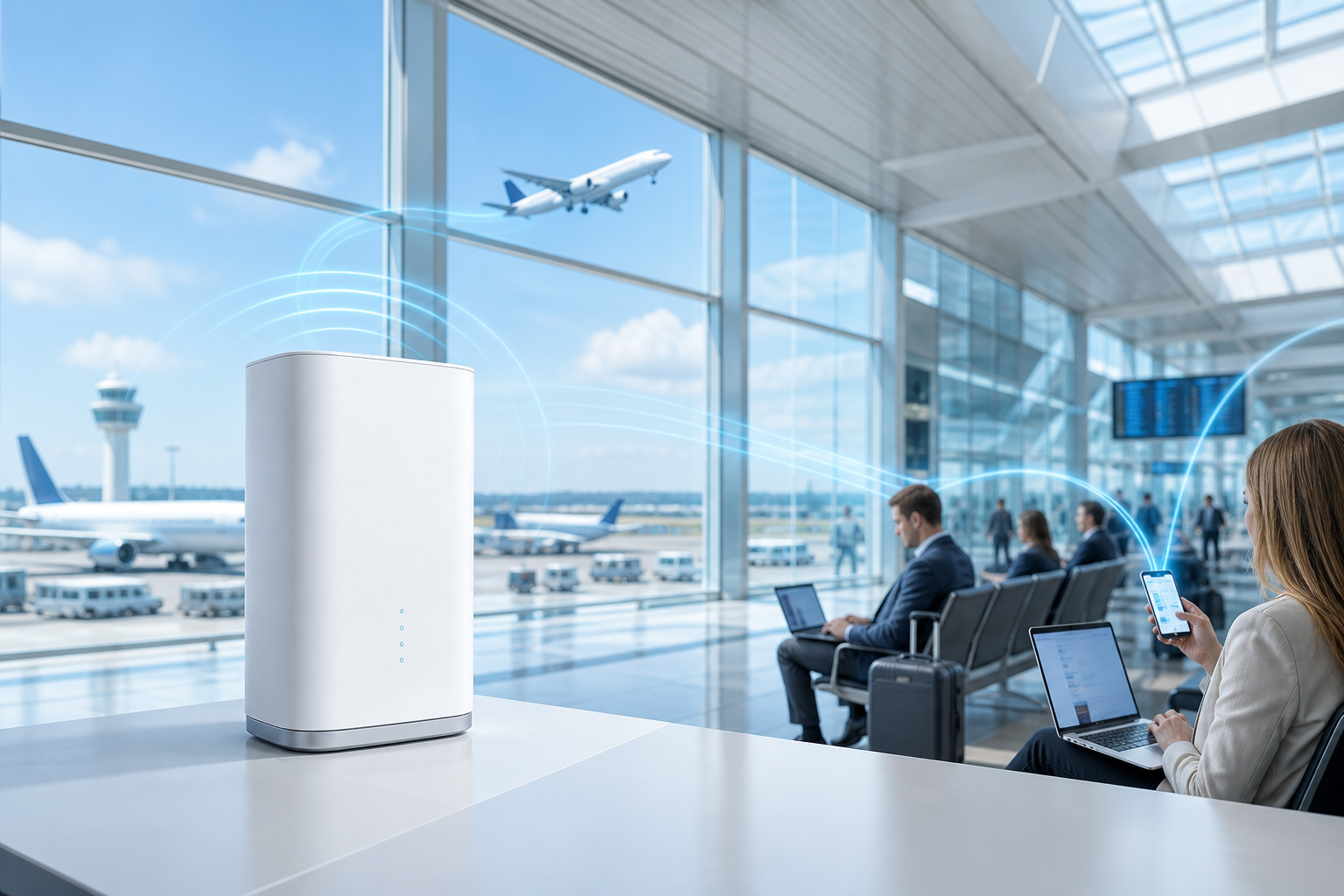
Airports are among the most connectivity-hungry environments on Earth. Millions of passengers stream through terminals each day expecting seamless Wi-Fi, while airlines, ground handlers, and retailers run thousands of connected devices across concourses, gates, and aprons. Traditionally, that demand was met by dense fiber builds — but trenching cable across a live terminal is slow, expensive, and hugely disruptive to operations.
In 2026, a growing number of airport operators and their system integrators are turning to 5G fixed wireless access (FWA) CPE as a faster, more flexible alternative. A compact, carrier-grade CPE mounted in a ceiling, a comms room, or an outdoor enclosure can deliver multi-gigabit backhaul in days rather than months, and it can be relocated as terminals are renovated or traffic patterns shift.
The Connectivity Pressure Points at Modern Airports
Airports face a unique combination of challenges that wired infrastructure struggles to solve. Terminals are continuously remodeled, which makes permanent cabling a moving target. Security and safety constraints limit where contractors can dig. And the mix of users — passengers, staff, airlines, concessionaires, and ground crews — demands segmented, reliable, and often temporary connectivity.
On top of that, passenger expectations have risen sharply. Travelers now expect to stream video, join conference calls, and use biometric boarding apps the moment they pass through the door. A single connectivity dead zone can damage an airport’s reputation and its non-aeronautical revenue, which increasingly depends on digital retail and advertising.
Why 5G FWA CPE Fits Airport Deployments
5G FWA CPE changes the economics of airport connectivity in several important ways. First, it removes the need for last-mile trenching: a CPE that bonds multiple 5G carriers can deliver the throughput of a leased line using the public cellular network, with failover built in. Second, it is inherently flexible — a unit can be installed in a temporary pop-up retail zone or a seasonal gate and relocated in minutes.
Third, modern FWA CPE brings enterprise-grade features airports need: VLAN segmentation to separate passenger traffic from operational systems, IPsec and firewall capabilities for PCI-compliant retail backhaul, dual-SIM redundancy across carriers, and Power over Ethernet (PoE) for simplified installation at the edge.
Passenger-Facing Use Cases
- Lounge and gate Wi-Fi backhaul: FWA CPE feeds high-capacity access points in lounges and gate areas where wired backhaul is absent or oversubscribed.
- Retail and food-service connectivity: Concessionaires need PCI-compliant links for point-of-sale, digital menu boards, and inventory systems — often in spaces that change frequently.
- Digital signage and wayfinding: Large-format displays and interactive kiosks require reliable, centrally managed connectivity across the terminal.
- Mobile check-in and biometric gates: Self-service kiosks and biometric boarding lanes depend on low-latency, always-on backhaul.
Ground Operations Use Cases
- Baggage handling and reconciliation: Scanners and handhelds on the ramp and in baggage halls need dependable wireless backhaul to tracking systems.
- Gate management and turnaround telemetry: Ground crews relay aircraft turnaround data, refueling status, and gate status to the airport operational database in near real time.
- Remote and temporary facilities: Cargo sheds, satellite gates, and temporary terminal extensions can be connected quickly without fiber extensions.
- Backup and diversity: FWA CPE provides an independent path for disaster recovery when primary fiber is cut or degraded.
What Airport IT Teams Should Look For in CPE
Not every CPE is suited to an airport. Buyers should prioritize industrial-grade enclosures rated for the temperature swings of aprons and equipment rooms, PoE support to simplify edge deployments, dual-SIM and multi-carrier aggregation for resilience, and robust management — including remote provisioning and TR-069/TR-369 telemetry — so thousands of units can be operated by a lean team.
Security is equally critical. Airport networks are high-value targets, so look for CPE that supports encrypted tunnels, certificate-based authentication, and granular VLAN and firewall policies that keep passenger, retail, and operational traffic strictly separated.
As terminals digitize further — from automated bag drops to AI-assisted queue management — flexible, high-capacity backhaul will become a foundational requirement. 5G FWA CPE gives airport operators a fast, scalable, and future-proof way to meet it.
Frequently Asked Questions
Why use 5G FWA CPE instead of fiber at airports?
5G FWA CPE can be deployed in days without trenching, relocated as terminals change, and used as an independent backup path to existing fiber — making it faster and more flexible for airports.
Can 5G FWA CPE support passenger Wi-Fi backhaul?
Yes. Carrier-grade CPE with multi-carrier aggregation can deliver multi-gigabit throughput to feed high-density access points in lounges, gates, and concourses.
Is 5G FWA CPE secure enough for airport networks?
Modern FWA CPE supports IPsec, certificate-based authentication, VLAN segmentation, and firewall policies, allowing passenger, retail, and operational traffic to be isolated securely.
What features should I look for in airport CPE?
Look for industrial-grade enclosures, dual-SIM redundancy, PoE support, remote management via TR-069/TR-369, and strong encryption for PCI-compliant retail and operational networks.
Partner With Honlly for Your Fixed Wireless Deployment
Honlly Telecom designs and manufactures carrier-grade 4G/5G FWA CPE, MiFi devices, and industrial routers for operators, ISPs, and enterprise integrators worldwide. From engineering samples to full OEM/ODM production, our team supports custom firmware, branding, and certification to match your deployment requirements.
Contact our team to discuss your project, request a datasheet, or schedule a technical evaluation.